
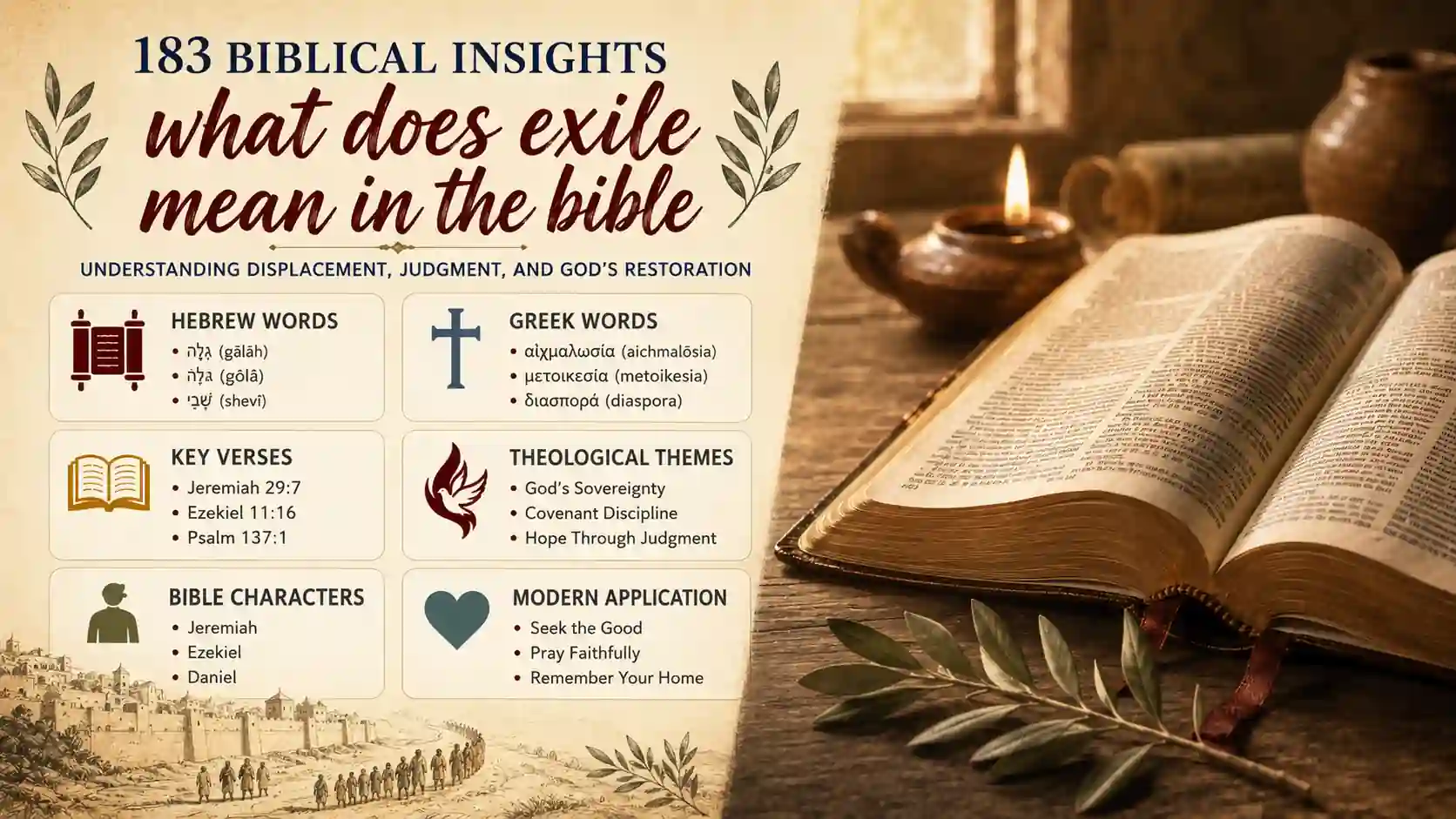
What does exile mean in the Bible? Exile is the painful removal of people from their homeland, usually under divine judgment, followed by life among foreign nations. Scripture presents exile as geographical displacement, covenant discipline, spiritual alienation, and longing for restoration.
Yet exile is never merely about punishment. Through Israel’s banishment, the prophets revealed God’s holiness, patience, sovereignty, and mercy. The biblical story ultimately moves from humanity’s expulsion from Eden toward reconciliation through Jesus Christ and the promised dwelling of God with his redeemed people.
Key Exile Scripture References
| Verse | Passage Snippet | Context |
|---|---|---|
| Genesis 3:23–24 | Sent out from Eden | Humanity loses sacred dwelling through sin |
| 2 Kings 17:6 | Israel carried into Assyria | Northern kingdom exiled after persistent rebellion |
| 2 Kings 25:11 | People carried away | Babylon completes Judah’s national exile |
| Jeremiah 29:7 | Seek the city’s welfare | Exiles must live faithfully in Babylon |
| Ezekiel 11:16 | A sanctuary for them | God remains present among scattered people |
| Daniel 1:6 | Daniel among the captives | Judean youths serve God in a foreign court |
| Psalm 137:1 | By Babylon’s rivers | Exiles mourn Jerusalem and remember Zion |
| Ezra 1:3 | Go up to Jerusalem | Cyrus permits the exiles to return |
| Matthew 1:17 | From exile to Christ | Jesus’ genealogy treats exile as a major era |
| 1 Peter 2:11 | Sojourners and exiles | Christians live as temporary residents in the world |
Exile Bible Translation Comparison
| Verse | KJV | NIV | ESV | NASB |
|---|---|---|---|---|
| 2 Kings 17:6 | carried Israel away | deported the Israelites | carried the Israelites away | led Israel into exile |
| 2 Kings 24:14 | carried away all Jerusalem | carried all Jerusalem into exile | carried away all Jerusalem | led away into exile |
| Jeremiah 29:1 | carried away captive | carried into exile | Nebuchadnezzar had taken into exile | taken into exile |
| Jeremiah 29:7 | peace of the city | peace and prosperity | welfare of the city | prosperity of the city |
| Ezekiel 11:16 | scattered them | scattered them | scattered them | scattered them |
| Ezra 6:21 | returned out of captivity | returned from the exile | returned from exile | returned from exile |
| Matthew 1:11 | carrying away into Babylon | exile to Babylon | deportation to Babylon | deportation to Babylon |
| Matthew 1:17 | carrying away into Babylon | exile to Babylon | deportation to Babylon | deportation to Babylon |
| James 1:1 | scattered abroad | scattered among the nations | in the Dispersion | dispersed abroad |
| 1 Peter 2:11 | strangers and pilgrims | foreigners and exiles | sojourners and exiles | strangers and pilgrims |
People and Characters Associated with Exile
| Person | Role | Connection |
|---|---|---|
| Adam and Eve | First humans | Expelled from Eden after disobedience |
| Moses | Covenant mediator | Warned Israel that rebellion would bring scattering |
| Tiglath-Pileser III | Assyrian king | Deported inhabitants of northern Israel |
| Sargon II | Assyrian king | Completed Samaria’s conquest and resettlement |
| Nebuchadnezzar II | Babylonian king | Conquered Jerusalem and deported Judah |
| Jeremiah | Prophet in Judah | Explained exile and promised eventual return |
| Ezekiel | Priest and prophet | Ministered among Judean exiles in Babylon |
| Daniel | Faithful exile | Served God within pagan imperial government |
| Cyrus II | Persian king | Authorized Jewish return and temple rebuilding |
| Zerubbabel | Davidic governor | Led an early return to Jerusalem |
| Ezra | Priest and scribe | Taught the law after the return |
| Nehemiah | Persian official | Rebuilt Jerusalem’s walls after exile |
Original Hebrew and Greek Exile Words
| Original Word | Transliteration | Strong’s # | Literal Meaning |
|---|---|---|---|
| גָּלָה | gālāh | H1540 | To uncover, remove, or go into exile |
| גּוֹלָה | gôlâ | H1473 | Exile, exiled community, captives |
| גָּלוּת | gālûth | H1546 | Captivity or state of exile |
| שָׁבָה | shāvâ | H7617 | To take captive |
| שְׁבִי | shevî | H7628 | Captivity or captives |
| נָדַח | nādaḥ | H5080 | To drive away or scatter |
| תְּפוּצָה | tephûtsâh | H8600 | Dispersion or scattered people |
| αἰχμαλωσία | aichmalōsia | G161 | Captivity or body of captives |
| μετοικεσία | metoikesia | G3350 | Deportation or forced relocation |
| διασπορά | diaspora | G1290 | Dispersion among foreign lands |
| πάροικος | paroikos | G3941 | Foreigner or resident alien |
| παρεπίδημος | parepidēmos | G3927 | Temporary resident or exile |
Biblical Concepts Related to Exile
| Concept | Connection | Supporting Verse |
|---|---|---|
| Covenant | Exile fulfills covenant warnings against rebellion | Deuteronomy 28:63–68 |
| Judgment | Removal from the land displays divine justice | 2 Kings 17:18–23 |
| Land | Israel’s residence depends on covenant faithfulness | Leviticus 18:24–28 |
| Scattering | Sin separates the people across foreign nations | Deuteronomy 30:3 |
| Remnant | God preserves a faithful people during judgment | Isaiah 10:20–22 |
| Lament | Exiles grieve lost worship, land, and community | Psalm 137:1–6 |
| Divine presence | God accompanies his people outside Jerusalem | Ezekiel 11:16 |
| Repentance | Exile creates an occasion to seek God again | Deuteronomy 4:27–31 |
| Return | Restoration reverses forced displacement | Jeremiah 30:3 |
| New covenant | God promises inward renewal beyond physical return | Jeremiah 31:31–34 |
Historical and Cultural Context of Exile
| Aspect | Detail | Biblical Source |
|---|---|---|
| Assyrian policy | Conquered peoples were deported and replaced | 2 Kings 17:24 |
| Northern exile | Samaria fell to Assyria in 722 BC | 2 Kings 17:5–6 |
| Babylonian pressure | Judah became subject to Babylonian power | 2 Kings 24:1 |
| First deportation | Royal and skilled classes were removed | Daniel 1:1–6 |
| Second deportation | Jehoiachin and Jerusalem’s leaders were taken | 2 Kings 24:12–16 |
| Jerusalem’s fall | Temple and city were destroyed in 586 BC | 2 Kings 25:8–12 |
| Exilic settlements | Judeans formed communities near Babylonian waterways | Ezekiel 1:1–3 |
| Family life | Exiles were told to marry, build, and plant | Jeremiah 29:5–6 |
| Imperial service | Some Judeans worked inside foreign administrations | Daniel 2:48–49 |
| Persian restoration | Cyrus permitted return and temple reconstruction | Ezra 1:1–4 |
Theological Themes within Exile
| Theme | Explanation | Scripture |
|---|---|---|
| God’s holiness | Covenant rebellion cannot be treated as harmless | Ezekiel 36:16–19 |
| God’s sovereignty | Foreign empires remain under divine authority | Daniel 2:20–21 |
| Covenant discipline | Exile corrects without canceling God’s promises | Leviticus 26:40–45 |
| Corporate responsibility | Generations suffer the effects of national sin | 2 Kings 24:3–4 |
| Individual faithfulness | Believers can obey God within pagan societies | Daniel 6:10 |
| Presence outside the land | God is not confined to Jerusalem’s temple | Ezekiel 11:16 |
| Hope through judgment | Promises of return arise within catastrophe | Jeremiah 29:10–14 |
| Purification | God cleanses his people from idolatry | Ezekiel 36:24–27 |
| Messianic expectation | Restoration centers on David’s promised ruler | Ezekiel 37:24–25 |
| New creation | Scripture ends with permanent fellowship with God | Revelation 21:1–4 |
Modern Exile Application for Believers
| Area | Practice | Scripture |
|---|---|---|
| Cultural pressure | Refuse idolatry without becoming hostile | Daniel 3:16–18 |
| Public life | Seek the good of the place where you live | Jeremiah 29:7 |
| Prayer | Maintain regular devotion under pressure | Daniel 6:10 |
| Identity | Remember that your primary citizenship is heavenly | Philippians 3:20 |
| Holiness | Abstain from desires that wage war against the soul | 1 Peter 2:11 |
| Work | Serve faithfully even in imperfect institutions | Colossians 3:23 |
| Community | Gather with God’s people during displacement | Ezekiel 8:1 |
| Suffering | Trust God’s presence when familiar supports disappear | Isaiah 43:2 |
| Hope | Look toward the lasting city God prepares | Hebrews 13:14 |
| Hospitality | Welcome strangers as fellow travelers | Hebrews 13:2 |
גָּלָה And the Covenant Meaning of Forced Removal
The Hebrew verb גָּלָה, gālāh, can describe uncovering, departing, or being carried away. In exile passages, it often refers to removal from one’s land by a conquering power. Its meaning is not merely emotional distance from home. It describes an actual historical catastrophe involving lost property, political freedom, worship centers, and social stability.
Israel’s exile must be read within the covenant. Long before Assyria or Babylon invaded, Moses warned that persistent idolatry and injustice would result in defeat and scattering. Exile was therefore neither an accident of international politics nor evidence that Israel’s God had been conquered. It was covenant judgment administered through nations that remained accountable to God.
What Does Exile Mean in the Bible’S Story of Eden and Israel?
The pattern of exile begins before Israel. Adam and Eve are driven from Eden after violating God’s command. They lose access to the garden, the tree of life, and the unhindered presence of God. Later, Israel receives a fruitful land where God dwells among his people, but repeated rebellion leads to another expulsion.
This connection helps you see that biblical exile is fundamentally about separation from sacred space because of sin. Israel’s removal from Canaan echoes humanity’s removal from Eden. Yet both stories also create longing for restoration, forgiveness, renewed access to God, and a home where righteousness can endure.
Babylonian Exile, the Remnant, and God’S Continuing Presence
The Babylonian exile reached its decisive stage when Jerusalem and the temple were destroyed in 586 BC. For many Judeans, this raised agonizing questions. Had God abandoned his covenant? Could worship continue without the temple? Would David’s royal line disappear? Jeremiah, Ezekiel, and Daniel answered these questions through warning, faithful witness, and hope.
Ezekiel’s vision was especially significant because God’s glory appeared to a prophet living outside Judah. God judged Jerusalem, yet he also promised to be a sanctuary for his scattered people. Exile removed familiar institutions, but it could not place the faithful beyond God’s reach. Divine presence was not restricted by geography or imperial borders.
From μετοικεσία to Christ and the Final Homecoming
Matthew uses μετοικεσία, metoikesia, meaning deportation, as a structural marker in Jesus’ genealogy. The generations are arranged around Abraham, David, the deportation to Babylon, and Christ. Matthew presents Jesus as the promised Davidic heir who enters a story still burdened by exile’s consequences.
The New Testament also describes believers as πάροικοι, paroikoi, and παρεπίδημοι, parepidēmoi, foreigners and temporary residents. This does not require withdrawal from society. Like Jeremiah’s exiles, you are called to seek your neighbors’ good. Yet you refuse to treat any earthly nation as your final home because your lasting citizenship and inheritance are with Christ.
Jesus addresses the deepest exile by reconciling sinners to God. Through his death and resurrection, estranged people are brought near and gathered into one family. The Bible’s final vision is not endless displacement but restored creation, where God dwells with his people and every cause of separation is removed.
Questions About Exile in the Bible
Does גָּלָה, gālāh, always refer to forced exile?
No. Its wider range includes uncovering and departing, so the surrounding passage determines whether deportation is intended.
Why do some translations say “deportation” while others say “exile” in Matthew 1:11?
Both translate μετοικεσία, metoikesia, with “deportation” emphasizing the forced event and “exile” emphasizing the resulting condition.
Were all Israelites taken away during the Assyrian and Babylonian exiles?
No. Large groups were deported, but the biblical accounts also mention poor residents, survivors, and scattered remnants who remained.
How could God judge Judah through Babylon and still condemn Babylon?
God sovereignly used Babylon as an instrument of judgment, while Babylon remained morally responsible for its violence, pride, and idolatry.
What does living as a παρεπίδημος, parepidēmos, mean for a Christian?
It means serving faithfully where God has placed you while remembering that your permanent homeland and fullest allegiance belong to Christ.