
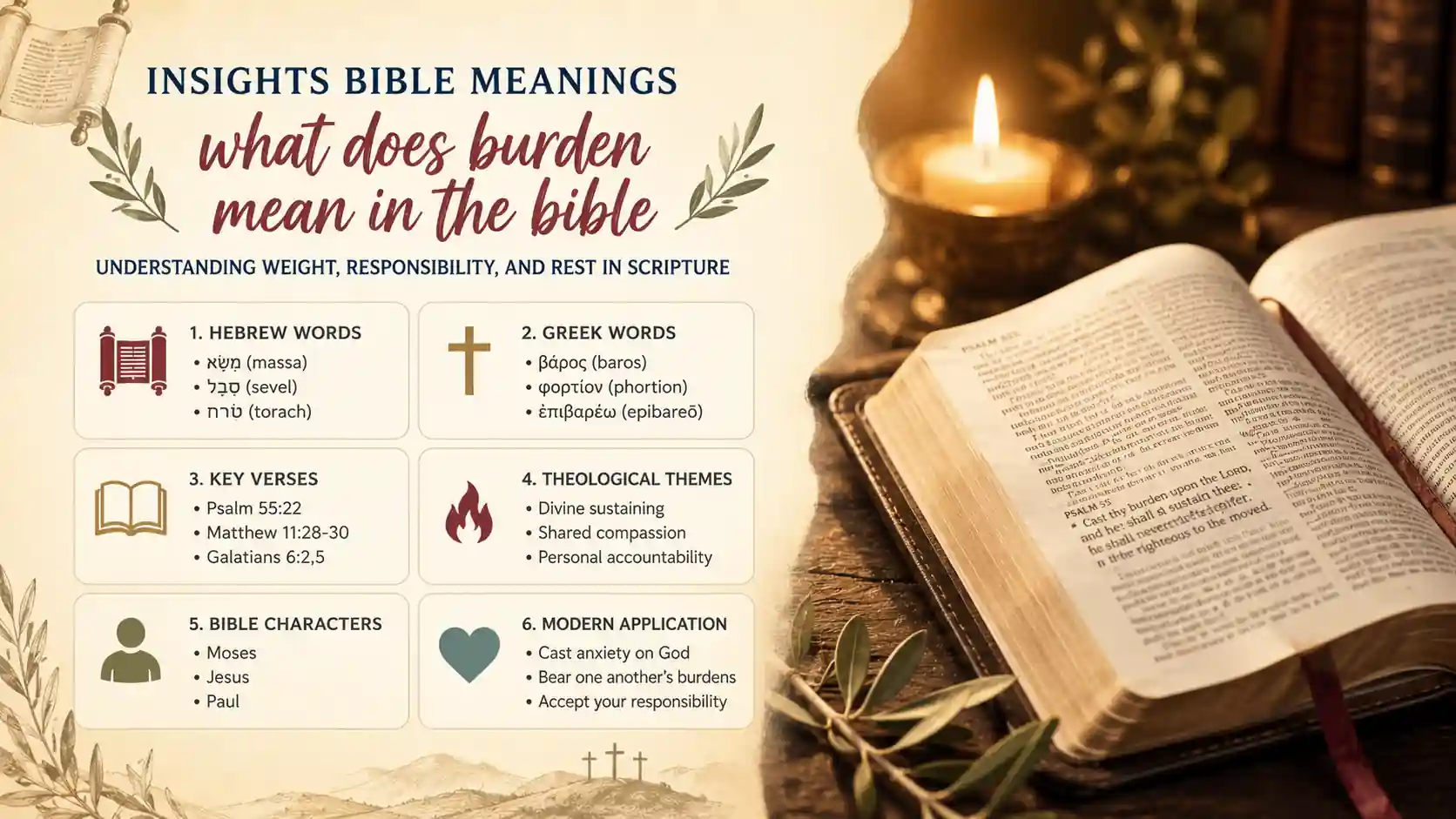
What does burden mean in the Bible? Scripture uses burden language for physical loads, emotional distress, moral responsibility, oppressive leadership, prophetic messages, and costly service. The word does not carry one fixed meaning in every passage.
Your study must therefore consider the original Hebrew or Greek term, the speaker, and the surrounding argument. Some burdens should be surrendered to God, some shared with other believers, and some faithfully carried as personal responsibilities. Christ does not promise a life without obedience. He gives you rest under his gracious and life-giving rule.
Key Burden Scripture References
| Verse | Passage Snippet | Context |
|---|---|---|
| Exodus 18:22 | “Bear the burden with thee” | Jethro advises shared leadership |
| Numbers 11:14 | “Bear all this people alone” | Moses feels overwhelmed |
| Psalm 38:4 | “Too heavy for me” | David laments guilt |
| Psalm 55:22 | “Cast thy burden” | Trust amid betrayal |
| Isaiah 10:27 | “His burden shall be taken away” | Assyrian oppression ends |
| Matthew 11:28-30 | “My burden is light” | Jesus offers rest |
| Luke 11:46 | “Burdens grievous to be borne” | Lawyers impose harsh demands |
| Galatians 6:2 | “Bear ye one another’s burdens” | Love restores the fallen |
| Galatians 6:5 | “Bear his own burden” | Personal accountability |
| 1 Peter 5:7 | “Casting all your care” | Humble trust in God |
Burden Bible Translation Comparison
| Verse | KJV | NIV | ESV | NASB |
|---|---|---|---|---|
| Exodus 18:22 | burden | load | burden | burden |
| Numbers 11:14 | burden | burden | burden | burden |
| Psalm 55:22 | burden | cares | burden | burden |
| Isaiah 10:27 | burden | burden | burden | burden |
| Matthew 11:28 | heavy laden | burdened | heavy laden | heavy-laden |
| Matthew 11:30 | burden | burden | burden | burden |
| Luke 11:46 | burdens | loads | burdens | burdens |
| Galatians 6:2 | burdens | burdens | burdens | burdens |
| Galatians 6:5 | burden | load | load | load |
| 2 Corinthians 11:9 | burdensome | burden | burden | burden |
People and Characters Associated with Burden
| Person | Role | Connection |
|---|---|---|
| Moses | Israel’s leader | Overwhelmed by national leadership |
| Jethro | Moses’ adviser | Recommends shared responsibility |
| Aaron | High priest | Helps carry leadership duties |
| David | King and psalmist | Casts distress upon God |
| Isaiah | Prophet | Announces removal of oppression |
| Jeremiah | Prophet | Bears a painful divine message |
| Jesus | Messiah and teacher | Gives rest and a light burden |
| Pharisees | Religious leaders | Bind heavy religious demands |
| Paul | Apostle | Teaches mutual and personal bearing |
| Epaphroditus | Gospel coworker | Risks himself in service |
Original Hebrew and Greek Burden Words
| Original Word | Transliteration | Strong’s # | Literal Meaning |
|---|---|---|---|
| מַשָּׂא | massa | H4853 | Load, burden, oracle |
| סֵבֶל | sevel | H5448 | Weight, forced labor |
| טֹרַח | torach | H2960 | Trouble, encumbrance |
| עֹל | ol | H5923 | Yoke, imposed obligation |
| נָשָׂא | nasa | H5375 | Lift, carry, bear |
| βάρος | baros | G922 | Weight, heavy burden |
| φορτίον | phortion | G5413 | Load, assigned freight |
| φορτίζω | phortizō | G5412 | Load or burden down |
| ἐπιβαρέω | epibareō | G1912 | Weigh heavily upon |
| γόμος | gomos | G1117 | Cargo, merchandise load |
Related Biblical Burden Concepts
| Concept | Connection | Supporting Verse |
|---|---|---|
| Yoke | Authority or obligation | Matthew 11:29 |
| Rest | Christ’s answer to weariness | Matthew 11:28 |
| Care | Anxiety entrusted to God | 1 Peter 5:7 |
| Guilt | Sin experienced as crushing weight | Psalm 38:4 |
| Service | Responsibility accepted for others | Romans 15:1 |
| Fellowship | Believers share suffering | Galatians 6:2 |
| Accountability | Each answers for personal conduct | Galatians 6:5 |
| Oppression | Rulers impose unjust weight | Isaiah 10:27 |
| Intercession | Prayer carries another’s need | James 5:16 |
| Providence | God sustains the faithful | Psalm 55:22 |
Historical and Cultural Context of Burden Language
| Aspect | Detail | Biblical Source |
|---|---|---|
| Pack animals | Loads were carried by donkeys | Exodus 23:5 |
| Human porters | Laborers transported heavy goods | 2 Chronicles 2:2 |
| Forced labor | Conquerors imposed work quotas | Exodus 1:11 |
| Tribute | Nations carried payments to rulers | 2 Kings 8:9 |
| Yokes | Wooden bars controlled animals | Jeremiah 27:2 |
| Rabbinic teaching | A yoke pictured accepted authority | Matthew 11:29 |
| Legal demands | Teachers multiplied obligations | Luke 11:46 |
| Prophetic speech | מַשָּׂא could introduce an oracle | Isaiah 13:1 |
| Household cargo | Loads differed by strength and role | Galatians 6:5 |
| Patronage | Ministers avoided financial dependence | 2 Corinthians 11:9 |
Theological Themes within Biblical Burden Passages
| Theme | Explanation | Scripture |
|---|---|---|
| Divine sustaining | God supports those who trust him | Psalm 55:22 |
| Human limitation | No leader is self-sufficient | Numbers 11:14 |
| Shared compassion | Love helps carry crushing weight | Galatians 6:2 |
| Personal duty | Grace does not erase responsibility | Galatians 6:5 |
| Messianic rest | Jesus receives the weary | Matthew 11:28 |
| Gentle lordship | Christ’s yoke is gracious | Matthew 11:29 |
| Freedom from oppression | God breaks unjust domination | Isaiah 10:27 |
| Conviction of sin | Guilt may feel unbearably heavy | Psalm 38:4 |
| Prophetic responsibility | God’s word weighs upon the messenger | Jeremiah 20:9 |
| Sacrificial ministry | Servants limit their rights for others | 1 Thessalonians 2:9 |
Modern Application of Burden Teaching for Believers
| Area | Practice | Scripture |
|---|---|---|
| Anxiety | Entrust your fears to God | 1 Peter 5:7 |
| Grief | Remain present with mourners | Romans 12:15 |
| Temptation | Restore gently and watch yourself | Galatians 6:1 |
| Community | Help with overwhelming needs | Galatians 6:2 |
| Responsibility | Complete your assigned work | Galatians 6:5 |
| Leadership | Delegate wisely | Exodus 18:21-22 |
| Prayer | Bring weariness to Christ | Matthew 11:28 |
| Finances | Give without exploiting others | 2 Corinthians 8:13 |
| Church teaching | Avoid man-made spiritual pressure | Luke 11:46 |
| Endurance | Lay aside obstructing weight | Hebrews 12:1 |
מַשָּׂא And the Many Meanings of Burden in the Old Testament
The Hebrew noun מַשָּׂא, massa, comes from the verb נָשָׂא, nasa, meaning to lift, carry, or bear. It may describe literal cargo, an obligation placed upon someone, tribute carried to a ruler, or a solemn prophetic declaration. Context determines whether the burden is physical, political, emotional, or verbal.
This explains why some prophetic books call an oracle a מַשָּׂא. The prophet receives a weighty message from God and must carry it publicly, even when the announcement concerns judgment. A prophetic burden is not merely a private feeling. It is an authoritative word entrusted to a messenger.
Other Hebrew terms sharpen the picture. סֵבֶל, sevel, often suggests labor, forced service, or oppressive weight. טֹרַח, torach, describes troublesome responsibility. עֹל, ol, is a yoke, the wooden instrument that became a vivid symbol of authority, servitude, discipline, or domination.
When Israel suffered under Egypt or Assyria, burden language described more than personal sadness. It named real systems of exploitation. God’s removal of the burden therefore revealed his justice. He heard oppressed people, confronted arrogant rulers, and acted to free those who could not free themselves.
What Does Burden Mean in the Bible in Galatians 6?
Galatians 6 presents an apparent tension. Verse 2 commands you to bear another person’s βάρη, barē, the plural form of βάρος, baros. Verse 5 says that each person must carry his own φορτίον, phortion. Paul deliberately uses two related but distinguishable images.
Βάρος commonly emphasizes a heavy weight. In Galatians 6:2, it fits the crushing burden associated with sin, temptation, sorrow, weakness, or hardship. The spiritual believer does not stand at a distance and condemn. You move toward the struggling person with gentleness, helping restore rather than humiliate.
Φορτίον can describe a load assigned to an individual, much like a soldier’s pack or a traveler’s cargo. Galatians 6:5 teaches that you remain responsible for examining your conduct before God. No one else can repent, obey, practice integrity, or answer to Christ in your place.
The two verses therefore complement each other. Christian love refuses to let another believer collapse under an unbearable weight. Christian maturity also refuses to transfer ordinary duties to everyone else. You receive help when a burden overwhelms you, yet you faithfully carry the responsibilities God has assigned to you.
Christ’S Yoke and the Light φορτίον of Matthew 11
In Matthew 11:28-30, Jesus addresses people who labor and are heavily burdened. The surrounding Gospel presents religious opposition, unbelief, and demanding interpretations of righteousness. Jesus does not merely offer relaxation. He summons weary people to come personally to him, become his disciples, and learn his character.
His “yoke” signifies his authority and teaching. A yoke normally suggests work and submission, so Christ’s invitation is not freedom from every command. It is freedom from attempting to secure righteousness through oppressive demands, self-salvation, or leadership that loads people without offering mercy.
Jesus calls his φορτίον, phortion, light because the Lord who assigns it is gentle and humble in heart. His commands remain serious, but they are joined to grace, fellowship, forgiveness, and divine strength. He carries what you could never carry, especially the guilt and judgment of sin.
You should not read “light burden” as a promise that discipleship will never involve sacrifice. Jesus calls followers to deny themselves and take up the cross. Yet even costly obedience is carried under a Savior who loves you, walks with you, and gives rest at the deepest level of your soul.
Casting Burdens on God without Abandoning Responsibility
Psalm 55:22 tells the faithful person to cast a burden upon the Lord. The psalm arises from anguish, violence, and betrayal by a close companion. Casting the burden does not mean pretending the danger is unreal. David names his pain honestly and places his future into God’s preserving hands.
First Peter 5:7 develops a similar practice by connecting the casting of anxiety with humility under God’s mighty hand. You release the illusion that everything depends upon your control. Prayer becomes an act of trust because God’s care, wisdom, and power are greater than your fear.
This surrender must not become spiritual avoidance. Moses needed divine help, but he also needed Jethro’s practical counsel and qualified assistants. Paul trusted God, yet he labored, planned, traveled, taught, and accepted hardship. Biblical trust joins dependence on God with obedient action.
A wise question is not simply, “How can I escape this burden?” Ask whether it should be surrendered, shared, resisted, or carried. Sinful guilt should lead to repentance. Anxiety should be cast on God. Oppressive burdens should be confronted. Personal callings should be accepted, and crushing hardships should be shared within Christ’s body.
Questions About Burden in the Bible
Why can מַשָּׂא, massa, mean both a burden and a prophetic oracle?
A prophetic oracle is a weighty message placed upon a messenger to carry and proclaim.
Do Galatians 6:2 and Galatians 6:5 contradict each other?
No. You help carry another’s crushing βάρος while remaining responsible for your own assigned φορτίον.
Does Christ’s light burden mean Christian obedience requires little effort?
No. It means you obey under the gracious rule and sustaining presence of the gentle Messiah.
Is every emotional burden evidence of personal sin?
No. Scripture connects burdens with guilt, grief, persecution, leadership, betrayal, illness, and concern for others.
How do you know whether to cast, share, or carry a burden?
Study its source and weight, surrender anxiety to God, seek help for crushing needs, and accept duties Scripture assigns to you.