
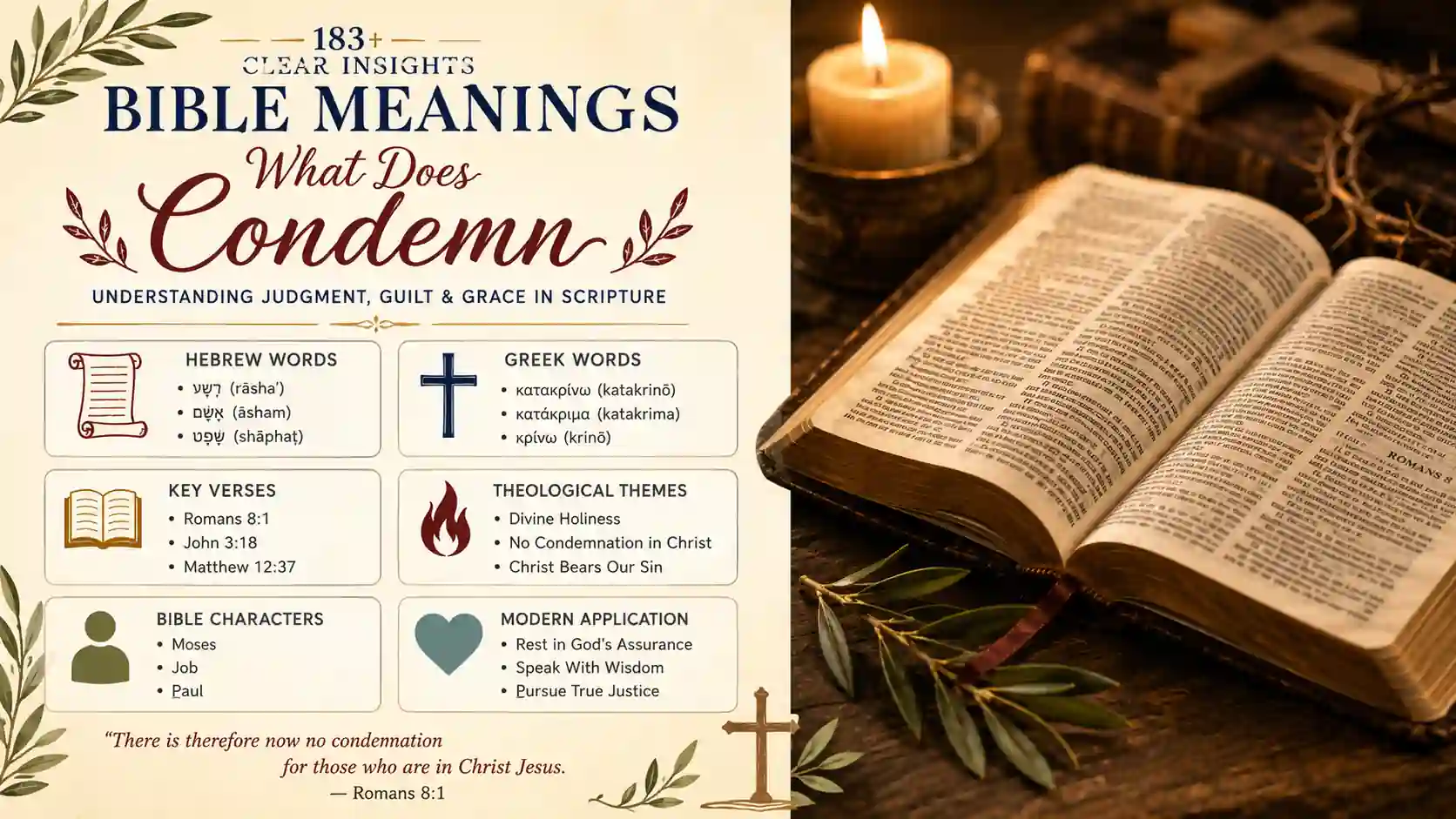
What does condemn mean in the Bible? Scripture uses the idea of condemnation for a judicial verdict that declares someone guilty and liable to punishment. It can describe human courts, personal accusations, divine judgment, or the sentence produced by sin.
Yet the biblical message does not end with guilt. God condemns sin justly, while offering salvation through Jesus Christ. As you study the Hebrew and Greek vocabulary, you will see why conviction, discipline, and condemnation must not be confused.
Condemn in Key Scripture References
| Verse | Passage Snippet | Context |
|---|---|---|
| Deuteronomy 25:1 | Condemn the wicked | Judges must decide justly |
| Job 9:20 | My mouth would condemn me | Job fears self-incrimination |
| Psalm 34:22 | None shall be condemned | God redeems his servants |
| Proverbs 17:15 | Condemns the just | Perverted verdicts offend God |
| Isaiah 50:9 | Who shall condemn me? | God vindicates his Servant |
| Matthew 12:37 | Words shall condemn you | Speech reveals the heart |
| John 3:18 | Condemned already | Unbelief leaves guilt unresolved |
| Romans 8:1 | No condemnation | Believers are secure in Christ |
| Romans 8:3 | Condemned sin in flesh | Christ bears sin’s judgment |
| 1 John 3:20 | Heart condemns us | God exceeds troubled conscience |
Condemn in Bible Translation Comparison
| Verse | KJV | NIV | ESV | NASB |
|---|---|---|---|---|
| Deuteronomy 25:1 | condemn the wicked | condemn the guilty | condemn the guilty | condemn the wicked |
| Job 9:20 | mouth shall condemn me | mouth would condemn me | mouth would condemn me | mouth would condemn me |
| Psalm 34:22 | shall be desolate | will be condemned | shall be condemned | will be condemned |
| Proverbs 17:15 | condemneth the just | condemning the innocent | condemns the righteous | condemns the righteous |
| Matthew 12:37 | shalt be condemned | condemned by your words | by words condemned | by words condemned |
| John 3:18 | is not condemned | is not condemned | is not condemned | is not judged |
| Romans 8:1 | no condemnation | no condemnation | no condemnation | no condemnation at all |
| Romans 8:3 | condemned sin | condemned sin | condemned sin | condemned sin |
| James 5:6 | condemned and killed | condemned and murdered | condemned and murdered | condemned and put to death |
| 1 John 3:20 | heart condemn us | hearts condemn us | heart condemns us | heart condemns us |
The NASB sometimes renders Greek judgment language with “judge” where other translations use “condemn.” The underlying context determines whether the judgment is merely an evaluation or an adverse verdict. Romans 8:1 is especially consistent across major translations because κατάκριμα, katakrima, explicitly denotes condemnation.
People and Characters Associated with Condemn
| Person | Role | Connection |
|---|---|---|
| Moses | Covenant mediator | Commands impartial verdicts |
| Job | Suffering righteous man | Fears being declared guilty |
| David | Psalmist and king | Trusts God for acquittal |
| Isaiah’s Servant | Vindicated sufferer | Challenges every accuser |
| Jesus | Savior and Judge | Saves sinners and condemns sin |
| Nicodemus | Jewish teacher | Hears Christ explain judgment |
| Adulterous woman | Publicly accused woman | Her accusers withdraw |
| Paul | Apostle to Gentiles | Proclaims no condemnation |
| James | Church leader | Rebukes oppression of the righteous |
| John | Apostle and pastor | Addresses a condemning conscience |
Original Hebrew and Greek Words for Condemn
| Original Word | Transliteration | Strong’s # | Literal Meaning |
|---|---|---|---|
| רָשַׁע | rāshaʿ | H7561 | Declare wicked or guilty |
| אָשַׁם | āsham | H816 | Be guilty or incur guilt |
| שָׁפַט | shāphaṭ | H8199 | Judge or govern |
| דִּין | dîn | H1777 | Judge or contend |
| חָרַם | ḥāram | H2763 | Devote to destruction |
| κρίνω | krinō | G2919 | Judge or decide |
| κατακρίνω | katakrinō | G2632 | Judge against, condemn |
| κατάκριμα | katakrima | G2631 | Adverse sentence |
| κρίμα | krima | G2917 | Judgment or verdict |
| αὐτοκατάκριτος | autokatakritos | G843 | Self-condemned |
The clearest Hebrew legal verb is רָשַׁע, rāshaʿ. In its causative form, it means to declare someone wicked or guilty, not necessarily to make that person morally wicked. Deuteronomy 25:1 contrasts condemning the guilty with justifying the righteous.
The most precise New Testament verb is κατακρίνω, katakrinō, formed from κατά, kata, and κρίνω, krinō. It expresses judgment against someone. Its related noun κατάκριμα, katakrima, describes the adverse sentence or penal verdict itself.
Related Biblical Concepts of Condemn
| Concept | Connection | Supporting Verse |
|---|---|---|
| Judgment | Condemnation follows a verdict | Hebrews 9:27 |
| Guilt | Liability precedes punishment | Romans 3:19 |
| Justification | God declares believers righteous | Romans 5:1 |
| Acquittal | Charges no longer stand | Romans 8:33 |
| Conviction | Truth exposes sin | John 16:8 |
| Discipline | Fatherly correction, not wrath | Hebrews 12:6 |
| Accusation | Charges may be true or false | Revelation 12:10 |
| Atonement | Christ bears sin’s penalty | Isaiah 53:5 |
| Mercy | God withholds deserved judgment | Psalm 103:10 |
| Vindication | God defends the righteous | Isaiah 50:8 |
Historical and Cultural Context of Condemn
| Aspect | Detail | Biblical Source |
|---|---|---|
| City gates | Elders heard legal disputes | Deuteronomy 21:19 |
| Multiple witnesses | One witness was insufficient | Deuteronomy 19:15 |
| Bribery forbidden | Gifts could distort verdicts | Exodus 23:8 |
| False testimony | Malicious witnesses faced penalty | Deuteronomy 19:18-19 |
| Roman tribunal | Governors issued legal judgments | Acts 25:6 |
| Sanhedrin proceedings | Jewish leaders examined Jesus | Mark 14:55 |
| Public accusation | Shame accompanied legal charges | John 8:3 |
| Crucifixion | Roman execution followed sentencing | Luke 23:24 |
| Patronage inequality | Rich litigants oppressed the poor | James 2:6 |
| Final assize | God judges through Christ | Acts 17:31 |
Biblical condemnation often uses courtroom language because Israel’s covenant law treated justice as a holy responsibility. Judges were not permitted to condemn the innocent or justify the wicked. A corrupt verdict was more than a social failure. It misrepresented the character of the righteous Judge.
Under Roman rule, political authorities could impose imprisonment, scourging, or execution. The trials of Jesus reveal interaction between Jewish accusations and Roman sentencing. Though human courts condemned the innocent Christ, God used his death to address the true guilt of sinners.
Theological Themes of Condemn
| Theme | Explanation | Scripture |
|---|---|---|
| Divine holiness | God judges evil truthfully | Psalm 96:13 |
| Human guilt | All people answer to God | Romans 3:19 |
| Adam’s offense | Sin brings condemnation | Romans 5:18 |
| Christ’s obedience | His righteousness brings life | Romans 5:18 |
| Substitution | Christ bears the curse | Galatians 3:13 |
| Union with Christ | His people escape condemnation | Romans 8:1 |
| Condemned sin | God judges sin in Christ’s flesh | Romans 8:3 |
| Final judgment | Christ will judge humanity | John 5:27 |
| Assurance | No charge defeats God’s elect | Romans 8:33-34 |
| Mercy and truth | Forgiveness never denies justice | Romans 3:26 |
Modern Application of Condemn for Believers
| Area | Practice | Scripture |
|---|---|---|
| Conscience | Test feelings by God’s truth | 1 John 3:20 |
| Confession | Admit sin without hiding | 1 John 1:9 |
| Assurance | Rest in Christ’s completed work | Romans 8:1 |
| Speech | Refuse reckless accusations | Matthew 12:36 |
| Church discipline | Seek restoration, not humiliation | Galatians 6:1 |
| Justice | Hear both sides fairly | Proverbs 18:17 |
| Forgiveness | Release personal vengeance | Romans 12:19 |
| Discernment | Judge teaching by Scripture | 1 John 4:1 |
| Evangelism | Announce salvation through Christ | John 3:17 |
| Hope | Await God’s righteous verdict | 2 Timothy 4:8 |
What Does Condemn Mean in the Bible’S Courtroom Language?
To condemn is to render an unfavorable judgment, usually a declaration of guilt that carries consequences. The word can refer to a human judge’s sentence, a person’s self-accusation, or God’s righteous judgment. It is stronger than noticing that something is wrong.
This distinction helps you read commands such as “judge not” carefully. Scripture does not forbid every moral evaluation. It forbids hypocritical, unjust, and self-exalting judgment. Condemnation assumes authority to issue a verdict, while discernment recognizes truth and responds faithfully.
רָשַׁע And the Old Covenant Demand for Just Verdicts
In Deuteronomy 25:1, Israel’s judges were to justify the righteous and condemn the wicked. Here רָשַׁע, rāshaʿ, belongs to a legal contrast. “Justify” means to declare someone in the right, while “condemn” means to declare someone guilty.
Proverbs 17:15 warns that reversing these verdicts is detestable to the Lord. God opposes both the acquittal of persistent evil and the condemnation of innocent people. Biblical mercy never requires calling evil good, and biblical justice never permits punishing someone without truth.
κατάκριμα And No Condemnation in Romans 8
Paul’s declaration of “no condemnation” rests on the argument developed in Romans 5 through 8. Adam’s trespass brought condemnation, but Christ’s obedience provides justification and life. The believer’s freedom is therefore covenantal and representative, not merely emotional.
Romans 8:3 explains how God can remain just while releasing sinners from condemnation. God condemned sin in the flesh through the mission and sacrificial death of his Son. The verdict against the believer is removed because sin’s judgment has been addressed in Christ.
Conviction, Discipline, and a Condemning Heart
The Holy Spirit’s conviction brings sin into the light and leads you toward repentance, faith, and restored fellowship. Condemnation, by contrast, pronounces guilt and punishment. Conviction is specific and redemptive, while uncontrolled self-condemnation is often vague, hopeless, and inwardly consuming.
God may discipline his children, but fatherly correction is not the same as judicial rejection. When your heart condemns you, 1 John 3:20 directs you to the greater knowledge of God. Your assurance rests in God’s promise and Christ’s work, not in the changing intensity of your feelings.
Frequently Asked Questions About Condemn in the Bible
Does κρίνω, krinō, always mean condemn?
No. It can mean judge, decide, evaluate, or condemn, so the context determines whether an adverse sentence is intended.
Why does the NASB say “judged” in John 3:18 when other translations say “condemned”?
The Greek verb κρίνω can carry either sense, but John 3:18 describes an unfavorable judgment caused by unbelief.
Does Romans 8:1 mean a Christian never experiences conviction?
No. It means the believer is free from God’s condemning sentence, not from the Spirit’s loving exposure and correction of sin.
How can God condemn sin without condemning the believer?
Romans 8:3 teaches that God judged sin in connection with Christ’s incarnate, sacrificial work, securing freedom for those united to him.
What should you do when your heart condemns you according to 1 John 3:20?
Confess known sin, trust God’s complete knowledge, and ground your assurance in Christ rather than in fluctuating emotions.