
What does condemnation mean in the Bible? Scripture presents condemnation as more than feeling ashamed or receiving criticism. It is a judicial verdict that declares someone guilty and liable to judgment. The biblical writers use courtroom language to describe humanity’s accountability before the holy God.
Yet condemnation is not the final word for those who belong to Jesus Christ. Your study will show how Adam’s sin brought judgment, how God consistently defended righteous justice, and how Christ bore the sentence sinners deserved so that believers could receive justification, peace, and new life.
Condemnation Key Scripture References
| Verse | Passage Snippet | Context |
|---|---|---|
| Genesis 3:17-19 | The ground is cursed | Adam receives judgment after rebellion |
| Deuteronomy 25:1 | Justify righteous, condemn wicked | Israel’s judges must render just verdicts |
| Proverbs 17:15 | Condemning the just is abominable | God rejects corrupt judicial decisions |
| Matthew 12:37 | By your words you are condemned | Jesus teaches accountability for speech |
| John 3:18 | The unbeliever is condemned already | Rejecting the Son leaves guilt unresolved |
| Romans 5:16 | Judgment brought condemnation | Adam’s trespass produces a guilty sentence |
| Romans 5:18 | One trespass led to condemnation | Adam and Christ represent two humanities |
| Romans 8:1 | No condemnation in Christ | Christ frees believers from the adverse verdict |
| 1 Corinthians 11:32 | Not condemned with the world | Fatherly discipline differs from final judgment |
| Hebrews 11:7 | Noah condemned the world | His faith exposed his generation’s unbelief |
Condemnation Bible Translation Comparison
| Verse | KJV | NIV | ESV | NASB |
|---|---|---|---|---|
| Romans 8:1 | No condemnation | No condemnation | No condemnation | No condemnation |
| Romans 5:16 | Judgment was to condemnation | Judgment brought condemnation | Judgment brought condemnation | Judgment arose from one offense |
| Romans 5:18 | Judgment came upon all | Condemnation for all people | Condemnation for all men | Condemnation to all people |
| John 3:18 | Is condemned already | Stands condemned already | Is condemned already | Has been judged already |
| John 5:24 | Shall not come into condemnation | Will not be judged | Does not come into judgment | Does not come into judgment |
| Romans 14:23 | Is damned if he eat | Is condemned if he eats | Is condemned if he eats | Is condemned if he eats |
| Galatians 2:11 | He was to be blamed | He stood condemned | He stood condemned | He stood condemned |
| 1 Corinthians 11:32 | Condemned with the world | Finally condemned with the world | Condemned along with the world | Condemned with the world |
| James 5:9 | Lest ye be condemned | Or you will be judged | So that you may not be judged | So that you yourselves may not be judged |
The comparison shows that English translations sometimes use “judgment,” “condemned,” “damned,” or “blamed” for related Greek terms. Context must determine whether a passage concerns an unfavorable human evaluation, divine judgment, temporal discipline, or the final sentence against sin.
People and Characters Associated with Condemnation
| Person | Role | Connection |
|---|---|---|
| Adam | Representative head of humanity | His trespass brought condemnation |
| Eve | First woman | Shared in humanity’s primal rebellion |
| Noah | Righteous witness | His faith condemned an unbelieving world |
| Moses | Covenant mediator | Gave laws for righteous judgments |
| David | King and repentant sinner | Acknowledged guilt after Nathan’s rebuke |
| Jonah | Prophet to Nineveh | Announced approaching divine judgment |
| Jesus Christ | Savior and righteous Judge | Bore judgment and grants justification |
| Pontius Pilate | Roman governor | Sentenced Jesus despite recognizing innocence |
| Peter | Apostle | Stood condemned by inconsistent conduct |
| Paul | Apostle and theologian | Explained condemnation through Adam and freedom in Christ |
These figures reveal different dimensions of condemnation. Adam represents humanity under sin, Noah demonstrates how obedient faith exposes unbelief, and Pilate illustrates unjust human judgment. Jesus stands at the center because the innocent One willingly endured a criminal sentence to save the guilty.
Original Hebrew and Greek Words for Condemnation
| Original Word | Transliteration | Strong’s # | Literal Meaning |
|---|---|---|---|
| רָשַׁע | rasha | H7561 | Be wicked or declare guilty |
| מִשְׁפָּט | mishpat | H4941 | Judgment, justice, legal decision |
| דִּין | din | H1777 | Judge, contend, administer judgment |
| אָשַׁם | asham | H816 | Be guilty or become liable |
| עָוֹן | avon | H5771 | Iniquity, guilt, punishment |
| κατάκριμα | katakrima | G2631 | Adverse sentence or condemnation |
| κατακρίνω | katakrinō | G2632 | Pronounce guilty or condemn |
| κρίνω | krinō | G2919 | Judge, decide, evaluate |
| κρίμα | krima | G2917 | Judgment, verdict, sentence |
| κρίσις | krisis | G2920 | Judicial decision or judgment |
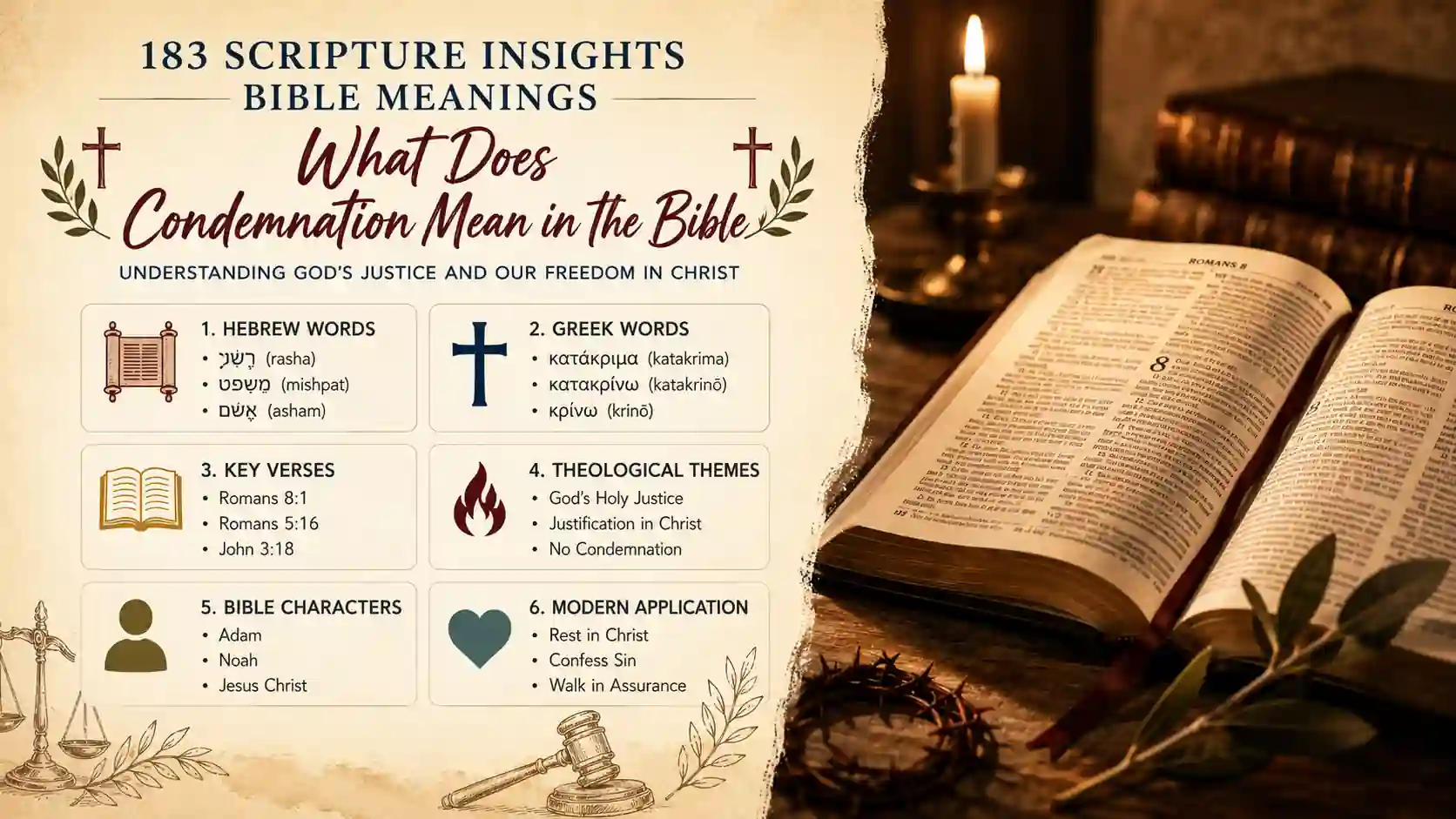
The clearest New Testament noun is κατάκριμα, katakrima, Strong’s G2631. It describes an adverse judicial sentence and occurs in Romans 5:16, Romans 5:18, and Romans 8:1. The related verb κατακρίνω, katakrinō, Strong’s G2632, means to pronounce someone guilty.
In the Old Testament, רָשַׁע, rasha, can describe acting wickedly or declaring someone guilty. Deuteronomy 25:1 contrasts condemning the wicked with vindicating the righteous. Biblical condemnation therefore belongs primarily to legal and covenantal language rather than merely to the language of emotion.
Related Biblical Concepts of Condemnation
| Concept | Connection | Supporting Verse |
|---|---|---|
| Sin | Creates genuine guilt before God | Romans 3:23 |
| Judgment | God evaluates people righteously | Ecclesiastes 12:14 |
| Wrath | God’s holy response to evil | Romans 1:18 |
| Death | Sin’s judicial consequence | Romans 6:23 |
| Justification | God declares the believer righteous | Romans 5:1 |
| Atonement | Sacrifice addresses guilt | Leviticus 16:30 |
| Forgiveness | God releases confessed sin | 1 John 1:9 |
| Propitiation | Christ satisfies righteous judgment | Romans 3:25 |
| Discipline | Corrects believers without condemning them | 1 Corinthians 11:32 |
| Assurance | Believers rest in Christ’s verdict | Romans 8:33-34 |
Condemnation is the opposite of justification. In condemnation, a judge declares the accused guilty. In justification, God declares the ungodly righteous through faith because of Christ’s saving work, not because the sinner has achieved moral perfection.
Forgiveness is closely connected but emphasizes the removal of debt or offense. Justification emphasizes legal standing. Reconciliation emphasizes restored relationship. Scripture uses all three truths to describe the richness of salvation.
Historical and Cultural Context of Condemnation
| Aspect | Detail | Biblical Source |
|---|---|---|
| City-gate courts | Elders heard disputes publicly | Deuteronomy 21:19 |
| Judicial impartiality | Judges could not favor rich or poor | Leviticus 19:15 |
| Multiple witnesses | Serious charges required confirmation | Deuteronomy 19:15 |
| False verdicts | Condemning the innocent was forbidden | Exodus 23:7 |
| Covenant sanctions | Disobedience brought stated penalties | Deuteronomy 28 |
| Prophetic lawsuits | Prophets presented God’s case | Micah 6:1-2 |
| Roman tribunal | Governors issued provincial sentences | John 19:10-16 |
| Crucifixion | Public Roman execution | Mark 15:15-24 |
| Sacrificial worship | Blood symbolized life given for guilt | Leviticus 17:11 |
| Church discipline | Correction sought repentance and restoration | 1 Corinthians 5:1-5 |
Ancient readers heard “condemnation” as courtroom language. Israelite judges were commanded to vindicate the innocent and condemn the guilty. A reversed verdict was not a minor procedural error. Proverbs 17:15 calls both acquitting the wicked and condemning the righteous detestable to God.
The trial of Jesus displays this injustice with terrible clarity. Religious leaders accused Him, Pilate acknowledged the weakness of the case, and Roman authority still imposed crucifixion. The righteous Messiah entered the place of condemned criminals.
Theological Themes of Condemnation
| Theme | Explanation | Scripture |
|---|---|---|
| God’s holiness | Evil cannot be morally ignored | Habakkuk 1:13 |
| Human solidarity | Adam’s trespass affects humanity | Romans 5:12-18 |
| Personal responsibility | Each person answers to God | Romans 14:12 |
| Impartial justice | God judges without favoritism | Romans 2:6-11 |
| Substitution | Christ bears the curse of sinners | Galatians 3:13 |
| Justification | Faith receives a righteous standing | Romans 5:1 |
| Union with Christ | His status becomes the believer’s security | Romans 8:1 |
| Final judgment | Evil receives a conclusive verdict | Revelation 20:11-15 |
| Fatherly discipline | God corrects His children | Hebrews 12:5-11 |
| Christian assurance | No accusation can overturn God’s verdict | Romans 8:33-34 |
Romans 5 places condemnation within the contrast between Adam and Christ. Adam’s one trespass brought an adverse verdict, while Christ’s obedient work provides justification and life. Paul is not teaching that every person is morally identical, but that humanity exists under the representative consequences of Adam’s rebellion.
Romans 8 then declares the believer’s new position. “No condemnation” does not mean sin has become harmless or that God has abandoned justice. It means the sentence has been answered in Christ, and no remaining charge can reverse God’s justifying verdict.
Modern Application of Condemnation for Believers
| Area | Practice | Scripture |
|---|---|---|
| Assurance | Rest in Christ rather than self-merit | Romans 8:1 |
| Confession | Admit sin honestly before God | 1 John 1:9 |
| Repentance | Turn from conduct Scripture exposes | Acts 3:19 |
| Conscience | Train it through God’s truth | Hebrews 9:14 |
| Speech | Refuse reckless accusations | James 4:11-12 |
| Church care | Restore repentant sinners gently | Galatians 6:1 |
| Justice | Defend those falsely accused | Proverbs 31:8-9 |
| Discipline | Receive correction without despair | Hebrews 12:11 |
| Evangelism | Present both judgment and grace | John 3:16-18 |
| Hope | Await Christ without terror | 1 John 4:17-18 |
You should distinguish biblical conviction from condemning despair. Conviction identifies sin truthfully and draws you toward confession, repentance, and restored fellowship. Condemning despair tells you that mercy is unavailable, your identity is permanently defined by failure, and approaching God is pointless.
Romans 8:1 directly contradicts that hopeless message for everyone who is in Christ. Grace does not prevent you from taking sin seriously. It gives you a safe place to take sin seriously because your Judge is also the Savior who bore your judgment.
Κατάκριμα And Paul’S Courtroom Meaning
The Greek noun κατάκριμα, katakrima, refers to an adverse sentence rather than a passing feeling of disapproval. Paul uses it only three times, all in Romans. Each occurrence belongs to his explanation of Adam’s trespass, Christ’s righteous work, and the believer’s changed standing before God.
This helps you avoid reducing Romans 8:1 to positive thinking. Paul is not simply saying you should stop feeling bad about yourself. He announces that those united to Christ are no longer under the judicial sentence produced by sin.
What Does Condemnation Mean in the Bible’S Adam and Christ Contrast?
Romans 5:12-21 presents Adam and Christ as representative heads. Through Adam came sin, death, judgment, and condemnation. Through Christ come grace, righteousness, justification, and life. The contrast explains both the seriousness of humanity’s condition and the sufficiency of Christ’s obedience.
Your hope therefore rests outside your own performance. Adam’s act affected those represented by him, while Christ’s righteous achievement benefits those who receive God’s gracious gift. Salvation is not God pretending you were never guilty. It is God dealing righteously with guilt through His Son.
No Condemnation Does Not Mean No Correction
First Corinthians 11:32 says believers may be disciplined by the Lord so that they will not be condemned with the world. This distinction is pastorally essential. Divine discipline is corrective treatment from a Father, while final condemnation is the punitive sentence of the Judge against unresolved rebellion.
A Christian may experience conviction, consequences, correction, or church discipline without returning to a condemned status. God’s discipline aims at holiness and restoration. You can receive correction humbly without treating every painful circumstance as proof that Christ has rejected you.
The Condemned Christ and the Justified Sinner
Jesus was not personally guilty, yet He was treated as condemned. Human courts falsely sentenced Him, and on the cross He bore the curse associated with sin. His resurrection publicly vindicated Him and demonstrated that death’s claim had been broken.
Because Christ died and rose, Romans 8:33-34 asks who can successfully accuse God’s chosen people. God has justified them, Christ has died for them, Christ has risen, and Christ intercedes for them. The answer is not that accusations never arise, but that none can overturn God’s verdict.
Frequently Asked Questions About Condemnation
Does κατάκριμα, katakrima, mean guilt or the sentence resulting from guilt?
It primarily describes an adverse judicial sentence, though that sentence presupposes a finding of guilt.
Why does the NASB use “judged” in John 3:18 while other translations use “condemned”?
The Greek verb κρίνω, krinō, can mean judge or decide, and the unfavorable context gives the judgment a condemning force.
Does Romans 8:1 mean Christians will never face God’s discipline?
No, believers are free from condemnation but may receive loving correction that trains them in holiness.
How can Peter stand condemned in Galatians 2:11 if believers have no condemnation?
Peter’s conduct deserved public correction, but that situational verdict did not cancel his justification in Christ.
What should you do when you feel condemned after confessing a sin?
Trust Christ’s completed work, accept God’s forgiveness, make needed restitution, and reject accusations that contradict Romans 8:1.