
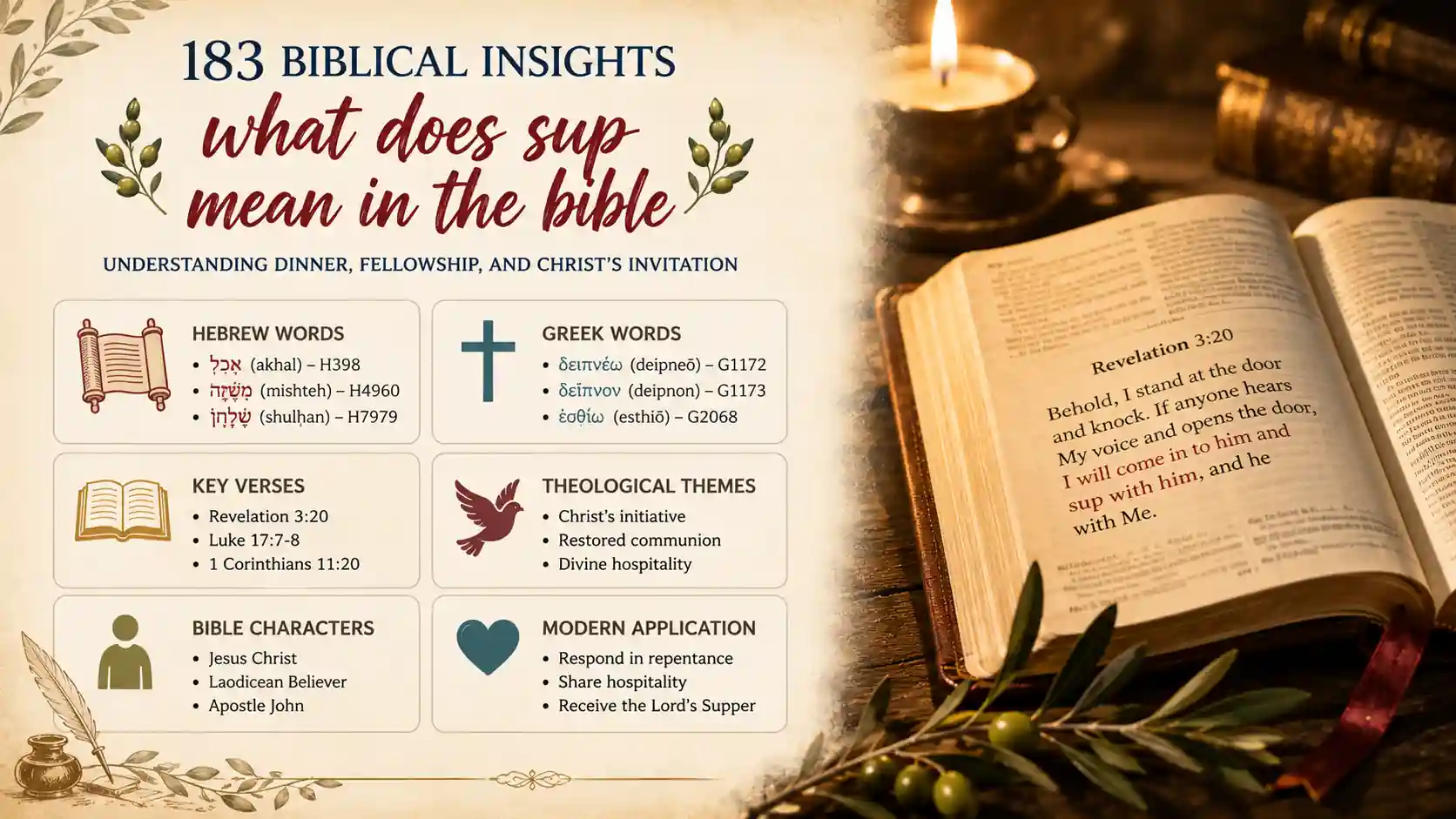
What does sup mean in the Bible? In older English, sup means to eat a meal, especially the principal evening meal, or to dine with someone. The King James Version uses it most memorably in Revelation 3:20, where Christ promises to “sup” with the person who opens the door to Him.
The underlying Greek verb is δειπνέω, deipneō, meaning “to dine” or “eat supper.” Yet biblical supping involves more than food. A shared table could express welcome, fellowship, covenant loyalty, remembrance, reconciliation, or participation in God’s kingdom.
Key Sup Scripture References
| Verse | Passage Snippet | Context |
|---|---|---|
| Luke 17:7 | “sit down to meat” | A servant returns from labor |
| Luke 17:8 | “wherewith I may sup” | The servant prepares his master’s meal |
| Luke 22:20 | “the cup after supper” | Jesus establishes the new covenant meal |
| John 12:2 | “they made him a supper” | Jesus dines with Lazarus and his family |
| John 13:2 | “supper being ended” | Jesus serves His disciples |
| John 21:20 | “leaned on his breast at supper” | John recalls the final meal |
| 1 Corinthians 11:20 | “the Lord’s supper” | Paul corrects disorderly worship |
| Revelation 3:20 | “sup with him” | Christ offers restored fellowship |
Sup Bible Translation Comparison
| Verse | KJV | NIV | ESV | NASB |
|---|---|---|---|---|
| Luke 17:7 | “sit down to meat” | “sit down to eat” | “recline at table” | “come immediately and sit down” |
| Luke 17:8 | “I may sup” | “prepare my supper” | “prepare supper for me” | “prepare something for me to eat” |
| Luke 22:20 | “after supper” | “after the supper” | “after they had eaten” | “after they had eaten” |
| John 12:2 | “made him a supper” | “dinner was given” | “gave a dinner” | “made Him a dinner” |
| John 13:2 | “supper being ended” | “evening meal was in progress” | “during supper” | “during supper” |
| 1 Corinthians 11:20 | “Lord’s supper” | “Lord’s Supper” | “Lord’s supper” | “Lord’s Supper” |
| Revelation 3:20 | “sup with him” | “eat with that person” | “eat with him” | “dine with him” |
| Revelation 19:9 | “marriage supper” | “wedding supper” | “marriage supper” | “wedding feast” |
The translations show why modern readers sometimes misunderstand the word. “Sup” is not a mysterious religious act. It is an older verb for dining, although its biblical settings often give the meal profound spiritual significance. The Greek verb δειπνέω appears in Luke 17:8 and Revelation 3:20.
People and Characters Associated with Sup
| Person | Role | Connection |
|---|---|---|
| Jesus Christ | Host, servant, and promised guest | Offers fellowship and institutes the Supper |
| Laodicean believer | Hearer at the door | Invited to receive Christ |
| Laodicean church | Lukewarm congregation | Called to repentance and renewed communion |
| Unnamed master | Figure in Jesus’ parable | Commands his servant to prepare supper |
| Unnamed servant | Household worker | Serves before eating |
| Peter | Apostle | Helps prepare the Passover meal |
| John | Apostle and witness | Reclines near Jesus at supper |
| Lazarus | Resurrected disciple | Dines with Jesus at Bethany |
| Martha | Disciple and hostess | Serves at the Bethany supper |
| Paul | Apostle and teacher | Corrects abuses of the Lord’s Supper |
Original Hebrew and Greek Words for Sup
| Original Word | Transliteration | Strong’s # | Literal Meaning |
|---|---|---|---|
| δειπνέω | deipneō | G1172 | To dine, eat supper |
| δεῖπνον | deipnon | G1173 | Dinner, supper, principal meal |
| ἐσθίω | esthiō | G2068 | To eat, consume |
| τράπεζα | trapeza | G5132 | Table, dining table |
| ἀνάκειμαι | anakeimai | G345 | To recline at a meal |
| אָכַל | akhal | H398 | To eat, consume |
| לֶחֶם | leḥem | H3899 | Bread, food |
| מִשְׁתֶּה | mishteh | H4960 | Feast, drinking banquet |
| שֻׁלְחָן | shulḥan | H7979 | Table |
| סָעַד | saʿad | H5582 | To support, refresh with food |
The English word “sup” directly represents the Greek δειπνέω, deipneō, Strong’s G1172. Its related noun δεῖπνον, deipnon, Strong’s G1173, refers to a supper, dinner, banquet, or principal meal. The Hebrew words in the table are conceptual Old Testament parallels, not direct sources behind Revelation 3:20.
Related Biblical Sup Concepts
| Concept | Connection | Supporting Verse |
|---|---|---|
| Fellowship | Eating together signifies personal welcome | Revelation 3:20 |
| Hospitality | Guests are honored through food and service | Genesis 18:6-8 |
| Covenant | A meal may confirm a sacred relationship | Exodus 24:9-11 |
| Passover | Israel remembers deliverance through a meal | Exodus 12:11 |
| Lord’s Supper | Believers remember Christ’s death | 1 Corinthians 11:23-26 |
| Repentance | Christ’s table invitation follows correction | Revelation 3:19-20 |
| Service | Jesus washes feet during supper | John 13:2-5 |
| Kingdom hope | Salvation is pictured as a banquet | Luke 14:15 |
| Reconciliation | Table fellowship can restore relationship | John 21:12-17 |
| Communion | One bread expresses one spiritual body | 1 Corinthians 10:16-17 |
Historical and Cultural Context of Sup
| Aspect | Detail | Biblical Source |
|---|---|---|
| Main meal | Supper was commonly the day’s substantial meal | Luke 17:7-8 |
| Reclining | Diners often reclined beside a low table | John 13:23 |
| Foot washing | Dusty feet were cleaned before or during hospitality | John 13:5 |
| Household service | Servants prepared and attended meals | Luke 17:8 |
| Open hospitality | Receiving a guest expressed honor and peace | Genesis 18:1-8 |
| Passover setting | Jesus’ final supper occurred in festival context | Luke 22:7-15 |
| Shared dishes | Diners could dip food into a common dish | Matthew 26:23 |
| Social boundaries | Table fellowship revealed acceptance or exclusion | Luke 5:29-32 |
| Church gathering | Early believers combined fellowship and meals | Acts 2:46 |
| Banquet imagery | Feasts symbolized future kingdom blessing | Revelation 19:9 |
In the ancient Mediterranean world, sharing a table was relational. You did not merely consume food beside another person. You received that person into a sphere of welcome, peace, and mutual recognition.
This background deepens Revelation 3:20. Christ’s promise is not simply that He will enter a building. He promises the closeness of restored table fellowship to a church that has become spiritually complacent.
Theological Themes in Sup Passages
| Theme | Explanation | Scripture |
|---|---|---|
| Christ’s initiative | Jesus stands, knocks, and speaks | Revelation 3:20 |
| Human response | The hearer must open the door | Revelation 3:20 |
| Restored communion | Repentance leads to renewed fellowship | Revelation 3:19-20 |
| Grace and discipline | Christ rebukes those He loves | Revelation 3:19 |
| Humble service | Disciples serve without demanding praise | Luke 17:7-10 |
| Sacrificial remembrance | The Supper proclaims Christ’s death | 1 Corinthians 11:26 |
| Covenant redemption | The cup signifies the new covenant | Luke 22:20 |
| Church unity | The meal must not humiliate poorer believers | 1 Corinthians 11:21-22 |
| Future hope | God’s people await the marriage supper | Revelation 19:9 |
| Divine hospitality | God welcomes His people to His table | Psalm 23:5 |
Modern Sup Application for Believers
| Area | Practice | Scripture |
|---|---|---|
| Repentance | Respond quickly to Christ’s correction | Revelation 3:19 |
| Prayer | Welcome Christ’s rule into daily life | Revelation 3:20 |
| Hospitality | Share your table with generosity | Romans 12:13 |
| Communion | Receive the Lord’s Supper reverently | 1 Corinthians 11:28 |
| Unity | Refuse favoritism at Christian gatherings | 1 Corinthians 11:22 |
| Service | Meet others’ needs without seeking applause | Luke 17:10 |
| Remembrance | Keep Christ’s sacrifice central | Luke 22:19 |
| Fellowship | Make meals occasions for encouragement | Acts 2:46 |
| Reconciliation | Use table fellowship to rebuild trust | John 21:12-17 |
| Hope | Anticipate the kingdom’s final feast | Revelation 19:9 |
What Does Sup Mean in the Bible in Revelation 3:20?
Revelation 3:20 is addressed within Christ’s message to the church in Laodicea. The congregation considered itself prosperous and self-sufficient, but Christ described it as spiritually poor, blind, and naked. His knock comes after a call to repent, showing that the promised meal concerns restored communion.
When Jesus says, “I will sup with him,” He depicts mutual fellowship. He will dine with the responsive person, and that person will dine with Him. The image is warm and personal, but it also carries royal authority because the speaker is the risen Lord who evaluates His church.
δειπνέω And the Personal Fellowship of Christ
The verb δειπνέω, deipneō, describes eating the principal meal. In Luke 17:8, it is ordinary household language. The master tells the servant to prepare his supper and continue serving until the master has eaten. Jesus uses the custom to teach faithful duty rather than entitlement.
In Revelation 3:20, the same verb becomes an image of gracious fellowship. The difference lies not in the dictionary definition but in the speaker, setting, and promise. To sup with Christ means to enjoy communion with Him through a repentant, responsive relationship.
From Passover Supper to the Lord’S Table
At Jesus’ final Passover meal, supper becomes connected with His approaching death. The bread points to His body, while the cup is identified with the new covenant in His blood. The meal interprets the cross as a sacrificial act that brings forgiveness and covenant blessing.
Paul later calls the church’s observance κυριακὸν δεῖπνον, kyriakon deipnon, “the Lord’s Supper.” It belongs to the Lord, displays His gospel, and announces His death until He comes. Paul therefore condemns selfish eating that shames poorer members and contradicts the unity the meal proclaims.
The Supper Motif from Present Communion to Future Glory
Biblical meals often point beyond themselves. God’s covenant representatives eat in His presence at Sinai, Jesus welcomes sinners at tables, and the early church shares food with gladness. These scenes portray belonging, peace, provision, and fellowship under God’s gracious rule.
Revelation moves the theme toward its final fulfillment in the marriage supper of the Lamb. Present fellowship with Christ anticipates the public joy of His kingdom. Each faithful celebration of the Lord’s Supper looks backward to the cross and forward to His return.
Frequently Asked Questions About Sup in the Bible
Does “sup” in Revelation 3:20 mean taking Communion?
Not directly. It pictures restored fellowship with Christ, although it naturally resonates with the broader biblical theology of the Lord’s table.
Why does the KJV say “sup” while the NIV says “eat”?
“Sup” was familiar English for dining when the KJV was produced, while modern translations use current expressions such as “eat” or “dine.”
Is δειπνέω, deipneō, used anywhere besides Revelation 3:20?
Yes. It appears in Luke 17:8, where a master tells his servant to prepare the evening meal.
Is Revelation 3:20 addressed to unbelievers or to a church?
Its immediate setting is Christ’s rebuke of the Laodicean church, though the invitation is directed to any individual who hears and opens.
How can you practice the biblical meaning of supping with Christ?
Respond to His Word with repentance, cultivate prayerful communion, receive His table reverently, and extend hospitable fellowship to others.