
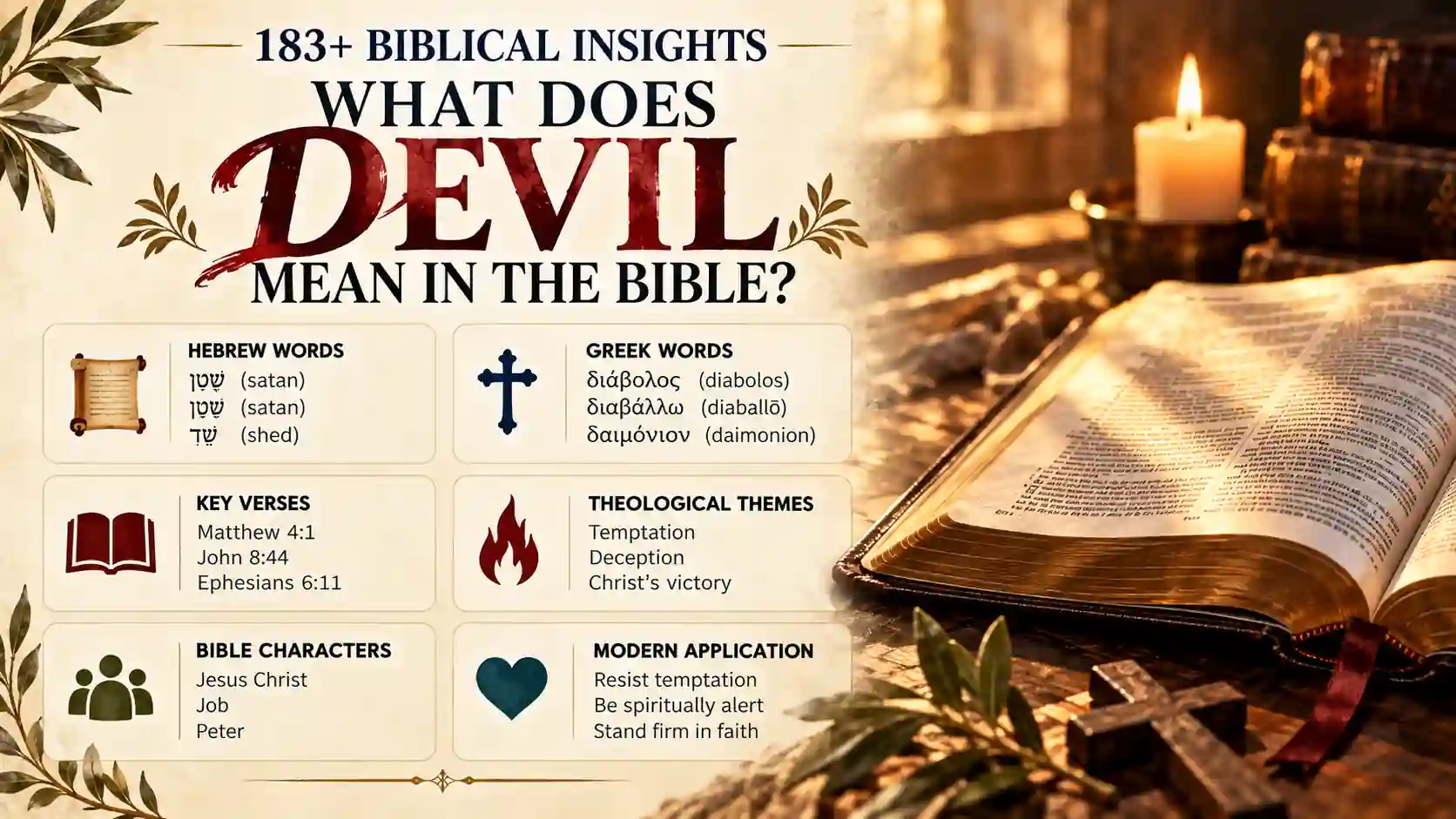
When you ask what does devil mean in the bible, Scripture leads you beyond the popular image of a generic evil spirit. The Bible uses several Hebrew and Greek terms for adversaries, demons, accusers, and especially the personal spiritual enemy identified as Satan. The English word devil most directly represents the Greek διάβολος (diabolos), meaning a slanderer or accuser.
Your study also needs to distinguish the Devil from demons, human adversaries, and related Old Testament terms. Seeing these distinctions helps you read difficult passages more carefully and understand the Bible’s larger teaching about temptation, accusation, spiritual conflict, judgment, and Christ’s victory.
Key Devil Scripture References
| Verse | Passage Snippet | Context |
|---|---|---|
| Matthew 4:1 | Jesus tempted by the devil | Spirit leads Jesus into wilderness testing |
| Matthew 4:5 | Devil takes Jesus to holy city | Satan challenges Jesus to misuse Scripture |
| Matthew 13:39 | Enemy is the devil | Jesus explains the weeds parable |
| Luke 4:2 | Tempted by the devil | Forty days of testing precede Jesus’ ministry |
| John 8:44 | Your father the devil | Jesus connects the devil with lies and murder |
| Ephesians 4:27 | Give no place to the devil | Anger must not become spiritual opportunity |
| Ephesians 6:11 | Schemes of the devil | Believers need God’s armor against deception |
| James 4:7 | Resist the devil | Submission to God accompanies spiritual resistance |
| 1 Peter 5:8 | Devil prowls like a lion | Christians are called to sober vigilance |
| Revelation 12:9 | Devil and Satan | Dragon is identified as the ancient deceiver |
Devil Bible Translation Comparison
| Verse | KJV | NIV | ESV | NASB |
|---|---|---|---|---|
| Matthew 4:1 | “tempted of the devil” | “tempted by the devil” | “tempted by the devil” | “tempted by the devil” |
| Matthew 13:39 | “enemy…is the devil” | “enemy…is the devil” | “enemy…is the devil” | “enemy…is the devil” |
| John 8:44 | “father the devil” | “father, the devil” | “father the devil” | “father, the devil” |
| Ephesians 4:27 | “place to the devil” | “foothold” for the devil | “opportunity” to the devil | “opportunity” to the devil |
| Ephesians 6:11 | “wiles of the devil” | “devil’s schemes” | “schemes of the devil” | “schemes of the devil” |
| 1 Timothy 3:6 | “condemnation of the devil” | devil’s judgment | devil’s condemnation | condemnation of the devil |
| James 4:7 | “resist the devil” | “resist the devil” | “resist the devil” | “resist the devil” |
| 1 Peter 5:8 | “adversary the devil” | “enemy the devil” | “adversary the devil” | “adversary, the devil” |
| Revelation 12:9 | “Devil, and Satan” | “devil, or Satan” | “devil and Satan” | “devil and Satan” |
People and Characters Associated with the Devil
| Person | Role | Connection |
|---|---|---|
| Jesus Christ | Son of God and Messiah | Resists the devil’s temptations and defeats his works |
| Satan | Chief spiritual adversary | Explicitly identified with the Devil in Revelation |
| Eve | First woman | Deceived by the serpent later associated with Satan |
| Job | Righteous sufferer | Satan challenges his faithfulness before God |
| Peter | Apostle | Warned about satanic testing and later warns believers |
| Judas Iscariot | Betrayer of Jesus | Devil influences the betrayal of Christ |
| Paul | Apostle | Teaches about the devil’s schemes and spiritual warfare |
| Timothy | Church leader | Warned about traps and condemnation linked with the devil |
| Michael | Archangel | Contends with the devil in Jude |
| Believers | Followers of Christ | Called to resist the devil through faith and obedience |
Original Hebrew and Greek Words Behind Devil
| Original Word | Transliteration | Strong’s # | Literal Meaning |
|---|---|---|---|
| διάβολος | diabolos | G1228 | Slanderer, false accuser |
| διαβάλλω | diaballō | G1225 | To accuse, malign, slander |
| Σατανᾶς | Satanas | G4567 | Satan, adversary |
| δαιμόνιον | daimonion | G1140 | Demon, evil spirit |
| δαίμων | daimōn | G1142 | Demon, spiritual being |
| שָׂטָן | satan | H7854 | Adversary, accuser |
| שָׂטַן | satan | H7853 | To oppose, act as adversary |
| שֵׁד | shed | H7700 | Demon |
| שָׂעִיר | sa’ir | H8163 | Hairy one, goat, goat-demon |
Related Biblical Concepts Connected with the Devil
| Concept | Connection | Supporting Verse |
|---|---|---|
| Satan | Personal adversary identified as the Devil | Revelation 12:9 |
| Accusation | διάβολος describes slanderous accusation | Revelation 12:10 |
| Temptation | Devil seeks to draw people from faithful obedience | Matthew 4:1 |
| Deception | Devil is associated with falsehood | John 8:44 |
| Spiritual warfare | Christians oppose devilish schemes | Ephesians 6:11 |
| Resistance | Believers actively withstand the devil | James 4:7 |
| Vigilance | Devil seeks vulnerable believers | 1 Peter 5:8 |
| Sin | Devil is associated with ongoing rebellion | 1 John 3:8 |
| Judgment | Eternal fire is prepared for devil and his angels | Matthew 25:41 |
| Christ’s victory | Jesus destroys the devil’s works | 1 John 3:8 |
Historical and Cultural Context of Devil Language
| Aspect | Detail | Biblical Source |
|---|---|---|
| Hebrew courtroom imagery | שָׂטָן can describe an accuser or opponent | Job 1:6-12 |
| Ordinary adversaries | Satan can describe human opposition | 1 Samuel 29:4 |
| Heavenly accuser | Job presents Satan challenging Job’s integrity | Job 1:9-11 |
| Persian-era accusation | Satan opposes the high priest Joshua | Zechariah 3:1 |
| Greek slander language | διάβολος carries the idea of malicious accusation | New Testament usage |
| Wilderness testing | Jesus reenacts Israel-like testing while remaining faithful | Matthew 4:1-11 |
| Jewish apocalyptic imagery | Dragon and serpent imagery portrays cosmic rebellion | Revelation 12:9 |
| Roman-era churches | Christians faced spiritual pressure amid pagan culture | Ephesians 6:10-18 |
| Household ethics | Devil language appears alongside anger and conduct | Ephesians 4:26-27 |
| Early Christian vigilance | Churches were warned against spiritual deception | 1 Peter 5:8-9 |
Theological Themes in Biblical Teaching About the Devil
| Theme | Explanation | Scripture |
|---|---|---|
| Personal evil | The Devil acts, speaks, tempts, and deceives | Matthew 4:1-11 |
| Rebellion against God | Satan opposes God’s purposes | Zechariah 3:1 |
| Falsehood | Jesus calls him a liar and father of lies | John 8:44 |
| Accusation | Satan accuses God’s people | Revelation 12:10 |
| Limited authority | Satan cannot operate independently of God’s sovereignty | Job 1:10-12 |
| Christ’s superiority | Jesus consistently exercises authority over evil powers | Luke 10:17-20 |
| Cross and defeat | Christ breaks the devil’s power through death | Hebrews 2:14 |
| Spiritual conflict | Christian life includes resistance to evil schemes | Ephesians 6:11 |
| Final judgment | Devil’s rebellion ends under divine judgment | Revelation 20:10 |
| Persevering faith | Believers resist by remaining firm in faith | 1 Peter 5:9 |
Modern Application of Biblical Teaching About the Devil
| Area | Practice | Scripture |
|---|---|---|
| Temptation | Answer temptation with truth and obedience | Matthew 4:4 |
| Anger | Resolve sinful anger rather than giving evil opportunity | Ephesians 4:26-27 |
| Discernment | Test claims rather than accepting spiritual deception | 1 John 4:1 |
| Prayer | Depend on God in spiritual conflict | Ephesians 6:18 |
| Scripture | Use God’s Word faithfully, not manipulatively | Matthew 4:7 |
| Resistance | Submit to God and resist the devil | James 4:7 |
| Alertness | Practice sober spiritual vigilance | 1 Peter 5:8 |
| Faith | Stand firm rather than yielding to fear | 1 Peter 5:9 |
| Forgiveness | Avoid schemes that exploit unresolved conflict | 2 Corinthians 2:10-11 |
| Hope | Remember that evil faces final judgment | Revelation 20:10 |
διάβολος Shows Why the Bible Calls Satan the Devil
The Greek noun διάβολος (diabolos, G1228) comes from language associated with accusation and slander. When the New Testament uses it as a title, it portrays the Devil not merely as someone who behaves badly but as a spiritual adversary whose characteristic activity involves accusation, deception, temptation, and opposition to God’s purposes.
This meaning becomes especially clear in Revelation 12:9-10. The dragon is identified as “the Devil and Satan,” while the next verse describes him as the accuser of God’s people. The biblical title therefore communicates character as well as identity. He is the adversary who deceives and accuses.
What Does Devil Mean in the Bible When שָׂטָן Means Adversary?
The Hebrew שָׂטָן (satan, H7854) fundamentally means an adversary or accuser. Context determines whether the word describes an ordinary opponent or the supernatural figure familiar from Job and Zechariah. In 1 Samuel 29:4, for example, the Philistine rulers fear that David might become an adversary to them.
Job 1 presents “the satan” in a heavenly scene where he challenges Job’s motives before God. Zechariah 3:1 similarly portrays Satan standing beside Joshua the high priest to accuse him. These texts develop the biblical association between satanic opposition and accusation without suggesting that Satan possesses authority equal to God’s.
Jesus Confronts the Devil as Tempter, Liar, and Defeated Enemy
Matthew 4 and Luke 4 give you one of Scripture’s clearest portraits of the Devil’s activity. Satan tempts Jesus to misuse divine sonship through appetite, spectacle, and worldly rule. Jesus refuses each temptation by faithfully applying Scripture and remaining obedient to the Father.
Later, Jesus calls the devil a murderer and “the father of lies” in John 8:44. Yet the New Testament never presents evil as God’s equal opposite. Christ casts out demons, overcomes temptation, announces Satan’s downfall, and through his death destroys the one who held the power of death, as Hebrews 2:14 describes it.
The Devil, Demons, and the Final Judgment in the New Testament
Your Bible study should distinguish διάβολος (diabolos) from δαιμόνιον (daimonion, G1140). The first commonly identifies the Devil, while daimonion refers to demons or evil spirits. This explains why older English Bibles sometimes use “devils” where many modern translations use “demons.”
The distinction matters because Scripture portrays one chief adversary alongside numerous evil spiritual beings. Matthew 25:41 speaks of “the devil and his angels,” while Revelation 20:10 describes the Devil’s final judgment. Christian hope therefore rests not on fear of evil powers but on the ultimate authority and victory of God in Christ.
Frequently Asked Questions About the Devil in the Bible
Does διάβολος mean exactly the same thing as Satan?
Not exactly. διάβολος (diabolos) means slanderer or accuser, while שָׂטָן (satan) means adversary, though the New Testament often uses both as titles for the same spiritual being.
Why does the KJV sometimes say “devils” when newer translations say “demons”?
The KJV often renders Greek δαιμόνιον (daimonion, G1140) as “devils,” while modern versions normally use “demons” to distinguish those spirits from the singular Devil.
Is the Satan in Job the same figure later called the Devil?
Job uses שָׂטָן (satan) for the heavenly accuser, and later biblical revelation strongly associates Satan with the personal Devil identified explicitly in Revelation 12:9.
What does James 4:7 mean when it says to resist the devil?
It calls you to submit yourself to God and actively oppose satanic temptation rather than treating spiritual resistance as independent human power.
Does the Bible teach that the Devil has power equal to God?
No. Job, the Gospels, and Revelation consistently portray the Devil as a created and limited adversary who remains subject to God’s authority and ultimately faces divine judgment.