
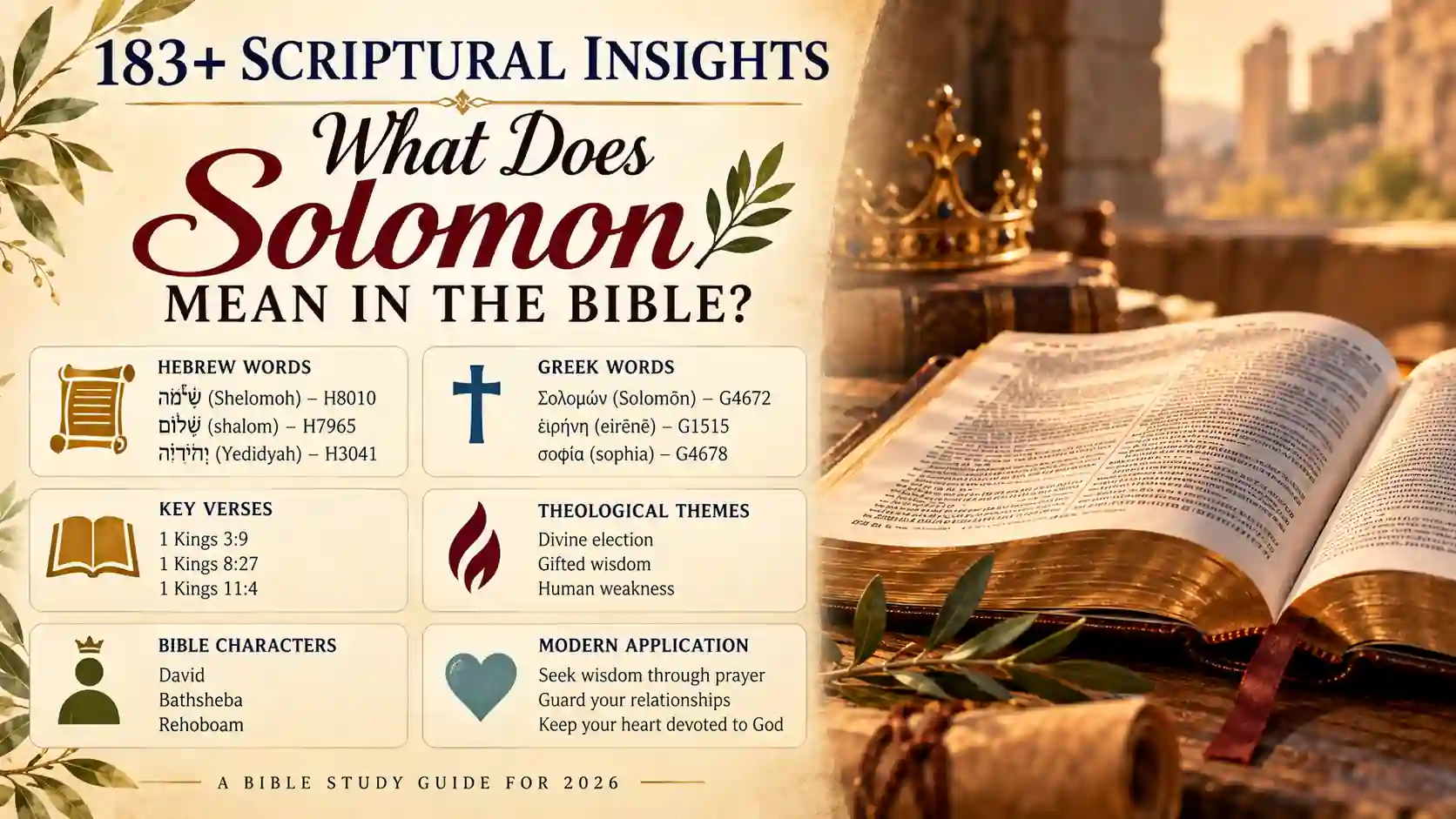
When you ask what does Solomon mean in the Bible, you are asking about more than the definition of a famous king’s name. Solomon’s Hebrew name, שְׁלֹמֹה (Shelomoh), is closely related to שָׁלוֹם (shalom), the Hebrew word associated with peace, completeness, welfare, and wholeness. His life also becomes a biblical study of wisdom, kingship, worship, prosperity, covenant responsibility, and human failure.
Solomon stands at a remarkable point in Israel’s history. Through his reign, Scripture shows you both the beauty of God-given wisdom and the danger of allowing divided loyalties to weaken faithful obedience.
Key Scripture References About Solomon
| Verse | Passage Snippet | Context |
|---|---|---|
| 2 Samuel 12:24 | Bathsheba bore Solomon | Solomon’s birth after David’s repentance |
| 2 Samuel 12:25 | He was called Jedidiah | The Lord expressed special love for him |
| 1 Kings 1:39 | They anointed Solomon | Solomon became David’s successor |
| 1 Kings 3:5 | Ask what I shall give you | God appeared to Solomon at Gibeon |
| 1 Kings 3:9 | Give your servant understanding | Solomon requested discernment for governing |
| 1 Kings 4:29 | God gave Solomon wisdom | His wisdom was extraordinarily broad |
| 1 Kings 6:1 | Solomon began building the house | Construction of the temple commenced |
| 1 Kings 8:27 | Heaven cannot contain you | Solomon acknowledged God’s transcendence |
| 1 Kings 11:4 | His heart was not wholly true | Foreign wives turned his heart toward other gods |
| Matthew 12:42 | Greater than Solomon is here | Jesus declared His superiority to Solomon |
Solomon Bible Translation Comparison
| Verse | KJV | NIV | ESV | NASB |
|---|---|---|---|---|
| 1 Kings 3:9 | understanding heart | discerning heart | understanding mind | understanding heart |
| 1 Kings 3:12 | wise and understanding heart | wise and discerning heart | wise and discerning mind | wise and discerning heart |
| 1 Kings 4:29 | wisdom and understanding | wisdom and very great insight | wisdom and understanding | wisdom and very great discernment |
| 1 Kings 4:30 | wisdom excelled | wisdom was greater | wisdom surpassed | wisdom surpassed |
| 1 Kings 8:23 | no God like thee | no God like you | no God like you | no God like You |
| 1 Kings 8:27 | heaven cannot contain thee | heavens cannot contain you | heaven cannot contain you | heavens cannot contain You |
| 1 Kings 10:24 | sought to Solomon | sought the presence of Solomon | sought the presence of Solomon | sought an audience with Solomon |
| 1 Kings 11:4 | heart was not perfect | heart was not fully devoted | heart was not wholly true | heart was not wholly devoted |
| Matthew 6:29 | Solomon in all his glory | Solomon in all his splendor | Solomon in all his glory | Solomon in all his glory |
People and Characters Associated with Solomon
| Person | Role | Connection |
|---|---|---|
| David | King and father | Chose Solomon as his successor |
| Bathsheba | Mother | Bore Solomon to David |
| Nathan | Prophet | Supported Solomon’s succession |
| Zadok | Priest | Anointed Solomon as king |
| Adonijah | Half brother | Tried to claim David’s throne |
| Hiram | King of Tyre | Supplied materials for temple construction |
| Queen of Sheba | Foreign ruler | Tested Solomon’s celebrated wisdom |
| Rehoboam | Son | Succeeded Solomon after his death |
| Jeroboam | Royal official | Received prophecy concerning the divided kingdom |
| Jesus | Davidic Messiah | Described Himself as greater than Solomon |
Original Hebrew and Greek Words Connected with Solomon
| Original Word | Transliteration | Strong’s # | Literal Meaning |
|---|---|---|---|
| שְׁלֹמֹה | Shelomoh | H8010 | Solomon, peaceful |
| שָׁלוֹם | shalom | H7965 | peace, welfare, completeness |
| יְדִידְיָהּ | Yedidyah | H3041 | beloved of Yah |
| חָכְמָה | chokmah | H2451 | wisdom, skill |
| חָכָם | chakam | H2450 | wise, skillful |
| מֶלֶךְ | melekh | H4428 | king |
| בַּיִת | bayit | H1004 | house, household, temple |
| מִשְׁלֵי | mishley | H4912 | proverbs |
| Σολομών | Solomōn | G4672 | Solomon |
| εἰρήνη | eirēnē | G1515 | peace |
Related Biblical Concepts Around Solomon
| Concept | Connection | Supporting Verse |
|---|---|---|
| Peace | Solomon’s name reflects the idea of shalom | 1 Chronicles 22:9 |
| Wisdom | God granted exceptional discernment | 1 Kings 3:12 |
| Kingship | Solomon inherited David’s throne | 1 Kings 2:12 |
| Temple | He built Israel’s first temple in Jerusalem | 1 Kings 6:1 |
| Prayer | He led Israel in temple dedication prayer | 1 Kings 8:22 |
| Covenant | His kingship carried covenant responsibilities | 1 Kings 9:4 |
| Prosperity | His reign enjoyed remarkable wealth | 1 Kings 10:23 |
| Proverbs | Wisdom tradition is strongly linked with Solomon | Proverbs 1:1 |
| Apostasy | His later loyalties became divided | 1 Kings 11:4 |
| Messiah | Jesus surpassed Solomon’s wisdom and glory | Matthew 12:42 |
Historical and Cultural Context of Solomon
| Aspect | Detail | Biblical Source |
|---|---|---|
| Dynasty | Solomon belonged to David’s royal house | 2 Samuel 7:12 |
| Succession | His accession followed palace conflict | 1 Kings 1:5-40 |
| Capital | He ruled from Jerusalem | 1 Kings 3:1 |
| Temple era | Temple construction began early in his reign | 1 Kings 6:1 |
| Phoenician ties | Hiram assisted with timber and craftsmen | 1 Kings 5:1-12 |
| Trade | Solomon developed international commerce | 1 Kings 9:26-28 |
| Administration | Officials managed districts and provisions | 1 Kings 4:7 |
| Diplomacy | Royal marriages strengthened foreign connections | 1 Kings 3:1 |
| Wealth | Gold became abundant at Solomon’s court | 1 Kings 10:14-23 |
| Division | His policies helped set the stage for rupture | 1 Kings 11:26-40 |
Theological Themes in Solomon’S Biblical Story
| Theme | Explanation | Scripture |
|---|---|---|
| Divine election | God established Solomon on David’s throne | 1 Chronicles 28:5 |
| Gifted wisdom | Wisdom came from God rather than mere intellect | 1 Kings 3:12 |
| Reverent worship | Solomon devoted the temple to the Lord | 1 Kings 8:63 |
| God’s transcendence | No building can contain the Creator | 1 Kings 8:27 |
| Covenant faithfulness | Obedience remained essential for the king | 1 Kings 9:4-7 |
| Human weakness | Great wisdom did not eliminate temptation | 1 Kings 11:1-4 |
| Idolatry | Divided worship brought divine judgment | 1 Kings 11:9-10 |
| Judgment | The kingdom would be torn because of rebellion | 1 Kings 11:11 |
| Davidic hope | Solomon partially embodied Davidic promises | 2 Samuel 7:12-13 |
| Greater King | Jesus claimed superiority to Solomon | Matthew 12:42 |
Modern Application from Solomon’S Life
| Area | Practice | Scripture |
|---|---|---|
| Prayer | Ask God for wisdom rather than status | 1 Kings 3:9 |
| Leadership | Seek discernment when serving others | 1 Kings 3:28 |
| Worship | Remember God is greater than sacred buildings | 1 Kings 8:27 |
| Scripture | Receive wisdom with humility | Proverbs 1:7 |
| Success | Refuse to equate wealth with faithfulness | 1 Kings 10:23 |
| Relationships | Guard influences that redirect your worship | 1 Kings 11:2 |
| Devotion | Keep your heart fully directed toward God | 1 Kings 11:4 |
| Repentance | Learn from the consequences of compromise | 1 Kings 11:9 |
| Stewardship | Use God-given ability responsibly | 1 Kings 4:29 |
| Christology | Recognize Jesus as greater than Solomon | Matthew 12:42 |
What Does Solomon Mean in the Bible Through שְׁלֹמֹה Shelomoh?
The name שְׁלֹמֹה (Shelomoh, H8010) is traditionally associated with שָׁלוֹם (shalom, H7965), the rich Hebrew idea of peace, well-being, completeness, and wholeness. This connection is especially fitting because David described Solomon as a man who would experience rest from surrounding enemies.
In 1 Chronicles 22:9, David says that his son would be a “man of rest” and that God would give Israel peace during his days. Solomon’s name therefore fits the peaceful conditions surrounding much of his reign, especially when contrasted with David’s life of warfare.
Solomon, שָׁלוֹם Shalom, and the Peaceful Davidic Kingdom
Solomon’s peaceful reign had covenant significance. David wanted to build a house for God, but his history as a warrior prevented him from becoming the temple builder. Solomon inherited a comparatively settled kingdom and completed the sanctuary in Jerusalem.
Yet biblical shalom means more than the absence of war. True peace includes rightly ordered life under God. Solomon’s later idolatry reveals an important tension in his story. A peaceful political environment could not substitute for an undivided heart devoted to the Lord.
His reign therefore teaches you to distinguish outward stability from spiritual faithfulness. A person may possess security, influence, knowledge, and resources while still becoming vulnerable to gradual compromise.
Solomon’S חָכְמָה Chokmah and the Limits of Human Wisdom
One of Solomon’s defining gifts was חָכְמָה (chokmah, H2451), meaning wisdom or skill. When God invited him to ask for what he desired, Solomon requested an understanding capacity to judge Israel well. God honored the humility behind that request.
His wisdom became famous throughout the ancient world. First Kings presents him as a ruler able to judge difficult cases, speak about creation, compose sayings, and attract international attention. The Queen of Sheba came because reports of his wisdom had spread far beyond Israel.
Yet Solomon’s later life shows that possessing wisdom is not identical to consistently obeying wisdom. Knowledge can identify what is right without compelling the heart to choose it. Scripture presents this contradiction without hiding the king’s failures.
That tension makes Solomon especially relevant to your study. Biblical wisdom must become faithful practice. Intelligence, theological understanding, and even spiritual privilege cannot replace sustained love for God.
Why Jesus Says Someone Greater than Solomon Has Come
The New Testament remembers Solomon as a figure of extraordinary wisdom and royal splendor. Jesus refers to “Solomon in all his glory” when teaching about God’s provision, showing how deeply Solomon remained associated with magnificence in Jewish memory.
More significantly, Matthew 12:42 records Jesus saying that “something greater than Solomon” was present. The comparison places Solomon within a larger biblical pattern. He was an impressive Davidic king, but he was not the final fulfillment of Israel’s hope.
Solomon built a temple, but Jesus identifies Himself with a reality greater than the temple. Solomon possessed remarkable wisdom, but Jesus speaks with divine authority. Solomon’s kingdom eventually fractured, while the New Testament presents Christ’s reign as belonging to God’s enduring redemptive purpose.
For Christian readers, then, Solomon functions both historically and typologically. His wisdom, peace, temple building, and royal glory point beyond themselves, while his failures demonstrate why God’s people needed a greater and completely faithful Son of David.
Frequently Asked Questions About Solomon in the Bible
Does שְׁלֹמֹה Shelomoh literally mean peace?
The name is closely associated with שָׁלוֹם (shalom), so “peaceful” is a fitting sense, especially in light of 1 Chronicles 22:9.
Why was Solomon also called יְדִידְיָהּ Yedidyah?
Second Samuel 12:25 says the Lord, through Nathan, gave him the name Yedidyah, H3041, meaning “beloved of Yah.”
If Solomon had חָכְמָה chokmah, why did he fall into idolatry?
First Kings 11 shows that possessing God-given wisdom did not remove Solomon’s responsibility to guard his affections and obey God faithfully.
Why does Matthew 12:42 say Jesus is greater than Solomon?
Jesus uses Solomon’s renowned wisdom as a comparison and presents His own authority and significance as surpassing Israel’s celebrated wise king.
What should Solomon’s connection with שָׁלוֹם shalom teach you?
His life teaches that lasting biblical peace requires more than prosperity or political rest because genuine wholeness remains tied to faithful relationship with God.