
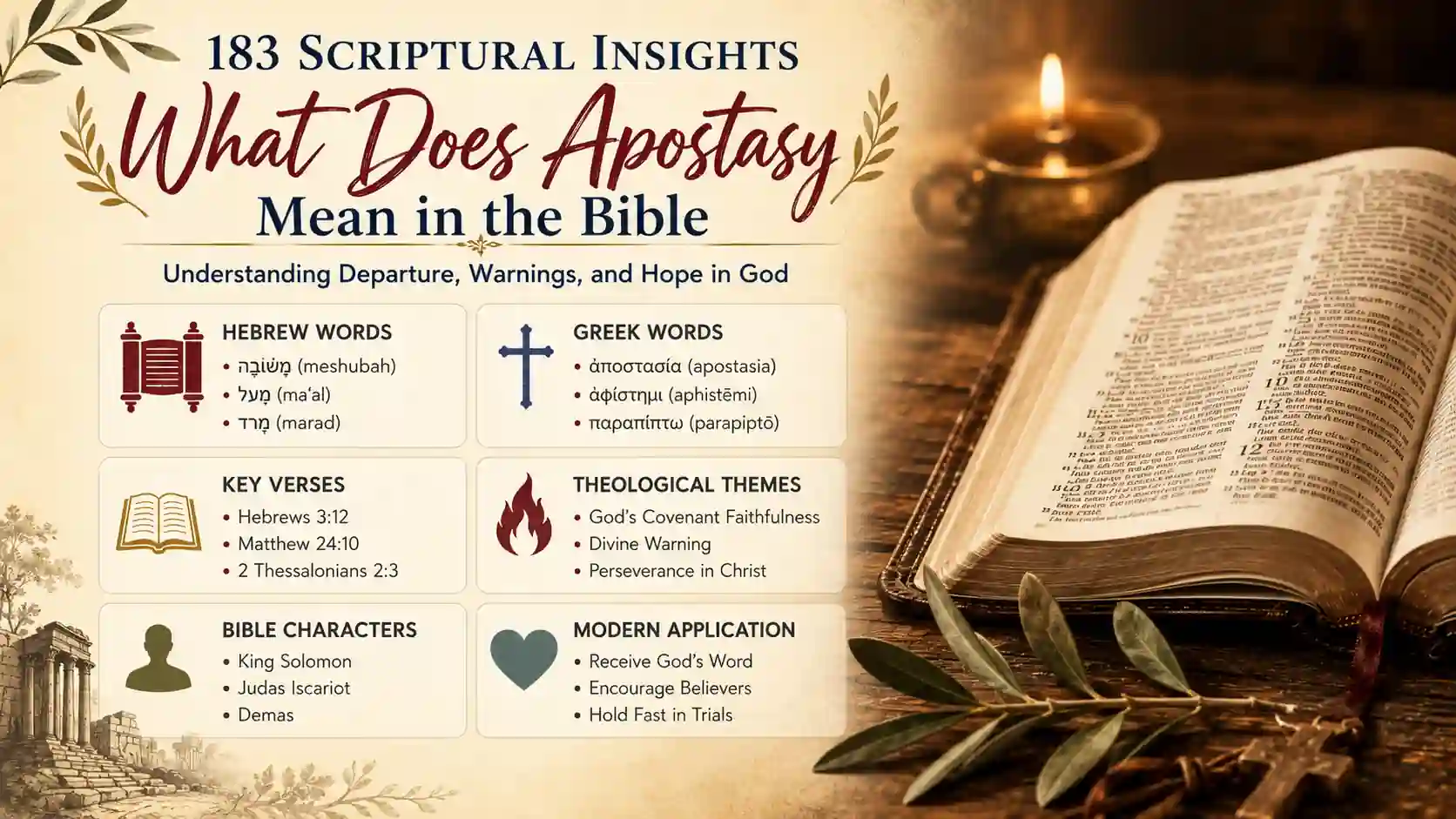
What does apostasy mean in the Bible? Apostasy is a deliberate departure from God, his revealed truth, or a faith once professed. Scripture presents it not merely as doubt, weakness, or an isolated sin, but as rebellion, abandonment, and covenant unfaithfulness.
The Greek noun ἀποστασία, apostasia, describes defection or rebellion, while related Hebrew words portray turning aside, acting faithlessly, and forsaking the Lord. Your study of apostasy should therefore include biblical warnings, historical examples, calls to perseverance, and God’s gracious invitations to return.
Apostasy Key Scripture References
| Verse | Passage Snippet | Context |
|---|---|---|
| Deuteronomy 13:6-10 | “Let us go and serve other gods” | Israel warned against idolatrous enticement |
| Jeremiah 3:22 | “Return, O faithless children” | God calls apostate Judah to repentance |
| Daniel 9:9 | “We have rebelled against him” | Daniel confesses Israel’s covenant rebellion |
| Matthew 24:10-13 | “Many will fall away” | Jesus warns of end-time pressure |
| Luke 8:13 | “In time of testing fall away” | Temporary faith in the rocky soil |
| John 6:66 | “Many of his disciples turned back” | Disciples abandon Jesus’ difficult teaching |
| Hebrews 3:12 | “Fall away from the living God” | Christians warned against unbelief |
| Hebrews 6:4-6 | “Then have fallen away” | Severe warning against repudiating Christ |
| 1 Timothy 4:1 | “Some will depart from the faith” | False teaching marks later times |
| 2 Thessalonians 2:3 | “The rebellion comes first” | Apostasy precedes the man of lawlessness |
Apostasy Bible Translation Comparison
| Verse | KJV | NIV | ESV | NASB |
|---|---|---|---|---|
| Jeremiah 3:22 | “backsliding children” | “faithless people” | “faithless children” | “faithless sons” |
| Matthew 24:10 | “many be offended” | “many will turn away” | “many will fall away” | “many will fall away” |
| Luke 8:13 | “fall away” | “fall away” | “fall away” | “fall away” |
| Acts 21:21 | “forsake Moses” | “turn away from Moses” | “forsake Moses” | “abandon Moses” |
| 1 Timothy 4:1 | “depart from the faith” | “abandon the faith” | “depart from the faith” | “fall away from the faith” |
| Hebrews 3:12 | “departing from” | “turns away from” | “fall away from” | “falls away from” |
| Hebrews 6:6 | “fall away” | “fallen away” | “fallen away” | “fallen away” |
| 2 Thessalonians 2:3 | “falling away” | “rebellion” | “rebellion” | “apostasy” |
The noun ἀποστασία occurs in Acts 21:21 and 2 Thessalonians 2:3. Its different renderings, including “forsake,” “falling away,” “rebellion,” and “apostasy,” reflect the word’s broad sense of abandoning an established allegiance.
People and Characters Associated with Apostasy
| Person | Role | Connection |
|---|---|---|
| Israel at Sinai | Covenant nation | Worshiped the golden calf |
| King Saul | Israel’s first king | Rejected God’s command |
| King Solomon | Davidic king | Followed foreign gods |
| King Jeroboam | Northern kingdom ruler | Established rival worship centers |
| King Ahab | Israelite king | Promoted Baal worship |
| Judas Iscariot | Apostle of Jesus | Betrayed and abandoned Christ |
| Demas | Paul’s coworker | Deserted Paul for the present world |
| Hymenaeus | False teacher | Made shipwreck of the faith |
| Alexander | Opponent of truth | Rejected faith and conscience |
| Unnamed disciples | Followers of Jesus | Turned back after hard teaching |
Apostasy Original Hebrew and Greek Words
| Original Word | Transliteration | Strong’s # | Literal Meaning |
|---|---|---|---|
| ἀποστασία | apostasia | G646 | Defection, rebellion, departure |
| ἀφίστημι | aphistēmi | G868 | To withdraw or depart |
| παραπίπτω | parapiptō | G3895 | To fall away |
| ἀρνέομαι | arneomai | G720 | To deny or disown |
| מְשׁוּבָה | meshubah | H4878 | Turning back, faithlessness |
| מַעַל | maʿal | H4604 | Unfaithful or treacherous act |
| מָרַד | marad | H4775 | To rebel or revolt |
| סוּר | sur | H5493 | To turn aside or depart |
| שׁוּב | shuv | H7725 | To turn or return |
The principal New Testament noun, ἀποστασία, apostasia, is Strong’s G646. It denotes defection, rebellion, or departure from a previous position and is related to ἀφίστημι, aphistēmi, “to depart” or “withdraw.”
Apostasy Related Biblical Concepts
| Concept | Connection | Supporting Verse |
|---|---|---|
| Unbelief | Hardness leads away from God | Hebrews 3:12 |
| Idolatry | Replaces God with rival loyalties | Exodus 32:4 |
| Covenant breaking | Violates pledged allegiance | Deuteronomy 29:25 |
| False teaching | Draws hearers from truth | 1 Timothy 4:1 |
| Spiritual adultery | Pictures betrayal of God | Jeremiah 3:8 |
| Hardness of heart | Resists God’s voice repeatedly | Hebrews 3:15 |
| Denial of Christ | Publicly rejects the Lord | Matthew 10:33 |
| Lawlessness | Rejects divine authority | 2 Thessalonians 2:3 |
| Worldliness | Competes with love for God | 2 Timothy 4:10 |
| Perseverance | Contrasts with falling away | Hebrews 10:36 |
Apostasy Historical and Cultural Context
| Aspect | Detail | Biblical Source |
|---|---|---|
| Sinai covenant | Israel pledged obedience to God | Exodus 24:7 |
| Canaanite religion | Baal worship tempted Israel | Judges 2:11-13 |
| Divided monarchy | Jeroboam created rival shrines | 1 Kings 12:28-30 |
| Royal intermarriage | Foreign alliances imported idols | 1 Kings 11:1-8 |
| Prophetic lawsuits | Prophets charged Israel with betrayal | Jeremiah 2:9 |
| Exile | Covenant rebellion brought judgment | 2 Kings 17:7-23 |
| Second Temple Judaism | Forsaking Moses was a serious charge | Acts 21:21 |
| Roman pressure | Persecution tested Christian confession | Hebrews 10:32-39 |
| Household religion | Families could pressure converts | Matthew 10:35-37 |
| Imperial culture | Loyalty to Christ challenged civic worship | Revelation 13:15 |
Apostasy Theological Themes
| Theme | Explanation | Scripture |
|---|---|---|
| God’s covenant faithfulness | Human betrayal does not alter God’s character | 2 Timothy 2:13 |
| Human responsibility | Hearers must respond faithfully to truth | Hebrews 2:1-3 |
| Perseverance | Genuine disciples continue with Christ | John 8:31 |
| Divine warning | God uses warnings to guard his people | Hebrews 3:12-13 |
| Corporate care | Believers help one another resist sin | Hebrews 10:24-25 |
| Christ’s supremacy | Turning from Christ abandons God’s final revelation | Hebrews 1:1-3 |
| Judgment | Persistent rebellion faces divine accountability | Hebrews 10:26-31 |
| Repentance | God calls the faithless to return | Jeremiah 3:22 |
| Assurance | Christ preserves those who trust him | John 10:27-29 |
| Endurance in suffering | Trials reveal the direction of faith | Matthew 24:13 |
Apostasy Modern Application for Believers
| Area | Practice | Scripture |
|---|---|---|
| Scripture | Receive God’s Word with endurance | Luke 8:15 |
| Prayer | Ask God to sustain your faith | Luke 22:32 |
| Doctrine | Test teachings by apostolic truth | 1 John 4:1 |
| Worship | Reject idols and divided loyalties | 1 John 5:21 |
| Church life | Encourage believers regularly | Hebrews 3:13 |
| Trials | Hold your confession firmly | Hebrews 4:14 |
| Temptation | Watch against hardened unbelief | Hebrews 3:12 |
| Repentance | Return quickly after wandering | James 5:19-20 |
| Leadership | Guard both life and teaching | 1 Timothy 4:16 |
| Hope | Look to Jesus for endurance | Hebrews 12:1-2 |
What Does Apostasy Mean in the Bible Through ἀποστασία?
The Greek ἀποστασία, apostasia, does not describe an accidental misstep. It suggests a decisive departure, defection, or revolt from a prior allegiance. In Acts 21:21, Paul is accused of teaching Jewish believers to forsake Moses. The accusation concerns abandoning an established religious commitment, although the charge against Paul was distorted.
In 2 Thessalonians 2:3, Paul says “the apostasy” or “the rebellion” will precede the revelation of the man of lawlessness. The context joins religious defection with deception, opposition to God, and lawlessness. Though interpreters debate some details, the passage clearly portrays organized resistance to divine truth rather than an innocent change of opinion.
מְשׁוּבָה And Israel’S Covenant Unfaithfulness
The Old Testament commonly describes apostasy through covenant language rather than one technical Hebrew term. מְשׁוּבָה, meshubah, depicts turning back, faithlessness, or backsliding. Jeremiah uses it for Israel and Judah, whose pursuit of idols resembled marital betrayal against the Lord who had bound them to himself.
מַעַל, maʿal, emphasizes treachery or breach of trust, while מָרַד, marad, expresses rebellion. These words show that biblical apostasy is relational. Israel did not merely adopt mistaken ideas. The nation violated a covenant, rejected God’s authority, and transferred worship to false gods. Yet the prophets repeatedly called the faithless to return.
Hebrews Warns Against Departing from the Living God
Hebrews 3:12 warns you against “an evil, unbelieving heart” that falls away from the living God. The verb ἀφίστημι, aphistēmi, describes withdrawal or departure. The danger develops through unbelief, sin’s deceitfulness, and resistance to God’s voice. Apostasy is therefore a hardened direction of life, not every season of fear or spiritual dryness.
The severe warnings in Hebrews 6:4-6 and 10:26-31 have produced several theological interpretations. Christians disagree about whether these texts describe loss of salvation, exposure to covenant blessings without regeneration, or warnings God uses to preserve believers. Every view should preserve the passages’ pastoral force. You are called to endure, encourage others, and cling to Christ.
Apostasy, Doubt, Repentance, and Perseverance
Apostasy should not be confused with honest questions, temporary doubt, or a believer’s painful struggle against sin. Peter denied Jesus, yet he wept, returned, and was restored. Judas moved in the opposite direction by betraying Christ and abandoning his discipleship. The distinction involves not sinlessness, but the settled direction of the heart toward or away from Christ.
Scripture’s warnings are accompanied by invitations. Jeremiah cries, “Return, O faithless children,” and James urges believers to restore anyone wandering from the truth. When you recognize spiritual drift, your response should be repentance rather than despair. God’s means of preservation include Scripture, prayer, fellowship, discipline, remembrance, and continued trust in Jesus.
Frequently Asked Questions About Apostasy
Does ἀποστασία always mean abandoning Christianity?
No. The word denotes defection or rebellion, and its specific object must be identified from the context.
Is the “falling away” in 2 Thessalonians 2:3 a religious apostasy?
The context strongly associates it with rebellion, deception, lawlessness, and opposition to God.
Does Hebrews 6:4-6 teach that a true believer can lose salvation?
Christians interpret the passage differently, but all should receive its warning against repudiating Christ with full seriousness.
Is מְשׁוּבָה, meshubah, the exact Hebrew equivalent of ἀποστασία?
Not exactly, but it expresses closely related ideas of backsliding, faithlessness, and turning away from God.
Can someone who has wandered from the faith return to God?
Scripture repeatedly calls wanderers to repent, while warning against persistent, hardened rejection of Christ.