
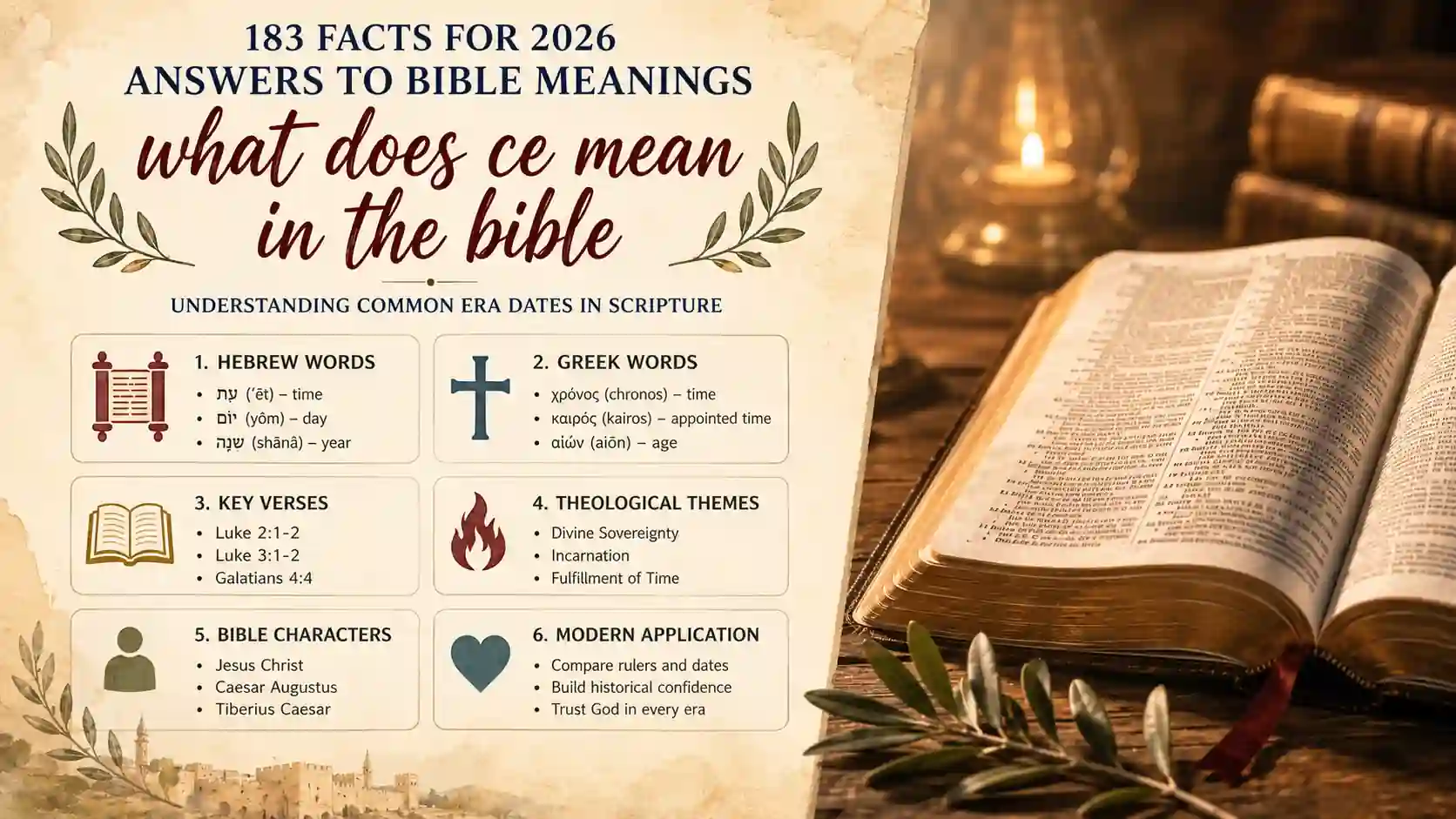
The question “what does CE mean in the Bible” usually arises when you encounter dates such as 30 CE, 70 CE, or 95 CE in a study Bible or commentary. CE means “Common Era.” It is a modern calendar designation equivalent to AD, not a word or abbreviation found in the biblical text.
Understanding CE still helps your study because scholars use it to date Jesus’ ministry, Paul’s journeys, Jerusalem’s destruction, and the writing of New Testament books. Scripture measures time differently, usually through rulers, festivals, genealogies, and major covenant events.
Key Ce Scripture References
| Verse | Passage Snippet | Context |
|---|---|---|
| Luke 2:1-2 | Caesar Augustus issued a decree | Jesus’ birth under Roman rule |
| Luke 3:1-2 | Fifteenth year of Tiberius | John’s ministry dated by rulers |
| Luke 3:23 | Jesus was about thirty | Beginning of Jesus’ ministry |
| John 2:20 | Temple built for forty-six years | Chronological clue near Passover |
| Acts 11:28 | Famine under Claudius | Event dated within Roman history |
| Acts 18:2 | Claudius expelled the Jews | Paul meets Aquila and Priscilla |
| Acts 18:12 | Gallio governed Achaia | Major anchor for Pauline chronology |
| Acts 24:27 | Felix succeeded by Festus | Paul’s imprisonment dated politically |
Ce Bible Translation Comparison
| Verse | KJV | NIV | ESV | NASB |
|---|---|---|---|---|
| Luke 2:1 | all the world taxed | census of Roman world | all the world registered | census of inhabited earth |
| Luke 2:2 | Cyrenius was governor | Quirinius was governor | Quirinius was governor | Quirinius was governor |
| Luke 3:1 | fifteenth year | fifteenth year | fifteenth year | fifteenth year |
| Luke 3:23 | about thirty years | about thirty years | about thirty years | about thirty years |
| John 2:20 | forty and six years | forty-six years | forty-six years | forty-six years |
| Acts 11:28 | great dearth | severe famine | great famine | great famine |
| Acts 18:12 | deputy of Achaia | proconsul of Achaia | proconsul of Achaia | proconsul of Achaia |
| Acts 24:27 | Porcius Festus came | Festus succeeded Felix | Felix was succeeded | Festus succeeded Felix |
People and Characters Associated with Ce Dating
| Person | Role | Connection |
|---|---|---|
| Jesus Christ | Messiah and Lord | His earthly life marks the era’s traditional center |
| Caesar Augustus | Roman emperor | Ruled around the time of Jesus’ birth |
| Tiberius Caesar | Roman emperor | His reign dates John’s ministry |
| Pontius Pilate | Judean governor | Presided over Jesus’ crucifixion |
| Herod the Great | Client king | Ruled Judea near Jesus’ birth |
| Claudius | Roman emperor | His reign frames events in Acts |
| Gallio | Achaian proconsul | Dates Paul’s ministry in Corinth |
| Paul | Apostle to Gentiles | His journeys occurred during the first century CE |
Original Hebrew and Greek Words Related to Ce Chronology
| Original Word | Transliteration | Strong’s # | Literal Meaning |
|---|---|---|---|
| עֵת | ʿēt | H6256 | time or appointed occasion |
| יוֹם | yôm | H3117 | day |
| שָׁנָה | shānâ | H8141 | year |
| דּוֹר | dôr | H1755 | generation or age |
| עוֹלָם | ʿôlām | H5769 | long duration or eternity |
| χρόνος | chronos | G5550 | measurable time |
| καιρός | kairos | G2540 | appointed or fitting time |
| αἰών | aiōn | G165 | age or world period |
Related Ce Biblical Concepts
| Concept | Connection | Supporting Verse |
|---|---|---|
| Incarnation | Christ entered human history | John 1:14 |
| Fullness of time | God acted at the appointed moment | Galatians 4:4 |
| Roman government | Emperors provide historical markers | Luke 3:1 |
| Passover chronology | Festivals organize Gospel events | John 2:13 |
| Sabbath sequence | Weeks structure resurrection accounts | Luke 24:1 |
| Apostolic mission | Acts follows historical expansion | Acts 1:8 |
| Temple destruction | Jesus foretold Jerusalem’s judgment | Luke 21:6 |
| Second coming | History moves toward Christ’s return | Acts 1:11 |
Historical and Cultural Context of Ce
| Aspect | Detail | Biblical Source |
|---|---|---|
| Roman calendar | New Testament events occurred under Roman rule | Luke 2:1 |
| Regnal dating | Years were identified by reigning rulers | Luke 3:1 |
| Jewish calendar | Months followed lunar religious cycles | Leviticus 23:5 |
| Passover | Annual feast helps sequence Gospel events | John 6:4 |
| Temple worship | Daily and annual observances marked time | Luke 1:9 |
| Provincial governors | Officials help date events in Acts | Acts 18:12 |
| Imperial decrees | Government actions affected Jewish communities | Acts 18:2 |
| Genealogical memory | Generations connected people with covenant history | Matthew 1:17 |
Theological Themes Connected with Ce
| Theme | Explanation | Scripture |
|---|---|---|
| Divine sovereignty | God rules within real political history | Luke 2:1-7 |
| Incarnation | The eternal Son entered time | John 1:1-14 |
| Providence | Civil events serve God’s purposes | Acts 17:26 |
| Fulfillment | Christ came at God’s appointed time | Galatians 4:4 |
| Kingdom | Jesus’ reign confronts earthly powers | John 18:36 |
| Judgment | Historical events can express divine justice | Luke 19:41-44 |
| Mission | The gospel advances through nations and eras | Acts 1:8 |
| Consummation | History awaits Christ’s appearing | Revelation 22:20 |
Modern Application of Ce for Believers
| Area | Practice | Scripture |
|---|---|---|
| Bible study | Distinguish CE from biblical vocabulary | 2 Timothy 2:15 |
| Chronology | Compare rulers, journeys, and festivals | Luke 3:1-2 |
| Historical confidence | Notice Scripture’s concrete settings | Luke 1:1-4 |
| Humility | Recognize limits in disputed dates | Deuteronomy 29:29 |
| Worship | Remember Christ entered real history | John 1:14 |
| Providence | Trust God amid political change | Romans 13:1 |
| Mission | Serve faithfully in your generation | Acts 13:36 |
| Hope | View history as moving toward Christ | Titus 2:13 |
What Does Ce Mean in the Bible and Biblical Scholarship?
CE stands for “Common Era.” It identifies years within the same numerical calendar system that AD uses. Thus, 70 CE and AD 70 refer to the same year. BCE, meaning “Before the Common Era,” corresponds numerically to BC.
CE is not a secret biblical symbol, manuscript abbreviation, Hebrew expression, or Greek title. You will usually find it in study notes, timelines, archaeological reports, academic books, and introductions to biblical writings rather than in translated verses.
Why Ce Has No Hebrew or Greek Strong’S Number
Strong’s numbers catalogue Hebrew, Aramaic, and Greek words appearing in the biblical text. Because CE is a modern English abbreviation used for calendar notation, it has no Strong’s number and no direct Hebrew or Greek equivalent.
Words such as χρόνος, chronos, and καιρός, kairos, are relevant because they describe time within Scripture. Yet neither word means “Common Era.” Chronos commonly concerns duration or chronological time, while kairos emphasizes a suitable, decisive, or appointed occasion.
Chronos, Kairos, and God’S Fullness of Time
Galatians 4:4 declares that God sent his Son when “the fullness of time” had come. Paul uses χρόνος, chronos, in this verse. His point is theological rather than a statement about whether dates should carry AD or CE labels.
God’s redemptive purpose unfolded within identifiable history. Jesus was born under Roman authority, ministered during the governorship of Pontius Pilate, died near Passover, and rose on the first day of the week. Biblical faith is rooted in God’s action within the world.
From Caesar Augustus to Jerusalem in 70 Ce
Luke connects Jesus’ birth with Caesar Augustus and his public ministry with Tiberius Caesar. Acts later names Claudius, Gallio, Felix, and Festus. Such references allow historians to compare the biblical narrative with evidence from the wider Roman world.
The year 70 CE is especially significant because Roman forces destroyed Jerusalem and its temple. Jesus had warned that the temple would be overthrown. This catastrophe reshaped Jewish life and forms an important historical background for interpreting several New Testament passages.
Questions About Ce in Bible Study
Is CE actually written anywhere in the Bible?
No. CE is a modern dating abbreviation found in study materials, not in the Hebrew, Aramaic, or Greek biblical text.
Does 30 CE describe a different year from AD 30?
No. Both designations refer to the same calendar year, although scholars debate the exact year of Jesus’ crucifixion.
Does αἰών, aiōn, mean Common Era?
No. Aiōn, Strong’s G165, means an age, extended period, or world order, not the modern calendar label CE.
Why do some Christian scholars use CE instead of AD?
CE is widely used in academic settings because it provides shared chronological terminology without changing the numbering of years.
Can using CE weaken your confession that Jesus is Lord?
Not by itself. A calendar label cannot determine your faith, and you may use CE or AD while openly confessing Christ as Lord.