
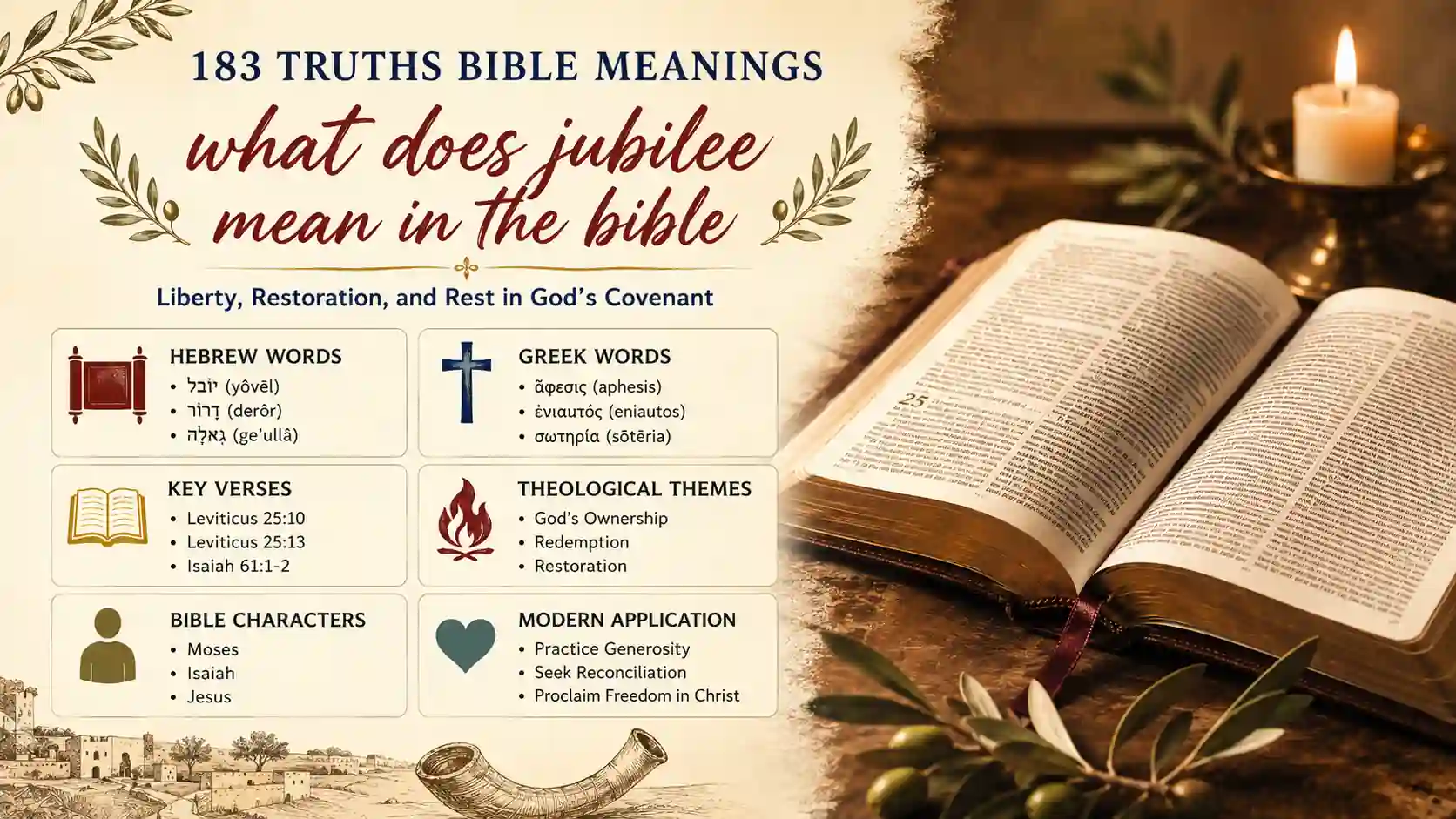
What does jubilee mean in the Bible? Jubilee is God’s appointed season of liberty, restoration, rest, and return. Established in Leviticus 25, it came after seven cycles of seven years and was proclaimed in the fiftieth year with a trumpet blast on the Day of Atonement.
Jubilee protected Israelite families from permanent dispossession, restrained economic oppression, released Israelite servants, and reminded the nation that the land belonged to God. As you follow this theme into Isaiah and Luke, you also see how Jubilee language illuminates the saving mission of Jesus Christ.
Jubilee Key Scripture References
| Verse | Passage Snippet | Context |
|---|---|---|
| Leviticus 25:8 | Seven sabbaths of years | Forty-nine years were counted |
| Leviticus 25:9 | Sound the trumpet | Proclaimed on the Day of Atonement |
| Leviticus 25:10 | Proclaim liberty | The fiftieth year was consecrated |
| Leviticus 25:11-12 | It shall be holy | Sowing and ordinary harvesting ceased |
| Leviticus 25:13 | Return to property | Ancestral holdings were restored |
| Leviticus 25:14-17 | Do not wrong another | Prices reflected remaining harvests |
| Leviticus 25:23-24 | The land is mine | Israel held God’s land as tenants |
| Leviticus 25:39-43 | Serve until Jubilee | Impoverished Israelites received release |
| Leviticus 25:47-55 | Right of redemption | A relative could redeem a servant |
| Isaiah 61:1-2 | Proclaim liberty | Prophetic language anticipates restoration |
Leviticus presents Jubilee as part of Israel’s covenant life in the land, not as an isolated festival. Its laws connect worship, agriculture, family inheritance, economic dealings, and care for the poor.
Jubilee Bible Translation Comparison
| Verse | KJV | NIV | ESV | NASB |
|---|---|---|---|---|
| Leviticus 25:8 | sabbaths of years | sabbath years | weeks of years | Sabbaths of years |
| Leviticus 25:9 | trumpet of the jubile | trumpet sounded | loud trumpet | ram’s horn |
| Leviticus 25:10 | proclaim liberty | proclaim liberty | proclaim liberty | proclaim a release |
| Leviticus 25:10 | unto his possession | family property | his property | his own property |
| Leviticus 25:10 | unto his family | own clan | his clan | his family |
| Leviticus 25:11 | fiftieth year | fiftieth year | fiftieth year | fiftieth year |
| Leviticus 25:12 | holy unto you | holy for you | holy to you | holy to you |
| Leviticus 25:13 | year of jubile | year of Jubilee | year of jubilee | year of jubilee |
| Isaiah 61:1 | liberty to captives | freedom for captives | liberty to captives | freedom to captives |
| Luke 4:18 | preach deliverance | proclaim freedom | proclaim liberty | proclaim release |
The translations agree on the basic institution while differing in wording such as “liberty,” “release,” “freedom,” “property,” and “family property.” In Leviticus 25:9, some emphasize the trumpet’s sound, while the NASB identifies the instrument as a ram’s horn.
Jubilee People and Characters Associated
| Person | Role | Connection |
|---|---|---|
| The Lord | Covenant giver | Declares the land and people his own |
| Moses | Mediator | Receives Jubilee commands at Sinai |
| Israelites | Covenant community | Observe release, return, and rest |
| Priests | Worship leaders | Associate the proclamation with atonement |
| Landholders | Stewards | Return ancestral property |
| Impoverished Israelites | Protected neighbors | Receive support and eventual release |
| Kinsman-redeemer | Family protector | Redeems property or relatives |
| Isaiah | Prophet | Announces liberty and divine favor |
| Zedekiah | King of Judah | Participates in a failed release covenant |
| Jesus | Anointed Messiah | Proclaims fulfillment of Isaiah’s promise |
Jubilee was never only about anonymous economic regulations. It concerned real families, vulnerable workers, landholders, relatives, rulers, and worshipers. Every participant was called to act under God’s ownership and authority.
Jeremiah 34 provides a sobering contrast. King Zedekiah and the people agreed to release Hebrew servants, then reversed their decision. Their failure showed that proclaiming liberty without sustained obedience violated the covenant.
Jubilee Original Hebrew and Greek Words
| Original Word | Transliteration | Strong’s # | Literal Meaning |
|---|---|---|---|
| יוֹבֵל | yôvēl | H3104 | Ram’s horn, Jubilee |
| דְּרוֹר | derôr | H1865 | Liberty, free release |
| גְּאֻלָּה | geʾullâ | H1353 | Redemption, redemption right |
| גָּאַל | gāʾal | H1350 | Redeem as a kinsman |
| שׁוּב | shûv | H7725 | Return, turn back |
| שַׁבָּת | shabbāth | H7676 | Sabbath, cessation |
| כִּפֻּר | kippur | H3725 | Atonement, covering |
| אֲחֻזָּה | ʾăḥuzzâ | H272 | Possession, inherited holding |
| ἄφεσις | aphesis | G859 | Release, forgiveness |
| ἐνιαυτός | eniautos | G1763 | Year, appointed annual period |
The central Hebrew term is יוֹבֵל, yôvēl, Strong’s H3104. It can denote a ram’s horn, the horn blast, or the Jubilee year announced by that sound. The name therefore preserves the connection between the sacred year and its public proclamation.
The word דְּרוֹר, derôr, Strong’s H1865, describes the liberty proclaimed in Leviticus 25:10. In the Greek New Testament, ἄφεσις, aphesis, Strong’s G859, can mean release or forgiveness. This word appears in Luke 4:18 when Jesus announces liberty to captives.
Jubilee Related Biblical Concepts
| Concept | Connection | Supporting Verse |
|---|---|---|
| Sabbath | Jubilee follows seven sabbatical cycles | Leviticus 25:8 |
| Atonement | The trumpet sounds on Atonement Day | Leviticus 25:9 |
| Liberty | Release is publicly proclaimed | Leviticus 25:10 |
| Restoration | Families return to inherited land | Leviticus 25:13 |
| Redemption | Property may be bought back | Leviticus 25:24-28 |
| Kinship | Relatives protect vulnerable family members | Leviticus 25:25 |
| Divine ownership | The land ultimately belongs to God | Leviticus 25:23 |
| Neighbor love | Economic exploitation is forbidden | Leviticus 25:17 |
| Trust | Israel depends on God’s provision | Leviticus 25:20-22 |
| Forgiveness | Release language reaches Luke’s Gospel | Luke 4:18 |
These concepts belong together. Jubilee united sacred time with social responsibility. Israel could not claim to honor God’s Sabbath while permanently exploiting a poor covenant brother or manipulating the price of family land.
The Day of Atonement setting is especially significant. The year of release began in the context of reconciliation with God. Divine mercy received in worship was meant to shape mercy, justice, and restored relationships within the covenant community.
Jubilee Historical and Cultural Context
| Aspect | Detail | Biblical Source |
|---|---|---|
| Timing | Fiftieth year after seven sevens | Leviticus 25:8-10 |
| Calendar date | Tenth day of seventh month | Leviticus 25:9 |
| Announcement | Horn sounded throughout the land | Leviticus 25:9 |
| Agriculture | No regular sowing or reaping | Leviticus 25:11 |
| Food | People ate the field’s natural produce | Leviticus 25:12 |
| Land sales | Prices followed remaining crop years | Leviticus 25:15-16 |
| Rural property | Returned to ancestral families | Leviticus 25:28 |
| Walled houses | Different redemption rules applied | Leviticus 25:29-30 |
| Levitical property | Permanently redeemable | Leviticus 25:32-34 |
| Israelite service | Ended at Jubilee | Leviticus 25:39-43 |
Land in ancient Israel represented more than wealth. It was a covenant inheritance connected to tribe, clan, and family. Selling land because of poverty did not erase God’s original gift, because the buyer was effectively purchasing a limited number of harvests.
This explains why the price rose or fell according to the years remaining until Jubilee. The system restrained permanent accumulation of ancestral land and preserved the possibility that a family damaged by poverty could regain its place.
Jubilee Theological Themes
| Theme | Explanation | Scripture |
|---|---|---|
| God’s ownership | Israel cannot treat the land as absolute property | Leviticus 25:23 |
| Holiness | Jubilee is consecrated to the Lord | Leviticus 25:10-12 |
| Grace | Restoration is built into covenant life | Leviticus 25:13 |
| Justice | Buyers and sellers must not exploit one another | Leviticus 25:14-17 |
| Mercy | The poor must be supported | Leviticus 25:35 |
| Freedom | Israelite servants are not permanent slaves | Leviticus 25:39-43 |
| Redemption | A kinsman may recover what was lost | Leviticus 25:25 |
| Providence | God promises provision during rest | Leviticus 25:20-22 |
| Restoration | Lost inheritance returns to the family | Leviticus 25:28 |
| Messianic hope | Jesus announces release and favor | Luke 4:18-21 |
Jubilee teaches that God’s holiness reaches into contracts, property, labor, food production, and treatment of neighbors. Worship is not separated from economic life. Reverence for God becomes visible when powerful people refuse to exploit those weakened by debt or loss.
It also teaches that poverty must not become a mechanism for permanently erasing a person’s covenant identity. Jubilee does not pretend that hardship never occurs. It places limits on hardship so that loss does not automatically become endless bondage.
Jubilee Modern Application for Believers
| Area | Practice | Scripture |
|---|---|---|
| Money | Refuse dishonest advantage | Leviticus 25:14 |
| Lending | Help without predatory profit | Leviticus 25:35-37 |
| Work | Treat workers with dignity | Leviticus 25:39-43 |
| Possessions | Remember God’s ownership | Leviticus 25:23 |
| Rest | Receive limits as God’s gift | Leviticus 25:11-12 |
| Generosity | Strengthen people in hardship | Leviticus 25:35 |
| Forgiveness | Release personal vengeance | Colossians 3:13 |
| Reconciliation | Seek restored relationships | Matthew 5:23-24 |
| Justice | Defend vulnerable neighbors | Isaiah 1:17 |
| Gospel witness | Proclaim freedom in Christ | Luke 4:18-21 |
Christians are not ancient Israel living under its land-allotment system, so Jubilee should not be transferred mechanically into modern civil law. Yet its moral vision still challenges your use of possessions, power, labor, lending, and influence.
You honor Jubilee’s principles when you treat wealth as stewardship, resist exploitation, help people regain stability, forgive as you have been forgiven, and participate in Christ’s ministry of mercy. Such practices do not earn redemption. They display the transforming fruit of redemption.
יוֹבֵל YôVēL and the Trumpet That Announced Return
The word yôvēl ties the year to the horn that announced it. Jubilee was not meant to remain a private calculation known only by officials. Its arrival was sounded throughout the land so families, laborers, landholders, and the poor could hear that God’s appointed release had come.
The trumpet declared that existing arrangements were not ultimate. Debt, servitude, and loss did not possess unlimited authority over God’s covenant people. At the Lord’s command, land returned, service ended, agricultural striving stopped, and the community entered a holy season of restoration.
What Does Jubilee Mean in the Bible within the Sinai Covenant?
Within the Sinai covenant, Jubilee regulated Israel’s life in the land God promised to give them. Its commands assumed tribal inheritances, Israelite kinship obligations, Levitical towns, covenant servants, sabbatical agriculture, and the Lord’s unique claim over Canaan.
For that reason, Jubilee first means exactly what Leviticus says it means. It was a consecrated fiftieth year involving rest for the land, release for Israelite servants, fair valuation of property, redemption rights, and return to ancestral holdings.
דְּרוֹר DerôR and the Liberty Proclaimed by Isaiah
Isaiah 61 uses Jubilee-shaped language to announce good news to the poor, liberty to captives, comfort for mourners, and the year of the Lord’s favor. The prophet takes the vocabulary of release and places it within a larger promise of national and spiritual restoration.
This does not erase Leviticus. It draws out the theological pattern already present there. The God who commands release from oppressive conditions is also the God who promises to redeem his people from ruin, shame, exile, and the consequences of sin.
Ἄφεσις Aphesis and Jesus’ Jubilee Mission in Luke 4
In Nazareth, Jesus reads Isaiah’s promise and announces, “Today this Scripture has been fulfilled in your hearing.” Luke uses ἄφεσις, aphesis, a word associated with release and also with forgiveness of sins. Jesus presents himself as the Spirit-anointed bearer of God’s saving favor.
His ministry embodies this announcement through forgiveness, healing, deliverance, welcome for outsiders, and good news for the poor. Biblical Jubilee therefore helps you understand Christ’s mission, while Christ reveals the deepest source of true release through his redemptive work.
Jubilee Questions Bible Students Often Ask
Was Jubilee observed every forty-nine years or every fiftieth year?
Leviticus calls it the fiftieth year following seven complete cycles of seven years, though scholars discuss how the counting related to the next sabbatical cycle.
Does יוֹבֵל, yôvēl, mean the festival or the trumpet?
It can refer to the ram’s horn, its blast, or the Jubilee year announced by that blast.
Why does the NASB say “release” where other translations say “liberty”?
Both render דְּרוֹר, derôr, which expresses freedom or release from a binding condition.
Did Jubilee cancel every kind of debt in Israel?
Leviticus 25 emphasizes restored land and released Israelite servants, while Deuteronomy 15 separately addresses the remission of debts in the sabbatical year.
Does Luke 4 teach that Jesus is the fulfillment of Jubilee?
Jesus explicitly fulfills Isaiah’s proclamation of liberty and divine favor, presenting his saving mission in language strongly shaped by Jubilee.