
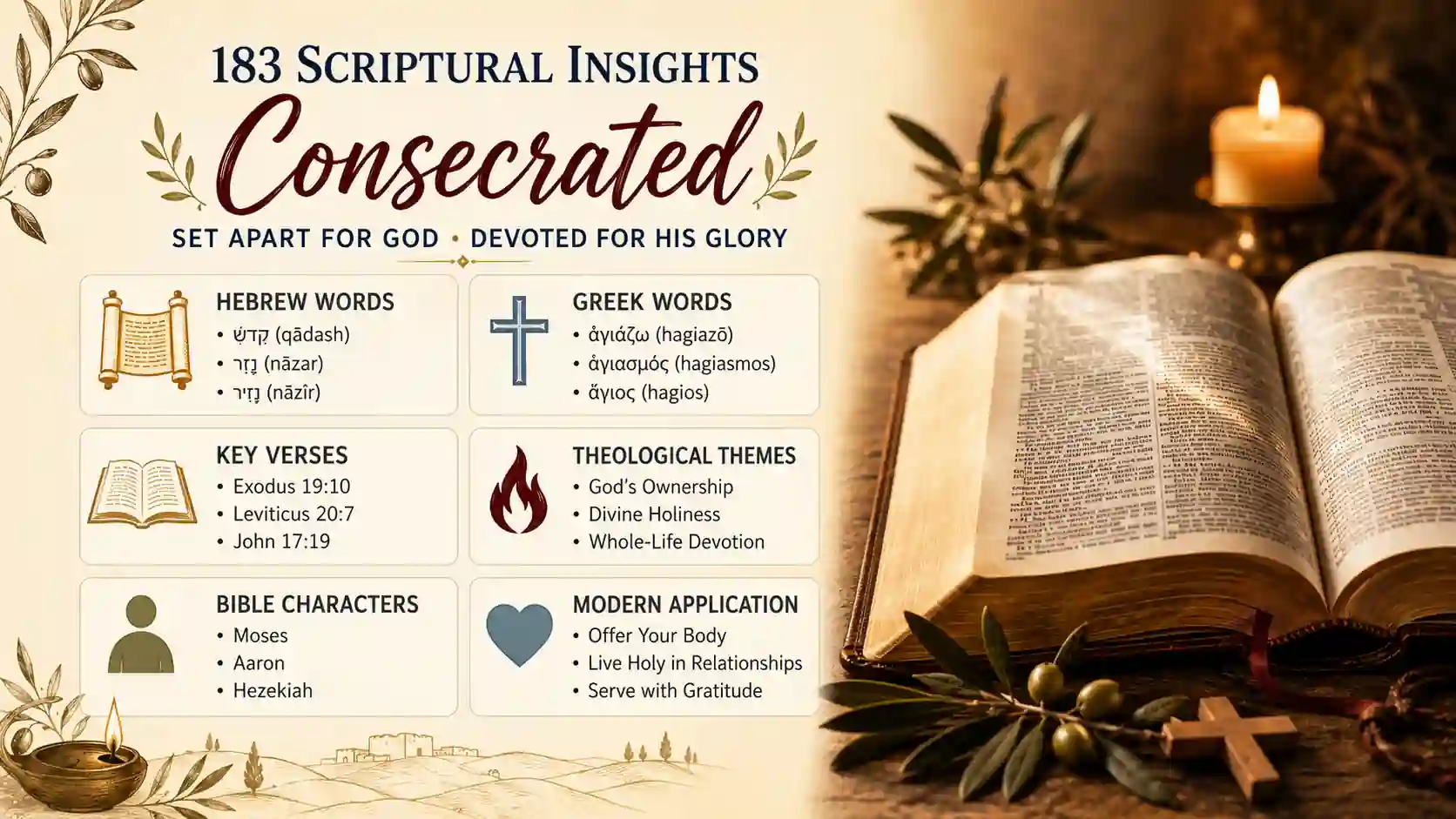
What does consecrated mean in the Bible? To be consecrated is to be set apart from ordinary use and devoted to God’s holy purposes. Scripture applies this idea to people, places, days, objects, offerings, and even the whole covenant community.
Consecration includes cleansing, dedication, worship, and obedient service. Yet it is more than a ceremony. As you follow the theme from Exodus to the New Testament, you discover that God consecrates his people by grace, then calls them to live in a manner consistent with their sacred identity.
Key Consecrated Scripture References
| Verse | Passage Snippet | Context |
|---|---|---|
| Exodus 13:2 | “Consecrate to me every firstborn” | Israel’s firstborn belonged uniquely to God |
| Exodus 19:10 | “Consecrate them today and tomorrow” | Israel prepared to meet God at Sinai |
| Exodus 28:41 | “Consecrate them” | Aaron and his sons entered priestly service |
| Exodus 29:37 | “Consecrate it” | The altar became most holy |
| Leviticus 20:7 | “Consecrate yourselves” | Israel was commanded to pursue holiness |
| Joshua 3:5 | “Consecrate yourselves” | Israel prepared to cross the Jordan |
| 1 Samuel 16:5 | “Consecrate yourselves” | Samuel prepared worshipers for sacrifice |
| 2 Chronicles 29:5 | “Consecrate yourselves” | Hezekiah restored temple worship |
| John 17:19 | “I consecrate myself” | Jesus devoted himself to his saving mission |
| Hebrews 10:10 | “Sanctified through the offering” | Christ’s sacrifice sets believers apart |
Consecrated Bible Translation Comparison
| Verse | KJV | NIV | ESV | NASB |
|---|---|---|---|---|
| Exodus 13:2 | “Sanctify unto me” | “Consecrate to me” | “Consecrate to me” | “Sanctify to Me” |
| Exodus 19:10 | “Sanctify them” | “Consecrate them” | “Consecrate them” | “Consecrate them” |
| Exodus 28:41 | “Consecrate them” | “Consecrate them” | “Consecrate them” | “Consecrate them” |
| Leviticus 20:7 | “Sanctify yourselves” | “Consecrate yourselves” | “Consecrate yourselves” | “Consecrate yourselves” |
| Joshua 3:5 | “Sanctify yourselves” | “Consecrate yourselves” | “Consecrate yourselves” | “Consecrate yourselves” |
| 1 Chronicles 15:12 | “Sanctify yourselves” | “Consecrate yourselves” | “Consecrate yourselves” | “Consecrate yourselves” |
| 2 Chronicles 29:5 | “Sanctify now yourselves” | “Consecrate yourselves” | “Consecrate yourselves” | “Consecrate yourselves” |
| John 17:19 | “I sanctify myself” | “I sanctify myself” | “I consecrate myself” | “I sanctify Myself” |
People and Characters Associated with Consecrated Service
| Person | Role | Connection |
|---|---|---|
| Moses | Covenant mediator | Consecrated Aaron, his sons, and the tabernacle |
| Aaron | High priest | Set apart for priestly ministry |
| Aaron’s sons | Priests | Washed, clothed, anointed, and ordained |
| Israel’s firstborn | Belonging to God | Consecrated after the exodus from Egypt |
| Joshua | Israel’s leader | Called the nation to consecrate itself |
| Samuel | Prophet and priest | Consecrated worshipers before sacrifice |
| David | King | Organized consecrated Levites for worship |
| Hezekiah | Reforming king | Reopened and purified the temple |
| Jesus Christ | Son and High Priest | Consecrated himself for his disciples |
| Paul | Apostle | Urged believers to offer themselves to God |
Original Hebrew and Greek Words for Consecrated
| Original Word | Transliteration | Strong’s # | Literal Meaning |
|---|---|---|---|
| קָדַשׁ | qādash | H6942 | To set apart as holy |
| קֹדֶשׁ | qōdesh | H6944 | Holiness or sacredness |
| קָדוֹשׁ | qādôsh | H6918 | Holy or sacred |
| מִקְדָּשׁ | miqdāsh | H4720 | Holy place or sanctuary |
| נָזַר | nāzar | H5144 | To separate or dedicate |
| נָזִיר | nāzîr | H5139 | Consecrated or separated person |
| חָנַךְ | ḥānak | H2596 | To dedicate or initiate |
| ἁγιάζω | hagiazō | G37 | To sanctify or consecrate |
| ἁγιασμός | hagiasmos | G38 | Sanctification or holiness |
| ἅγιος | hagios | G40 | Holy or set apart |
The primary Old Testament verb is קָדַשׁ, qādash, Strong’s H6942. It can describe being holy, declaring something holy, or setting someone apart for sacred use. The central New Testament verb is ἁγιάζω, hagiazō, Strong’s G37, meaning to make holy, sanctify, dedicate, or separate for God.
Related Consecrated Biblical Concepts
| Concept | Connection | Supporting Verse |
|---|---|---|
| Holiness | Consecration places someone within God’s holy sphere | Leviticus 20:7 |
| Sanctification | God sets believers apart and transforms them | 1 Thessalonians 5:23 |
| Dedication | A person or object is assigned to God’s service | Numbers 7:1 |
| Cleansing | Impurity is removed before sacred service | Exodus 19:10 |
| Anointing | Oil visibly marked priests and objects as holy | Exodus 30:30 |
| Sacrifice | Consecration often accompanied an offering | Exodus 29:1 |
| Covenant | A consecrated people belong to the covenant Lord | Exodus 19:5–6 |
| Priesthood | Priests were separated for ministry before God | Exodus 28:41 |
| Obedience | Consecrated identity requires holy conduct | Leviticus 20:8 |
| Worship | Sacred devotion directs life toward God | Romans 12:1 |
Historical and Cultural Context of Consecrated Things
| Aspect | Detail | Biblical Source |
|---|---|---|
| Priestly washing | Priests washed before entering sacred service | Exodus 29:4 |
| Sacred clothing | Priestly garments displayed dignity and holiness | Exodus 28:2–3 |
| Anointing oil | Oil marked people and furnishings as God’s possession | Exodus 30:26–30 |
| Ordination offerings | Sacrifices accompanied priestly consecration | Exodus 29:1–37 |
| Seven-day rite | Priestly installation continued for seven days | Leviticus 8:33 |
| Altar holiness | The consecrated altar was reserved for worship | Exodus 29:37 |
| Firstborn devotion | Firstborn males commemorated deliverance from Egypt | Exodus 13:2 |
| Sinai preparation | Washing and boundaries prepared Israel for God’s presence | Exodus 19:10–15 |
| Nazirite vow | Voluntary separation involved visible restrictions | Numbers 6:1–8 |
| Temple reform | Cleansing restored worship after national unfaithfulness | 2 Chronicles 29:15–19 |
Theological Themes of Consecrated Life
| Theme | Explanation | Scripture |
|---|---|---|
| God’s ownership | What is consecrated belongs especially to God | Exodus 13:2 |
| Divine holiness | Consecration reflects God’s holy character | Leviticus 11:44 |
| Grace before duty | God redeemed Israel before commanding holiness | Exodus 19:4–6 |
| Sacred presence | Preparation is required where God reveals his glory | Exodus 19:10–12 |
| Mediated worship | Priests served through God-appointed ceremonies | Leviticus 8:1–36 |
| Whole-life devotion | Believers present their bodies to God | Romans 12:1 |
| Christ’s mission | Jesus devoted himself to his sacrificial work | John 17:19 |
| Spiritual cleansing | Christ sanctifies his people through his blood | Hebrews 13:12 |
| Covenant identity | God forms a holy people for his possession | 1 Peter 2:9 |
| Future completion | God will preserve believers wholly and blamelessly | 1 Thessalonians 5:23 |
Modern Application of Consecrated Living for Believers
| Area | Practice | Scripture |
|---|---|---|
| Body | Use your physical life for God’s honor | Romans 12:1 |
| Mind | Let Scripture renew your thinking | Romans 12:2 |
| Speech | Speak in ways that give grace | Ephesians 4:29 |
| Work | Serve sincerely as working for the Lord | Colossians 3:23 |
| Relationships | Pursue purity, patience, and forgiveness | Colossians 3:12–14 |
| Possessions | Treat resources as entrusted by God | 1 Timothy 6:17–19 |
| Time | Use your days wisely for faithful service | Ephesians 5:15–16 |
| Worship | Approach God with reverence and gratitude | Hebrews 12:28 |
| Church service | Use spiritual gifts for the common good | 1 Peter 4:10 |
| Moral choices | Flee impurity and pursue holiness | 2 Timothy 2:21–22 |
QāDash and the Old Testament Meaning of Sacred Separation
The Hebrew verb קָדַשׁ, qādash, does not merely mean that something becomes religious or respectable. It indicates movement from common use into a special relationship with the holy God. A consecrated altar was no longer ordinary furniture, and a consecrated priest no longer lived solely for private concerns.
This separation did not always imply moral transformation. An object could be consecrated without possessing character. When people were consecrated, however, their sacred status carried moral responsibility. Those who drew near to God were expected to honor his holiness through reverence, purity, and obedience.
What Does Consecrated Mean in the Bible at Sinai and the Tabernacle?
At Sinai, God told Moses to consecrate the people before the Lord descended upon the mountain. They washed their garments, observed boundaries, and prepared themselves for the encounter. These actions taught Israel that God’s presence is gracious, yet never casual.
The tabernacle developed this lesson through priests, sacrifices, washings, anointing oil, sacred garments, and holy furnishings. Each ceremony showed that sinful human beings cannot appoint themselves to divine service. God establishes the way his people approach him, and he defines what holiness requires.
Jesus, Hagiazō, and Consecration Through the New Covenant
In John 17:19, Jesus says, “For their sake I consecrate myself,” translating ἁγιάζω, hagiazō. Jesus was already morally perfect, so he was not speaking of cleansing himself from sin. He was declaring his complete dedication to the saving mission that would lead to the cross.
His consecration becomes the foundation of yours. Hebrews teaches that believers are sanctified through Christ’s once-for-all offering. You do not earn acceptance by making yourself holy enough for God. You are set apart through Christ, then called to express that identity through faithful living.
Consecration as Grace-Filled, Whole-Life Worship
Romans 12:1 captures the personal shape of consecration under the new covenant. Because of God’s mercies, you present your body as a living sacrifice. Christian devotion is therefore not limited to a sanctuary, ceremony, ministry title, or emotional moment.
Your work, habits, relationships, money, sexuality, speech, and private thoughts all come under Christ’s lordship. Consecration does not require withdrawing from every ordinary responsibility. It means carrying out ordinary responsibilities as someone who belongs wholly to God.
Frequently Asked Questions About Consecrated
Does קָדַשׁ, qādash, always refer to moral purity?
No. It can describe sacred status or separation, though consecrated people are also called to moral holiness.
Why does the KJV sometimes say “sanctify” where modern translations say “consecrate”?
Both words can translate qādash or hagiazō, but “consecrate” often emphasizes dedication while “sanctify” emphasizes holiness.
Why did Jesus consecrate himself in John 17:19 if he was already sinless?
Jesus was dedicating himself to his sacrificial mission, not cleansing himself from personal impurity.
Can a believer consecrate himself or herself to God?
Yes, but your dedication responds to God’s prior grace and sanctifying work rather than creating your own acceptance.
What does a consecrated life look like outside church activities?
It means offering every area of life to God through obedient, holy, grateful, and loving service.