
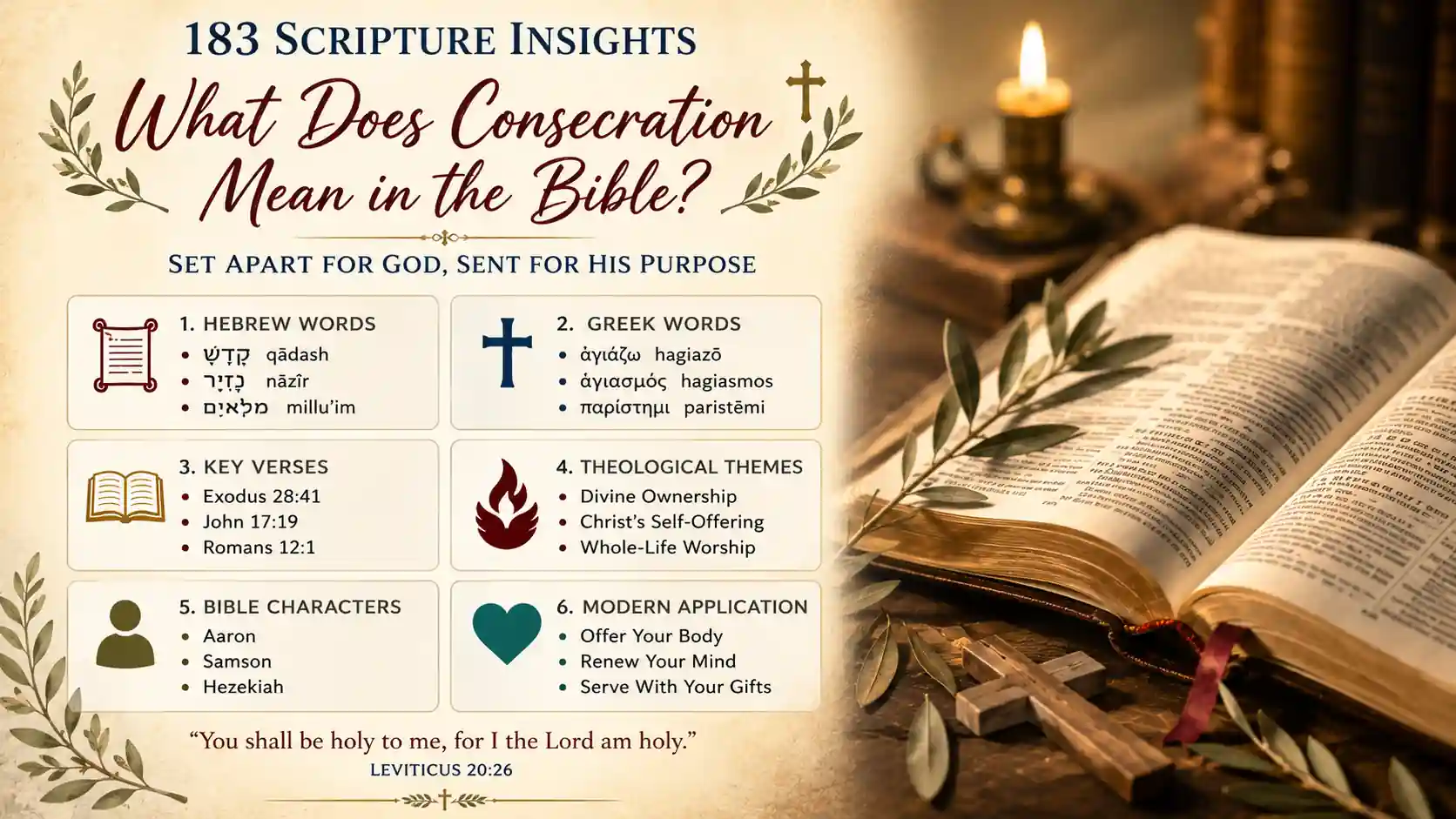
What does consecration mean in the Bible? Consecration is the act of setting a person, place, object, or entire life apart for God’s holy purposes. It involves belonging to God, being prepared for His service, and refusing uses that conflict with His character.
Scripture presents consecration through priestly ordination, covenant worship, dedicated offerings, Nazirite vows, Christ’s self-offering, and the believer’s daily surrender. As you study these passages, you discover that biblical consecration is not merely an emotional promise. It is a God-centered reordering of identity, worship, conduct, and calling.
Consecration Key Scripture References
| Verse | Passage Snippet | Context |
|---|---|---|
| Exodus 19:10 | “Consecrate them today” | Israel prepares to meet God at Sinai |
| Exodus 28:41 | “Consecrate them” | Aaron and his sons enter priestly service |
| Exodus 29:9 | “Consecrate Aaron and his sons” | Priestly ordination under the Mosaic covenant |
| Leviticus 8:33 | “Until your consecration is ended” | Seven-day priestly ordination ceremony |
| Numbers 6:5 | “Consecration to God” | The Nazirite remains specially devoted |
| Joshua 3:5 | “Consecrate yourselves” | Israel prepares for God’s wonders |
| 2 Chronicles 29:5 | “Consecrate yourselves” | Hezekiah restores temple worship |
| John 17:19 | “I sanctify myself” | Jesus sets Himself apart for sacrificial mission |
| Romans 12:1 | “Present your bodies” | Believers offer their whole lives to God |
| 2 Timothy 2:21 | “Set apart as holy” | A cleansed servant becomes useful to the Master |
Consecration Bible Translation Comparison
| Verse | KJV | NIV | ESV | NASB |
|---|---|---|---|---|
| Exodus 19:10 | “sanctify them” | “consecrate them” | “consecrate them” | “consecrate them” |
| Exodus 28:41 | “consecrate them” | “ordain them” | “consecrate them” | “consecrate them” |
| Leviticus 8:33 | “days of your consecration” | “days of your ordination” | “days of your ordination” | “days of your ordination” |
| Numbers 6:5 | “vow of his separation” | “period of their dedication” | “time of his separation” | “period of his dedication” |
| Joshua 3:5 | “Sanctify yourselves” | “Consecrate yourselves” | “Consecrate yourselves” | “Consecrate yourselves” |
| 2 Chronicles 29:5 | “Sanctify now yourselves” | “Consecrate yourselves now” | “Consecrate yourselves” | “Consecrate yourselves now” |
| John 17:19 | “I sanctify myself” | “I sanctify myself” | “I consecrate myself” | “I sanctify Myself” |
| Romans 12:1 | “present your bodies” | “offer your bodies” | “present your bodies” | “present your bodies” |
| Hebrews 7:28 | “consecrated for evermore” | “made perfect forever” | “made perfect forever” | “made perfect forever” |
| 2 Timothy 2:21 | “sanctified” | “made holy” | “set apart as holy” | “sanctified” |
Consecration People and Characters Associated
| Person | Role | Connection |
|---|---|---|
| Aaron | Israel’s first high priest | Consecrated through washing, clothing, anointing, and sacrifice |
| Aaron’s sons | Priests | Ordained to serve at the altar and sanctuary |
| Moses | Covenant mediator | Conducted Israel’s priestly consecration rites |
| Samson | Nazirite judge | Consecrated to God from his mother’s womb |
| Samuel | Prophet and judge | Dedicated by Hannah for lifelong sanctuary service |
| David | King of Israel | Dedicated resources for the future temple |
| Hezekiah | Reforming king | Called priests and Levites back to consecrated service |
| Josiah | Covenant-renewing king | Restored worship and removed defilement |
| Jesus Christ | High Priest and sacrifice | Consecrated Himself to accomplish redemption |
| Paul | Apostle | Urged believers to present themselves wholly to God |
Consecration Original Hebrew and Greek Words
| Original Word | Transliteration | Strong’s # | Literal Meaning |
|---|---|---|---|
| קָדַשׁ | qādash | H6942 | To make holy or set apart |
| קֹדֶשׁ | qōdesh | H6944 | Holiness or sacredness |
| מִלֻּאִים | millu’im | H4394 | Fillings, installation, ordination |
| נָזִיר | nāzîr | H5139 | Consecrated or separated person |
| נֵזֶר | nēzer | H5145 | Consecration, crown, sign of dedication |
| חֵרֶם | ḥērem | H2764 | Something irrevocably devoted |
| ἁγιάζω | hagiazō | G37 | To sanctify or set apart |
| ἁγιασμός | hagiasmos | G38 | Holiness or sanctification |
| παρίστημι | paristēmi | G3936 | To present or place at another’s disposal |
| τελειόω | teleioō | G5048 | To complete, perfect, or qualify fully |
Consecration Related Biblical Concepts
| Concept | Connection | Supporting Verse |
|---|---|---|
| Holiness | Consecration separates someone for the holy God | Leviticus 20:7 |
| Sanctification | God progressively shapes a consecrated life | 1 Thessalonians 4:3 |
| Dedication | People and possessions may be assigned to God | 1 Samuel 1:28 |
| Sacrifice | Consecration often involves costly surrender | Romans 12:1 |
| Covenant | God claims a people as His treasured possession | Exodus 19:5–6 |
| Priesthood | Priests are set apart for worship and mediation | Exodus 29:1 |
| Cleansing | Defilement must be removed before sacred service | 2 Chronicles 29:15 |
| Obedience | Dedication is demonstrated through faithful conduct | 1 Samuel 15:22 |
| Anointing | Oil signifies divine appointment and empowerment | Leviticus 8:12 |
| Worship | A consecrated life responds to God’s worth | Hebrews 13:15–16 |
Consecration Historical and Cultural Context
| Aspect | Detail | Biblical Source |
|---|---|---|
| Sinai preparation | Washing and boundaries emphasized God’s holiness | Exodus 19:10–15 |
| Priestly washing | Aaron and his sons were washed before ministry | Exodus 29:4 |
| Sacred garments | Priestly clothing displayed honor and holy office | Exodus 28:2–3 |
| Anointing oil | Special oil marked priests and sanctuary objects | Exodus 30:22–33 |
| Ordination offerings | Bulls and rams accompanied priestly installation | Exodus 29:1–37 |
| Filled hands | Priests received offerings into their hands | Leviticus 8:27–28 |
| Seven-day rite | Priestly consecration required a complete period | Leviticus 8:33–35 |
| Nazirite signs | Uncut hair visibly represented special devotion | Numbers 6:5 |
| Temple cleansing | Reform included removing impurities from worship | 2 Chronicles 29:15–19 |
| New covenant worship | The believer’s body becomes a living sacrifice | Romans 12:1–2 |
Consecration Theological Themes
| Theme | Explanation | Scripture |
|---|---|---|
| Divine ownership | What is consecrated belongs especially to God | Leviticus 27:28 |
| God’s holiness | Consecration reflects the character of the One served | Leviticus 19:2 |
| Gracious calling | God sets apart before assigning holy work | Jeremiah 1:5 |
| Cleansing from sin | Useful service requires removal of moral defilement | 2 Timothy 2:21 |
| Whole-life worship | Worship includes the body, mind, and daily conduct | Romans 12:1–2 |
| Priestly mediation | Old covenant priests anticipated Christ’s ministry | Hebrews 7:26–28 |
| Christ’s self-offering | Jesus devoted Himself fully to the Father’s will | John 17:19 |
| Union with Christ | Believers are sanctified through Christ’s offering | Hebrews 10:10 |
| Spirit-formed holiness | The Spirit produces obedience in God’s people | 1 Peter 1:2 |
| Mission | God sets people apart to proclaim His excellencies | 1 Peter 2:9 |
Consecration Modern Application for Believers
| Area | Practice | Scripture |
|---|---|---|
| Body | Honor God in physical habits and sexuality | 1 Corinthians 6:19–20 |
| Mind | Reject worldly patterns and pursue renewal | Romans 12:2 |
| Time | Use each opportunity wisely for God’s purposes | Ephesians 5:15–16 |
| Work | Serve sincerely as working for the Lord | Colossians 3:23 |
| Money | Give willingly and manage resources faithfully | 2 Corinthians 9:7 |
| Speech | Use words that give grace and build others | Ephesians 4:29 |
| Relationships | Practice love, purity, forgiveness, and truth | Colossians 3:12–14 |
| Spiritual gifts | Employ each gift in service to others | 1 Peter 4:10 |
| Suffering | Entrust yourself to God while continuing good | 1 Peter 4:19 |
| Witness | Live visibly as part of God’s holy people | 1 Peter 2:9–12 |
QāDash and the Old Testament Pattern of Holy Separation
The central Hebrew verb for consecration is קָדַשׁ, qādash, meaning to be holy, to declare holy, or to set apart. Its basic idea is not withdrawal for its own sake. Something consecrated is separated from ordinary use because it now belongs to God and serves His purpose.
At Sinai, Israel had to consecrate itself before approaching the mountain. The washing of garments and the boundaries around Sinai taught that sinful people could not treat God’s presence casually. Consecration prepared them to hear the covenant words of the holy King who had redeemed them from Egypt.
The same root describes priests, altars, vessels, days, offerings, and the nation itself. These were not automatically morally perfect. They were assigned a sacred status and therefore had to be treated according to God’s commands. Their new ownership determined their proper use.
This pattern helps you distinguish biblical consecration from self-improvement. Consecration begins with God’s claim, not your ambition. You are set apart from sin because you are set apart to God. Separation without devotion becomes mere isolation, while devotion without obedience becomes sentimentality.
Millu’Im and Priestly Consecration Under the Mosaic Covenant
The Hebrew noun מִלֻּאִים, millu’im, is associated with the ordination of Aaron and his sons. It comes from the idea of filling, especially filling the priests’ hands with portions of the offerings. A priest’s filled hands symbolized authorization and readiness to serve before the Lord.
Exodus 29 and Leviticus 8 describe washing, sacred clothing, anointing, sacrifices, applied blood, and a seven-day installation period. Blood was placed on the right ear, thumb, and big toe of the priests. This symbolically claimed their hearing, work, and walk for God’s service.
Priestly consecration was both a privilege and a weighty responsibility. Nadab and Abihu later demonstrated that appointment to holy office did not permit self-designed worship. Their unauthorized fire showed that consecrated servants must approach God as He commands, not according to personal preference.
These ceremonies pointed beyond Aaron to Jesus Christ. Unlike Israel’s priests, Christ is sinless and permanent. Hebrews 7:28 describes the Son as τετελειωμένον, teteleiōmenon, the perfect participle of τελειόω, teleioō. He is fully qualified and perfected forever as the new covenant High Priest.
What Does Consecration Mean in the Bible Through Christ’S Self-Offering?
In John 17:19, Jesus says, “For their sake I sanctify myself.” The verb is ἁγιάζω, hagiazō. Jesus did not need cleansing from sin. He set Himself apart to complete the mission given by His Father, especially His obedient death, resurrection, and priestly work for His people.
Christ’s consecration is unique because He is both priest and offering. Old covenant priests presented sacrifices that could not finally remove sin. Jesus offered Himself once for all. Through that offering, believers are sanctified and granted confident access to God.
This keeps Christian consecration rooted in grace. You do not offer yourself in order to earn acceptance. You offer yourself because Christ has already reconciled you to God. Romans 12 begins its appeal with “the mercies of God,” placing surrender after the proclamation of saving grace.
Your consecration is therefore responsive rather than redemptive. Christ alone atones for sin. Your living sacrifice is grateful worship, expressed through renewed thinking, humble service, sincere love, patient endurance, hospitality, generosity, and refusal to repay evil with evil.
Living Sacrifices and the Daily Shape of Consecrated Faith
Romans 12:1 uses the verb παρίστημι, paristēmi, which means to present, place beside, or put at someone’s disposal. Paul calls you to present your body as a living, holy, acceptable sacrifice. The language recalls the altar while transforming the image into lifelong obedience.
A dead offering was placed on the altar once. A living sacrifice continues choosing surrender. Consecration includes what you watch, how you speak, how you work, how you treat your body, how you use money, and how you respond when obedience becomes costly.
Second Timothy 2:21 adds the image of a household vessel cleansed from dishonorable use. Such a person is sanctified, useful to the Master, and prepared for every good work. Consecration involves turning away from corrupt desires while pursuing righteousness, faith, love, and peace.
You should not confuse consecration with instant spiritual maturity. God’s claim upon you is decisive, yet your growth in holiness continues throughout life. Daily consecration means repeatedly bringing every area under the lordship of Christ, depending on the Holy Spirit rather than human resolve alone.
Questions About Biblical Consecration
Are qādash and hagiazō exact equivalents?
They strongly overlap in meaning, since both describe making holy or setting apart, though each word gains nuance from its Hebrew or Greek context.
Why does the KJV say “sanctify” where newer translations say “consecrate”?
The translations represent the same underlying idea, but “consecrate” often emphasizes dedication while “sanctify” emphasizes holiness.
Does John 17:19 mean that Jesus needed to become morally holy?
No. The sinless Jesus set Himself apart for His saving mission so that His people would be sanctified in truth.
Why is Hebrews 7:28 translated “consecrated” in the KJV but “made perfect” elsewhere?
The Greek τελειόω, teleioō, means to bring to completion or full qualification, which in context describes Christ’s perfected priestly status.
How can you practice consecration without becoming legalistic?
Begin with God’s mercy in Christ, depend on the Spirit, and treat obedience as grateful worship rather than a way to earn salvation.