
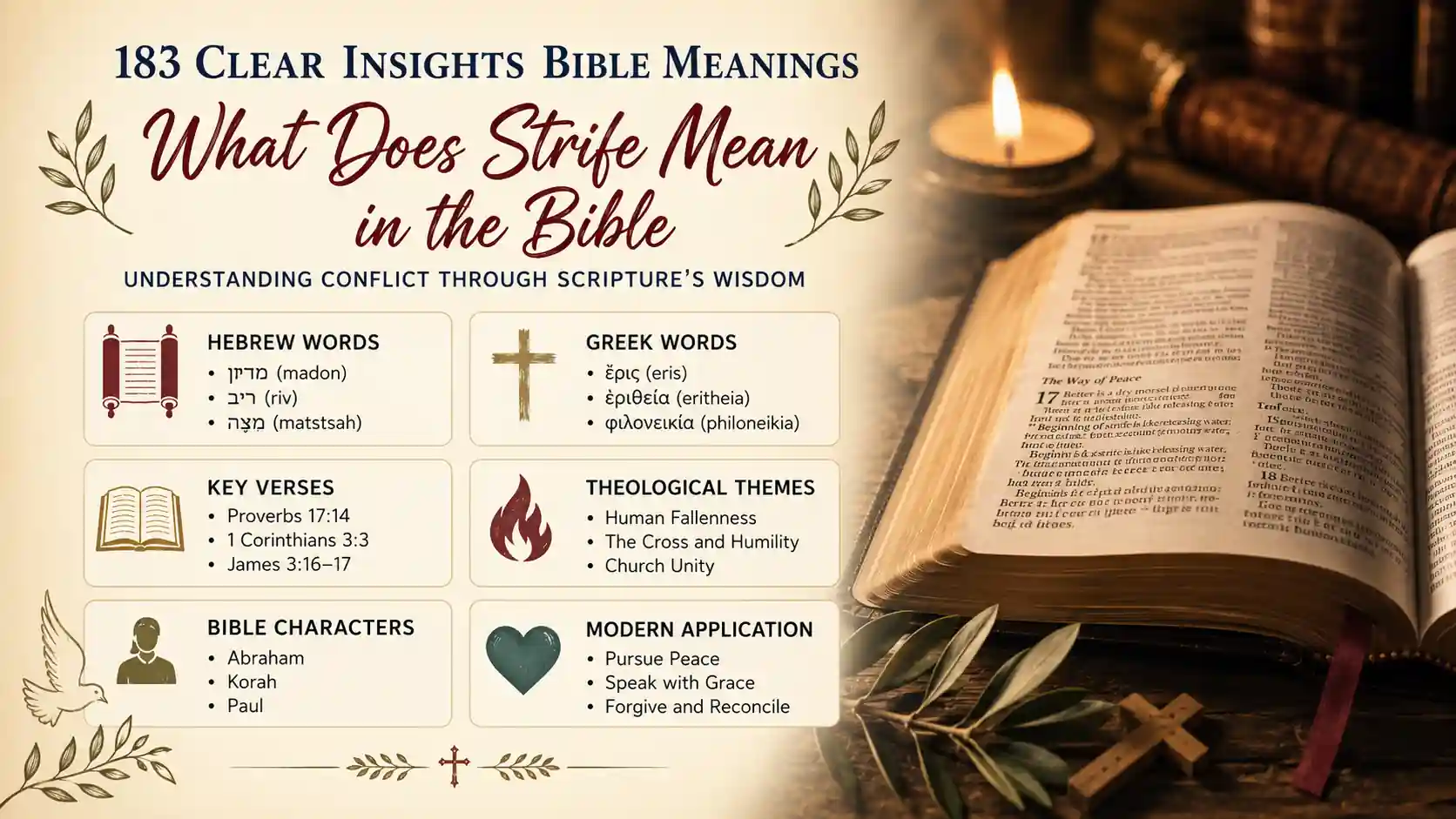
What does strife mean in the Bible? Scripture presents strife as more than an ordinary disagreement. It is conflict intensified by pride, rivalry, selfish ambition, anger, or an unwillingness to pursue peace. Biblical writers use several Hebrew and Greek words to describe quarrels, disputes, factions, and hostile competition.
Your study will show that God does not forbid every disagreement. Faithful believers may address error and defend truth. Yet Scripture consistently condemns the contentious spirit that damages relationships, divides God’s people, and places personal victory above love, wisdom, and righteousness.
Key Strife Scripture References
| Verse | Passage Snippet | Context |
|---|---|---|
| Proverbs 10:12 | Hatred stirs up strife | Love covers offenses |
| Proverbs 13:10 | Pride produces contention | Wisdom receives counsel |
| Proverbs 15:18 | Anger stirs up conflict | Patience calms disputes |
| Proverbs 17:14 | Strife resembles released water | Stop before escalation |
| Proverbs 20:3 | Avoiding strife brings honor | Fools insist on quarreling |
| Proverbs 26:21 | Contentious people kindle strife | Conflict needs fuel |
| Romans 13:13 | Reject strife and jealousy | Live honorably in Christ |
| 1 Corinthians 3:3 | Jealousy and strife reveal carnality | Corinthian church divisions |
| Philippians 2:3 | Do nothing through strife | Practice humility |
| James 3:16 | Selfish ambition brings disorder | Contrast with heavenly wisdom |
Strife in Bible Translation Comparison
| Verse | KJV | NIV | ESV | NASB |
|---|---|---|---|---|
| Proverbs 10:12 | stirreth up strifes | stirs up conflict | stirs up strife | stirs up strife |
| Proverbs 13:10 | Only by pride cometh contention | pride breeds quarrels | insolence comes strife | presumption comes strife |
| Proverbs 15:18 | stirreth up strife | stirs up conflict | stirs up strife | stirs up strife |
| Proverbs 17:14 | beginning of strife | starting a quarrel | beginning of strife | beginning of strife |
| Proverbs 20:3 | cease from strife | avoid strife | keep aloof from strife | keep away from strife |
| Romans 13:13 | strife and envying | dissension and jealousy | quarreling and jealousy | strife and jealousy |
| 1 Corinthians 3:3 | envying, strife, divisions | jealousy and quarreling | jealousy and strife | jealousy and strife |
| Philippians 2:3 | through strife | selfish ambition | selfish ambition | selfishness |
| James 3:16 | strife is | selfish ambition | selfish ambition | selfish ambition |
Translation differences often reflect the range of the underlying words. “Strife,” “quarreling,” “contention,” “dissension,” and “selfish ambition” may describe related expressions of rivalry rather than completely different sins.
People and Characters Associated with Strife
| Person | Role | Connection |
|---|---|---|
| Abraham | Patriarch | Prevented conflict with Lot |
| Lot | Abraham’s nephew | Separated peacefully over land |
| Isaac | Covenant heir | Withdrew from well disputes |
| Korah | Levitical leader | Stirred rebellion against Moses |
| Saul | King of Israel | Jealousy drove hostility toward David |
| David | Future king | Refused personal vengeance |
| Paul | Apostle | Corrected factions in churches |
| Barnabas | Missionary | Sharp disagreement with Paul |
| Euodia | Philippian believer | Urged to agree in the Lord |
| Syntyche | Philippian believer | Needed help toward reconciliation |
Abraham’s response to the herdsmen’s dispute is especially instructive. He valued family peace above first choice of territory. Isaac likewise refused to turn arguments over wells into prolonged warfare, showing that yielding personal advantage can sometimes preserve a greater good.
Paul and Barnabas demonstrate that mature servants of God can experience serious disagreement. Acts 15 does not conceal their sharp dispute, yet neither man abandoned the gospel. Their example warns you against romanticizing Christian relationships while also showing that God can continue working through imperfect people.
Original Hebrew and Greek Words for Strife
| Original Word | Transliteration | Strong’s # | Literal Meaning |
|---|---|---|---|
| מָדוֹן | madon | H4066 | contention, quarrel |
| רִיב | riv | H7379 | dispute, legal controversy |
| מַצָּה | matstsah | H4683 | strife, heated contention |
| מְרִיבָה | merivah | H4808 | quarrel, dispute |
| ἔρις | eris | G2054 | strife, wrangling |
| ἐριθεία | eritheia | G2052 | selfish ambition, faction |
| μάχη | machē | G3163 | fight, battle, quarrel |
| φιλονεικία | philoneikia | G5379 | love of contention |
| λογομαχία | logomachia | G3055 | battle about words |
| ζήτησις | zētēsis | G2214 | debate, controversy |
The Greek noun ἔρις, eris, describes quarrelsome contention or wrangling. The King James Version renders it with terms including “strife,” “debate,” “contention,” and “variance.”
The related noun ἐριθεία, eritheia, emphasizes selfish ambition and factional behavior. This explains why Philippians 2:3 may read “strife” in the KJV but “selfish ambition” in several modern translations. The issue is not merely noisy arguing. It is self-seeking rivalry that threatens Christian unity.
Related Biblical Concepts Connected with Strife
| Concept | Connection | Supporting Verse |
|---|---|---|
| Pride | Makes correction difficult | Proverbs 13:10 |
| Hatred | Keeps offenses active | Proverbs 10:12 |
| Anger | Provokes fresh disputes | Proverbs 15:18 |
| Jealousy | Resents another’s position | 1 Corinthians 3:3 |
| Selfish ambition | Seeks personal advancement | Philippians 2:3 |
| Gossip | Supplies fuel for conflict | Proverbs 26:20 |
| Foolish speech | Multiplies arguments | Proverbs 18:6 |
| Partiality | Creates factions | James 2:4 |
| Humility | Removes rivalry | Philippians 2:3 |
| Peacemaking | Reflects heavenly wisdom | James 3:17–18 |
Strife rarely stands alone. Proverbs connects it with hatred, pride, anger, meddling, and combustible speech. The New Testament joins it to jealousy, worldly thinking, and selfish ambition. These connections help you examine the motives beneath a disagreement rather than judging only its visible intensity.
Peace is also more than the absence of argument. Biblical peace grows from humility, truthfulness, mercy, patience, and submission to God’s wisdom. A silent relationship may still contain bitterness, while an honest but gracious conversation may become an instrument of genuine peace.
Historical and Cultural Context of Strife
| Aspect | Detail | Biblical Source |
|---|---|---|
| Scarce pasture | Herds competed for grazing land | Genesis 13:5–9 |
| Water rights | Wells could determine survival | Genesis 26:19–22 |
| Tribal identity | Rival loyalties threatened unity | Judges 12:1–6 |
| Royal succession | Power struggles caused bloodshed | 2 Samuel 3 |
| Honor culture | Insults could provoke retaliation | 1 Samuel 25 |
| Wisdom instruction | Proverbs trained covenant households | Proverbs 17:14 |
| Patronage | Status competition affected churches | 1 Corinthians 1:10–12 |
| Banquet rank | Guests competed for honor | Luke 14:7–11 |
| Traveling teachers | False teaching produced disputes | 1 Timothy 6:3–5 |
| House churches | Social differences tested fellowship | James 2:1–4 |
Many biblical disputes arose where essential resources were limited. Pasture, wells, inheritance, political authority, and social honor could determine a family’s future. Strife was therefore not always a minor personality clash. It could threaten survival, kinship, and covenant stability.
The early churches met in households and brought together people from different social, ethnic, and economic backgrounds. Competition for status could easily enter Christian fellowship. Paul repeatedly redirected believers toward the cross, where boasting in human leaders, wisdom, or rank loses its legitimacy.
Theological Themes within Biblical Strife
| Theme | Explanation | Scripture |
|---|---|---|
| Human fallenness | Sin fractures fellowship | Genesis 4:3–8 |
| Covenant community | God calls His people to unity | Psalm 133:1 |
| Wisdom and folly | Fools delight in quarrels | Proverbs 20:3 |
| Flesh and Spirit | Strife belongs to fallen desires | Galatians 5:19–23 |
| The cross | Christ overturns selfish ambition | Philippians 2:5–8 |
| Church unity | Believers share one Lord | Ephesians 4:1–6 |
| Truth and love | Correction must remain gentle | 2 Timothy 2:24–25 |
| Heavenly wisdom | God’s wisdom produces peace | James 3:17–18 |
| Reconciliation | Christ creates one new people | Ephesians 2:14–16 |
| Final judgment | God exposes hidden motives | 1 Corinthians 4:5 |
Strife reveals a theological problem before it becomes a social problem. It shows what the heart worships. You may contend because you crave recognition, control, vindication, comfort, or superiority. James teaches that disorder grows where jealousy and selfish ambition are permitted to govern.
The gospel addresses this condition through Christ’s humility. Jesus possessed true glory but took the form of a servant. Paul presents His self-giving obedience as the pattern for Christian relationships. The cure for factional ambition is not weak conviction but a cross-shaped use of strength.
Modern Application of Strife for Believers
| Area | Practice | Scripture |
|---|---|---|
| Marriage | Listen before answering | James 1:19 |
| Family | Refuse repeated provocation | Proverbs 15:1 |
| Church | Reject personality factions | 1 Corinthians 1:12–13 |
| Workplace | Pursue honorable peace | Romans 12:18 |
| Social media | Avoid foolish controversies | 2 Timothy 2:23 |
| Leadership | Correct with gentleness | 2 Timothy 2:24–25 |
| Friendship | Address offenses privately | Matthew 18:15 |
| Theology | Speak truth with love | Ephesians 4:15 |
| Personal prayer | Ask God to examine motives | Psalm 139:23–24 |
| Reconciliation | Forgive as Christ forgave | Colossians 3:13 |
What Does Strife Mean in the Bible Beyond Disagreement?
Strife is disagreement corrupted by sinful motives or conduct. Two believers may interpret a secondary matter differently without entering biblical strife. The danger appears when pride, contempt, manipulation, envy, slander, or selfish ambition begins directing the exchange.
You should therefore ask more than, “Who is correct?” Ask whether your words display patience, honesty, and love. Truth does not require cruelty. A righteous concern can become a sinful quarrel when winning becomes more important than serving the person before you.
מָדוֹן And the Escalating Conflict in Proverbs
The Hebrew word מָדוֹן, madon, appears repeatedly in Proverbs for contention and quarrels. Proverbs 17:14 compares the beginning of strife to releasing water. Once a barrier breaks, the flow quickly becomes difficult to contain.
This image calls you to act early. A restrained answer, private conversation, sincere apology, or willingness to pause may prevent deep damage. Delaying reconciliation often allows suspicion to harden into a story about another person’s character.
ἔρις And ἐριθεία in the New Testament Church
The New Testament distinguishes open contention from the ambition that produces it. ἔρις, eris, identifies strife or wrangling, while ἐριθεία, eritheia, often points to self-interested rivalry. Both are opposed to the mind of Christ.
This distinction helps your self-examination. You may speak calmly while quietly building a faction, seeking influence, or undermining another believer. Biblical peace requires purified motives as well as controlled speech.
Heavenly Wisdom Confronts Jealousy and Selfish Ambition
James 3 contrasts earthly wisdom with wisdom from above. Jealousy and selfish ambition produce disorder, but God’s wisdom is pure, peaceable, gentle, open to reason, merciful, fruitful, impartial, and sincere.
Peacemaking does not mean ignoring sin or pretending that truth is unclear. It means pursuing righteousness through methods consistent with God’s character. You defend truth without loving the fight, correct error without humiliating people, and seek restoration rather than conquest.
Frequently Asked Questions About Biblical Strife
Does מָדוֹן, madon, refer to every disagreement?
No. It normally describes contention or quarreling, especially conflict that is being provoked, sustained, or intensified.
Why does the KJV say “strife” in Philippians 2:3 while modern versions say “selfish ambition”?
The underlying word ἐριθεία, eritheia, emphasizes self-seeking rivalry, so both renderings express related aspects of factional ambition.
Is all theological debate a form of λογομαχία, logomachia?
No. Paul condemns fruitless battles over words, not careful study or gracious defense of sound doctrine.
How can you obey Romans 12:18 when another person refuses peace?
You remain responsible for your conduct, pursuing peace as far as it genuinely depends on you without approving sin or abandoning truth.
What is the clearest biblical remedy for strife?
Scripture directs you toward humility, restrained speech, forgiveness, gentle correction, heavenly wisdom, and the self-giving mind of Christ.