
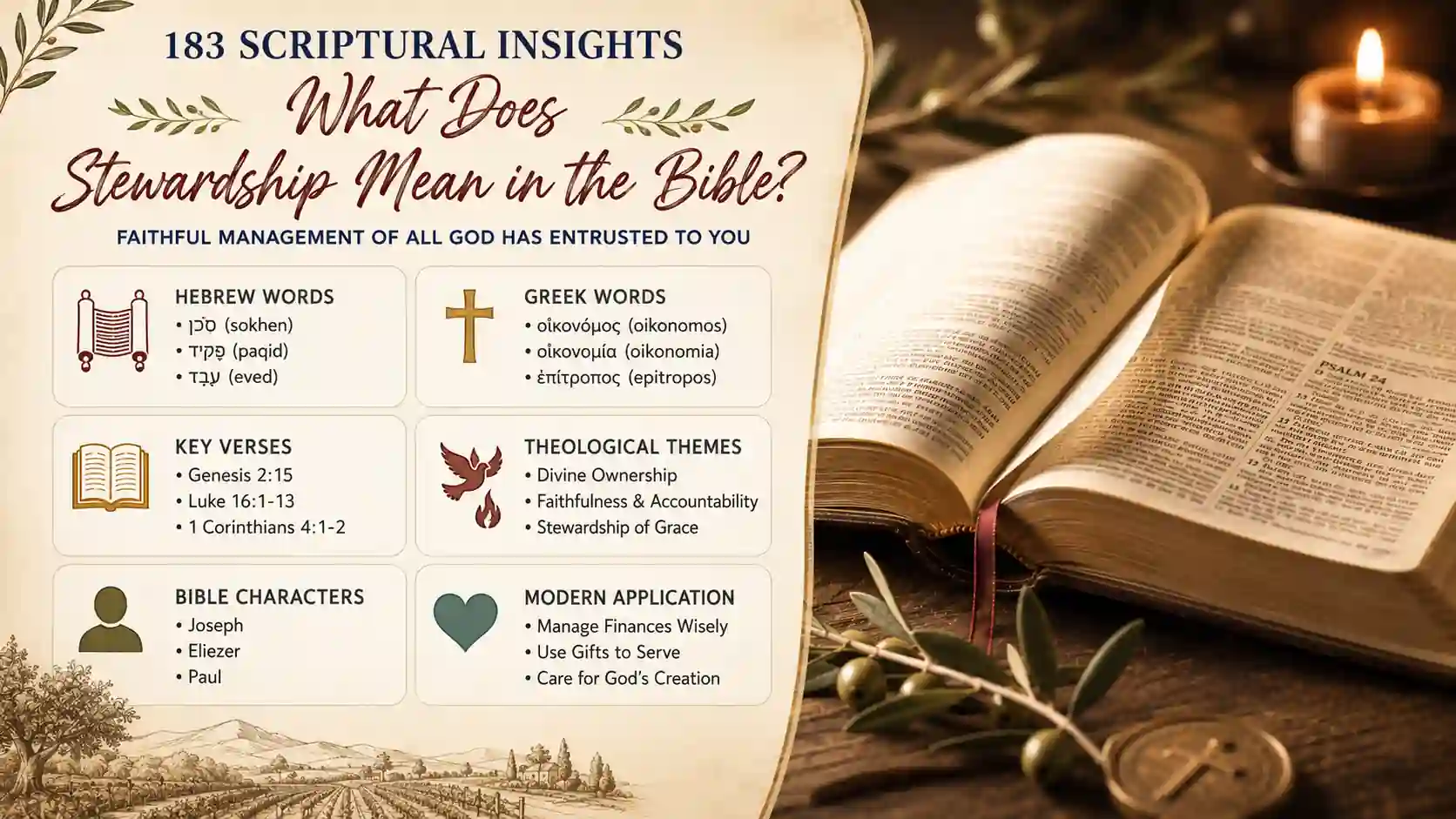
What does stewardship mean in the Bible? Biblical stewardship means faithfully managing everything God has entrusted to you while recognizing that he remains the rightful owner. Scripture applies this responsibility to possessions, work, time, creation, spiritual gifts, relationships, ministry, and the gospel itself.
You are not presented as an independent owner but as a servant who will give an account to the Lord. Stewardship therefore joins privilege with responsibility, gratitude with obedience, and present faithfulness with future evaluation.
Key Scripture References for Stewardship
| Verse | Passage Snippet | Context |
|---|---|---|
| Genesis 1:26-28 | Humanity rules over living creatures | God delegates care of creation |
| Genesis 2:15 | Adam works and keeps the garden | Cultivation includes protection |
| Psalm 24:1 | The earth belongs to the Lord | God retains ultimate ownership |
| Proverbs 3:9 | Honor God with your wealth | Possessions become worship |
| Matthew 25:14-30 | Servants receive entrusted property | Faithfulness is evaluated |
| Luke 12:42-48 | A faithful household manager | Greater trust brings accountability |
| Luke 16:1-13 | A manager accounts for wealth | Money tests spiritual faithfulness |
| 1 Corinthians 4:1-2 | Stewards must prove faithful | Ministers guard divine mysteries |
| Colossians 1:25 | Paul receives a divine stewardship | Gospel ministry is entrusted work |
| 1 Peter 4:10 | Steward God’s varied grace | Gifts are used to serve others |
Bible Translation Comparison for Stewardship
| Verse | KJV | NIV | ESV | NASB |
|---|---|---|---|---|
| Genesis 2:15 | Dress and keep | Work and take care | Work and keep | Cultivate and tend |
| Psalm 24:1 | Earth is the Lord’s | Earth is the Lord’s | Earth is the Lord’s | Earth is the Lord’s |
| Matthew 25:21 | Faithful over a few things | Faithful with a few things | Faithful over a little | Faithful with a few things |
| Luke 12:42 | Faithful and wise steward | Faithful and wise manager | Faithful and wise manager | Faithful and sensible steward |
| Luke 16:2 | Account of thy stewardship | Account of your management | Account of your management | Accounting of your management |
| 1 Corinthians 4:1 | Stewards of God’s mysteries | Entrusted with God’s mysteries | Stewards of God’s mysteries | Stewards of God’s mysteries |
| 1 Corinthians 4:2 | Found faithful | Prove faithful | Found faithful | Found trustworthy |
| Colossians 1:25 | Dispensation of God | Commission from God | Stewardship from God | Stewardship from God |
| Titus 1:7 | Steward of God | Manages God’s household | God’s steward | God’s steward |
| 1 Peter 4:10 | Good stewards of grace | Faithful stewards of grace | Good stewards of grace | Good stewards of grace |
The variation between “steward,” “manager,” “commission,” and “dispensation” reflects different aspects of the same biblical idea. A steward occupies an entrusted office, while stewardship describes the responsibility or administration attached to that office.
People and Characters Associated with Stewardship
| Person | Role | Connection |
|---|---|---|
| Adam | Garden keeper | Entrusted with cultivating Eden |
| Joseph | Potiphar’s overseer | Managed an Egyptian household |
| Joseph | Administrator of Egypt | Preserved grain during famine |
| Eliezer | Abraham’s chief servant | Managed possessions and a mission |
| Moses | Covenant servant | Faithful in God’s household |
| David | King of Israel | Received wealth for temple worship |
| Daniel | Imperial administrator | Served faithfully under pagan rulers |
| Joanna | Supporter of Jesus | Used resources for gospel ministry |
| Paul | Apostle and minister | Entrusted with gospel stewardship |
| Unnamed servants | Parable characters | Accountable for entrusted talents |
Joseph provides one of Scripture’s clearest narrative pictures. Potiphar placed everything under Joseph’s authority, yet the estate still belonged to Potiphar. Later, Pharaoh gave Joseph administrative authority over Egypt, and Joseph used that trust to preserve life during famine.
Original Hebrew and Greek Words for Stewardship
| Original Word | Transliteration | Strong’s # | Literal Meaning |
|---|---|---|---|
| סֹכֵן | sokhen | H5532 | Administrator or steward |
| פָּקִיד | paqid | H6496 | Overseer or appointed officer |
| עֶבֶד | ʿeved | H5650 | Servant or bondservant |
| בַּיִת | bayit | H1004 | House or household |
| מָשַׁל | mashal | H4910 | To rule or govern |
| οἰκονόμος | oikonomos | G3623 | Household manager |
| οἰκονομία | oikonomia | G3622 | Administration or stewardship |
| ἐπίτροπος | epitropos | G2012 | Guardian, manager, or overseer |
| δοῦλος | doulos | G1401 | Slave or bondservant |
| πιστός | pistos | G4103 | Faithful or trustworthy |
The principal New Testament noun is οἰκονόμος, oikonomos, formed from words associated with a house and its ordering. It describes someone entrusted with another person’s household, estate, finances, servants, or provisions. The related οἰκονομία, oikonomia, identifies the administration itself, including a divinely assigned ministry.
The Hebrew Bible does not organize the entire doctrine around one technical term. Instead, it develops stewardship through servants, overseers, household officials, royal administrators, land laws, temple treasurers, and humanity’s delegated rule under God.
Related Biblical Concepts of Stewardship
| Concept | Connection | Supporting Verse |
|---|---|---|
| Divine ownership | Everything ultimately belongs to God | Psalm 24:1 |
| Image of God | Humanity represents God’s rule | Genesis 1:26 |
| Dominion | Authority is delegated, not absolute | Genesis 1:28 |
| Service | A steward acts for a master | Matthew 24:45 |
| Faithfulness | Trustworthiness is the central requirement | 1 Corinthians 4:2 |
| Accountability | Every steward must answer | Luke 16:2 |
| Contentment | Stewardship resists covetousness | 1 Timothy 6:6-8 |
| Generosity | Resources are shared freely | 2 Corinthians 9:6-8 |
| Spiritual gifts | Grace is administered through service | 1 Peter 4:10 |
| Reward | Faithful service receives approval | Matthew 25:21 |
Biblical stewardship is broader than financial giving. Money matters because it reveals loyalties, but stewardship also concerns truth, authority, opportunity, ability, bodily life, community responsibilities, and the created world.
The connecting truth is entrustment. Something belongs to God, is placed under human care, must be handled according to his will, and will eventually be included in an account.
Historical and Cultural Context of Stewardship
| Aspect | Detail | Biblical Source |
|---|---|---|
| Ancient household | Large estates required trusted managers | Luke 16:1 |
| Managerial authority | Stewards handled accounts and provisions | Luke 12:42 |
| Servant status | Managers could be servants or freedmen | Genesis 39:4 |
| Written accounts | Debts and produce were formally recorded | Luke 16:5-7 |
| Agricultural economy | Wealth included fields, grain, oil, and animals | Deuteronomy 14:22 |
| Royal government | Officers administered taxes and supplies | 1 Kings 4:7 |
| Temple treasury | Levites guarded offerings and sacred goods | 1 Chronicles 26:20 |
| Land tenure | Israel’s land belonged ultimately to God | Leviticus 25:23 |
| Patronage | Believers supported ministry materially | Luke 8:3 |
| Final accounting | Masters reviewed servant performance | Matthew 25:19 |
In the ancient Mediterranean household, an οἰκονόμος could exercise substantial authority while remaining subordinate to the owner. The steward might supervise workers, distribute food, keep records, negotiate obligations, and manage an estate. His authority was real, but it was never independent.
This setting explains Jesus’ repeated use of household managers in his parables. His listeners understood that a manager’s character became visible when the master was absent, delayed, or ready to inspect the accounts.
Theological Themes of Stewardship
| Theme | Explanation | Scripture |
|---|---|---|
| Creation | God owns and sustains creation | Psalm 24:1 |
| Human vocation | People cultivate God’s world | Genesis 2:15 |
| Providence | Every good gift comes from God | James 1:17 |
| Covenant | Israel managed covenant blessings | Deuteronomy 8:18 |
| Lordship | Jesus claims authority over the disciple | Luke 6:46 |
| Grace | Gifts are entrusted, not earned | 1 Peter 4:10 |
| Mission | The gospel is a sacred trust | 1 Corinthians 9:17 |
| Faithfulness | God values trustworthy obedience | 1 Corinthians 4:2 |
| Judgment | Christ evaluates each servant | 2 Corinthians 5:10 |
| Reward | Grace honors faithful labor | Matthew 25:23 |
Stewardship rests first on theology, not technique. Your habits change when you believe that God created all things, Christ is Lord, grace supplies every gift, and judgment will disclose the quality of your service.
This doctrine also guards against pride. Your abilities may be genuinely yours in a personal sense, yet they remain received gifts. Stewardship allows you to develop them vigorously without pretending that you are self-created or self-sufficient.
Modern Application of Stewardship for Believers
| Area | Practice | Scripture |
|---|---|---|
| Money | Budget, give, save, and spend prayerfully | Proverbs 3:9 |
| Time | Use opportunities wisely | Ephesians 5:15-16 |
| Work | Labor sincerely for the Lord | Colossians 3:23 |
| Body | Honor God physically | 1 Corinthians 6:19-20 |
| Gifts | Serve others with your abilities | 1 Peter 4:10 |
| Creation | Cultivate and protect what God made | Genesis 2:15 |
| Family | Provide and care responsibly | 1 Timothy 5:8 |
| Church | Contribute to shared ministry | Romans 12:4-8 |
| Gospel | Guard and communicate sound teaching | 2 Timothy 1:14 |
| Influence | Lead as one accountable to God | Romans 14:12 |
Stewardship becomes practical when you ask, “What has God placed in my care, and what would faithfulness look like here?” That question applies to your salary, calendar, home, education, health, relationships, influence, and knowledge of Scripture.
The goal is not anxious control. A steward works diligently but remembers that results finally belong to the Master. You are responsible for obedient service, while God remains sovereign over growth, opportunity, and outcome.
What Does Stewardship Mean in the Bible Through οἰκονόμος?
The word οἰκονόμος, oikonomos, gives biblical stewardship its household shape. A steward does not merely protect possessions. He arranges, distributes, supervises, and uses them according to the owner’s interests. Jesus therefore asks who the “faithful and wise” manager is, not merely who possesses the largest resources.
This helps you distinguish stewardship from ownership. Ownership asks, “What may I do with what is mine?” Stewardship asks, “What does my Lord desire from what he has entrusted to me?” Christian obedience begins with the second question.
Creation Stewardship from Eden to Israel’S Land Laws
Genesis presents humanity as God’s image-bearing representative within creation. Adam receives the garden “to work it and keep it.” The paired responsibilities imply productive cultivation and attentive preservation. Dominion is therefore neither neglect nor exploitation.
Israel’s law reinforces this principle. The land could not be sold permanently because, God declared, “the land is mine” in Leviticus 25:23. Israel possessed covenant privileges, but its families lived as tenants under the divine Landowner.
Faithfulness, Accounting, and the Difficult Manager of Luke 16
Luke 16 troubles many readers because the rich man praises the dishonest manager’s shrewdness. Jesus does not approve fraud. He draws attention to the manager’s decisive awareness that an accounting is coming and that present resources affect his future.
The following teaching supplies the moral center. Faithfulness in little prepares a person for greater trust, and no servant can serve both God and money. Wealth is not the master. It is a temporary trust through which loyalty to the true Master becomes visible.
Gospel Stewardship and the Manifold Grace of God
Paul describes apostolic ministry as an οἰκονομία, oikonomia, given by God. He did not invent the gospel or own its mysteries. He received a commission to proclaim Christ faithfully, especially among the nations.
Peter extends the pattern to every believer. Each gift you receive becomes a form of God’s “manifold grace” to be served to others. Grace does not terminate on the recipient. Like provisions passing through a household manager, divine gifts are entrusted to you for the strengthening of God’s people.
Frequently Asked Questions About Biblical Stewardship
Is οἰκονόμος, oikonomos, limited to managing money?
No. It can describe household management, ministry responsibility, spiritual leadership, or the administration of God’s grace.
Why does Luke 16 appear to praise a dishonest steward?
The steward is praised for foresight and decisiveness, not dishonesty, while Jesus explicitly commands faithfulness in the verses that follow.
Does Psalm 24:1 mean Christians cannot own private property?
No. Scripture recognizes human possession while teaching that every possession remains under God’s higher ownership and moral authority.
How does stewardship differ from generosity?
Generosity is one expression of stewardship, while stewardship includes the faithful management of every resource, responsibility, and gift.
What is the primary quality God requires from a steward?
According to 1 Corinthians 4:2, the defining requirement is faithfulness, meaning proven trustworthiness before the Master.