
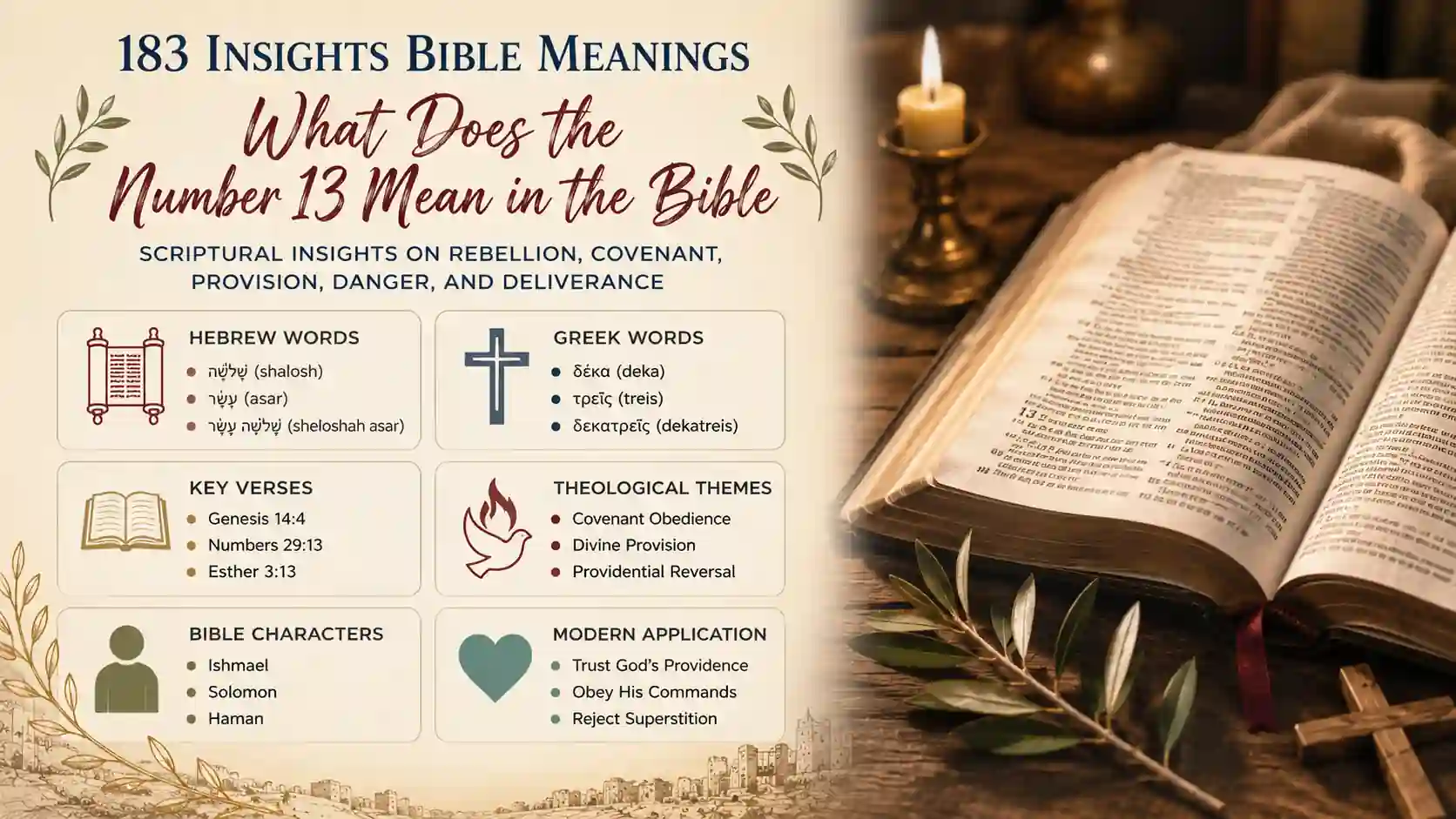
What does the number 13 mean in the Bible? Scripture does not assign thirteen one fixed mystical meaning, nor does it call the number inherently unlucky. Instead, thirteen appears within narratives about covenant, rebellion, royal construction, priestly inheritance, national danger, judgment, and deliverance.
As you study each occurrence in context, you find that the biblical emphasis rests on God’s actions and human responses, not on numerological superstition. Thirteen may mark an age, year, date, measurement, census total, or allocation. Its significance comes from the passage in which it appears.
Key Number 13 Scripture References
| Verse | Passage Snippet | Context |
|---|---|---|
| Genesis 14:4 | “In the thirteenth year they rebelled” | Five kings reject Chedorlaomer’s rule |
| Genesis 17:25 | Ishmael was thirteen years old | Circumcision within Abraham’s household |
| Numbers 29:13 | Thirteen young bulls offered | First day of the Feast of Booths |
| Joshua 19:6 | Thirteen towns with villages | Simeon’s territorial inheritance |
| Joshua 21:6 | Thirteen cities assigned | Gershonite Levites receive towns |
| Joshua 21:33 | Thirteen Gershonite cities | Summary of Levitical allocation |
| 1 Kings 7:1 | Solomon built thirteen years | Construction of the royal palace |
| 1 Chronicles 6:60 | Thirteen cities by families | Priestly and Levitical settlements |
| Esther 3:13 | Thirteenth day of Adar | Haman schedules Jewish destruction |
| Esther 9:1 | Thirteenth day arrives | Intended victims overcome their enemies |
Number 13 Bible Translation Comparison
| Verse | KJV | NIV | ESV | NASB |
|---|---|---|---|---|
| Genesis 14:4 | “thirteenth year” | “thirteenth year” | “thirteenth year” | “thirteenth year” |
| Genesis 17:25 | “thirteen years old” | “was thirteen” | “thirteen years old” | “thirteen years old” |
| Numbers 29:13 | “thirteen young bullocks” | “thirteen young bulls” | “thirteen bulls” | “thirteen bulls” |
| Joshua 19:6 | “thirteen cities” | “thirteen towns” | “thirteen cities” | “thirteen cities” |
| Joshua 21:6 | “thirteen cities” | “thirteen towns” | “thirteen cities” | “thirteen cities” |
| 1 Kings 7:1 | “thirteen years” | “thirteen years” | “thirteen years” | “thirteen years” |
| Esther 3:12 | “thirteenth day” | “thirteenth day” | “thirteenth day” | “thirteenth day” |
| Esther 3:13 | “thirteenth day” | “thirteenth day” | “thirteenth day” | “thirteenth day” |
| Esther 9:1 | “thirteenth day” | “thirteenth day” | “thirteenth day” | “thirteenth day” |
| Ezekiel 40:11 | “thirteen cubits” | “thirteen cubits” | “thirteen cubits” | “thirteen cubits” |
People and Characters Associated with Number 13
| Person | Role | Connection |
|---|---|---|
| Ishmael | Son of Abraham and Hagar | Circumcised at age thirteen |
| Abraham | Covenant patriarch | Circumcises Ishmael and his household |
| Chedorlaomer | King of Elam | Faces rebellion in the thirteenth year |
| Solomon | King and temple builder | Spends thirteen years building his palace |
| Moses | Covenant mediator | Gives festival offerings involving thirteen bulls |
| Joshua | Israel’s leader | Oversees tribal and Levitical allotments |
| Gershon | Son of Levi | Descendants receive thirteen cities |
| Haman | Enemy of the Jews | Chooses the thirteenth of Adar for destruction |
| Esther | Jewish queen of Persia | Acts within the crisis created by Haman |
| Mordecai | Jewish leader | Helps reverse the decree’s intended outcome |
Original Hebrew and Greek Words Connected with Number 13
| Original Word | Transliteration | Strong’s # | Literal Meaning |
|---|---|---|---|
| שָׁלוֹשׁ | shalosh | H7969 | Three |
| שְׁלֹשָׁה | sheloshah | H7969 | Three, masculine form |
| עָשָׂר | asar | H6240 | Ten, used in teen numbers |
| שְׁלֹשָׁה עָשָׂר | sheloshah asar | H7969, H6240 | Three and ten, thirteen |
| שָׁנָה | shanah | H8141 | Year |
| יוֹם | yom | H3117 | Day |
| חֹדֶשׁ | chodesh | H2320 | Month |
| δέκα | deka | G1176 | Ten |
| τρεῖς | treis | G5140 | Three |
| δεκατρεῖς | dekatreis | G1176, G5140 | Thirteen, three plus ten |
The Old Testament normally expresses thirteen as a compound number, essentially “three and ten.” The exact form changes according to the grammatical gender of the noun being counted. Strong’s numbers identify the component words rather than a separate mystical Hebrew term for thirteen.
The Greek New Testament does not use δεκατρεῖς as a cardinal numeral in its surviving text. The ordinary Greek construction combines δέκα, “ten,” with τρεῖς, “three.” Therefore, no New Testament doctrine about thirteen can be built from a special Greek vocabulary word.
Related Biblical Concepts of Number 13
| Concept | Connection | Supporting Verse |
|---|---|---|
| Rebellion | Subject kings revolt in year thirteen | Genesis 14:4 |
| Covenant sign | Ishmael receives circumcision at thirteen | Genesis 17:25 |
| Consecrated worship | Thirteen bulls begin festival offerings | Numbers 29:13 |
| Tribal inheritance | Thirteen towns belong to Simeon’s list | Joshua 19:6 |
| Levitical provision | Gershonites receive thirteen cities | Joshua 21:6 |
| Royal priorities | Palace construction lasts thirteen years | 1 Kings 7:1 |
| Imperial power | Persian decree issued on day thirteen | Esther 3:12 |
| Threatened destruction | Haman selects the thirteenth of Adar | Esther 3:13 |
| Providential reversal | Jews prevail on the appointed date | Esther 9:1 |
| Measured order | Temple gateway measures thirteen cubits | Ezekiel 40:11 |
Historical and Cultural Context of Number 13
| Aspect | Detail | Biblical Source |
|---|---|---|
| Ancient treaties | Lesser kings served stronger rulers | Genesis 14:1-4 |
| Circumcision | Covenant sign applied to household males | Genesis 17:23-27 |
| Israelite festivals | Offerings followed an ordered schedule | Numbers 29:12-38 |
| Land distribution | Towns were assigned by tribal boundaries | Joshua 19:1-9 |
| Levitical cities | Levites received cities rather than one region | Joshua 21:1-42 |
| Royal architecture | Palaces displayed administrative power | 1 Kings 7:1-12 |
| Persian bureaucracy | Decrees were copied into many languages | Esther 3:12-15 |
| Persian calendar | Adar was the twelfth month | Esther 3:7, 13 |
| Casting lots | Pur selected a date for Haman’s plan | Esther 3:7 |
| Temple visions | Measurements communicated sacred order | Ezekiel 40:1-49 |
Theological Themes within Number 13 Passages
| Theme | Explanation | Scripture |
|---|---|---|
| Human rebellion | Political revolt brings conflict and judgment | Genesis 14:4-12 |
| Covenant obedience | Abraham obeys God without delay | Genesis 17:23-27 |
| Covenant distinction | Ishmael is blessed, though Isaac carries the promised line | Genesis 17:18-21 |
| Ordered worship | Israel approaches God according to revealed commands | Numbers 29:12-16 |
| Divine provision | God supplies places for Levitical service | Joshua 21:1-8 |
| Stewardship and power | Solomon’s building program invites comparison | 1 Kings 6:38; 7:1 |
| Hidden providence | God preserves His people in Persia | Esther 3:13; 9:1 |
| Reversal | An appointed day of death becomes victory | Esther 9:1-5 |
| Justice | Violent schemes return upon their authors | Esther 7:9-10 |
| Sacred order | God’s future temple is carefully measured | Ezekiel 40:11 |
Modern Application of Number 13 for Believers
| Area | Practice | Scripture |
|---|---|---|
| Bible interpretation | Read numbers within literary context | Nehemiah 8:8 |
| Superstition | Refuse fear based on dates or numerals | Isaiah 8:12-13 |
| Covenant faithfulness | Respond promptly to God’s commands | Genesis 17:23 |
| Family discipleship | Teach covenant truth across generations | Genesis 18:19 |
| Worship | Honor God according to His revealed will | Numbers 29:12-13 |
| Stewardship | Examine whether personal projects overshadow worship | 1 Kings 6:38; 7:1 |
| Courage | Act faithfully when evil appears powerful | Esther 4:14-16 |
| Prayer | Seek God during threats and uncertainty | Esther 4:16 |
| Providence | Trust God when His work remains unseen | Esther 9:1 |
| Hope | Remember that God can reverse intended harm | Esther 9:22 |
What Does the Number 13 Mean in the Bible When Context Controls Interpretation?
The clearest answer is that thirteen has no single, universal biblical meaning. Genesis 14:4 connects a thirteenth year with rebellion, but that does not make rebellion the fixed definition of thirteen. The verse reports when the revolt happened, not a spiritual law governing every appearance of the number.
Likewise, Ishmael’s age in Genesis 17:25 concerns covenant obedience, while the thirteen bulls in Numbers 29:13 belong to Israel’s worship. The thirteen cities of Joshua 21 concern God’s provision for the Levites. These settings are too diverse to support one rigid symbolic interpretation.
שְׁלֹשָׁה עָשָׂר And the Difference Between Language and Symbolism
The Hebrew phrase שְׁלֹשָׁה עָשָׂר, sheloshah asar, is an ordinary numerical expression. It combines the words for three and ten. The grammar tells you how Hebrew forms a number, but it does not secretly define thirteen as rebellion, sin, judgment, or misfortune.
This distinction protects your study from a common error. A lexicon can explain what a word means, while context explains why the inspired writer used that number in a particular passage. Sound interpretation begins with grammar and history, then asks how the passage contributes to the book’s message.
Ishmael at Thirteen within the Abrahamic Covenant
Genesis 17 records the strongest personal association with thirteen. Ishmael is thirteen when Abraham circumcises him, together with every male in the household. His age marks his place within Abraham’s family at the moment the covenant sign is administered.
Yet the chapter carefully distinguishes participation in Abraham’s household from carrying the promised covenant line. God promises to bless Ishmael and make him fruitful, but He establishes the covenant of promise through Isaac. Thirteen here highlights neither a curse nor rebellion, but obedience, blessing, and covenant distinction.
The Thirteenth of Adar and God’S Reversal in Esther
In Esther, the thirteenth day of Adar becomes the date chosen for the annihilation of the Jewish people. Haman casts the pur, secures royal authority, and sends the decree throughout the Persian Empire. The date seems to place God’s people beneath an irreversible sentence of death.
By Esther 9:1, the same day displays providential reversal. Those who expected to overpower the Jews are themselves overcome. The number does not cause either danger or deliverance. God’s preserving providence transforms the meaning of the date within the story, showing that evil cannot overturn His purposes.
Questions Bible Students Ask About Number 13
Does Genesis 14:4 prove that the number 13 means rebellion?
No. The verse dates a specific rebellion in the thirteenth year but never defines thirteen as the universal symbol of rebellion.
Does שְׁלֹשָׁה עָשָׂר, sheloshah asar, carry a hidden negative meaning?
No. It is the normal Hebrew expression for thirteen, formed from words meaning three and ten.
Why was Ishmael circumcised when he was thirteen years old?
He was thirteen when God commanded Abraham to circumcise every male in his household, and Abraham obeyed that same day.
Was the thirteenth of Adar an unlucky date in Esther?
No. Haman chose it for destruction, but God turned that same date into deliverance and victory for the Jewish people.
Should Christians fear Friday the thirteenth or other uses of thirteen?
No. Scripture calls you to fear the Lord, trust His providence, and reject superstition rather than treating a created number as spiritually dangerous.