
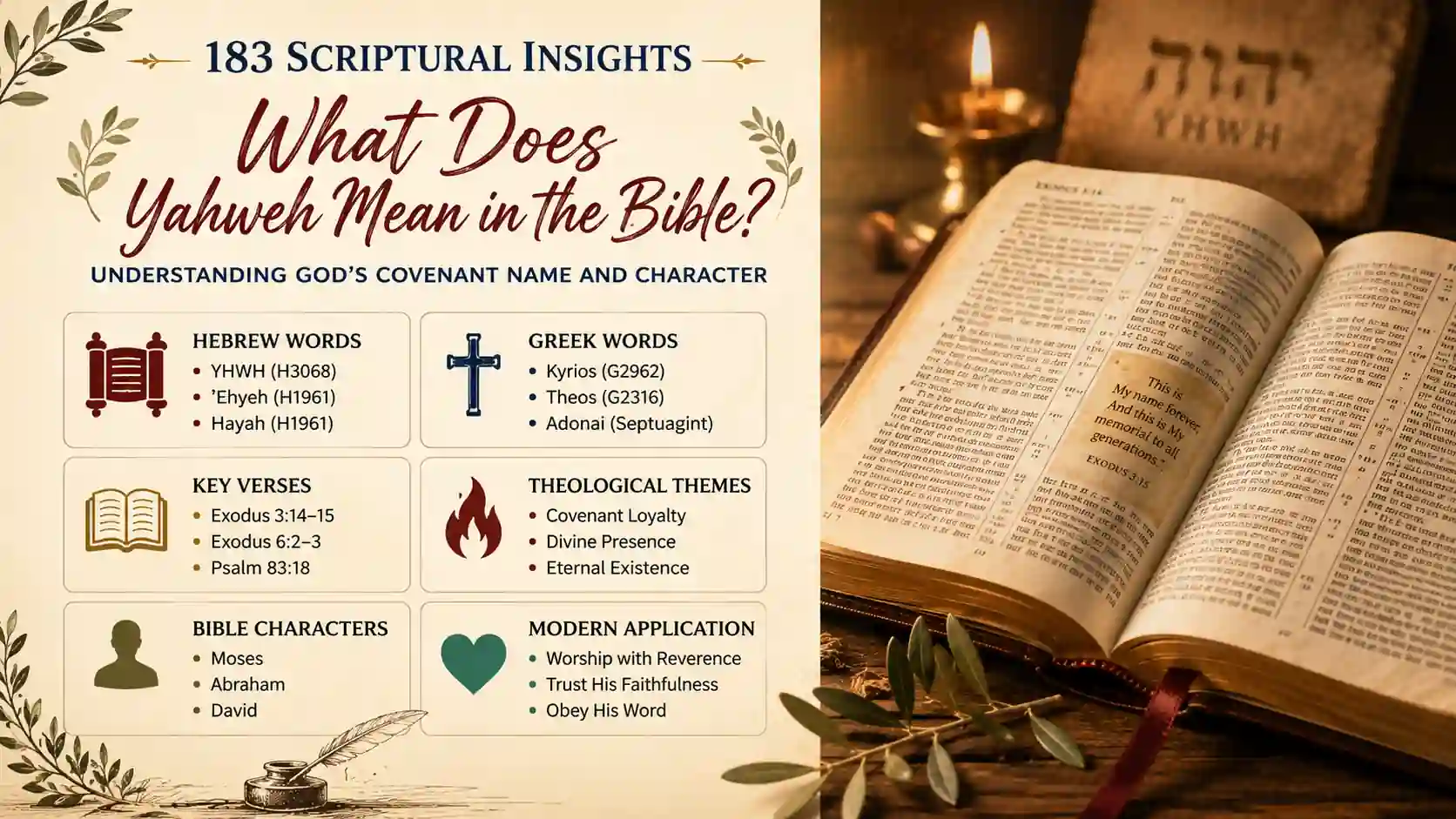
What does Yahweh mean in the Bible? Yahweh is the customary English form of יהוה, YHWH, the personal covenant name by which the God of Israel identifies himself. Most English Bibles represent this sacred name as “LORD” in small capital letters.
The name is closely associated with God’s declaration אֶהְיֶה אֲשֶׁר אֶהְיֶה, ʾEhyeh ʾAsher ʾEhyeh, in Exodus 3:14. It communicates God’s living presence, independent existence, faithfulness, and unchanging commitment to fulfill his promises.
Key Yahweh Scripture References
| Verse | Passage Snippet | Context |
|---|---|---|
| Genesis 2:4 | “LORD God” | Yahweh appears with Elohim in the creation account |
| Genesis 4:26 | “call upon the name” | Worshipers publicly invoke Yahweh |
| Genesis 12:8 | “called upon the name” | Abraham worships Yahweh near Bethel |
| Exodus 3:14 | “I AM WHO I AM” | God explains his identity to Moses |
| Exodus 3:15 | “This is my name forever” | YHWH is revealed as the ancestral God |
| Exodus 6:2–3 | “I am the LORD” | Yahweh confirms his covenant mission |
| Exodus 20:2 | “who brought you out” | The covenant law begins with redemption |
| Exodus 34:6 | “the LORD, the LORD” | God proclaims his merciful character |
| Psalm 83:18 | “whose name alone is JEHOVAH” | Yahweh is declared Most High |
| Isaiah 42:8 | “I am the LORD” | God refuses to share his glory |
Yahweh in Major Bible Translations
| Verse | KJV | NIV | ESV | NASB |
|---|---|---|---|---|
| Genesis 2:4 | LORD God | LORD God | LORD God | LORD God |
| Exodus 3:14 | I AM THAT I AM | I AM WHO I AM | I AM WHO I AM | I AM WHO I AM |
| Exodus 3:15 | LORD God | LORD | LORD | LORD |
| Exodus 6:2 | I am the LORD | I am the LORD | I am the LORD | I am the LORD |
| Exodus 15:3 | LORD is his name | LORD is his name | LORD is his name | LORD is His name |
| Psalm 68:4 | his name JAH | his name is the LORD | his name is the LORD | whose name is the LORD |
| Psalm 83:18 | name alone is JEHOVAH | name is the LORD | name is the LORD | name is the LORD |
| Isaiah 42:8 | I am the LORD | I am the LORD | I am the LORD | I am the LORD |
| Jeremiah 16:21 | name is The LORD | name is the LORD | name is the LORD | name is the LORD |
People and Characters Associated with Yahweh
| Person | Role | Connection |
|---|---|---|
| Adam | First man | Encounters Yahweh God in Eden |
| Eve | First woman | Speaks of receiving a son from Yahweh |
| Noah | Flood survivor | Builds an altar to Yahweh |
| Abraham | Covenant patriarch | Calls on Yahweh and receives promises |
| Sarah | Covenant matriarch | Receives the son promised by Yahweh |
| Isaac | Promised son | Experiences Yahweh’s covenant blessing |
| Jacob | Father of Israel | Identifies Yahweh as his fathers’ God |
| Moses | Prophet and deliverer | Receives the divine name at the bush |
| Aaron | Israel’s first high priest | Ministers before Yahweh |
| David | Covenant king | Worships Yahweh as shepherd and refuge |
Original Hebrew and Greek Words Connected with Yahweh
| Original Word | Transliteration | Strong’s # | Literal Meaning |
|---|---|---|---|
| יהוה | YHWH, Yahweh | H3068 | Personal name of Israel’s God |
| אֶהְיֶה | ʾEhyeh | H1961 | I am, I will be |
| הָיָה | Hayah | H1961 | To be, become, happen |
| יָהּ | Yah | H3050 | Short form of Yahweh |
| אֲדֹנָי | ʾAdonai | H136 | Lord, Master |
| אֱלֹהִים | ʾElohim | H430 | God, mighty one |
| יְהֹוִה | YHWH variant | H3069 | Divine name after Adonai |
| κύριος | Kyrios | G2962 | Lord, master, owner |
| θεός | Theos | G2316 | God, deity |
Biblical Concepts Related to Yahweh
| Concept | Connection | Supporting Verse |
|---|---|---|
| Divine name | Yahweh personally identifies God | Exodus 3:15 |
| Self-existence | God depends on no created being | Exodus 3:14 |
| Covenant | Yahweh binds himself to his promises | Genesis 15:18 |
| Presence | Yahweh promises to accompany Moses | Exodus 3:12 |
| Redemption | Yahweh delivers Israel from slavery | Exodus 6:6 |
| Holiness | Yahweh is morally pure and distinct | Leviticus 19:2 |
| Mercy | Yahweh is compassionate and gracious | Exodus 34:6 |
| Faithfulness | Yahweh keeps covenant love | Deuteronomy 7:9 |
| Kingship | Yahweh reigns over all creation | Psalm 97:1 |
| Glory | Yahweh alone deserves worship | Isaiah 42:8 |
Historical and Cultural Context of Yahweh
| Aspect | Detail | Biblical Source |
|---|---|---|
| Ancient writing | Early Hebrew recorded YHWH with four consonants | Exodus 3:15 |
| Tetragrammaton | The four letters are yod, he, waw, he | Deuteronomy 6:4 |
| Sacred reading | Jewish readers commonly substituted Adonai | Reflected in LORD |
| Small capitals | English Bibles use LORD for YHWH | Genesis 2:4 |
| Burning bush | The name is revealed during Israel’s oppression | Exodus 3:1–15 |
| Patriarchal continuity | Yahweh identifies with Abraham, Isaac, and Jacob | Exodus 3:15 |
| Exodus setting | The name assures Israel of deliverance | Exodus 6:2–8 |
| Covenant worship | Israel must not misuse Yahweh’s name | Exodus 20:7 |
| Temple worship | Priests bless Israel in Yahweh’s name | Numbers 6:24–27 |
| Prophetic proclamation | Prophets speak as messengers of Yahweh | Jeremiah 1:9 |
Theological Themes Revealed Through Yahweh
| Theme | Explanation | Scripture |
|---|---|---|
| Eternal existence | Yahweh is not created or temporary | Psalm 90:2 |
| Divine freedom | God acts according to his holy will | Exodus 33:19 |
| Covenant loyalty | God remains true to his sworn promises | Exodus 6:5 |
| Personal presence | God is with those he calls | Exodus 3:12 |
| Moral holiness | Yahweh defines goodness and purity | Leviticus 11:44 |
| Compassion | His power is joined with mercy | Exodus 34:6 |
| Justice | Yahweh judges evil without corruption | Deuteronomy 32:4 |
| Uniqueness | No rival possesses his divine identity | Deuteronomy 6:4 |
| Sovereignty | Yahweh rules nations and creation | Psalm 103:19 |
| Saving purpose | Yahweh makes his name known through redemption | Exodus 9:16 |
Modern Application of Yahweh for Believers
| Area | Practice | Scripture |
|---|---|---|
| Worship | Honor God for who he has revealed himself to be | Psalm 29:2 |
| Prayer | Call upon the Lord with reverence | Psalm 116:4 |
| Trust | Rest in God’s enduring faithfulness | Psalm 9:10 |
| Obedience | Treat his commands as covenant instruction | Deuteronomy 6:17 |
| Speech | Refuse careless use of God’s name | Exodus 20:7 |
| Anxiety | Remember that God is present with his people | Isaiah 41:10 |
| Repentance | Return to the compassionate Lord | Joel 2:13 |
| Witness | Make God’s saving character known | Psalm 105:1 |
| Justice | Reflect Yahweh’s love of righteousness | Jeremiah 9:24 |
| Hope | Trust the God whose purposes do not fail | Isaiah 46:9–10 |
What Does Yahweh Mean in the Bible and Exodus 3?
The form Yahweh represents the four Hebrew consonants יהוה, YHWH, often called the Tetragrammaton. Scripture presents it as God’s personal name, not merely a general title such as “God” or “Lord.” In Exodus 3:15, God tells Moses that this is his name forever and his memorial from generation to generation.
The preceding statement, אֶהְיֶה אֲשֶׁר אֶהְיֶה, ʾEhyeh ʾAsher ʾEhyeh, may be rendered “I AM WHO I AM” or “I WILL BE WHAT I WILL BE.” The verbal form allows the declaration to emphasize both God’s existence and his active presence. The God who sends Moses will also be with him.
Hayah, Ehyeh, and the Living God Who Will Be Present
The name YHWH is commonly connected with the Hebrew verb הָיָה, hayah, meaning “to be,” “to become,” or “to happen.” You should treat that relationship carefully. Exodus does not offer a modern dictionary definition, but it deliberately places אֶהְיֶה, ʾehyeh, beside יהוה, YHWH, creating a powerful theological association.
God is not simply describing existence as an abstract idea. He is answering Moses during a crisis of slavery, fear, and calling. “I will be with you” in Exodus 3:12 uses the same verbal form, ʾehyeh. Yahweh’s name therefore assures Moses that the living God will be present, active, and faithful throughout Israel’s deliverance.
Yahweh as the Covenant Name of Abraham, Moses, and Israel
Yahweh identifies himself as the God of Abraham, Isaac, and Jacob. His name connects the exodus to promises previously given to the patriarchs. The deliverance from Egypt is not an isolated miracle. It is an act of covenant remembrance in which God demonstrates that generations may pass, but his word remains dependable.
Exodus 6:2–8 develops this point through repeated declarations such as “I am the LORD” and “I will.” Yahweh promises to bring Israel out, redeem them, take them as his people, and give them the promised land. His name becomes inseparable from faithful action. You learn who Yahweh is by seeing what he promises and accomplishes.
From Yhwh to Kyrios in the Greek Scriptures
Ancient Jewish translators commonly represented יהוה with the Greek word κύριος, kyrios, meaning “Lord” or “Master.” This practice influenced the New Testament, where κύριος may refer to God and is also repeatedly applied to Jesus. New Testament writers sometimes quote Old Testament passages about YHWH and use those passages in speaking about Christ.
This usage contributes to the New Testament’s presentation of Jesus within the divine identity, while still affirming the distinction between the Father and the Son. Philippians 2:9–11 echoes Isaiah’s declaration that every knee will bow to Yahweh. The confession “Jesus Christ is Lord” therefore carries profound biblical and covenant significance.
Questions Bible Students Ask About Yahweh
Is Yahweh the most likely pronunciation of יהוה, YHWH?
Yahweh is the leading scholarly reconstruction, though the ancient Hebrew text originally recorded consonants without preserving a fully certain pronunciation.
Why do most English Bibles print LORD instead of Yahweh?
They follow a Jewish reading tradition that substitutes אֲדֹנָי, ʾAdonai, meaning “Lord,” when the divine name appears.
Does אֶהְיֶה, ʾEhyeh, mean “I am” or “I will be” in Exodus 3:14?
The Hebrew form can express either sense, allowing the verse to emphasize God’s living existence and promised presence.
Are Yahweh and Jehovah two different names?
No. Jehovah arose from combining the consonants YHWH with vowel signals associated with the traditional substitute ʾAdonai.
How should knowing the name Yahweh affect your faith?
It should deepen your reverence, strengthen your trust in God’s covenant faithfulness, and encourage you to live as a witness to his holy character.