
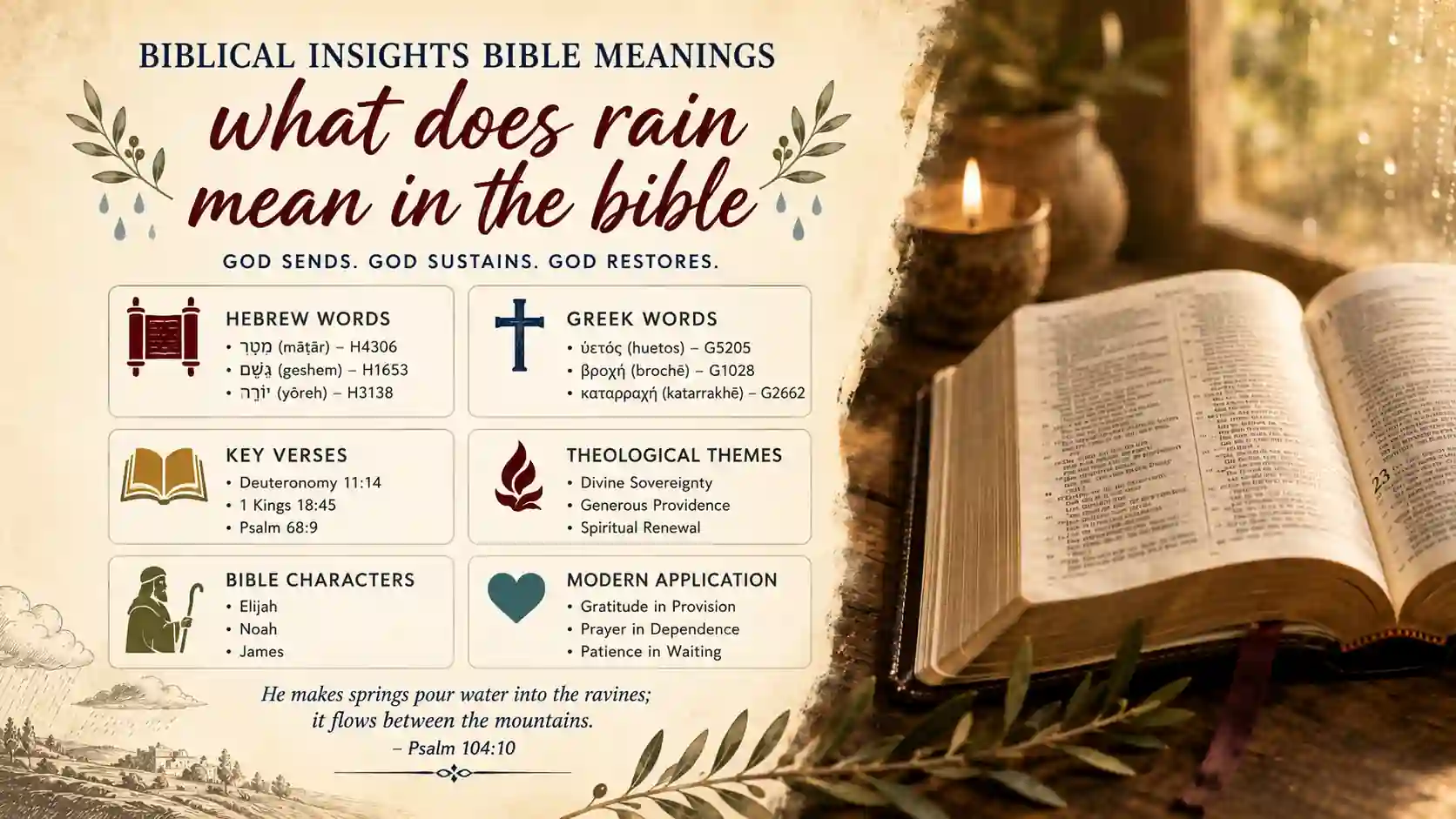
What does rain mean in the Bible? Scripture presents rain as a physical necessity, a gift from the Creator, a covenant blessing, an instrument of judgment, and a picture of spiritual fruitfulness. Because ancient Israel depended heavily on seasonal rainfall, biblical references to rain carried immediate agricultural, economic, and theological significance.
As you study these passages, you will see that rain is never controlled by chance or rival deities. It remains under God’s authority, revealing his generosity, holiness, patience, and faithfulness while calling his people to obedience, prayer, perseverance, and trust.
Key Rain Scripture References
| Verse | Passage Snippet | Context |
|---|---|---|
| Genesis 7:12 | Rain fell forty days | Judgment through the flood |
| Leviticus 26:4 | Rain in due season | Covenant blessing for obedience |
| Deuteronomy 11:14 | Early and latter rain | Provision in the promised land |
| 1 Kings 18:45 | A great rain | Drought ends through God’s mercy |
| Psalm 68:9 | Abundant rain | God refreshes his inheritance |
| Isaiah 55:10 | Rain waters the earth | God’s effective word |
| Matthew 5:45 | Rain on just and unjust | God’s common kindness |
| James 5:18 | Heaven gave rain | Elijah’s effective prayer |
Rain Bible Translation Comparison
| Verse | KJV | NIV | ESV | NASB |
|---|---|---|---|---|
| Deuteronomy 11:14 | First and latter rain | Autumn and spring rains | Early and later rain | Early and late rain |
| 1 Kings 18:41 | Abundance of rain | Heavy rain | Rushing of rain | Roar of heavy rain |
| Psalm 68:9 | Plentiful rain | Abundant showers | Rain in abundance | Abundant rain |
| Isaiah 55:10 | Rain cometh down | Rain comes down | Rain and snow come down | Rain and snow come down |
| Hosea 6:3 | Latter and former rain | Winter and spring rains | Showers and spring rains | Spring and winter rain |
| Joel 2:23 | Former rain moderately | Autumn rains | Early rain | Early rain |
| Matthew 5:45 | Sendeth rain | Sends rain | Sends rain | Sends rain |
| James 5:7 | Early and latter rain | Autumn and spring rains | Early and late rains | Early and late rains |
People and Characters Associated with Rain
| Person | Role | Connection |
|---|---|---|
| Noah | Flood survivor | Endured forty days of rain |
| Moses | Covenant mediator | Taught rain as blessing or judgment |
| Samuel | Prophet and judge | Prayed for rain during wheat harvest |
| Elijah | Prophet | Announced drought and later rain |
| Ahab | King of Israel | Witnessed the end of drought |
| Solomon | King and temple builder | Prayed concerning withheld rain |
| Amos | Prophet | Recalled selective rainfall as warning |
| James | Apostle and teacher | Used Elijah’s rain prayer as an example |
Original Hebrew and Greek Words for Rain
| Original Word | Transliteration | Strong’s # | Literal Meaning |
|---|---|---|---|
| מָטָר | māṭār | H4306 | Rain |
| גֶּשֶׁם | geshem | H1653 | Rain or heavy shower |
| יוֹרֶה | yôreh | H3138 | Early or autumn rain |
| מַלְקוֹשׁ | malqôsh | H4456 | Latter or spring rain |
| רְבִיבִים | rebîbîm | H7241 | Showers or abundant drops |
| זֶרֶם | zerem | H2230 | Downpour or rainstorm |
| ὑετός | huetos | G5205 | Rain or shower |
| βροχή | brochē | G1028 | Wetting or heavy rain |
Biblical Concepts Related to Rain
| Concept | Connection | Supporting Verse |
|---|---|---|
| Creation | God governs weather | Job 5:10 |
| Providence | Rain sustains life | Acts 14:17 |
| Covenant | Rain accompanies obedience | Deuteronomy 28:12 |
| Judgment | Rain may destroy | Genesis 7:12 |
| Discipline | Rain may be withheld | Amos 4:7 |
| Restoration | Rain renews damaged land | Joel 2:23 |
| Revelation | Teaching falls like rain | Deuteronomy 32:2 |
| Perseverance | Farmers wait for rain | James 5:7 |
Historical and Cultural Context of Rain
| Aspect | Detail | Biblical Source |
|---|---|---|
| Dry season | Little rain fell during summer | Proverbs 26:1 |
| Early rain | Softened soil for planting | Deuteronomy 11:14 |
| Latter rain | Matured grain before harvest | Jeremiah 5:24 |
| Mountain terrain | Land drank water from heaven | Deuteronomy 11:11 |
| Cisterns | Stored water during dry months | Jeremiah 2:13 |
| Wheat harvest | Rain was unusual and alarming | 1 Samuel 12:17 |
| Drought | Threatened crops and livestock | 1 Kings 17:1 |
| Pagan worship | Baal was falsely linked to storms | 1 Kings 18:21 |
Theological Themes Revealed Through Rain
| Theme | Explanation | Scripture |
|---|---|---|
| Divine sovereignty | God commands rainfall | Job 37:6 |
| Generous providence | God gives fruitful seasons | Acts 14:17 |
| Common grace | Rain benefits all people | Matthew 5:45 |
| Covenant faithfulness | Seasonal rain confirms care | Deuteronomy 11:14 |
| Holy judgment | Destructive rain confronts sin | Genesis 7:17 |
| Corrective discipline | Drought calls for repentance | Amos 4:7 |
| Spiritual renewal | Showers portray restoration | Ezekiel 34:26 |
| Effective revelation | God’s word fulfills its purpose | Isaiah 55:10-11 |
Modern Application of Rain for Believers
| Area | Practice | Scripture |
|---|---|---|
| Gratitude | Thank God for daily provision | Acts 14:17 |
| Prayer | Ask God for genuine needs | Zechariah 10:1 |
| Patience | Wait faithfully for spiritual fruit | James 5:7 |
| Obedience | Receive God’s commands seriously | Deuteronomy 11:13-14 |
| Repentance | Respond humbly to discipline | Amos 4:7-8 |
| Trust | Depend on God in uncertain seasons | Jeremiah 14:22 |
| Scripture | Receive God’s word like watered soil | Isaiah 55:10-11 |
| Compassion | Reflect kindness toward every neighbor | Matthew 5:45 |
מָטָר And גֶּשֶׁם Show God’S Authority Over Creation
The common Hebrew nouns מָטָר, māṭār, and גֶּשֶׁם, geshem, describe rain and showers, sometimes emphasizing a strong downpour. Their biblical use consistently places rainfall under the Lord’s authority. He sends it, withholds it, directs it, and determines where it falls.
This conviction distinguished Israel’s faith from surrounding fertility religions. The contest on Mount Carmel was therefore more than a dramatic miracle. Elijah confronted the claim that Baal controlled storms and fertility. The returning rain declared that the Lord alone is God and that creation responds to his command.
The flood narrative reveals rain as an instrument of judgment. Genesis 7 does not portray water as an independent destructive force. God announces the judgment, preserves Noah’s family, remembers those in the ark, and restrains the waters. Even catastrophic rain remains subject to divine purpose.
Yet judgment is not rain’s most frequent meaning. Scripture ordinarily treats rain as good, necessary, and life-giving. God waters fields, feeds animals, fills people with food and gladness, and preserves the rhythms of seedtime and harvest. Rain invites you to recognize ordinary provision as personal generosity from the Creator.
What Does Rain Mean in the Bible’S Covenant with Israel?
Israel’s promised land differed from irrigated Egypt. Deuteronomy describes it as a land of hills and valleys that “drinks water by the rain from heaven.” Its crops depended on timely rainfall, teaching Israel to live in conscious dependence on the Lord rather than trusting human engineering alone.
The יוֹרֶה, yôreh, was the early rain, usually associated with the autumn planting season. It softened sun-hardened soil so farmers could plow and sow. The מַלְקוֹשׁ, malqôsh, was the latter or spring rain that helped grain mature before harvest.
These rains appear in covenant passages because Israel’s relationship with God affected life in the land. Leviticus 26 and Deuteronomy 28 connect rain in season with covenant obedience. Deuteronomy 11 warns that idolatry could lead to a closed sky, failed crops, and hunger.
This does not mean every modern drought can be traced to a particular personal sin. Those promises belonged to Israel’s national life under the Mosaic covenant. They still teach a permanent truth, however. Creation belongs to God, rebellion has consequences, and material abundance should never be separated from gratitude and faithfulness.
Rain as Grace, Discipline, and Restoring Mercy
Rain communicates God’s kindness beyond the boundaries of covenant Israel. Jesus says that the Father sends rain on both the righteous and the unrighteous. This does not suggest divine indifference to morality. It reveals patient generosity toward people who have not earned his gifts.
Jesus places this truth within his command to love your enemies. God’s indiscriminate rainfall becomes a model for Christian mercy. You are called to do good without limiting kindness to those who appreciate you, agree with you, or can repay you.
Rain may also express discipline. Through Amos, God reminded Israel that he had withheld rain from some towns while allowing it to fall on others. The unequal rainfall was meant to awaken repentance, yet the repeated refrain says that the people did not return to him.
The prophets also use rain to promise restoration. Joel announces renewed early and latter rains after devastation. Ezekiel speaks of “showers of blessing” surrounding God’s people. These promises join physical restoration with renewed fellowship, showing that God’s final purpose is not barrenness but fruitful life under his gracious rule.
Ὑετός, Patient Farmers, and the Fruitful Word
The New Testament noun ὑετός, huetos, appears in passages about providence, prayer, fruitfulness, and judgment. In Acts 14, Paul points to rain from heaven as evidence that the living God has not left himself without witness. Every fruitful season quietly testifies to his goodness.
James uses seasonal rain to teach patience. A farmer cannot force seed to mature immediately. He prepares the ground, plants faithfully, and waits for the early and late rains. In the same way, you establish your heart while awaiting Christ’s coming, refusing to let delay produce grumbling or despair.
James also recalls Elijah, who prayed during the three-and-a-half-year drought and prayed again when heaven gave rain. His example does not turn prayer into control over nature. It shows that a righteous person’s prayer is effective because God graciously chooses to work through faithful dependence.
Isaiah 55 compares rain’s effect on soil with God’s spoken word. Rain does not descend without producing growth, seed, or bread. Likewise, God’s word never returns empty. Your study of Scripture may not produce instant visible results, but God uses it to nourish faith, expose sin, create endurance, and accomplish his saving purpose.
Frequently Asked Questions About Rain in the Bible
What is the difference between יוֹרֶה, yôreh, and מַלְקוֹשׁ, malqôsh?
Yôreh is the early autumn rain that prepared the soil, while malqôsh is the later spring rain that helped crops mature.
Does Matthew 5:45 teach that rain represents common grace?
Yes. Jesus presents rain as God’s undeserved kindness to both righteous and unrighteous people, forming a pattern for generous love.
Why was rain during the wheat harvest significant in 1 Samuel 12:17?
Rain was highly unusual during that dry season, so the storm confirmed Samuel’s warning and exposed Israel’s demand for a king as sinful.
Does withheld rain always mean that God is punishing someone?
No. Israel received specific covenant warnings, but Scripture does not authorize you to interpret every drought as punishment for a particular sin.
How does ὑετός, huetos, strengthen the message of James 5:7?
The seasonal rain pictures God-governed timing, teaching you to work faithfully and wait patiently for spiritual fruit and Christ’s return.