
What does abundance mean in the Bible? Scripture presents abundance as the generous fullness that flows from God’s character, covenant, and saving work. It may include food, land, family, wisdom, spiritual fruit, grace, or eternal life, but it is never limited to material wealth.
Biblical abundance means having enough to fulfill God’s purpose and enough to share with others. Its clearest expression is found in Jesus Christ, who gives life beyond spiritual poverty and teaches you to receive God’s gifts with gratitude, faithfulness, contentment, and openhanded love.
Key Abundance Scripture References
| Verse | Passage Snippet | Context |
|---|---|---|
| Genesis 27:28 | Abundance of grain and new wine | Isaac blesses Jacob with agricultural fruitfulness |
| Deuteronomy 28:11 | Abundant prosperity in offspring and produce | Covenant blessings for Israel’s obedience |
| Psalm 23:5 | My cup overflows | God hosts, protects, and honors the psalmist |
| Psalm 36:8 | Feast on the abundance of your house | Worshipers receive God’s steadfast goodness |
| Psalm 65:11 | Your paths overflow with plenty | Creation displays God’s generous provision |
| Proverbs 3:9-10 | Barns filled with plenty | Honoring God shapes the use of possessions |
| John 10:10 | Life more abundantly | Jesus contrasts his shepherding with destructive thieves |
| Romans 5:17 | Abundance of grace | Believers reign in life through Christ |
| 2 Corinthians 9:8 | Abound in every good work | God supplies generous believers for service |
| Ephesians 3:20 | Exceedingly abundantly beyond | God’s power surpasses human requests and thoughts |
Abundance Bible Translation Comparison
| Verse | KJV | NIV | ESV | NASB |
|---|---|---|---|---|
| Psalm 36:8 | Abundantly satisfied | Feast on abundance | Feast on abundance | Drink their fill |
| Psalm 65:11 | Paths drop fatness | Carts overflow | Wagon tracks overflow | Paths drip with fatness |
| Proverbs 3:10 | Barns filled with plenty | Barns filled to overflowing | Barns filled with plenty | Barns filled with plenty |
| John 10:10 | More abundantly | Life to the full | Have it abundantly | Have it abundantly |
| Romans 5:17 | Abundance of grace | Abundant provision of grace | Abundance of grace | Abundance of grace |
| 2 Corinthians 8:2 | Abundance of joy | Overflowing joy | Abundance of joy | Abundance of joy |
| 2 Corinthians 9:8 | Abound to every good work | Abound in every good work | Abound in every good work | Abundance for every good deed |
| Philippians 4:12 | How to abound | What it is to have plenty | How to abound | Living in prosperity |
| Ephesians 3:20 | Exceeding abundantly | Immeasurably more | Far more abundantly | Far more abundantly |
| 2 Peter 1:11 | Entrance ministered abundantly | Rich welcome | Richly provided entrance | Abundantly supplied entrance |
People and Characters Associated with Abundance
| Person | Role | Connection |
|---|---|---|
| Abraham | Covenant patriarch | God blesses him so nations may be blessed |
| Isaac | Heir of promise | Reaps a hundredfold during famine |
| Joseph | Egyptian administrator | Stores abundant grain before famine |
| Moses | Covenant mediator | Teaches that prosperity must not produce forgetfulness |
| David | King and psalmist | Describes God as shepherd, host, and overflowing provider |
| Solomon | King and wisdom teacher | Receives wealth but warns against trusting riches |
| Ruth | Faithful widow | Receives generous provision through gleaning and redemption |
| Elijah | Prophet | Experiences daily provision during drought |
| Jesus | Good Shepherd | Gives abundant life through sacrificial care |
| Paul | Apostle | Teaches abundance of grace, generosity, and contentment |
Original Hebrew and Greek Words for Abundance
| Original Word | Transliteration | Strong’s # | Literal Meaning |
|---|---|---|---|
| שָׂבַע | sava | H7646 | To be satisfied or filled |
| שֹׂבַע | sova | H7648 | Satisfaction, fullness, plenty |
| רֹב | rov | H7230 | Multitude, greatness, abundance |
| מָלֵא | male | H4390 | To fill or become full |
| פָּרָה | parah | H6509 | To bear fruit or be fruitful |
| פֶּרֶץ | perets | H6556 | Bursting forth or increase |
| περισσός | perissos | G4053 | Beyond the usual measure |
| περισσεία | perisseia | G4050 | Abundance, surplus, overflow |
| περισσεύω | perisseuō | G4052 | To abound or exceed |
| πλοῦτος | ploutos | G4149 | Riches, wealth, fullness |
Related Biblical Concepts of Abundance
| Concept | Connection | Supporting Verse |
|---|---|---|
| Blessing | God empowers life to flourish under his favor | Genesis 12:2 |
| Fruitfulness | Abundance often appears as multiplying life | Genesis 1:28 |
| Provision | God supplies the needs of his creatures | Psalm 104:27-28 |
| Satisfaction | God fills those who seek him | Psalm 107:9 |
| Grace | Divine favor overflows beyond human sin | Romans 5:20 |
| Generosity | Received abundance becomes shared abundance | 2 Corinthians 9:11 |
| Contentment | Plenty and need are both faced through Christ | Philippians 4:12-13 |
| Stewardship | Resources remain accountable to God | Luke 12:42-48 |
| Eternal life | Christ gives life that death cannot diminish | John 10:28 |
| Spiritual fruit | The Spirit produces abundant holy character | Galatians 5:22-23 |
Historical and Cultural Context of Abundance
| Aspect | Detail | Biblical Source |
|---|---|---|
| Rainfall | Seasonal rains determined harvest success | Deuteronomy 11:13-15 |
| Grain | Wheat and barley were basic measures of provision | Deuteronomy 8:8 |
| Vineyards | Wine symbolized celebration and agricultural blessing | Psalm 104:14-15 |
| Olive oil | Oil served food, light, medicine, and worship | Deuteronomy 8:8 |
| Storehouses | Surplus crops were preserved for future need | Genesis 41:48 |
| Gleaning | Landowners left produce for vulnerable people | Leviticus 19:9-10 |
| Tithes | Israel’s increase supported worship and community care | Deuteronomy 14:22-29 |
| Feasts | Shared meals celebrated God’s covenant provision | Deuteronomy 16:10-15 |
| Shepherding | A good shepherd led flocks to nourishment and safety | Psalm 23:1-3 |
| Patronage | Roman wealth could create dependence and social rank | 2 Corinthians 8:13-15 |
Theological Themes of Abundance
| Theme | Explanation | Scripture |
|---|---|---|
| Divine generosity | Creation and redemption originate in God’s giving nature | James 1:17 |
| Covenant faithfulness | God provides according to his promises | Deuteronomy 7:9 |
| Christ-centered life | True fullness is received through the Son | John 1:16 |
| Grace over sin | Christ’s grace exceeds Adam’s ruin | Romans 5:15-20 |
| Already and not yet | Believers have eternal life while awaiting its completion | 1 John 5:11-12 |
| Dependence | Daily provision teaches reliance on God | Matthew 6:11 |
| Justice | Surplus should relieve another person’s need | 2 Corinthians 8:14 |
| Stewardship | Abundance creates responsibility rather than autonomy | Luke 12:48 |
| Contentment | Christ sustains believers in scarcity and plenty | Philippians 4:11-13 |
| New creation | Final abundance includes healing, life, and God’s presence | Revelation 22:1-5 |
Modern Application of Abundance for Believers
| Area | Practice | Scripture |
|---|---|---|
| Prayer | Ask for daily bread rather than anxious excess | Matthew 6:11 |
| Work | Labor honestly so you can share | Ephesians 4:28 |
| Money | Give willingly and without compulsion | 2 Corinthians 9:7 |
| Possessions | Refuse to define life by accumulated goods | Luke 12:15 |
| Hospitality | Share meals and space without seeking repayment | Luke 14:13-14 |
| Contentment | Learn faithfulness in both lack and plenty | Philippians 4:12 |
| Church life | Meet genuine needs within the body | Acts 4:34-35 |
| Spiritual growth | Abound in love, knowledge, and discernment | Philippians 1:9 |
| Service | Use God’s supply to increase good works | 2 Corinthians 9:8 |
| Hope | Seek the lasting inheritance kept by God | 1 Peter 1:3-4 |
שָׂבַע And the Old Testament Picture of Satisfied Life
The Hebrew verb שָׂבַע, sava, means to be filled, satisfied, or sated. It describes more than possessing a large quantity. A person may own much and remain restless, while another receives ordinary bread with gratitude and experiences genuine satisfaction before God.
This distinction appears in Psalm 107:9, where God satisfies the longing soul and fills the hungry soul with good things. Biblical abundance therefore answers a God-shaped hunger. Material provision matters, but the deepest satisfaction comes when God himself is recognized as the giver and sustaining good.
The related noun שֹׂבַע, sova, expresses fullness or satisfaction. Psalm 16:11 connects this fullness with God’s presence, where there is fullness of joy. Your study of abundance must therefore begin with communion, not consumption. Scripture’s richest person is the one whose life is full of God.
Covenant Abundance from Eden to Israel’S Promised Land
The Bible first presents abundance through creation. God fills seas, skies, and land with living creatures, then commands humanity to be fruitful. Eden’s abundance is ordered, relational, and holy. Humanity receives a garden to cultivate, but its fruitfulness remains God’s gift.
After sin enters the world, abundance becomes complicated by toil, scarcity, oppression, and misuse. Yet God’s covenant with Abraham promises blessing that will reach all families of the earth. Abraham’s prosperity is not a private guarantee of luxury. He is blessed to become an instrument of blessing.
Israel’s promised land is described through grain, vines, figs, pomegranates, olive oil, and honey. These images reflect genuine agricultural plenty. Yet Deuteronomy 8 warns Israel that full houses and multiplied possessions could lead them to forget the Lord who delivered them.
Covenant abundance therefore includes a moral test. Plenty can encourage worship and generosity, or it can produce pride and self-sufficiency. The land remains God’s gift, and Israel’s laws require its yield to benefit Levites, immigrants, widows, orphans, and the poor.
What Does Abundance Mean in the Bible Through Christ?
John 10:10 contains the New Testament’s best-known statement about abundance. Jesus says that he came so his sheep might have life and have it abundantly. The adjective περισσός, perissos, describes something exceeding the ordinary measure or extending beyond what is merely sufficient.
The surrounding passage defines this abundance through the Good Shepherd. Unlike thieves who exploit the flock, Jesus knows his sheep, leads them, protects them, and lays down his life for them. Abundant life is therefore life under Christ’s saving care, not a promise that every believer will become wealthy.
The cross prevents you from reducing abundance to comfort. Jesus gives life by surrendering his own life, and his followers may experience persecution, sacrifice, or material need. Yet they possess forgiveness, reconciliation with God, the Spirit’s presence, resurrection hope, and membership in Christ’s flock.
This abundance begins now but reaches completion in the age to come. Eternal life is not merely endless duration. It is restored fellowship with God through Christ, a life that death cannot finally conquer and that will flourish fully in the new creation.
περισσεύω And the Overflow of Grace, Love, and Generosity
Paul frequently uses περισσεύω, perisseuō, meaning to abound, overflow, or exceed. His letters apply abundance to grace, hope, love, thanksgiving, spiritual understanding, good works, and generosity. This pattern shows that New Testament abundance is strongly ethical and communal.
Romans 5 declares that grace abounds where sin increased. Paul does not minimize sin. He magnifies the sufficiency of Christ’s obedient death. Grace is abundant because God’s saving action in Christ is greater than the condemnation and ruin introduced through Adam.
In 2 Corinthians 8, the Macedonian believers possess abundant joy even during severe trial and deep poverty. Their joy overflows into generosity. This difficult example overturns the assumption that only wealthy people can experience or express biblical abundance.
Second Corinthians 9:8 adds that God makes grace abound so believers have sufficiency for every good work. God’s provision is not pictured as a stagnant private reservoir. It moves through you toward worship, service, mercy, and the needs of others.
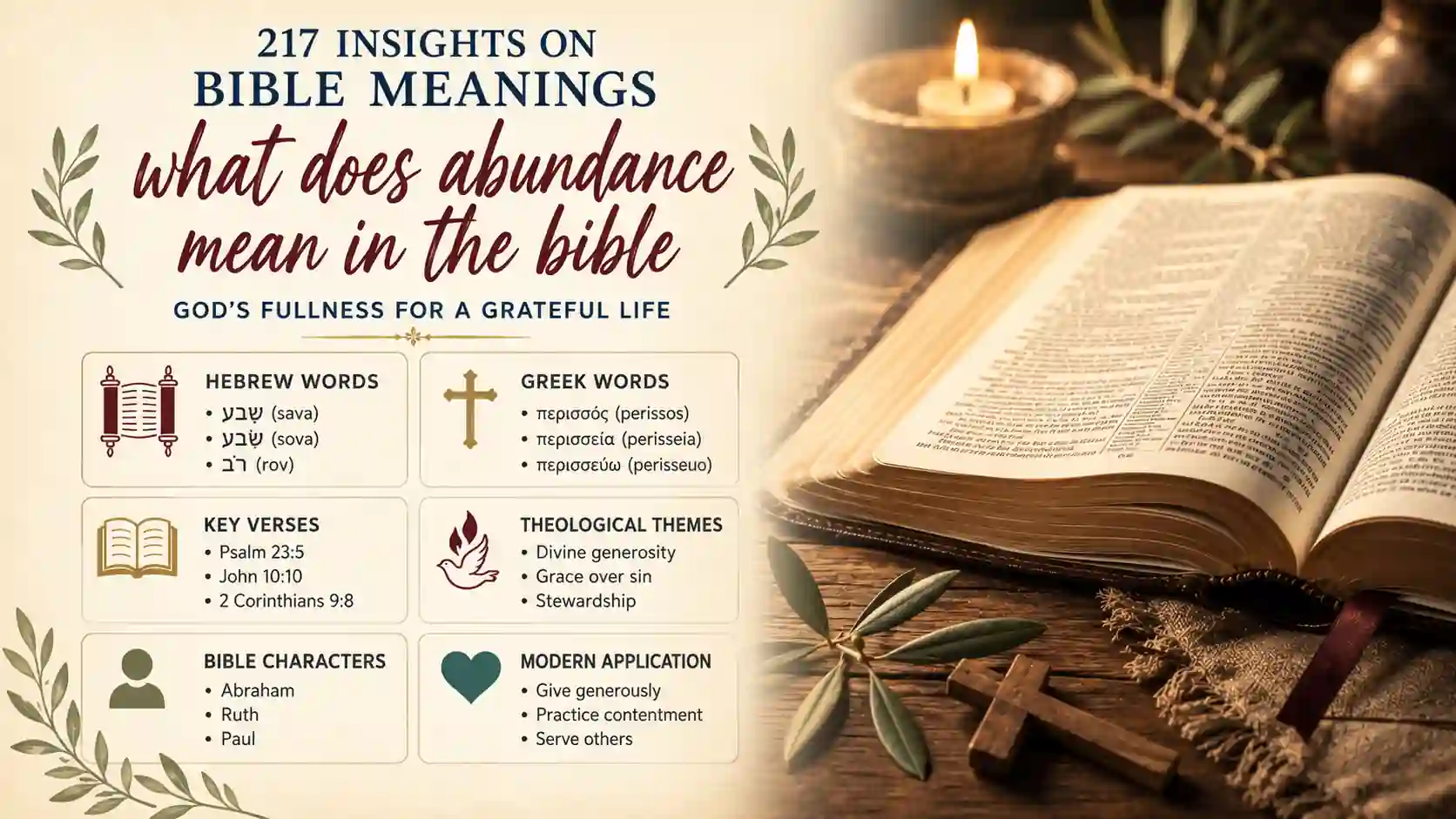
Questions About Biblical Abundance
Does the Hebrew word שָׂבַע mean that God promises unlimited possessions?
No. שָׂבַע emphasizes being satisfied or filled, which may involve provision but ultimately depends on God rather than unlimited accumulation.
Does John 10:10 promise health and financial prosperity to every Christian?
No. Its shepherding context points to secure, saving life under Christ, even when disciples experience suffering or material loss.
Why does the KJV say “more abundantly” while some translations say “to the full”?
Both expressions translate περισσός, perissos, which describes life exceeding ordinary measure rather than specifying one material form of blessing.
How can 2 Corinthians 8 describe poor Macedonian believers as abundant?
Their abundance consists of overflowing joy and generosity produced by grace, showing that spiritual fullness can exist alongside economic hardship.
How should you respond when God gives you material abundance?
Receive it gratefully, avoid pride, practice wise stewardship, and let your surplus serve worship, hospitality, justice, and people in need.