
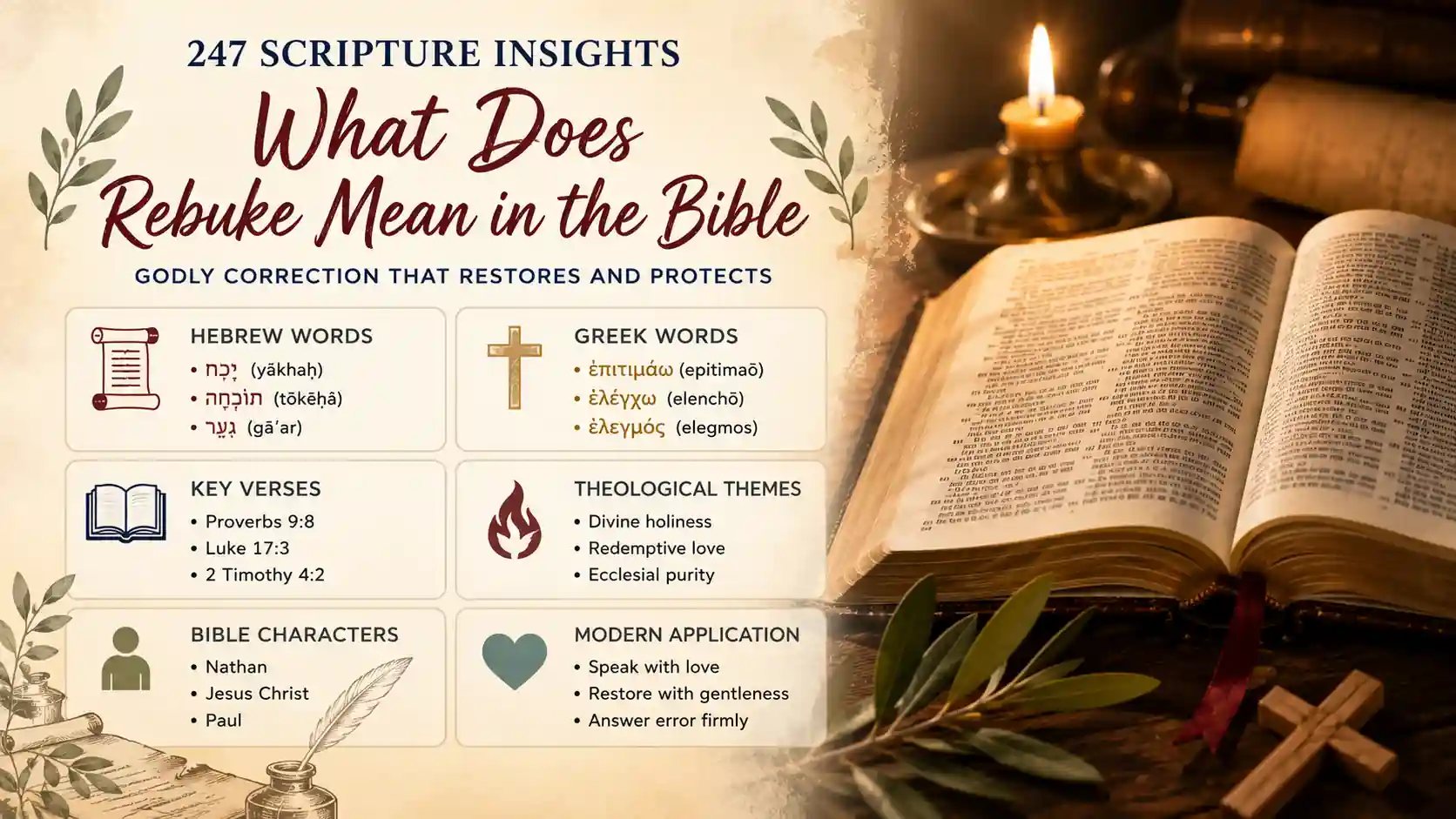
When you ask, “what does rebuke mean in the Bible,” you are asking how God confronts sin, corrects error, restrains evil, and restores people to wisdom. Biblical rebuke is not uncontrolled anger, personal humiliation, or harsh criticism. It is truthful correction spoken with moral authority and a redemptive purpose.
Scripture presents rebuke through several Hebrew and Greek words. Some emphasize exposing wrongdoing, while others describe warning, correction, discipline, or commanding evil to cease. Your study of these terms reveals that godly rebuke protects holiness, promotes repentance, and seeks restoration.
Key Rebuke Scripture References
| Verse | Passage Snippet | Context |
|---|---|---|
| Leviticus 19:17 | “Rebuke your neighbor frankly” | Covenant love requires honest correction |
| Psalm 141:5 | “Let a righteous man rebuke me” | David welcomes faithful correction |
| Proverbs 9:8 | “Rebuke the wise” | Wise people grow through correction |
| Proverbs 27:5 | “Open rebuke is better” | Honest love surpasses hidden affection |
| Ecclesiastes 7:5 | “Hear the rebuke of the wise” | Wisdom is better than foolish praise |
| Luke 17:3 | “If your brother sins, rebuke him” | Correction is joined to forgiveness |
| 1 Timothy 5:20 | “Rebuke before all” | Public sin may require public correction |
| 2 Timothy 4:2 | “Reprove, rebuke, exhort” | Preaching confronts error patiently |
| Titus 1:13 | “Rebuke them sharply” | Serious deception requires firm correction |
| Revelation 3:19 | “Those whom I love, I reprove” | Christ corrects His beloved people |
Rebuke Bible Translation Comparison
| Verse | KJV | NIV | ESV | NASB |
|---|---|---|---|---|
| Leviticus 19:17 | “rebuke thy neighbour” | “rebuke your neighbor frankly” | “reason frankly with your neighbor” | “surely rebuke your neighbor” |
| Proverbs 9:8 | “rebuke a wise man” | “rebuke the wise” | “reprove a wise man” | “rebuke a wise person” |
| Proverbs 27:5 | “Open rebuke is better” | “Better is open rebuke” | “Better is open rebuke” | “Better is open rebuke” |
| Luke 17:3 | “rebuke him” | “rebuke them” | “rebuke him” | “rebuke him” |
| 1 Timothy 5:20 | “rebuke before all” | “reprove before everyone” | “rebuke them in the presence of all” | “rebuke in the presence of all” |
| 2 Timothy 4:2 | “reprove, rebuke, exhort” | “correct, rebuke and encourage” | “reprove, rebuke, and exhort” | “reprove, rebuke, exhort” |
| Titus 1:13 | “rebuke them sharply” | “rebuke them sharply” | “rebuke them sharply” | “reprimand them severely” |
| Revelation 3:19 | “rebuke and chasten” | “rebuke and discipline” | “reprove and discipline” | “reprove and discipline” |
People and Characters Associated with Rebuke
| Person | Role | Connection |
|---|---|---|
| Moses | Covenant mediator | Rebuked Israel’s rebellion and unbelief |
| Nathan | Prophet | Confronted David over Bathsheba and Uriah |
| Samuel | Prophet and judge | Rebuked Saul for disobedience |
| Elijah | Prophet | Confronted Ahab and Israel’s idolatry |
| Nehemiah | Governor | Rebuked exploitation and Sabbath violations |
| John the Baptist | Prophetic forerunner | Rebuked Herod’s unlawful marriage |
| Jesus Christ | Messiah and Teacher | Rebuked demons, storms, hypocrisy, and unbelief |
| Peter | Apostle | Rebuked Jesus wrongly and was corrected |
| Paul | Apostle | Rebuked Peter and corrected churches |
| Timothy | Church leader | Commanded to rebuke persistent public sin |
Original Hebrew and Greek Rebuke Words
| Original Word | Transliteration | Strong’s # | Literal Meaning |
|---|---|---|---|
| יָכַח | yākhaḥ | H3198 | Prove, correct, reprove, decide |
| תּוֹכֵחָה | tôkēḥâ | H8433 | Correction, reproof, rebuke |
| גָּעַר | gāʿar | H1605 | Rebuke, restrain, threaten |
| מוּסָר | mûsār | H4148 | Discipline, correction, instruction |
| ἐπιτιμάω | epitimaō | G2008 | Rebuke, warn, command sternly |
| ἐλέγχω | elenchō | G1651 | Expose, convict, reprove |
| ἐλεγμός | elegmos | G1650 | Reproof, conviction, correction |
| ἐπιπλήσσω | epiplēssō | G1969 | Strike at verbally, rebuke harshly |
| νουθετέω | noutheteō | G3560 | Admonish, warn, put in mind |
| παιδεύω | paideuō | G3811 | Train, discipline, correct |
Related Biblical Rebuke Concepts
| Concept | Connection | Supporting Verse |
|---|---|---|
| Repentance | Rebuke calls sinners to turn | Revelation 3:19 |
| Wisdom | Wise hearers accept correction | Proverbs 9:8 |
| Love | Honest correction can express love | Proverbs 27:5 |
| Discipline | God trains those He receives | Hebrews 12:6 |
| Conviction | Sin is exposed by truth | John 16:8 |
| Admonition | Believers warn one another | Colossians 3:16 |
| Church restoration | Correction seeks regained fellowship | Matthew 18:15 |
| Forgiveness | Rebuke may lead to forgiveness | Luke 17:3 |
| Sound doctrine | Error must be answered truthfully | Titus 1:13 |
| Self-examination | Correction tests the heart | Psalm 141:5 |
Historical and Cultural Context of Rebuke
| Aspect | Detail | Biblical Source |
|---|---|---|
| Covenant community | Israelites shared responsibility for holiness | Leviticus 19:17 |
| City gate | Elders judged disputes publicly | Deuteronomy 21:19 |
| Prophetic office | Prophets confronted kings and nations | 2 Samuel 12:7 |
| Wisdom instruction | Sages treated correction as a path to life | Proverbs 6:23 |
| Honor and shame | Public rebuke carried social weight | 1 Timothy 5:20 |
| Rabbinic teaching | Teachers corrected disciples directly | Mark 8:33 |
| Household order | Older believers received respectful correction | 1 Timothy 5:1 |
| Early churches | Elders guarded doctrine and conduct | Titus 1:9 |
| Public teaching | False claims could damage entire households | Titus 1:11 |
| Imperial pressure | Churches faced compromise and persecution | Revelation 2:14–16 |
Theological Themes within Biblical Rebuke
| Theme | Explanation | Scripture |
|---|---|---|
| Divine holiness | God confronts what opposes His character | Psalm 50:21 |
| Covenant faithfulness | Correction calls God’s people back | Nehemiah 9:30 |
| Christ’s authority | Jesus commands demons and creation | Mark 4:39 |
| Redemptive love | Christ rebukes those He loves | Revelation 3:19 |
| Human dignity | Correction must avoid hatred and vengeance | Leviticus 19:17–18 |
| Truth and mercy | Faithful correction seeks restoration | Galatians 6:1 |
| Ecclesial purity | Persistent public sin affects the church | 1 Timothy 5:20 |
| Final judgment | Rejected correction leads to accountability | Proverbs 29:1 |
| Spiritual maturity | Receiving rebuke produces wisdom | Proverbs 15:31 |
| Pastoral responsibility | Leaders must oppose destructive teaching | Titus 1:9 |
Modern Rebuke Application for Believers
| Area | Practice | Scripture |
|---|---|---|
| Personal relationships | Speak privately before involving others | Matthew 18:15 |
| Motive | Correct from love, not irritation | Revelation 3:19 |
| Tone | Restore with gentleness | Galatians 6:1 |
| Accuracy | Judge by Scripture, not preference | 2 Timothy 3:16 |
| Self-awareness | Examine yourself before correcting | Matthew 7:5 |
| Forgiveness | Forgive the repentant person | Luke 17:3–4 |
| Church leadership | Address persistent public sin openly | 1 Timothy 5:20 |
| False teaching | Answer serious error firmly | Titus 1:13 |
| Family discipleship | Combine correction with instruction | Ephesians 6:4 |
| Receiving correction | Listen humbly and seek wisdom | Proverbs 15:31 |
What Does Rebuke Mean in the Bible Through יָכַח And ἐλέγχω?
The Hebrew verb יָכַח, yākhaḥ, can describe proving a matter, settling a dispute, correcting someone, or demonstrating guilt. Its range explains why English translations may render the same word as “rebuke,” “reprove,” “reason,” or “correct.” Biblical rebuke therefore involves more than expressing disapproval. It brings conduct into the light of truth.
The Greek verb ἐλέγχω, elenchō, carries a similar judicial quality. It means exposing, convicting, or demonstrating that something is wrong. In John 3:20, evil deeds are exposed. In Revelation 3:19, Christ reproves those He loves. The aim is not embarrassment for its own sake, but truthful conviction that can produce repentance.
When Jesus Used ἐπιτιμάω with Divine Authority
The Gospels frequently use ἐπιτιμάω, epitimaō, when Jesus rebukes demons, disease, wind, and waves. In these scenes, rebuke functions as an authoritative command. Jesus does not offer advice to hostile spiritual powers or chaotic forces. He orders them to stop, and they submit to His sovereign word.
This usage differs from ordinary correction between believers. You do not possess Christ’s unlimited authority over creation, and Scripture does not authorize you to imitate every messianic command formula. Yet these passages strengthen your faith in Jesus. The One who rebukes evil and calms the sea is Lord over both visible and invisible creation.
Nathan, David, and the Restorative Purpose of Rebuke
Nathan’s confrontation with David in 2 Samuel 12 is one of Scripture’s clearest portraits of prophetic rebuke. Nathan wisely tells a story that awakens David’s moral judgment. He then declares, “You are the man,” exposing the king’s adultery, deception, and responsibility for Uriah’s death.
The rebuke is severe because David’s sin is severe, but restoration remains possible. David confesses, “I have sinned against the Lord,” and Nathan announces God’s forgiveness while explaining that consequences will remain. This account teaches you that gracious rebuke neither minimizes guilt nor denies mercy. It names sin truthfully and directs the sinner toward God.
Rebuke, Brotherhood, and the Holiness of the Church
Leviticus 19:17 places rebuke between commands against hatred and vengeance. Refusing to address a neighbor’s sin can appear peaceful while concealing resentment, fear, or indifference. Covenant love sometimes requires you to speak plainly so that you do not participate silently in another person’s wrongdoing.
Jesus applies this responsibility to His disciples in Matthew 18:15, beginning with a private conversation. Paul likewise requires patience, doctrinal faithfulness, and appropriate authority. Some errors need gentle restoration, while persistent public sins may require public correction. The form varies, but the goal remains holiness, repentance, reconciliation, and protection of Christ’s people.
Questions About Biblical Rebuke
How does יָכַח, yākhaḥ, differ from גָּעַר, gāʿar?
Yākhaḥ usually stresses reasoned correction or proof, while gāʿar often describes a forceful rebuke that restrains or silences.
Why does Leviticus 19:17 say “reason frankly” in the ESV but “rebuke” in other translations?
The wording reflects the broad range of יָכַח, which can include confronting, reasoning, correcting, and establishing what is right.
Did Peter sin when he rebuked Jesus in Mark 8:32?
Yes, because Peter opposed Jesus’ revealed mission and presumed to correct the Messiah according to human expectations.
Does Titus 1:13 permit Christians to rebuke everyone sharply?
No, Paul addresses a specific crisis involving destructive deception, while other passages require gentleness, patience, and careful self-examination.
How can you receive ἐλέγχω, elenchō, without becoming defensive?
You can test the correction by Scripture, acknowledge what is true, repent where necessary, and thank God for faithful people who seek your restoration.