
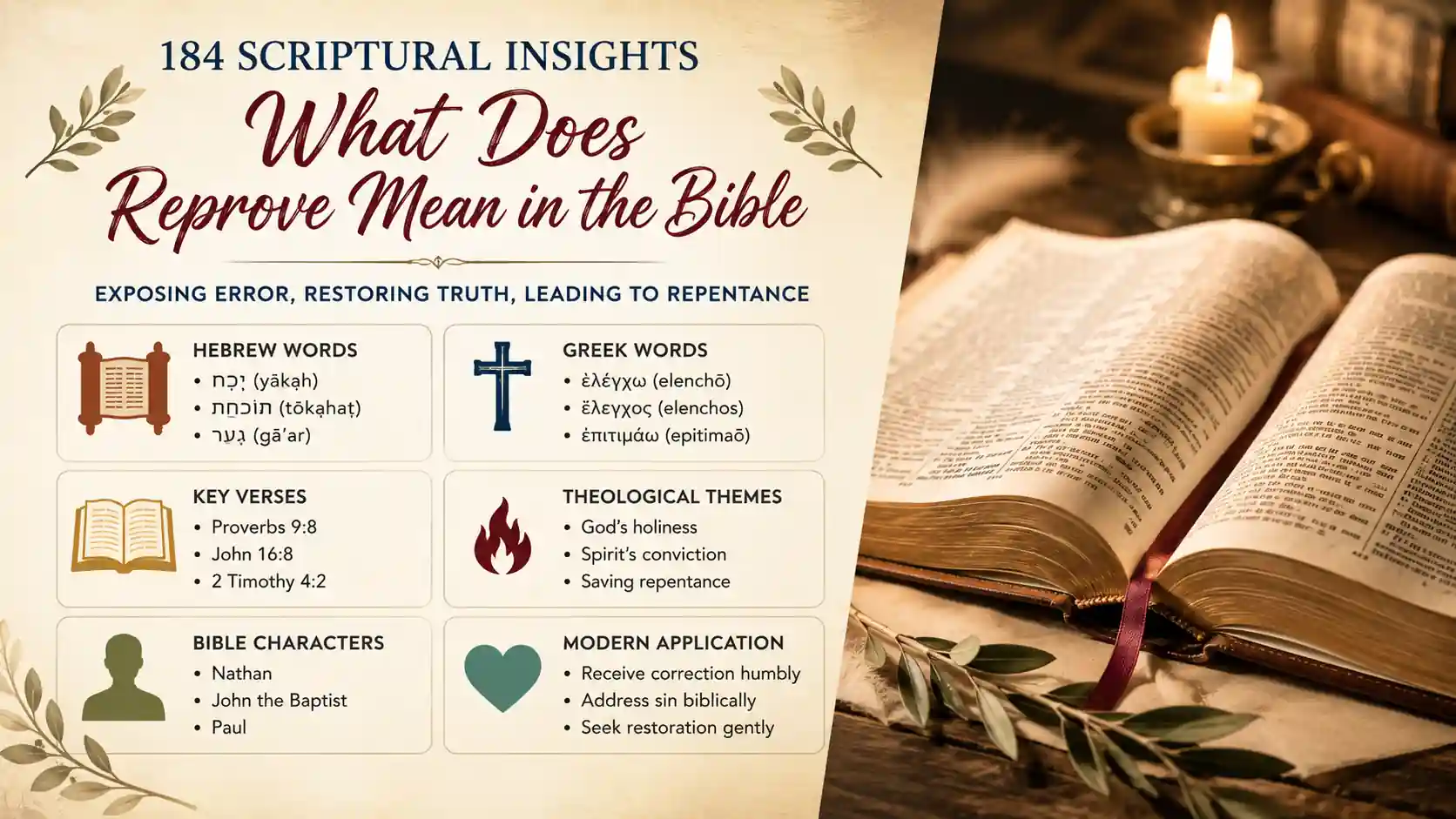
What does reprove mean in the Bible? In Scripture, to reprove is to expose wrongdoing, demonstrate error, convict the conscience, and call a person back to truth. Biblical reproof is stronger than casual criticism, yet it is never meant to be cruel or self-righteous.
God reproves through his Word, his Spirit, wise believers, prophets, apostles, and faithful church leaders. As you study the biblical language, you discover that reproof joins truth with correction so that repentance, restoration, wisdom, and holiness may follow.
Reprove in Key Scripture References
| Verse | Passage Snippet | Context |
|---|---|---|
| Genesis 20:16 | “Reproved” before others | Abimelech vindicates Sarah |
| Leviticus 19:17 | “Rebuke thy neighbour” | Loving correction prevents hatred |
| Job 5:17 | “Whom God correcteth” | Divine discipline is blessed |
| Proverbs 9:8 | “Reprove a wise man” | Wise people welcome correction |
| Proverbs 15:31 | “Heareth the reproof of life” | Correction leads to wisdom |
| Isaiah 11:3–4 | Messiah shall “reprove” | Righteous judgment of the poor |
| John 16:8 | Spirit will “reprove the world” | Conviction concerning sin |
| Ephesians 5:11 | “Rather reprove them” | Exposing works of darkness |
| 1 Timothy 5:20 | “Them that sin rebuke” | Public correction of persistent sin |
| 2 Timothy 4:2 | “Reprove, rebuke, exhort” | Timothy must preach faithfully |
Reprove in Bible Translation Comparison
| Verse | KJV | NIV | ESV | NASB |
|---|---|---|---|---|
| Proverbs 9:8 | Reprove | Rebuke | Reprove | Rebuke |
| Proverbs 15:12 | Reprover | Correction | Reproof | Reproof |
| Proverbs 24:25 | Rebuke | Convict | Rebuke | Rebuke |
| Isaiah 11:4 | Reprove | Give decisions | Decide | Decide |
| John 3:20 | Reproved | Exposed | Exposed | Exposed |
| John 16:8 | Reprove | Prove wrong | Convict | Convict |
| Ephesians 5:11 | Reprove | Expose | Expose | Expose |
| Ephesians 5:13 | Reproved | Exposed | Exposed | Exposed |
| 2 Timothy 4:2 | Reprove | Correct | Reprove | Reprove |
| Titus 1:13 | Rebuke sharply | Rebuke sharply | Rebuke sharply | Reprimand severely |
The translation differences reflect the breadth of ἐλέγχω, elenchō. Depending on context, it can mean to expose, convict, refute, correct, or reprove. It does not merely describe expressing disapproval. It often includes bringing persuasive evidence that reveals what is wrong.
People and Characters Associated with Reprove
| Person | Role | Connection |
|---|---|---|
| Moses | Covenant mediator | Corrected Israel’s rebellion |
| Nathan | Prophet | Reproved David’s adultery |
| Elijah | Prophet | Confronted Ahab’s idolatry |
| Micaiah | Prophet | Refuted false royal counsel |
| John the Baptist | Forerunner | Reproved Herod’s immorality |
| Jesus | Messiah and Teacher | Exposed hypocrisy and unbelief |
| Peter | Apostle | Reproved Simon the sorcerer |
| Paul | Apostle | Corrected churches and leaders |
| Timothy | Pastor and evangelist | Commanded to reprove patiently |
| Holy Spirit | Divine Counselor | Convicts the world of sin |
Original Hebrew and Greek Words for Reprove
| Original Word | Transliteration | Strong’s # | Literal Meaning |
|---|---|---|---|
| יָכַח | yāḵaḥ | H3198 | Decide, prove, correct |
| תּוֹכַחַת | tôḵaḥaṯ | H8433 | Reproof, correction |
| גָּעַר | gāʿar | H1605 | Rebuke, restrain |
| מוּסָר | mûsār | H4148 | Discipline, instruction |
| כָּלַם | kālam | H3637 | Shame, humiliate |
| ἐλέγχω | elenchō | G1651 | Expose, convict, refute |
| ἔλεγχος | elenchos | G1650 | Proof, conviction |
| ἐπιτιμάω | epitimaō | G2008 | Rebuke, warn sternly |
| ἐπιπλήσσω | epiplēssō | G1969 | Reprimand sharply |
| παιδεύω | paideuō | G3811 | Train, discipline, correct |
The principal Old Testament verb is יָכַח, yāḵaḥ. It can describe proving a case, settling a dispute, correcting an offender, or showing someone to be wrong. Its judicial coloring explains why biblical reproof frequently includes evidence and moral judgment rather than personal irritation.
The central New Testament verb is ἐλέγχω, elenchō, Strong’s G1651. It appears in passages concerning Christ’s correction, the Spirit’s conviction, the exposure of darkness, and pastoral preaching. Its range includes convicting, exposing, rebuking, and refuting.
Related Biblical Concepts of Reprove
| Concept | Connection | Supporting Verse |
|---|---|---|
| Conviction | Reveals guilt before God | John 16:8 |
| Rebuke | Directly confronts wrongdoing | Luke 17:3 |
| Correction | Restores sound thinking | 2 Timothy 3:16 |
| Discipline | Trains God’s children | Hebrews 12:5–11 |
| Repentance | Proper response to reproof | Revelation 3:19 |
| Wisdom | Welcomes truthful correction | Proverbs 9:8–9 |
| Exposure | Brings darkness into light | Ephesians 5:11–13 |
| Restoration | Seeks a sinner’s recovery | Galatians 6:1 |
| Judgment | Distinguishes right from wrong | Isaiah 11:3–4 |
| Exhortation | Encourages faithful obedience | 2 Timothy 4:2 |
Historical and Cultural Context of Reprove
| Aspect | Detail | Biblical Source |
|---|---|---|
| City gate | Elders judged disputes publicly | Deuteronomy 21:19 |
| Covenant law | Correction upheld God’s commands | Leviticus 19:17 |
| Wisdom school | Learners received moral instruction | Proverbs 1:20–30 |
| Prophetic office | Prophets confronted covenant breaking | 2 Samuel 12:1–12 |
| Royal court | Prophets corrected kings | 1 Kings 22:13–28 |
| Synagogue life | Scripture instructed communities | Acts 13:14–16 |
| Household order | Parents disciplined children | Proverbs 13:24 |
| Early church | Sin received accountable correction | Matthew 18:15–17 |
| Pastoral ministry | Elders guarded sound doctrine | Titus 1:9–13 |
| Public teaching | Error was answered openly | Acts 18:24–28 |
In ancient Israel, reproof often belonged to covenant life. Israel had received God’s law, so wrongdoing was not merely a private mistake. Sin violated a revealed relationship with the Lord and could damage the whole community.
The prophets therefore acted much like covenant prosecutors. Nathan confronted David, Elijah confronted Ahab, and John the Baptist confronted Herod. Their words named specific sins, appealed to God’s authority, and demanded a changed response.
Theological Themes within Reprove
| Theme | Explanation | Scripture |
|---|---|---|
| God’s holiness | Reproof identifies what opposes God | Habakkuk 1:13 |
| Divine love | Christ corrects those he loves | Revelation 3:19 |
| Human sin | Hearts resist exposing light | John 3:19–20 |
| Spirit’s work | He convicts concerning sin | John 16:8–11 |
| Scriptural authority | God’s Word corrects error | 2 Timothy 3:16 |
| Saving repentance | Reproof may awaken repentance | 2 Corinthians 7:9–10 |
| Church purity | Persistent sin cannot be ignored | 1 Timothy 5:20 |
| Spiritual wisdom | Wise people receive correction | Proverbs 15:31 |
| Restoration | Correction seeks renewed obedience | Galatians 6:1 |
| Final judgment | Christ exposes every hidden work | 1 Corinthians 4:5 |
Modern Application of Reprove for Believers
| Area | Practice | Scripture |
|---|---|---|
| Personal study | Let Scripture examine your conduct | Hebrews 4:12 |
| Prayer | Ask God to reveal hidden sin | Psalm 139:23–24 |
| Friendship | Receive honest correction humbly | Proverbs 27:5–6 |
| Family | Correct without provoking anger | Ephesians 6:4 |
| Church | Address sin through proper steps | Matthew 18:15–17 |
| Leadership | Correct patiently through teaching | 2 Timothy 4:2 |
| Doctrine | Refute error with sound Scripture | Titus 1:9 |
| Speech | Join truth with gentleness | 2 Timothy 2:24–25 |
| Restoration | Help the fallen without pride | Galatians 6:1 |
| Witness | Expose darkness through holy living | Ephesians 5:8–13 |
What Does Reprove Mean in the Bible Through יָכַח?
The Hebrew verb יָכַח, yāḵaḥ, shows that reproof can have a judicial character. In Job, Proverbs, and the prophets, the word may refer to arguing a case, establishing what is right, correcting someone, or rendering a just decision. Reproof is therefore grounded in truth that can be demonstrated.
This meaning protects biblical correction from becoming a weapon of personal preference. You do not reprove someone simply because that person irritates you. Faithful reproof identifies a genuine conflict with God’s revealed will and explains the matter honestly.
How ἐλέγχω Moves from Exposure to Conviction
In John 3:20, people avoid the light because they do not want their deeds exposed. In Ephesians 5:11–13, believers must not participate in works of darkness but must expose them. The same verb family links light, evidence, moral disclosure, and accountability.
John 16:8 gives the word an especially profound setting. Jesus promises that the Holy Spirit will convict the world concerning sin, righteousness, and judgment. The Spirit does more than make people feel uncomfortable. He reveals the truth about sin and directs attention to Christ.
Reproof Under the New Covenant Word
Paul tells Timothy that all Scripture is profitable for reproof and correction. Reproof identifies what is wrong, while correction helps restore what should be right. Both functions prepare the servant of God for faithful living and useful work.
Paul later commands Timothy to “reprove, rebuke, exhort” while preaching the Word. The surrounding phrases are essential. Correction must be exercised with patience and careful teaching, especially when hearers prefer pleasing myths to sound doctrine.
Why Loving Reproof Seeks Restoration
Biblical reproof is an expression of love when its purpose is repentance and restoration. Jesus says that he reproves and disciplines those he loves. Proverbs likewise teaches that open rebuke can be more faithful than affection that refuses to speak.
Still, correct content does not excuse a proud manner. Galatians 6:1 directs spiritual believers to restore a person gently while watching themselves. Your goal is not humiliation, superiority, or victory in an argument. It is the recovery of a brother or sister and the honor of Christ.
Frequently Asked Questions About Reprove
Does ἐλέγχω mean “convict” or “reprove” in John 16:8?
It includes both ideas, since the Spirit exposes the truth, demonstrates guilt, and presses that truth upon the conscience.
Why does the KJV say “reprove” in Ephesians 5:11 while newer translations say “expose”?
The Greek ἐλέγχω can describe correction, conviction, or exposure, and the imagery of light makes “expose” especially clear in that context.
Is יָכַח always a harsh form of correction?
No, the word can describe reasoning, deciding, proving a case, correcting, or judging, with its force determined by the passage.
What is the difference between reproof and rebuke in 2 Timothy 4:2?
Reproof demonstrates error, rebuke warns against wrongdoing, and exhortation urges the hearer toward faithful obedience.
How should you reprove another believer without becoming judgmental?
Use Scripture accurately, examine your own heart, speak gently, follow biblical accountability, and seek restoration rather than shame.