
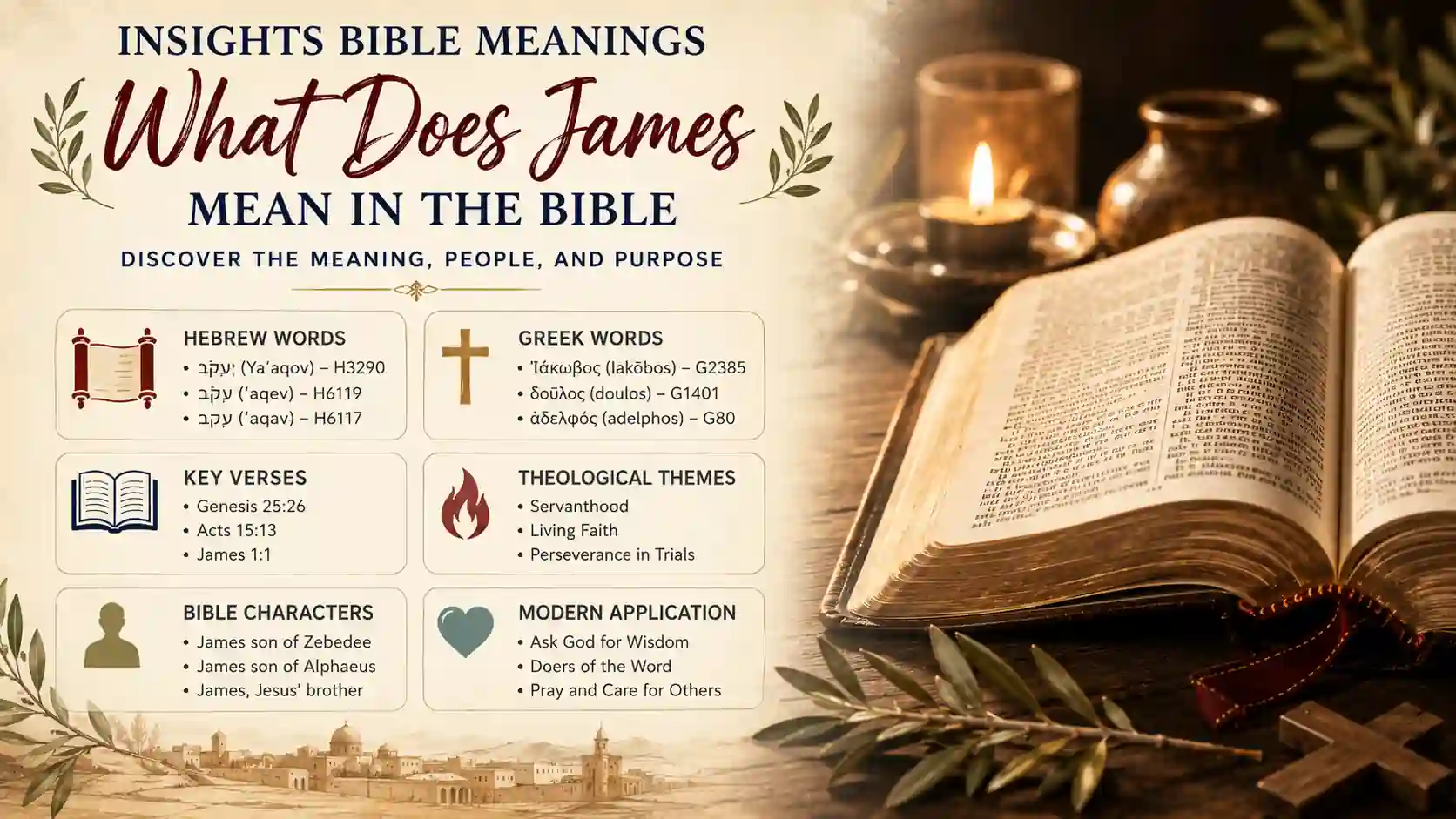
What does James mean in the Bible? The English name James represents the Greek name Ἰάκωβος (Iakōbos), which comes from the Hebrew יַעֲקֹב (Yaʿaqov), usually rendered Jacob in the Old Testament. The name is traditionally associated with grasping the heel, following behind, or supplanting, based on Jacob’s birth in Genesis 25.
In the New Testament, James does not describe only one person. Several important believers bear the name, including two apostles and James, the brother of Jesus, who became a leading shepherd of the Jerusalem church.
Key James Scripture References
| Verse | Passage Snippet | Context |
|---|---|---|
| Genesis 25:26 | “His hand took hold” | Jacob grasps Esau’s heel |
| Matthew 4:21 | James son of Zebedee | Jesus calls two brothers |
| Matthew 10:3 | James son of Alphaeus | Named among the Twelve |
| Mark 3:17 | James and John | Called Sons of Thunder |
| Mark 6:3 | James, Jesus’ brother | Nazareth identifies Jesus’ family |
| Acts 12:2 | James killed by Herod | First apostolic martyrdom recorded |
| Acts 15:13 | “James answered” | Jerusalem Council leadership |
| Galatians 1:19 | “The Lord’s brother” | Paul meets James |
| James 1:1 | “James, a servant” | Opening of the epistle |
| James 2:17 | Faith without works | Living faith produces action |
James Bible Translation Comparison
| Verse | KJV | NIV | ESV | NASB |
|---|---|---|---|---|
| Matthew 4:21 | James son of Zebedee | James son of Zebedee | James son of Zebedee | James the son of Zebedee |
| Matthew 10:3 | James the son of Alphaeus | James son of Alphaeus | James the son of Alphaeus | James the son of Alphaeus |
| Mark 6:3 | Brother of James | Brother of James | Brother of James | Brother of James |
| Acts 12:2 | Killed James | James put to death | Killed James | James put to death |
| Acts 15:13 | James answered | James spoke up | James replied | James responded |
| Galatians 1:19 | James the Lord’s brother | James, the Lord’s brother | James the Lord’s brother | James, the Lord’s brother |
| James 1:1 | A servant of God | A servant of God | A servant of God | A bond-servant of God |
| James 1:22 | Doers of the word | Do what it says | Doers of the word | Doers of the word |
| James 2:17 | Faith without works | Faith without action | Faith without works | Faith without works |
| James 5:16 | Effectual fervent prayer | Prayer is powerful | Prayer has great power | Prayer can accomplish much |
People and Characters Associated with James
| Person | Role | Connection |
|---|---|---|
| Jacob | Israelite patriarch | Hebrew source of the name James |
| James son of Zebedee | Apostle | Brother of John |
| John | Apostle | Brother and ministry partner |
| Zebedee | Galilean fisherman | Father of James and John |
| Salome | Disciple of Jesus | Traditionally linked with Zebedee’s family |
| James son of Alphaeus | Apostle | One of Jesus’ Twelve |
| Alphaeus | Father | Identifies the second apostle James |
| James, Jesus’ brother | Jerusalem leader | Prominent witness and church elder |
| Jesus Christ | Lord and Messiah | Brother and risen Lord of James |
| Jude | Servant of Christ | Identifies himself through James |
Original Hebrew and Greek Words Behind James
| Original Word | Transliteration | Strong’s # | Literal Meaning |
|---|---|---|---|
| יַעֲקֹב | Yaʿaqov | H3290 | Jacob |
| עָקֵב | ʿaqev | H6119 | Heel |
| עָקַב | ʿaqav | H6117 | Follow at the heel |
| Ἰακώβ | Iakōb | G2384 | Jacob |
| Ἰάκωβος | Iakōbos | G2385 | James or Jacob |
| δοῦλος | doulos | G1401 | Servant or bond-servant |
| ἀδελφός | adelphos | G80 | Brother |
| ἀπόστολος | apostolos | G652 | Apostle or sent one |
| πίστις | pistis | G4102 | Faith or trust |
| ἔργον | ergon | G2041 | Work or deed |
Related Biblical Concepts Connected with James
| Concept | Connection | Supporting Verse |
|---|---|---|
| Calling | James leaves his fishing work | Matthew 4:21–22 |
| Apostleship | Two men named James join the Twelve | Matthew 10:2–3 |
| Martyrdom | Zebedee’s son dies for the faith | Acts 12:1–2 |
| Resurrection witness | Jesus appears to James | 1 Corinthians 15:7 |
| Church leadership | James guides Jerusalem believers | Acts 15:13–21 |
| Humility | James calls himself Christ’s servant | James 1:1 |
| Wisdom | James urges believers to ask God | James 1:5 |
| Perseverance | Trials produce steadfastness | James 1:2–4 |
| Living faith | Genuine belief bears fruit | James 2:14–26 |
| Prayer | Righteous prayer is effective | James 5:16–18 |
Historical and Cultural Context of James
| Aspect | Detail | Biblical Source |
|---|---|---|
| Hebrew origin | James corresponds to Jacob | Genesis 25:26 |
| Greek language | Ἰάκωβος represents Yaʿaqov | Matthew 4:21 |
| Naming customs | Fathers distinguished men sharing names | Matthew 10:2–3 |
| Galilean fishing | Zebedee’s family worked by the sea | Mark 1:19–20 |
| Roman Judea | Herod Agrippa persecuted the church | Acts 12:1–2 |
| Jerusalem church | James held recognized authority | Acts 15:13 |
| Jewish dispersion | The letter addresses twelve scattered tribes | James 1:1 |
| Synagogue setting | Assembly language reflects Jewish roots | James 2:2 |
| Economic inequality | Rich and poor met in one assembly | James 2:1–7 |
| Agricultural life | Rain and harvest illustrate patience | James 5:7–8 |
Theological Themes Revealed Through James
| Theme | Explanation | Scripture |
|---|---|---|
| Servanthood | Honor begins with belonging to Christ | James 1:1 |
| Providence in trials | God forms endurance through testing | James 1:2–4 |
| Divine generosity | God gives wisdom without reproach | James 1:5 |
| God’s goodness | Every good gift comes from above | James 1:17 |
| New birth | God brings believers forth by truth | James 1:18 |
| Obedience | Hearing must lead to doing | James 1:22 |
| Impartiality | Faith rejects social favoritism | James 2:1 |
| Mercy | Mercy triumphs over judgment | James 2:13 |
| Justifying evidence | Works demonstrate living faith | James 2:18 |
| Restoration | Believers help wanderers return | James 5:19–20 |
Modern Application from James for Believers
| Area | Practice | Scripture |
|---|---|---|
| Trials | Receive hardship as spiritual formation | James 1:2–4 |
| Decisions | Ask God sincerely for wisdom | James 1:5–8 |
| Temptation | Recognize and resist sinful desire | James 1:13–15 |
| Bible study | Practice what Scripture teaches | James 1:22–25 |
| Speech | Listen carefully and speak slowly | James 1:19 |
| Community | Refuse favoritism toward the wealthy | James 2:1–4 |
| Service | Meet practical needs with compassion | James 2:15–16 |
| Communication | Use words to bless rather than harm | James 3:9–10 |
| Planning | Submit future plans to God’s will | James 4:13–15 |
| Suffering | Pray and seek mature spiritual care | James 5:13–16 |
What Does James Mean in the Bible Through יַעֲקֹב?
The name James reaches back through Greek into the Hebrew name יַעֲקֹב (Yaʿaqov). Genesis connects Jacob’s name with the unusual circumstances of his birth. He emerged holding the heel of his twin brother Esau, so his name became associated with the heel and with following closely behind another person.
Some explanations give James the simple meaning “supplanter.” That meaning reflects the later story of Jacob receiving Esau’s birthright and blessing, but it should not be treated as a complete definition of the name. Its clearest biblical wordplay concerns Jacob’s grasp of Esau’s heel in Genesis 25:26.
Why Ἰάκωβος Became James in English Bibles
The Greek New Testament uses Ἰάκωβος (Iakōbos) for the men English Bibles call James. The same name developed through Latin and later European languages before entering English in the familiar form James. Therefore, James and Jacob are not unrelated biblical names. They are English forms that developed from the same ancient name.
This explains why some modern teachers refer to the New Testament book as “Jacob” rather than “James.” Standard English translations retain James because that form is deeply established in English Christian usage. The difference concerns language history, not the identity or spiritual character of the biblical men.
Three Prominent Men Named James in the New Testament
James son of Zebedee was the brother of John and one of the first disciples called by Jesus. He belonged to Christ’s closest apostolic circle and witnessed events such as the Transfiguration. Herod Agrippa later executed him with the sword, making him the first of the Twelve whose martyrdom Scripture records.
James son of Alphaeus also belonged to the Twelve, though Scripture gives few details about his individual ministry. A third James, identified as the Lord’s brother, became a central leader in Jerusalem. He spoke decisively at the Jerusalem Council and was recognized by Paul as a leading pillar of the church.
James the Lord’S Brother and the Wisdom of Living Faith
During Jesus’ earthly ministry, his brothers did not believe in him. After the resurrection, however, Jesus appeared personally to James. James later prayed with the disciples, led the Jerusalem church, received Paul, and helped the early believers address the difficult question of Gentile inclusion.
The Letter of James is traditionally associated with this James, though authorship and dating remain subjects of scholarly discussion. Its teaching resembles Hebrew wisdom literature and the ethical instruction of Jesus. It does not present works as a replacement for faith. It teaches that genuine faith becomes visible through obedience, mercy, disciplined speech, endurance, and care for vulnerable people.
Questions Bible Students Ask About James
Does James literally mean “supplanter” in the Bible?
“Supplanter” reflects Jacob’s story, but the name’s earliest biblical wordplay is connected with the Hebrew heel, עָקֵב (ʿaqev).
Why is יַעֲקֹב translated Jacob in one Testament and James in another?
Both names developed from the same Hebrew source, but different stages of Greek, Latin, and English usage produced the two familiar forms.
Are James son of Alphaeus and James the brother of Jesus the same person?
Scripture does not explicitly identify them as the same man, so your study should preserve the distinction unless stronger evidence is established.
Does James 2:24 contradict Paul’s teaching about justification by faith?
Paul denies that works earn acceptance with God, while James argues that authentic faith is demonstrated and vindicated by obedient action.
How should the meaning of James affect your Christian life?
The name’s history may deepen your study, but the biblical men named James chiefly call you toward discipleship, humble service, courageous witness, practical faith, and faithful prayer.