
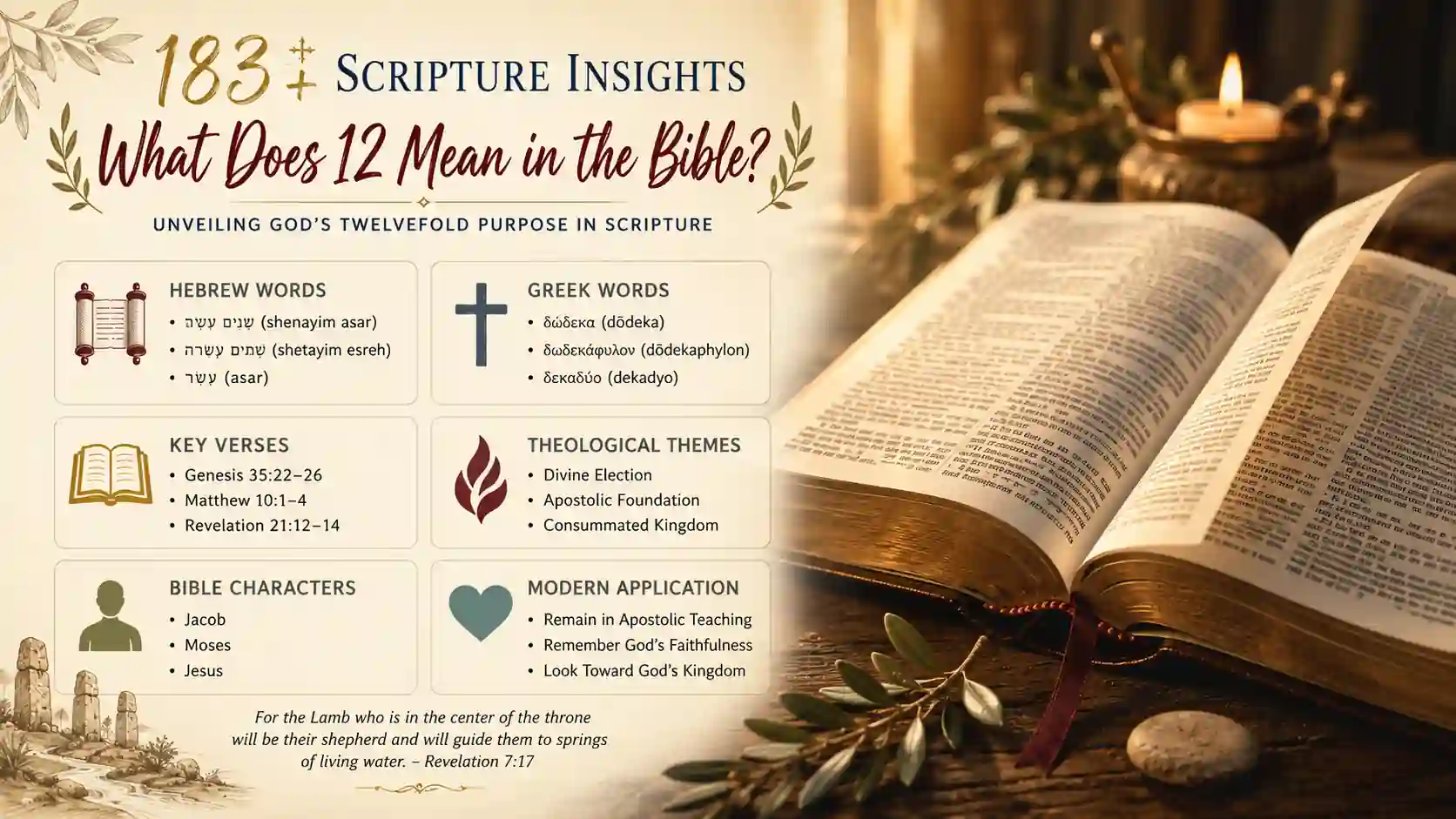
What does 12 mean in the Bible? Scripture frequently uses twelve in connection with God’s covenant people, appointed leadership, representative authority, worship, and the ordered fullness of his redemptive plan. Israel descended from twelve patriarchs, Jesus appointed twelve apostles, and the New Jerusalem displays twelve gates and twelve foundations.
Yet the Bible never gives a universal numerical dictionary declaring that twelve always carries one fixed symbolic meaning. You should begin with each passage’s historical and literary context, then observe how recurring patterns unite Israel, the church’s apostolic foundation, and the final kingdom of God.
Twelve in Key Scripture References
| Verse | Passage Snippet | Context |
|---|---|---|
| Genesis 17:20 | Ishmael will father twelve princes | God promises Ishmael a numerous, organized lineage |
| Genesis 35:22-26 | The sons of Jacob were twelve | Jacob’s sons become Israel’s tribal patriarchs |
| Exodus 24:4 | Twelve pillars for Israel’s tribes | Moses ratifies the Sinai covenant |
| Exodus 28:21 | Twelve stones bearing tribal names | The high priest represents Israel before God |
| Numbers 1:44 | Twelve tribal leaders assist Moses | Israel is counted and ordered in the wilderness |
| Joshua 4:8-9 | Twelve stones from the Jordan | A memorial recalls God’s covenant faithfulness |
| Matthew 10:1-4 | Jesus appoints the Twelve | The Messiah forms an authoritative apostolic group |
| Revelation 21:12-14 | Twelve gates and foundations | New Jerusalem joins Israel and the apostles |
Twelve in Bible Translation Comparison
| Verse | KJV | NIV | ESV | NASB |
|---|---|---|---|---|
| Genesis 35:22 | “sons of Jacob were twelve” | “Jacob had twelve sons” | “sons of Jacob were twelve” | “sons of Jacob were twelve” |
| Exodus 24:4 | “twelve pillars” | “twelve stone pillars” | “twelve pillars” | “twelve pillars” |
| Exodus 28:21 | “twelve, according to their names” | “There are to be twelve stones” | “There shall be twelve stones” | “The stones shall be twelve” |
| Joshua 4:8 | “twelve stones” | “twelve stones” | “twelve stones” | “twelve stones” |
| Matthew 10:2 | “twelve apostles” | “twelve apostles” | “twelve apostles” | “twelve apostles” |
| Luke 22:30 | “twelve tribes of Israel” | “twelve tribes of Israel” | “twelve tribes of Israel” | “twelve tribes of Israel” |
| Revelation 12:1 | “crown of twelve stars” | “crown of twelve stars” | “crown of twelve stars” | “crown of twelve stars” |
| Revelation 21:14 | “twelve foundations” | “twelve foundations” | “twelve foundations” | “twelve foundation stones” |
Twelve and the People Who Carry Its Meaning
| Person | Role | Connection |
|---|---|---|
| Jacob | Patriarch renamed Israel | Father of the twelve tribal ancestors |
| Reuben | Jacob’s firstborn | Head of one of Israel’s tribes |
| Joseph | Son of Jacob | His sons Ephraim and Manasseh receive tribal standing |
| Moses | Covenant mediator | Erects twelve pillars and appoints tribal representatives |
| Aaron | High priest | Bears twelve named stones on his breastpiece |
| Joshua | Israel’s leader | Commands twelve men to collect Jordan memorial stones |
| Jesus | Messiah and covenant Lord | Deliberately appoints twelve apostles |
| Peter | Apostle and witness | Named first in several lists of the Twelve |
| Matthias | Replacement apostle | Restores the apostolic group after Judas’s death |
| John | Apostle and seer | Records the twelvefold imagery of Revelation |
Twelve in the Original Hebrew and Greek Words
| Original Word | Transliteration | Strong’s # | Literal Meaning |
|---|---|---|---|
| שְׁנֵים | shenayim | H8147 | Two, masculine form |
| שְׁתֵּים | shetayim | H8147 | Two, feminine form |
| עָשָׂר | asar | H6240 | Ten, used in compound numbers |
| עֶשְׂרֵה | esreh | H6240 | Ten, feminine compound form |
| שְׁנֵים עָשָׂר | shenayim asar | H8147 + H6240 | Twelve, masculine construction |
| שְׁתֵּים עֶשְׂרֵה | shetayim esreh | H8147 + H6240 | Twelve, feminine construction |
| δώδεκα | dōdeka | G1427 | Twelve |
| δωδέκατος | dōdekatos | G1428 | Twelfth |
| δεκαδύο | dekadyo | G1177 | Ten and two, twelve |
| δωδεκάφυλον | dōdekaphylon | G1429 | The twelve tribes |
Twelve and Related Biblical Concepts
| Concept | Connection | Supporting Verse |
|---|---|---|
| Covenant people | Twelve sons form Israel’s tribal family | Genesis 35:22-26 |
| Representation | Twelve stones carry the tribes’ names | Exodus 28:21 |
| Covenant witness | Twelve pillars stand at Sinai | Exodus 24:4 |
| Sacred remembrance | Twelve stones memorialize the Jordan crossing | Joshua 4:6-7 |
| National order | Tribal leaders assist with Israel’s census | Numbers 1:44 |
| Apostolic authority | Jesus commissions the Twelve | Matthew 10:1-8 |
| Kingdom judgment | Apostles judge Israel’s twelve tribes | Luke 22:28-30 |
| Restored leadership | Matthias fills Judas’s vacant place | Acts 1:20-26 |
| Heavenly identity | A woman wears twelve stars | Revelation 12:1 |
| New creation | Twelve gates and foundations mark the city | Revelation 21:12-14 |
Twelve in Historical and Cultural Context
| Aspect | Detail | Biblical Source |
|---|---|---|
| Tribal society | Identity followed descent from Jacob’s sons | Genesis 49:1-28 |
| Land inheritance | Canaan was distributed among Israel’s tribes | Joshua 13-19 |
| Levitical distinction | Levi received cities rather than one territory | Joshua 21:1-3 |
| Joseph’s double share | Ephraim and Manasseh inherited through Joseph | Genesis 48:5 |
| Priestly representation | Gemstones carried tribal names before the Lord | Exodus 28:15-21 |
| Wilderness administration | One leader represented each tribe | Numbers 1:4-16 |
| Memorial practice | Physical stones taught later generations | Joshua 4:21-24 |
| Jewish expectation | Restored Israel remained a prophetic hope | Ezekiel 37:15-22 |
| Messianic renewal | Jesus’ Twelve evoke renewed Israel | Matthew 19:28 |
| Apocalyptic symbolism | Revelation intensifies twelve through multiples | Revelation 7:4-8 |
Twelve and Its Theological Themes
| Theme | Explanation | Scripture |
|---|---|---|
| Divine election | God forms a people through chosen patriarchs | Genesis 49:28 |
| Representative leadership | Selected individuals stand for the whole community | Numbers 1:44 |
| Covenant continuity | Israel’s tribes remain present in later biblical hope | Ezekiel 48:30-35 |
| Messianic restoration | Jesus’ choice of twelve signals Israel’s renewal | Matthew 19:28 |
| Apostolic foundation | The church receives authoritative gospel testimony | Ephesians 2:20 |
| Unity in redemption | Tribes and apostles appear together in the holy city | Revelation 21:12-14 |
| Ordered worship | Tribal names are carried into priestly service | Exodus 28:29 |
| Faithful remembrance | Twelve stones preserve testimony across generations | Joshua 4:6-7 |
| Complete community | Twelve often portrays God’s people corporately | Revelation 12:1 |
| Consummated kingdom | Twelvefold imagery fills the New Jerusalem | Revelation 21:12-21 |
Twelve in Modern Application for Believers
| Area | Practice | Scripture |
|---|---|---|
| Bible interpretation | Read numerical patterns within their contexts | Revelation 21:9-14 |
| Christian identity | Remember that you belong to God’s redeemed people | 1 Peter 2:9-10 |
| Church doctrine | Remain grounded in apostolic teaching | Acts 2:42 |
| Leadership | Treat spiritual authority as accountable service | Mark 10:42-45 |
| Remembrance | Establish practices that recall God’s faithfulness | Joshua 4:21-24 |
| Community | Value every member of Christ’s body | 1 Corinthians 12:12-27 |
| Mission | Carry Christ’s message as his sent servant | Matthew 10:5-8 |
| Hope | Look toward God’s united, holy city | Revelation 21:1-14 |
| Humility | Avoid speculative numerical predictions | Acts 1:7 |
| Worship | Praise the Lamb who gathers a worldwide people | Revelation 5:9-10 |
שְׁנֵים עָשָׂר And the Formation of Covenant Israel
The common Hebrew expression for twelve is שְׁנֵים עָשָׂר, shenayim asar, literally constructed from “two” and “ten.” Because biblical Hebrew marks grammatical gender in numbers, Scripture may also use the feminine construction שְׁתֵּים עֶשְׂרֵה, shetayim esreh. These expressions are ordinary counting terms before they carry any symbolic force.
Their theological weight grows from the history they describe. Jacob’s twelve sons become the fathers of Israel’s tribes, so twelve becomes closely associated with the covenant nation. Even when tribal lists vary because of Levi’s special status or Joseph’s representation through Ephraim and Manasseh, Israel continues to be understood corporately as twelve tribes.
The Twelve Stones from Sinai to the Jordan
At Sinai, Moses builds twelve pillars corresponding to the twelve tribes as Israel enters covenant with the Lord. The pillars do not possess mystical power. They visibly represent the entire people who have heard God’s words and pledged covenant obedience under the blood of the sacrifice.
The same representative purpose appears in Aaron’s breastpiece and Joshua’s Jordan memorial. Twelve engraved gemstones are carried before the Lord by the high priest, while twelve river stones teach future generations what God did. In both settings, twelve joins identity with remembrance. God knows his people by name, acts for them, and commands them to preserve faithful testimony.
What Does 12 Mean in the Bible When Jesus Chooses the Apostles?
Jesus’ appointment of twelve apostles is best understood against Israel’s story. He does not merely gather a convenient number of assistants. By forming “the Twelve,” Jesus presents himself as the Messiah who is restoring and reconstituting God’s covenant people around his own person, authority, death, and resurrection.
The apostles also receive a unique historical calling. They accompany Jesus, witness his resurrection, preach the gospel, and provide foundational testimony for the church. Their number points back to Israel’s tribes, while their mission points forward to a redeemed community extending to every nation. The pattern expresses continuity without making the apostles identical to the patriarchs.
δώδεκα In Revelation and the New Jerusalem
The Greek word δώδεκα, dōdeka, appears repeatedly in Revelation’s visions. A woman wears a crown of twelve stars, 144,000 servants are numbered as twelve times twelve times one thousand, and the New Jerusalem possesses twelve gates, twelve angels, twelve tribal names, and twelve apostolic foundations.
This imagery portrays the completeness, unity, and ordered beauty of God’s redeemed people. The tribal names and apostolic names do not erase the distinction between Israel’s history and the church’s apostolic witness. Instead, both stand within one redemptive story centered on the Lamb. Twelve therefore becomes especially appropriate for portraying the covenant community brought to its God-appointed fulfillment.
Questions Bible Students Ask About Twelve
Does שְׁנֵים עָשָׂר, shenayim asar, itself mean spiritual completeness?
No. The Hebrew phrase literally means twelve, while symbolic significance arises from its biblical settings and repeated covenant associations.
Why are there twelve tribes when Levi lacks a normal land inheritance?
Tribal reckoning varies by purpose, with Levi treated separately and Joseph sometimes represented through Ephraim and Manasseh.
Did Jesus choose twelve apostles only to symbolize Israel?
The choice recalls Israel, but the Twelve also served as commissioned witnesses whose testimony became foundational for the church.
Are the twelve gates and twelve foundations in Revelation 21 literal or symbolic?
Revelation presents a visionary city whose twelvefold features communicate theological truth, though faithful interpreters differ about how literally its physical details should be understood.
Should you use twelve to predict dates or hidden events?
No. Scripture uses twelve meaningfully, but it does not authorize speculative calculations that ignore a passage’s grammar, context, and revealed purpose.