
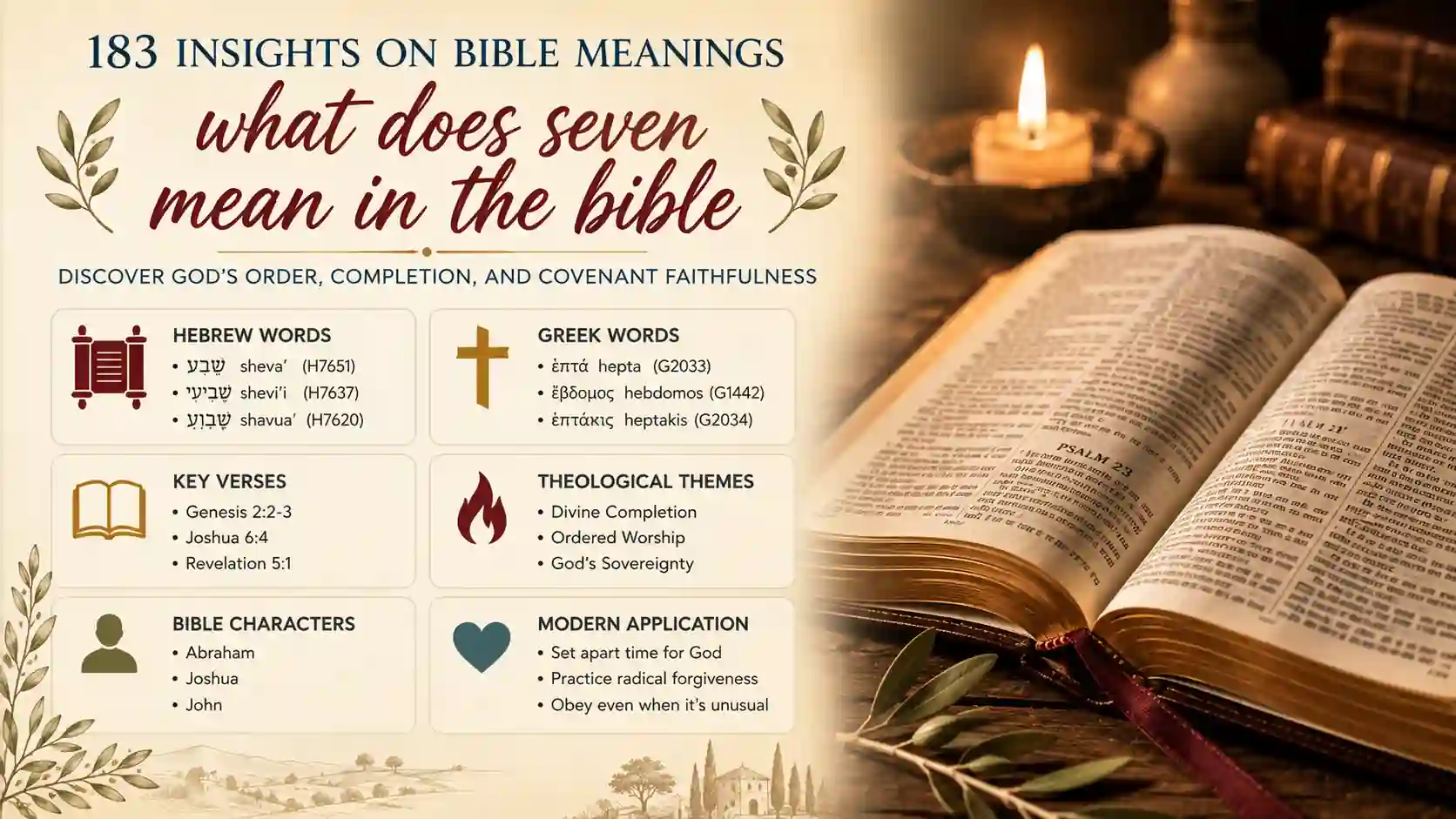
What does seven mean in the Bible? Scripture often uses seven in settings involving completion, consecration, covenant order, judgment, and divine fulfillment. The pattern begins with the seventh day of creation, which God blessed and made holy, and continues through Israel’s worship, festivals, prophetic visions, and the sevenfold imagery of Revelation.
Yet seven is not a secret code that carries precisely the same meaning in every verse. Your study must begin with context, grammar, genre, and the passage’s place within the whole biblical story.
Seven Key Scripture References
| Verse | Passage Snippet | Context |
|---|---|---|
| Genesis 2:2-3 | God rested on the seventh day | Creation reaches its ordered completion |
| Genesis 7:2-4 | Clean animals taken by sevens | Noah prepares for judgment and preservation |
| Genesis 21:28-31 | Abraham sets apart seven ewe lambs | A covenant oath confirms Beersheba |
| Exodus 20:10-11 | The seventh day is Sabbath | Israel imitates God’s creation pattern |
| Leviticus 23:6 | Seven days of unleavened bread | Redemption shapes Israel’s annual worship |
| Joshua 6:4 | Seven priests carry seven trumpets | Jericho falls through obedient faith |
| 2 Kings 5:10 | Naaman washes seven times | Healing follows humble submission |
| Revelation 1:4 | John writes to seven churches | Christ addresses His church in Asia |
| Revelation 5:1 | A scroll sealed with seven seals | God’s redemptive judgment awaits execution |
| Revelation 15:1 | Seven angels bear seven plagues | Divine wrath moves toward completion |
Genesis establishes the seventh day as blessed and holy, while Revelation repeatedly places seven within visions of churches, seals, trumpets, and bowls. These passages give the number its strongest biblical associations with ordered fullness and completed divine action.
Seven Bible Translation Comparison
| Verse | KJV | NIV | ESV | NASB |
|---|---|---|---|---|
| Genesis 2:2 | “seventh day God ended” | “By the seventh day” | “on the seventh day” | “By the seventh day” |
| Genesis 7:2 | “clean beast by sevens” | “seven pairs” | “seven pairs” | “seven pairs” |
| Genesis 21:28 | “seven ewe lambs” | “seven ewe lambs” | “seven ewe lambs” | “seven ewe lambs” |
| Leviticus 4:6 | “sprinkle…seven times” | “sprinkle…seven times” | “sprinkle…seven times” | “sprinkle…seven times” |
| Joshua 6:4 | “seven priests…seven trumpets” | “seven priests…seven trumpets” | “seven priests…seven trumpets” | “seven priests…seven trumpets” |
| 2 Kings 5:10 | “wash…seven times” | “wash yourself seven times” | “wash…seven times” | “wash…seven times” |
| Matthew 18:22 | “seventy times seven” | “seventy-seven times” | “seventy-seven times” | “seventy-seven times” |
| Revelation 1:4 | “seven churches…Asia” | “seven churches…province of Asia” | “seven churches…Asia” | “seven churches…Asia” |
The translations agree on most occurrences. Genesis 2:2 differs slightly because the underlying Hebrew can be represented as God finishing “on” the seventh day or having finished “by” that day. Matthew 18:22 presents a genuine numerical translation question, but every rendering communicates forgiveness beyond ordinary calculation.
Seven People and Characters Associated
| Person | Role | Connection |
|---|---|---|
| God | Creator and covenant Lord | Blesses and sanctifies the seventh day |
| Noah | Survivor of the flood | Receives clean animals in groups of seven |
| Abraham | Patriarch | Uses seven lambs in the Beersheba agreement |
| Jacob | Patriarch | Serves seven years for Rachel, then seven more |
| Joseph | Egyptian administrator | Interprets seven cows and seven grain heads |
| Moses | Covenant mediator | Receives Sabbath and festival instructions |
| Joshua | Israel’s military leader | Leads Jericho’s seven-day procession |
| Naaman | Aramean commander | Dips seven times in the Jordan |
| Daniel | Prophet in exile | Receives the prophecy of seventy sevens |
| John | Apostle and seer | Records Revelation’s extensive sevens |
These characters show that seven appears across biblical eras rather than within one isolated tradition. It belongs to creation, patriarchal covenants, Mosaic worship, conquest, prophetic symbolism, healing narratives, and New Testament apocalyptic revelation.
Seven Original Hebrew and Greek Words
| Original Word | Transliteration | Strong’s # | Literal Meaning |
|---|---|---|---|
| שֶׁבַע | shevaʿ | H7651 | Seven |
| שִׁבְעָה | shivʿah | H7651 | Seven, masculine form |
| שְׁבִיעִי | sheviʿi | H7637 | Seventh |
| שָׁבַע | shavaʿ | H7650 | To swear or bind by oath |
| שָׁבוּעַ | shavuaʿ | H7620 | A seven, a week |
| ἑπτά | hepta | G2033 | Seven |
| ἕβδομος | hebdomos | G1442 | Seventh |
| ἑπτάκις | heptakis | G2034 | Seven times |
| ἑπτακισχίλιοι | heptakischilioi | G2035 | Seven thousand |
The primary Hebrew numeral is שֶׁבַע, shevaʿ, Strong’s H7651. It is related in sound and form to שָׁבַע, shavaʿ, H7650, the verb used for swearing an oath. This relationship helps explain the wordplay surrounding Abraham’s seven lambs and Beersheba, the “well of the oath” or “well of seven.”
The ordinary Greek word is ἑπτά, hepta, Strong’s G2033. Greek writers form related words from the same numerical stem, including ἕβδομος, hebdomos, meaning “seventh,” and ἑπτάκις, heptakis, meaning “seven times.”
Seven Related Biblical Concepts
| Concept | Connection | Supporting Verse |
|---|---|---|
| Creation | God completes His work and rests | Genesis 2:2-3 |
| Sabbath | Every seventh day is set apart | Exodus 20:8-11 |
| Covenant | Seven lambs accompany Abraham’s oath | Genesis 21:28-31 |
| Consecration | Priestly rites include sevenfold actions | Leviticus 8:33-35 |
| Atonement | Blood is sprinkled seven times | Leviticus 16:14 |
| Festivals | Several feasts follow seven-day patterns | Leviticus 23:6, 34 |
| Jubilee | Seven cycles of seven years | Leviticus 25:8-10 |
| Forgiveness | Jesus rejects calculated mercy | Matthew 18:21-22 |
| Judgment | Seals, trumpets, and bowls come in sevens | Revelation 6-16 |
| Worship | Heaven praises the Lamb sevenfold | Revelation 5:12 |
Seven often gathers related biblical ideas into ordered patterns. Sabbath sanctifies time, festivals order Israel’s calendar, priestly rituals structure worship, and Revelation’s cycles organize visions of judgment and salvation.
Seven Historical and Cultural Contexts
| Aspect | Detail | Biblical Source |
|---|---|---|
| Ancient workweek | Six days of labor precede sacred rest | Exodus 20:9-10 |
| Israelite calendar | Weeks and festivals follow seven-day cycles | Leviticus 23 |
| Sabbatical year | Fields rest every seventh year | Leviticus 25:1-7 |
| Jubilee counting | Seven sets of seven years equal forty-nine | Leviticus 25:8 |
| Covenant ceremony | Oaths may involve symbolic objects | Genesis 21:27-31 |
| Priestly purification | Sevenfold sprinkling marks ritual cleansing | Leviticus 4:6 |
| Siege practice | Jericho’s ritual procession lasts seven days | Joshua 6:3-16 |
| Prophetic symbolism | Repeated numbers structure visions | Daniel 9:24-27 |
| Roman Asia | Seven real churches receive Revelation | Revelation 1:4, 11 |
| Apocalyptic writing | Sevens organize heavenly events | Revelation 5-16 |
The seven churches were actual congregations in Roman Asia, not imaginary communities. At the same time, their placement within Revelation’s larger pattern allows them to represent the church’s varied spiritual conditions more broadly. John’s symbolism grows from historical reality rather than replacing it.
Seven Theological Themes
| Theme | Explanation | Scripture |
|---|---|---|
| Divine completion | God brings His appointed work to fulfillment | Genesis 2:2 |
| Holiness | God sets the seventh day apart | Genesis 2:3 |
| Rest | Creation points toward fellowship with God | Hebrews 4:4-11 |
| Covenant faithfulness | God binds Himself to His promises | Genesis 21:31-33 |
| Ordered worship | Repetition teaches reverence and obedience | Leviticus 4:6 |
| Cleansing | Sevenfold acts portray thorough purification | 2 Kings 5:10-14 |
| Forgiveness | Grace exceeds human scorekeeping | Matthew 18:21-22 |
| Sovereignty | History unfolds under God’s authority | Revelation 5:1-9 |
| Judgment | God’s response to evil reaches its goal | Revelation 15:1 |
| Consummation | God completes redemption in the new creation | Revelation 21:1-6 |
Seven does not possess power apart from God. Biblical theology never invites you to trust a number, seek luck through it, or manipulate spiritual outcomes by repeating actions seven times. The number serves the message of the sovereign Lord.
Seven Modern Applications for Believers
| Area | Practice | Scripture |
|---|---|---|
| Work | Receive labor as good but limited | Exodus 20:9 |
| Rest | Set apart regular time for worship | Exodus 20:10 |
| Trust | Believe God completes what He begins | Philippians 1:6 |
| Forgiveness | Refuse to keep a ledger of offenses | Matthew 18:22 |
| Obedience | Follow God even when commands seem unusual | Joshua 6:4 |
| Humility | Submit rather than demanding dramatic signs | 2 Kings 5:13-14 |
| Worship | Honor Christ as the worthy Lamb | Revelation 5:12 |
| Repentance | Hear Christ’s words to the churches | Revelation 2:7 |
| Hope | Await the completion of God’s kingdom | Revelation 21:5-6 |
| Study | Interpret symbols through literary context | Revelation 1:20 |
You apply the biblical meaning of seven by trusting the God who orders time, fulfills covenants, cleanses sinners, judges evil, and completes redemption. Faithful application is not numerology. It is a life shaped by the truths that the number helps Scripture communicate.
שֶׁבַע And the Seventh Day of Creation
The first great theological use of seven appears in Genesis 2. God finishes His creative work, rests, blesses the seventh day, and makes it holy. His rest does not imply exhaustion. It announces that creation has reached its intended order and that the divine King has taken His rightful rest over His finished work.
This foundation controls many later uses. Israel’s Sabbath, sabbatical years, and festival calendar echo creation’s rhythm. Seven can therefore suggest completeness, but more specifically it often points to completeness established by God and directed toward holy fellowship with Him.
What Does Seven Mean in the Bible’S Covenants and Worship?
Seven enters covenant history through Abraham’s agreement with Abimelech. The seven ewe lambs publicly testify that Abraham dug the disputed well. The name Beersheba preserves a Hebrew wordplay involving both seven and oath, showing how numerical and covenant language could reinforce each other.
Under Moses, seven appears in priestly ordination, sacrifices, purification rites, feasts, and the Day of Atonement. These repetitions did not work as magic formulas. They expressed careful obedience, ritual thoroughness, and the holiness required for sinful people to approach the covenant Lord.
Daniel’S Sevens and God’S Appointed History
Daniel 9 moves beyond ordinary days and years by speaking of “seventy sevens.” The Hebrew שָׁבוּעַ, shavuaʿ, can describe a unit or period of seven. Daniel’s prophecy presents history as measured by God, moving toward the restraint of sin, the dealing with iniquity, and the fulfillment of His redemptive purposes.
Interpreters disagree about several chronological details, particularly how the sevens relate to Jerusalem, the Messiah, and later desolation. The passage’s central claim remains clear. Human kingdoms do not control the final timetable. Israel’s future and the triumph of God’s righteousness rest in His appointed plan.
Ἑπτά In Revelation’S Vision of Completion
Revelation uses ἑπτά, hepta, more extensively than any other New Testament book. John sees seven churches, lampstands, stars, seals, trumpets, thunders, angels, plagues, and bowls. These groups structure the visions and portray divine action advancing toward its ordained fullness.
Not every seven in Revelation should be flattened into the single word “perfection.” Some concern churches, others judgment, witness, authority, or worship. Yet together they proclaim that nothing in history is random. The risen Christ rules His churches, the Lamb opens God’s scroll, and evil cannot prevent redemption’s completion.
Questions About Seven in the Bible
Does שֶׁבַע, shevaʿ, always symbolize spiritual completeness?
No. It can function as an ordinary number, and its significance must be determined from each passage’s context.
Why is שָׁבַע, shavaʿ, associated with both seven and swearing an oath?
The Hebrew words are closely related, creating meaningful wordplay in covenant settings such as Abraham’s agreement at Beersheba.
Does Matthew 18:22 say seventy-seven or seventy times seven?
The Greek permits discussion, but either translation teaches forgiveness that refuses to stop at a calculated limit.
Are the seven churches in Revelation symbolic or historical?
They were seven historical congregations in Asia, while their messages also address enduring conditions faced by Christ’s churches.
Should Christians treat seven as a lucky or spiritually powerful number?
No. Scripture directs your faith toward God Himself, not toward numerology, luck, or ritual use of a number.