
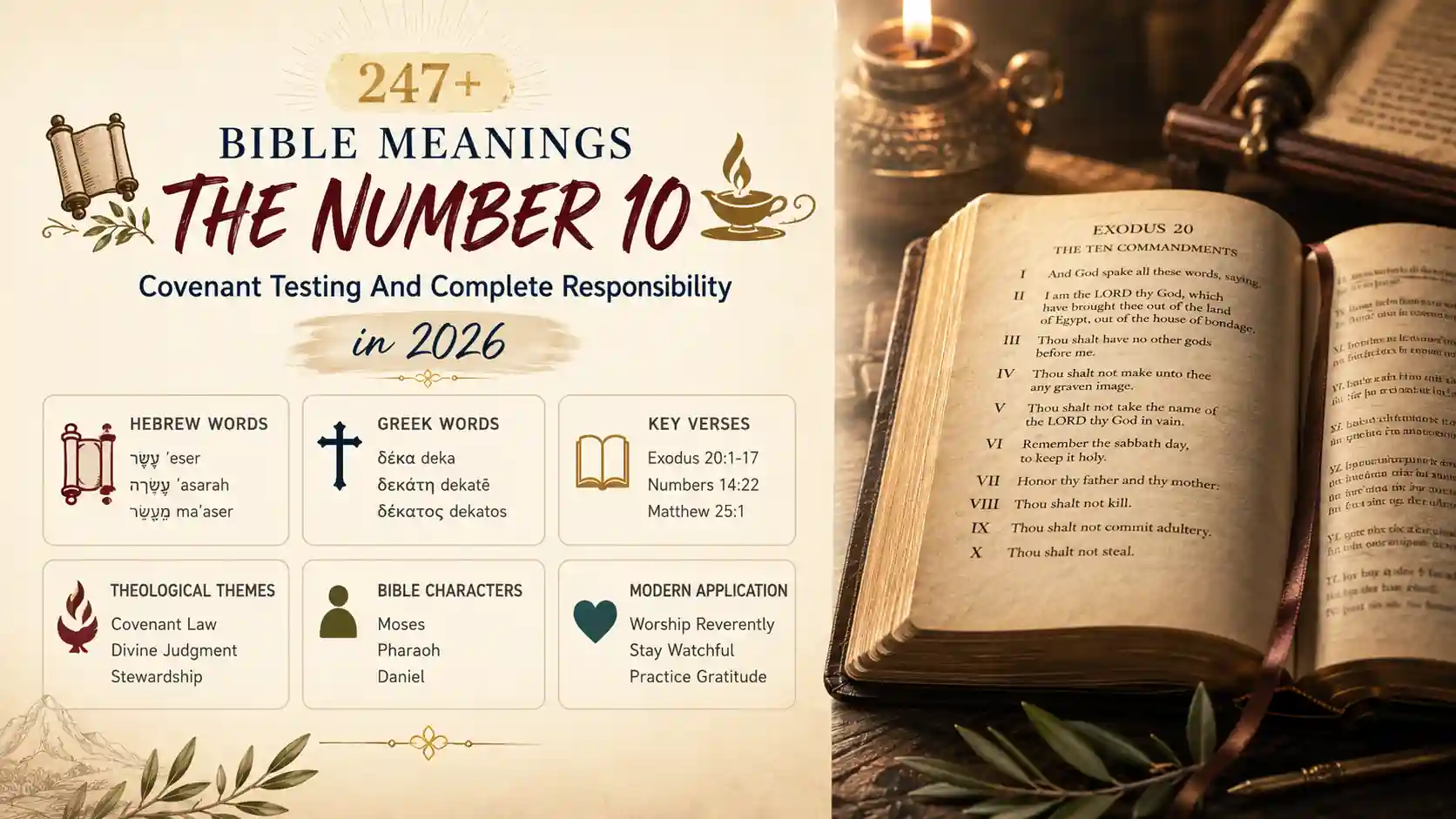
What does the number 10 mean in the Bible? In Scripture, ten often marks fullness in human responsibility, ordered testing, covenant obligation, and measured completeness under God’s rule. It is not a magic number, but a repeated biblical pattern.
As you study ten commandments, ten plagues, ten virgins, ten lepers, and ten minas, you see God addressing whole persons, whole communities, and complete moral accountability before Him.
Ten Key Scripture References
| Verse | Passage Snippet | Context |
|---|---|---|
| Genesis 24:10 | “ten camels” | Abraham’s servant seeks Rebekah |
| Genesis 31:7 | “changed my wages ten times” | Jacob speaks of Laban’s injustice |
| Exodus 7:14 to 12:30 | ten plagues | God judges Egypt |
| Exodus 20:1 to 17 | Ten Commandments | Covenant law at Sinai |
| Numbers 14:22 | “tested Me ten times” | Israel’s wilderness unbelief |
| Daniel 1:12 | “test your servants ten days” | Daniel’s faithfulness in exile |
| Luke 17:12 | ten lepers | Mercy, healing, gratitude |
| Matthew 25:1 | ten virgins | Watchfulness for the bridegroom |
Ten Bible Translation Comparison
| Verse | KJV | NIV | ESV | NASB |
|---|---|---|---|---|
| Exodus 34:28 | “ten commandments” | “Ten Commandments” | “Ten Commandments” | “Ten Commandments” |
| Deuteronomy 4:13 | “ten commandments” | “Ten Commandments” | “Ten Commandments” | “Ten Commandments” |
| Ruth 4:2 | “ten men” | “ten of the elders” | “ten men” | “ten men” |
| 1 Samuel 1:8 | “ten sons” | “ten sons” | “ten sons” | “ten sons” |
| Daniel 1:20 | “ten times better” | “ten times better” | “ten times better” | “ten times better” |
| Luke 15:8 | “ten pieces of silver” | “ten silver coins” | “ten silver coins” | “ten silver coins” |
| Luke 19:13 | “ten pounds” | “ten minas” | “ten minas” | “ten minas” |
| Revelation 2:10 | “ten days” | “ten days” | “ten days” | “ten days” |
Ten People & Characters Associated
| Person | Role | Connection |
|---|---|---|
| Moses | Covenant mediator | Receives the Ten Commandments |
| Pharaoh | Egyptian king | Confronted through ten plagues |
| Aaron | Moses’ spokesman | Serves during the plague judgments |
| Jacob | Patriarch | Says Laban changed wages ten times |
| Laban | Aramean kinsman | Example of repeated injustice |
| Daniel | Exile in Babylon | Tested for ten days |
| Boaz | Kinsman redeemer | Calls ten elders at the gate |
| Jesus | Messiah and Teacher | Tells parables using ten |
Ten Original Hebrew & Greek Words
| Original Word | Transliteration | Strong’s # | Literal Meaning |
|---|---|---|---|
| עֶשֶׂר | ʿeser | H6235 | ten |
| עֲשָׂרָה | ʿasarah | H6235 | ten |
| עֲשֶׂרֶת | ʿaseret | H6235 | ten, construct form |
| עָשִׂירִי | ʿasiri | H6224 | tenth |
| מַעֲשֵׂר | maʿaser | H4643 | tithe, tenth part |
| דֶּקָא | deka | G1176 | ten |
| δέκατος | dekatos | G1182 | tenth |
| δεκάτη | dekatē | G1181 | tenth, tithe |
Ten Related Biblical Concepts
| Concept | Connection | Supporting Verse |
|---|---|---|
| Covenant law | Ten Words at Sinai | Exodus 34:28 |
| Judgment | Ten plagues on Egypt | Exodus 7 to 12 |
| Testing | Ten days in Babylon | Daniel 1:12 |
| Accountability | Ten minas entrusted | Luke 19:13 |
| Readiness | Ten virgins waiting | Matthew 25:1 |
| Gratitude | One of ten returns | Luke 17:15 |
| Public witness | Ten elders at gate | Ruth 4:2 |
| Giving | Tenth set apart | Leviticus 27:30 |
Ten Historical & Cultural Context
| Aspect | Detail | Biblical Source |
|---|---|---|
| Sinai covenant | Law given to redeemed Israel | Exodus 20 |
| Egyptian crisis | Plagues expose false gods | Exodus 7 to 12 |
| Ancient gates | Elders settled public matters | Ruth 4:1 to 2 |
| Babylonian court | Youth trained for service | Daniel 1 |
| Jewish weddings | Virgins await bridegroom | Matthew 25 |
| Leprosy laws | Cleansed persons show priests | Luke 17 |
| Tithe practice | Tenth belongs to the Lord | Leviticus 27:30 |
| Roman money | Minas picture stewardship | Luke 19 |
Ten Theological Themes
| Theme | Explanation | Scripture |
|---|---|---|
| Divine authority | God speaks binding commands | Exodus 20:1 |
| Complete demand | Whole life stands under God | Deuteronomy 4:13 |
| Judgment | God humbles proud powers | Exodus 12:12 |
| Covenant mercy | Law follows redemption | Exodus 20:2 |
| Human failure | Israel repeatedly tests God | Numbers 14:22 |
| Faithful witness | Daniel honors God in exile | Daniel 1:12 |
| Watchfulness | Waiting must be wise | Matthew 25:13 |
| Stewardship | Servants answer for trust | Luke 19:15 |
Ten Modern Application for Believers
| Area | Practice | Scripture |
|---|---|---|
| Worship | Receive God’s commands reverently | Exodus 20:1 |
| Ethics | Love God and neighbor concretely | Matthew 22:37 to 40 |
| Trials | Treat testing as a call to faith | Daniel 1:12 |
| Money | Give as worship, not pride | Leviticus 27:30 |
| Work | Steward what Christ entrusts | Luke 19:13 |
| Gratitude | Return to thank the Lord | Luke 17:15 |
| Patience | Stay ready for Christ | Matthew 25:13 |
| Justice | Honor public truth and witness | Ruth 4:2 |
The Ten Words at Sinai Show Whole Life Under God
The Bible’s most famous use of ten is the Ten Commandments. Exodus calls them the “words” God spoke, and Deuteronomy 4:13 says He declared His covenant, “the Ten Commandments,” written on two tablets of stone.
The Hebrew expression often connected with this is עֲשֶׂרֶת הַדְּבָרִים, ʿaseret haddevarim, “the ten words.” These commandments do not begin with bare morality. They begin with redemption, “I am the Lord your God, who brought you out of the land of Egypt.”
What Does the Number 10 Mean in the Bible When God Tests His People
Ten can mark a full and searching test. In Numbers 14:22, the Lord says Israel tested Him “ten times,” a phrase that gathers their repeated unbelief into a complete pattern of rebellion.
Daniel 1 gives a brighter picture. Daniel asks for a ten day test with vegetables and water, trusting God in exile. At the end, he and his friends appear healthier, and later they are found “ten times better” than Babylon’s wise men.
Ten Plagues, Pharaoh, and the Completeness of Divine Judgment
The ten plagues are not random disasters. They move in a solemn sequence against Egypt’s pride, Pharaoh’s hardness, and the false security of a kingdom that enslaved God’s people.
By the tenth plague, judgment reaches Egypt’s firstborn, and Israel is sheltered through the Passover lamb. Ten here presses the reader to see that God’s patience is real, His warnings are serious, and His deliverance is merciful.
Jesus Uses Ten to Teach Readiness, Mercy, and Stewardship
Jesus uses ten in memorable teaching moments. Ten virgins wait for the bridegroom in Matthew 25, but only the wise are ready with oil. The number frames a complete visible group, yet reveals a division within it.
In Luke 17, ten lepers are cleansed, but one returns to give thanks. In Luke 19, ten servants receive minas and must account for them. In each case, ten brings the whole scene before God’s searching gaze.
Questions Bible Students Ask About Ten
Does עֶשֶׂר, ʿeser, always mean spiritual completeness?
No. It literally means ten, while context shows whether the number carries symbolic weight.
Why are the Ten Commandments called “words” in Hebrew?
Because דְּבָרִים, devarim, emphasizes God’s covenant speech, not merely legal rules.
Do the ten plagues prove that every use of ten means judgment?
No. Ten can appear in judgment, testing, order, responsibility, or ordinary counting.
Why does Luke mention ten lepers if only one returned?
The full group highlights the mercy given to all and the rare gratitude of the Samaritan.
Is the tithe word מַעֲשֵׂר, maʿaser, directly related to the number ten?
Yes. It means a tenth part and reflects giving a measured portion to the Lord.