
What does the number 11 mean in the Bible? Scripture uses eleven in several memorable settings, including Joseph’s dream, Jacob’s household, Israel’s wilderness journey, the tabernacle curtains, and the apostles after Judas’s departure. Yet the Bible never supplies a universal definition declaring that eleven always symbolizes disorder, judgment, or incompleteness.
Your study should therefore begin with the inspired contexts rather than later systems of numerology. Eleven sometimes describes a group lacking one member, but elsewhere it is simply an ordinary quantity, date, measurement, or period of time. Careful interpretation respects both patterns.
Eleven Key Scripture References
| Verse | Passage Snippet | Context |
|---|---|---|
| Genesis 32:22 | “his eleven sons” | Jacob crosses the Jabbok before meeting Esau |
| Genesis 37:9 | “eleven stars bowed” | Joseph dreams that his family will bow to him |
| Exodus 26:7 | “eleven curtains” | Goat-hair covering for the tabernacle |
| Numbers 7:72 | “the eleventh day” | Pagiel brings Issachar’s dedication offering |
| Deuteronomy 1:2 | “eleven days’ journey” | Distance from Horeb to Kadesh-barnea |
| 1 Kings 6:38 | “in the eleventh year” | Solomon’s temple is completed |
| Matthew 28:16 | “the eleven disciples” | The risen Christ commissions His followers |
| Luke 24:33 | “the eleven gathered” | Emmaus witnesses report Christ’s resurrection |
| Acts 1:26 | “added to the eleven” | Matthias restores the apostolic group to twelve |
These passages show why a rigid numerical formula is unsafe. Eleven may identify sons, stars, curtains, days, years, or apostles. Its significance arises from each passage’s subject and literary setting, not from an independent mystical power attached to the numeral.
Eleven Bible Translation Comparison
| Verse | KJV | NIV | ESV | NASB |
|---|---|---|---|---|
| Genesis 32:22 | “eleven sons” | “eleven sons” | “eleven children” | “eleven children” |
| Genesis 37:9 | “eleven stars” | “eleven stars” | “eleven stars” | “eleven stars” |
| Exodus 26:7 | “eleven curtains” | “eleven curtains” | “eleven curtains” | “eleven curtains” |
| Deuteronomy 1:2 | “eleven days’ journey” | “eleven days” | “eleven days’ journey” | “eleven days’ journey” |
| 1 Kings 6:38 | “eleventh year” | “eleventh year” | “eleventh year” | “eleventh year” |
| Matthew 28:16 | “eleven disciples” | “eleven disciples” | “eleven disciples” | “eleven disciples” |
| Luke 24:33 | “the eleven” | “the Eleven” | “the eleven” | “the eleven” |
| Acts 1:26 | “eleven apostles” | “eleven apostles” | “eleven apostles” | “eleven apostles” |
Genesis 32:22 illustrates a translation difference unrelated to numerical meaning. The Hebrew can be rendered “sons” or “children,” although Dinah had already been born. The narrative counts the eleven sons who were present before Benjamin’s birth, rather than teaching a doctrine through the number itself.
Eleven People and Characters Associated
| Person | Role | Connection |
|---|---|---|
| Jacob | Patriarch | Crosses the Jabbok with eleven sons |
| Joseph | Son of Jacob | Dreams of eleven bowing stars |
| Benjamin | Youngest son | Not yet born when Jacob has eleven sons |
| Moses | Covenant mediator | Describes the eleven-day journey |
| Pagiel | Tribal leader | Presents an offering on day eleven |
| Solomon | King and builder | Completes the temple in his eleventh year |
| Zedekiah | Final king of Judah | Jerusalem falls during his eleventh year |
| Judas Iscariot | Betraying apostle | His departure leaves eleven apostles |
| Peter | Apostolic witness | Stands with the eleven at Pentecost |
| Matthias | Chosen apostle | Is numbered with the eleven |
The most theologically prominent people are Joseph and the apostles. Joseph’s eleven stars foreshadow his brothers bowing before him in Egypt. In the New Testament, Judas’s absence gives “the eleven” a temporary corporate identity until Matthias is selected.
Eleven Original Hebrew and Greek Words
| Original Word | Transliteration | Strong’s # | Literal Meaning |
|---|---|---|---|
| עַשְׁתֵּי | ʿashtê | H6249 | One used in forming eleven |
| עָשָׂר | ʿāsār | H6240 | Ten, part of compound numerals |
| אֶחָד | ʾeḥad | H259 | One |
| יוֹם | yôm | H3117 | Day |
| שָׁנָה | shānâ | H8141 | Year |
| כּוֹכָב | kôkhāv | H3556 | Star |
| ἕνδεκα | hendeka | G1733 | Eleven, one plus ten |
| εἷς | heis | G1520 | One |
| δέκα | deka | G1176 | Ten |
| ἑνδέκατος | hendekatos | G1734 | Eleventh |
The characteristic Hebrew form is עַשְׁתֵּי־עָשָׂר, ʿashtê ʿāsār, a compound expression for eleven. Strong’s H6249 is used with the word for ten, H6240. The precise history of עַשְׁתֵּי is debated, so speculative claims about a hidden meaning in its root should be avoided.
The Greek ἕνδεκα, hendeka, is Strong’s G1733. It combines the ideas of one and ten and occurs six times in the New Testament, every time referring to the remaining apostolic company. The related ordinal ἑνδέκατος, hendekatos, means “eleventh.”
Eleven Related Biblical Concepts
| Concept | Connection | Supporting Verse |
|---|---|---|
| Patriarchal family | Eleven sons precede Benjamin | Genesis 32:22 |
| Providence | Joseph’s dream anticipates exaltation | Genesis 37:9 |
| Tabernacle worship | Eleven curtains cover the sanctuary | Exodus 26:7 |
| Wilderness testing | An eleven-day route becomes prolonged wandering | Deuteronomy 1:2 |
| Temple completion | Construction ends in Solomon’s eleventh year | 1 Kings 6:38 |
| National judgment | Zedekiah’s eleventh year brings Jerusalem’s fall | 2 Kings 25:2 |
| Apostolic loss | Judas’s departure leaves eleven | Matthew 28:16 |
| Resurrection witness | The eleven encounter the risen Jesus | Luke 24:33 |
| Apostolic restoration | Matthias joins the eleven | Acts 1:26 |
| Gospel mission | Christ commissions the eleven | Matthew 28:18-20 |
Deuteronomy 1:2 is sometimes treated as proof that eleven signifies disorder. The verse, however, merely identifies the normal travel distance from Horeb to Kadesh-barnea. Israel’s prolonged wandering resulted from unbelief and rebellion, not from an evil quality inherent in eleven.
The movement from twelve apostles to eleven and back to twelve does carry narrative weight. Twelve recalls Israel’s twelve tribes and Jesus’ deliberate formation of a renewed covenant community. Eleven marks an actual vacancy, but the text never turns that circumstance into a universal code.
Eleven Historical and Cultural Context
| Aspect | Detail | Biblical Source |
|---|---|---|
| Ancient counting | Eleven is expressed as a compound number | Genesis 32:22 |
| Patriarchal household | Benjamin is born after the Jabbok crossing | Genesis 35:16-18 |
| Dream symbolism | Stars represent members of Joseph’s family | Genesis 37:9-10 |
| Tent construction | Eleven goat-hair curtains form an outer covering | Exodus 26:7-13 |
| Travel geography | Horeb to Kadesh is an eleven-day route | Deuteronomy 1:2 |
| Regnal dating | Events are dated by a king’s reigning year | 1 Kings 6:38 |
| Babylonian siege | Jerusalem falls under Zedekiah | 2 Kings 25:1-7 |
| Jewish symbolism | Twelve evokes Israel’s tribal structure | Matthew 19:28 |
| Apostolic office | A replacement must witness the resurrection | Acts 1:21-22 |
| Public proclamation | Peter stands with the eleven at Pentecost | Acts 2:14 |
The tabernacle’s eleven goat-hair curtains had a practical architectural function. Five were joined together, six were joined together, and the extra portion hung at the front. Exodus emphasizes dimensions, arrangement, and obedience to God’s pattern, not a symbolic defect in the sanctuary.
Ancient writers also dated political and religious events by regnal years. Thus an “eleventh year” can function like an ordinary calendar marker. Solomon’s eleventh year celebrates temple completion, while Zedekiah’s eleventh year records catastrophe. Opposite outcomes caution you against assigning one fixed spiritual value to the number.
Eleven Theological Themes
| Theme | Explanation | Scripture |
|---|---|---|
| Divine providence | God fulfills Joseph’s unlikely dream | Genesis 42:6 |
| Human unbelief | Israel delays entry into the land | Deuteronomy 1:26-33 |
| Ordered worship | God specifies the tabernacle’s construction | Exodus 26:7 |
| Covenant continuity | God preserves Jacob’s developing family | Genesis 32:22 |
| Fulfilled labor | Solomon completes the temple | 1 Kings 6:38 |
| Covenant judgment | Persistent rebellion brings Jerusalem’s fall | 2 Kings 25:2-7 |
| Apostolic frailty | The eleven initially struggle with doubt | Mark 16:14 |
| Resurrection grace | Christ appears despite their weakness | Matthew 28:16-17 |
| Restored witness | Matthias is added to the eleven | Acts 1:26 |
| Mission by authority | Jesus sends imperfect disciples | Matthew 28:18-20 |
The strongest theological lesson associated with eleven is not a mystical property but God’s faithfulness amid human weakness. Joseph’s brothers resist God’s purpose, Israel refuses to trust, Judas betrays Christ, and the disciples hesitate. None of these failures overturn the Lord’s plan.
The risen Jesus entrusts the Great Commission to eleven disciples, some of whom still doubt. Their reduced number does not limit His authority. Their calling rests on His resurrection, His command, and His promise to remain with them.
Eleven Modern Applications for Believers
| Area | Practice | Scripture |
|---|---|---|
| Bible interpretation | Read numbers within their contexts | Nehemiah 8:8 |
| Discernment | Reject unsupported numerology | Deuteronomy 18:10-12 |
| Trust | Believe God during uncertain transitions | Proverbs 3:5-6 |
| Repentance | Learn from Israel’s unbelief | Hebrews 3:16-19 |
| Perseverance | Continue after painful loss | Acts 1:12-14 |
| Community | Address genuine gaps responsibly | Acts 1:21-26 |
| Witness | Speak from Christ-centered conviction | Acts 2:14 |
| Mission | Obey Christ despite personal weakness | Matthew 28:16-20 |
| Worship | Honor God through careful obedience | Exodus 26:30 |
| Hope | Trust God to complete His purposes | Philippians 1:6 |
When you encounter claims that 11 always means chaos, rebellion, transition, or judgment, ask where Scripture itself states that rule. Similar circumstances surrounding several passages do not establish a divinely revealed numerical dictionary.
A sound application is more pastoral and more biblical. God remains sovereign when a family is unfinished, a journey is delayed, a kingdom collapses, or a ministry team loses a member. Your security rests in His character rather than in favorable or unfavorable numbers.
What Does the Number 11 Mean in the Bible’S Story of the Apostles?
After Judas’s betrayal and death, the Gospel writers call Jesus’ remaining disciples “the eleven.” The expression οἱ ἕνδεκα, hoi hendeka, functions as a group title during the period between Judas’s departure and Matthias’s appointment.
This setting suggests temporary incompleteness because Jesus had intentionally chosen twelve apostles. Still, Matthew 28 places the eleven under Christ’s universal authority and commission. Their weakness highlights His sufficiency rather than creating a formula that eleven always means imperfection.
Joseph’S Eleven Stars and God’S Providential Rule
In Genesis 37:9, Joseph sees the sun, moon, and eleven stars bowing before him. Jacob immediately interprets the images as family members. The eleven stars correspond naturally to Joseph’s eleven brothers rather than representing an abstract spiritual code.
The dream anticipates the brothers’ later journeys to Egypt, where they bow before Joseph without recognizing him. Eleven contributes to the dream’s accuracy, but the theological emphasis falls on God’s providence, preservation, and ability to turn intended evil toward saving purposes.
עַשְׁתֵּי־עָשָׂר And the Limits of Biblical Numerology
The Hebrew expression עַשְׁתֵּי־עָשָׂר, ʿashtê ʿāsār, simply denotes eleven in passages involving objects, people, dates, and quantities. Its varied uses do not support the claim that every occurrence carries one concealed theological message.
Biblical writers can use numbers symbolically, but symbolism must be demonstrated from the text. You should distinguish literary patterns, such as twelve tribes and twelve apostles, from uncontrolled numerology that assigns spiritual predictions to addresses, dates, dreams, or repeated clock times.
From the Eleven-Day Journey to the Great Commission
Deuteronomy contrasts an eleven-day journey with Israel’s tragic history of unbelief. Eleven measures the route, while the surrounding chapters explain the delay through fear, rebellion, and refusal to enter the promised land.
Matthew presents another group confronted by fear and uncertainty. The eleven disciples nevertheless worship the risen Christ and receive His commission. Together, these accounts call you away from unbelief and toward obedient trust in the God who fulfills His covenant purposes.
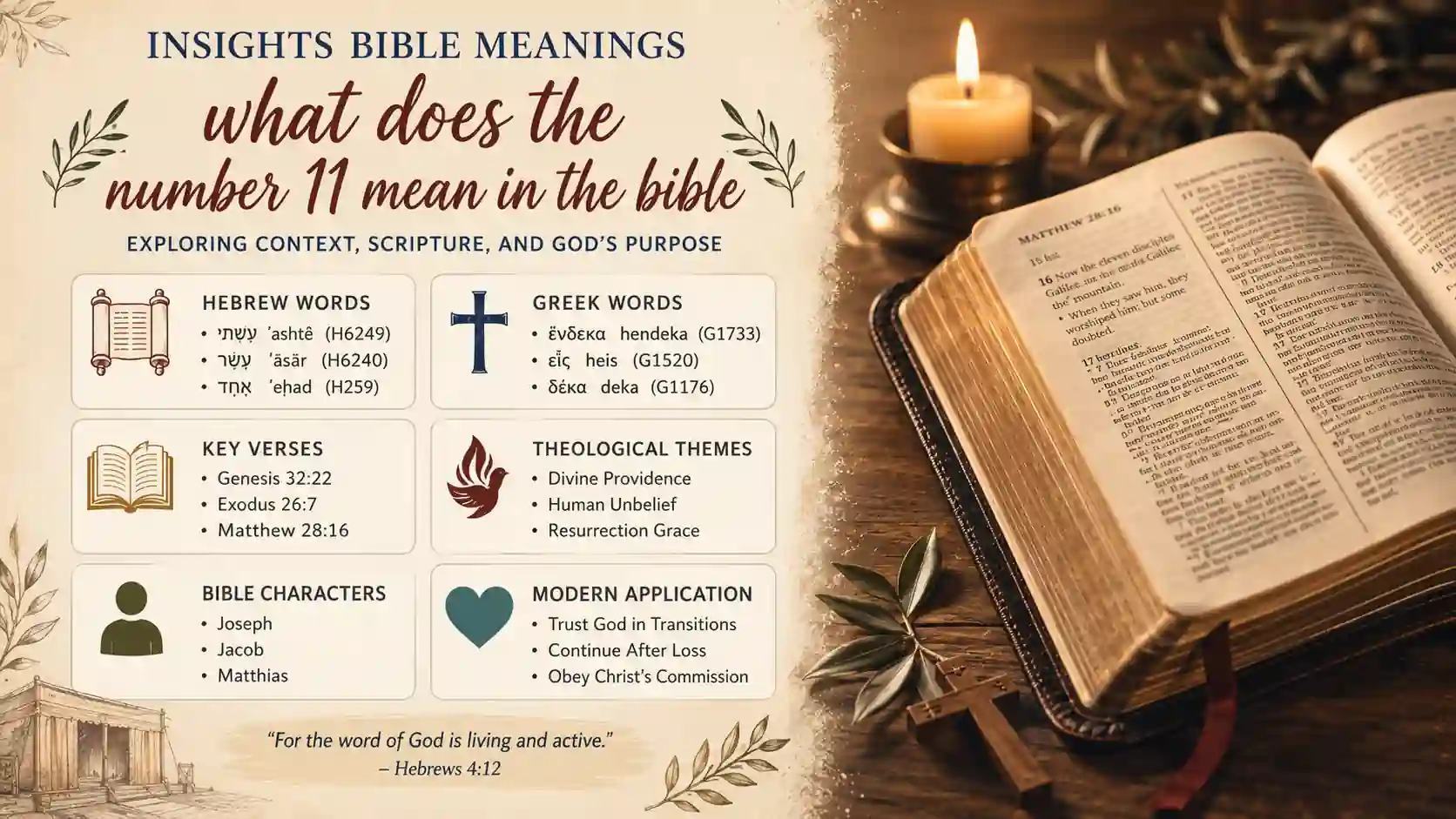
Frequently Asked Questions About Eleven in Scripture
Does עַשְׁתֵּי, ʿashtê, mean disorder or rebellion?
No. It is a Hebrew numerical term used in forming “eleven,” and the Bible gives it no inherent moral meaning.
Why does Matthew 28:16 call the disciples “the eleven”?
Judas Iscariot was no longer among them, and Matthias had not yet been appointed to restore the apostolic number to twelve.
Does Deuteronomy 1:2 teach that eleven symbolizes an incomplete journey?
No. It states the ordinary travel distance from Horeb to Kadesh-barnea, while later verses attribute Israel’s delay to unbelief.
Are Joseph’s eleven stars a prophecy about the eleven apostles?
No. Genesis 37:10 identifies the dream’s imagery with Joseph’s own family, especially his eleven brothers.
What should you do when you repeatedly see the number 11?
Avoid treating it as a private revelation and seek God’s guidance through Scripture, prayer, wisdom, and faithful obedience.