
You may know Esther as a queen in a palace, yet her story begins with loss, exile, and a hidden name. When you ask what does esther mean in the bible, you meet Hadassah, a young Jewish orphan raised by her cousin Mordecai in Susa.
Her name points toward a star, while her life points toward quiet providence. God is never named in her book, yet His hand guides every turn, from a royal banquet to a night the king could not sleep.
Esther Key Scripture References
| Verse | Passage Snippet | Context |
|---|---|---|
| Esther 1:12 | Vashti refused to come at the king’s command | A royal crisis opens the story |
| Esther 2:7 | Hadassah, that is Esther, had no parents | Mordecai raised his orphan cousin |
| Esther 2:17 | The king loved Esther above all women | She finds favor and becomes queen |
| Esther 2:23 | Mordecai told Esther of the plot | Two officials planned to kill the king |
| Esther 3:8 | Haman spoke against a scattered people | A proud enemy targets the Jews |
| Esther 4:14 | For such a time as this | Mordecai urges bold and timely action |
| Esther 4:16 | Fast, and I will go to the king | Esther risks death to intercede |
| Esther 5:2 | The king held out the golden scepter | Her approach is received with favor |
| Esther 7:3 | Let my life be given at my petition | Esther exposes Haman before the king |
| Esther 9:22 | Sorrow turned into gladness for them | Deliverance becomes the feast of Purim |
Esther Bible Translation Comparison
| Verse | KJV | NIV | ESV | NASB |
|---|---|---|---|---|
| Esther 2:7 | Hadassah, that is, Esther | Hadassah, also known as Esther | Hadassah, that is, Esther | Hadassah, that is Esther |
| Esther 2:17 | She obtained grace and favour | She won the favor of the king | She won grace and favor | She found favor with him |
| Esther 4:14 | For such a time as this | For such a time as this | For such a time as this | For such a time as this |
| Esther 4:16 | So will I go in unto the king | I will go to the king | I will go to the king | I will go in to the king |
| Esther 4:16 | If I perish, I perish | And if I perish, I perish | If I perish, I perish | If I perish, I perish |
| Esther 5:2 | He held out the golden sceptre | He extended the gold scepter | He held out the golden scepter | He extended the golden scepter |
| Esther 6:1 | The king could not sleep | The king could not sleep | The king could not sleep | That night the king could not sleep |
| Esther 7:10 | They hanged Haman on the gallows | They impaled Haman on the pole | They hanged Haman on the gallows | They hanged Haman on the gallows |
| Esther 8:17 | Light, and gladness, and joy | Happiness and joy, gladness and honor | Light and gladness and joy | Light, joy, gladness and honor |
Esther People and Characters Associated
| Person | Role | Connection |
|---|---|---|
| Esther | Queen of Persia | Born Hadassah, chosen to intercede |
| Mordecai | Cousin and guardian | Raised Esther and urged her courage |
| Ahasuerus | King of Persia | Ruled from India to Ethiopia |
| Vashti | Former queen | Refused the king and was removed |
| Haman | Royal official | Plotted to destroy the Jewish people |
| Zeresh | Wife of Haman | Advised the gallows for Mordecai |
| Hegai | King’s eunuch | Showed Esther favor in the palace |
| Hathach | King’s eunuch | Carried messages between Esther and Mordecai |
| Bigthan | Palace guard | Plotted with Teresh against the king |
| Memucan | Prince of Persia | Advised the king after Vashti refused |
Esther Original Hebrew and Greek Words
| Original Word | Transliteration | Strong’s # | Literal Meaning |
|---|---|---|---|
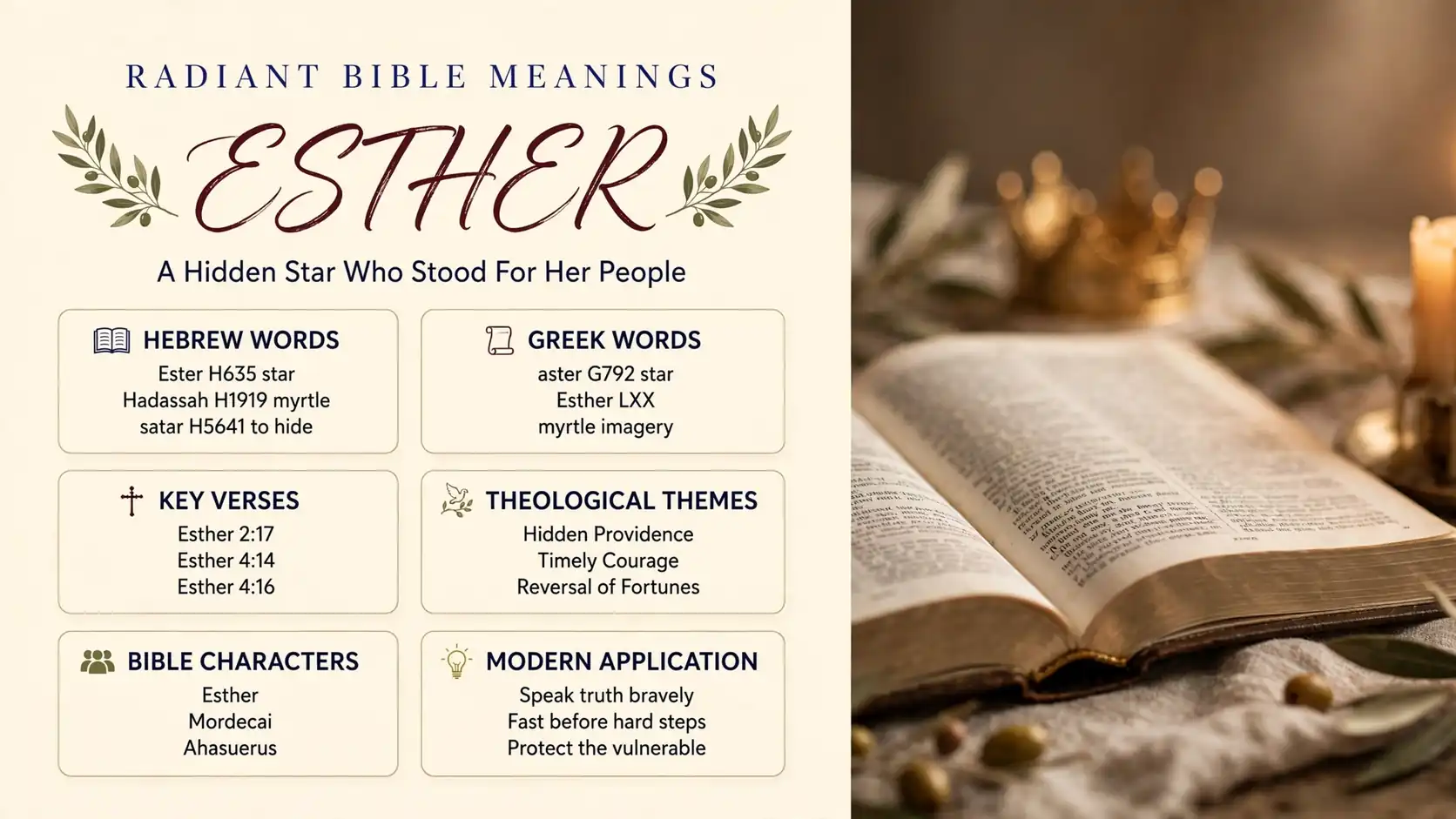
| אֶסְתֵּר | Ester | H635 | Star, the Persian name of Hadassah |
| הֲדַסָּה | Hadassah | H1919 | Myrtle, her Hebrew birth name |
| סָתַר | satar | H5641 | To hide or conceal |
| מַלְכָּה | malkah | H4436 | Queen or royal wife |
| מֶלֶךְ | melek | H4428 | King or royal ruler |
| פּוּר | pur | H6332 | Lot cast for a fateful day |
| צוֹם | tsom | H6685 | A fast or abstaining from food |
| מִשְׁתֶּה | mishteh | H4960 | Feast or drinking banquet |
| ἀστήρ | aster | G792 | Star, a bright shining body |
Esther Related Biblical Concepts
| Concept | Connection | Supporting Verse |
|---|---|---|
| Providence | Unseen guidance shapes each event | Esther 6:1 |
| Hiddenness | God works behind palace scenes | Esther 2:22 |
| Courage | Faith acts despite real danger | Esther 4:16 |
| Intercession | One voice pleads for many lives | Esther 7:3 |
| Fasting | Prayerful dependence before action | Esther 4:16 |
| Reversal | Mourning turns into glad celebration | Esther 9:22 |
| Identity | Esther reveals her Jewish heritage | Esther 7:4 |
| Deliverance | A threatened people are saved | Esther 8:11 |
| Remembrance | Purim keeps the story alive yearly | Esther 9:28 |
Esther Historical and Cultural Context
| Aspect | Detail | Biblical Source |
|---|---|---|
| Empire | Persia stretched across 127 provinces | Esther 1:1 |
| Capital | Royal rule centered in Susa | Esther 1:2 |
| King | Ahasuerus is linked with Xerxes I | Esther 1:1 |
| Exile | Jewish families lived far from home | Esther 2:5 |
| Court law | None could approach uninvited safely | Esther 4:11 |
| Lots | Pur gave Purim its enduring name | Esther 9:26 |
| Banquets | Feasts drive favor, pride, and reversal | Esther 5:4 |
| Records | Royal chronicles were read at night | Esther 6:1 |
| Decrees | A king seal made a law hard to revoke | Esther 8:8 |
Esther Theological Themes
| Theme | Explanation | Scripture |
|---|---|---|
| Hidden Providence | God guides events without being named | Esther 6:1 |
| Timely Courage | Faith rises at the appointed hour | Esther 4:14 |
| Costly Intercession | Esther risks her life for her people | Esther 4:16 |
| Pride Brought Low | Haman falls by his own proud device | Esther 7:10 |
| Reversal of Fortunes | Threat gives way to honor and joy | Esther 9:22 |
| Faithful Fasting | Dependence comes before deliverance | Esther 4:16 |
| Covenant Care | God preserves His scattered people | Esther 8:17 |
| Joy After Sorrow | Grief is answered with feasting | Esther 9:22 |
| Unseen Sovereignty | Human plans cannot cancel divine care | Esther 6:13 |
Esther Modern Application for Believers
| Area | Practice | Scripture |
|---|---|---|
| Courage | Speak truth when silence feels safer | Esther 4:14 |
| Prayer | Fast with others before hard steps | Esther 4:16 |
| Identity | Own your faith with quiet honesty | Esther 7:4 |
| Timing | Wait, prepare, then act with wisdom | Esther 5:8 |
| Advocacy | Use your place to protect the vulnerable | Esther 7:3 |
| Gratitude | Mark answered prayer with celebration | Esther 9:22 |
| Humility | Refuse pride in seasons of influence | Esther 7:10 |
| Trust | Rest when outcomes rest beyond you | Esther 6:1 |
| Community | Carry burdens together, not alone | Esther 4:16 |
Hadassah and Ester, the Two Names Behind Esther
Esther carries two names, and each one tells part of her story for your study. Hadassah means myrtle, a green and fragrant plant that fits a young woman growing quietly in exile. Ester likely comes from a Persian word for star, a fitting name for a woman raised to shine in a foreign court.
The link with satar, the Hebrew word for hiding, deepens the picture in a lovely way. Her Jewish identity stays hidden, her king stays unaware, and God Himself stays unnamed in the text. Yet nothing is truly lost, because the hidden things are revealed at exactly the right moment.
For Such a Time as This and What Does Esther Mean in the Bible
Mordecai’s words in chapter 4 remain the heartbeat of the whole book for many readers. He does not promise Esther safety, and he does not flatter her position. He simply asks whether her place in the palace was given for this very hour of need.
Your own place may feel ordinary, yet Esther shows that placement and purpose often meet quietly. She did not seek the crown, and she did not control the crisis. She prepared, she prayed through fasting, and then she stepped forward when the moment came.
Fasting, Banquets, and the Great Reversal in Esther
Esther is a book of feasts, from the opening banquets of the king to the final feast of Purim. Food marks pride, favor, danger, and joy at every stage of the plot. Against that rich backdrop, Esther’s choice to fast stands out with striking clarity.
The reversal is just as striking when you read the closing chapters slowly. Haman builds gallows for Mordecai and hangs on them himself, while a day set for destruction becomes a day of gladness. What enemies planned for sorrow, God turned toward joy and remembrance.
Esther and the God Who Works While Hidden
Some readers feel troubled that God’s name never appears in this book, and that silence is worth facing honestly. The writer seems to invite you to watch for fingerprints rather than headlines. A sleepless king, a timely record, and a remembered kindness all arrive without fanfare.
That hidden pattern can steady your faith in quiet seasons of your own life. You may not see a miracle or hear a clear explanation. Esther teaches you to trust that unseen care is still real care, even when heaven feels silent.
Frequently Asked Questions About Esther
Why does God’s name never appear in the book of Esther?
The silence highlights hidden providence, as God works through timing, courage, and ordinary events without being named once.
What does the name Esther mean in Hebrew and Persian roots?
Ester H635 likely comes from a Persian word for star, while her Hebrew name Hadassah H1919 means myrtle.
Why is Esther 4:14 so loved by believers today?
Mordecai’s words about such a time as this frame Esther’s royal place as a God-given moment for courageous action.
What is Purim and why does it matter in Esther?
Purim remembers how Haman lots, called pur, failed and a day of sorrow became a feast of deliverance and joy.
How did fasting shape Esther’s courage before the king?
Esther asked her people to fast for three days, showing dependence on God before she risked her life in Esther 4:16.