
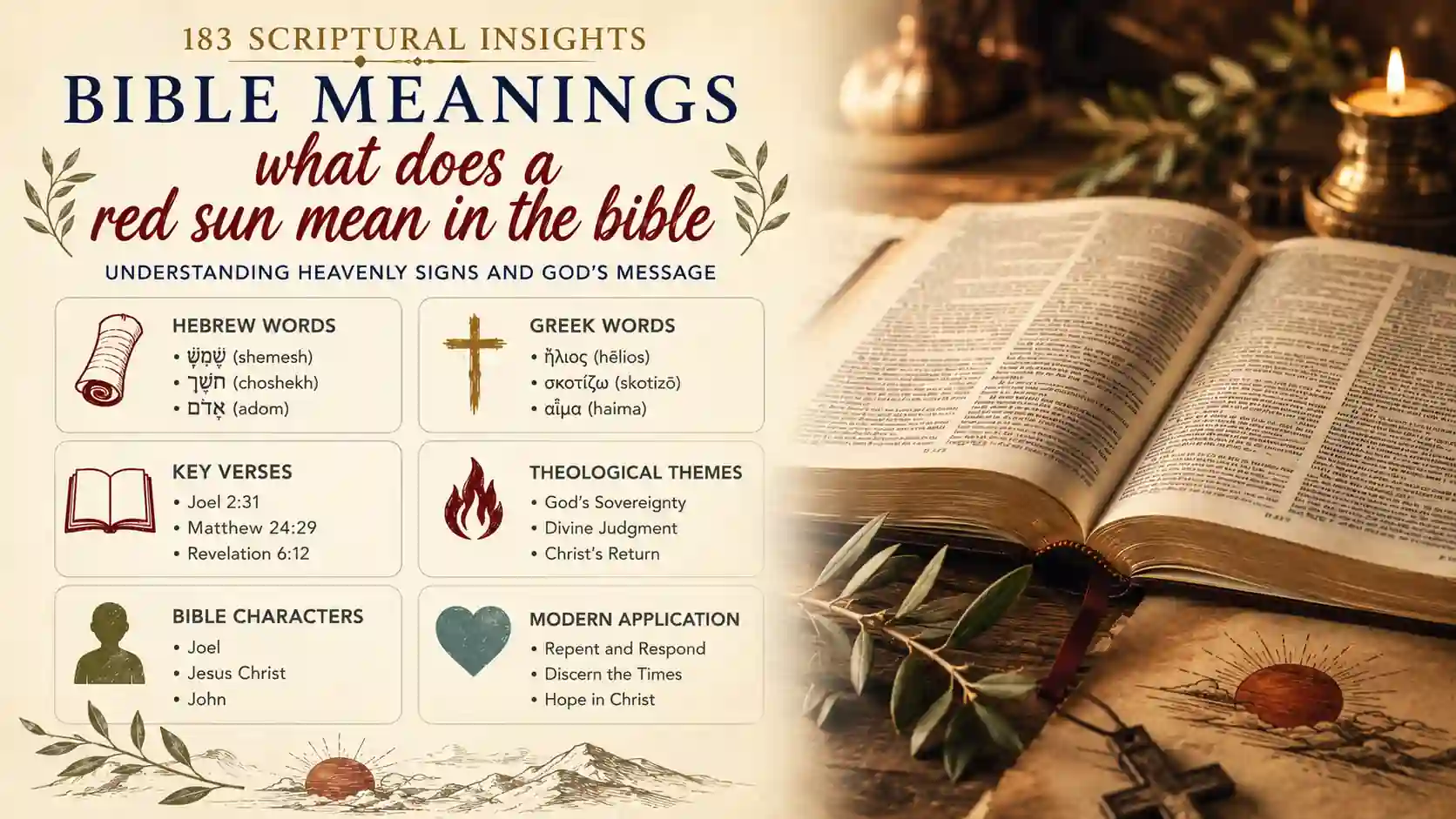
When you ask, “what does a red sun mean in the Bible,” you should begin with an important distinction. Scripture never establishes a red sun as an independent symbol with one fixed interpretation. It speaks instead of the sun becoming dark, the moon appearing like blood, and the sky becoming red.
These images occur in prophetic warnings, teachings about Christ’s return, and ordinary observations about weather. Your study must therefore consider the wording, genre, speaker, and covenant setting of each passage before assigning spiritual meaning.
Key Red Sun Scripture References
| Verse | Passage Snippet | Context |
|---|---|---|
| Joel 2:10 | “The sun and moon grow dark” | Cosmic signs accompany the day of the Lord |
| Joel 2:31 | “Sun shall be turned to darkness” | Judgment precedes the great day of the Lord |
| Acts 2:20 | “Sun shall be turned into darkness” | Peter applies Joel’s prophecy at Pentecost |
| Matthew 16:2 | “The sky is red” | Evening redness predicts fair weather |
| Matthew 16:3 | “Red and threatening” | Jesus rebukes poor spiritual discernment |
| Matthew 24:29 | “The sun will be darkened” | Jesus describes events after tribulation |
| Luke 21:25 | “Signs in sun and moon” | Cosmic distress precedes redemption |
| Revelation 6:12 | “Sun became black as sackcloth” | The sixth seal reveals divine judgment |
Red Sun Bible Translation Comparison
| Verse | KJV | NIV | ESV | NASB |
|---|---|---|---|---|
| Joel 2:10 | “Sun and moon shall be dark” | “Sun and moon are darkened” | “Sun and moon are darkened” | “Sun and moon become dark” |
| Joel 2:31 | “Sun shall be turned into darkness” | “Sun will be turned to darkness” | “Sun shall be turned to darkness” | “Sun will be turned into darkness” |
| Acts 2:20 | “Sun shall be turned into darkness” | “Sun will be turned to darkness” | “Sun shall be turned to darkness” | “Sun will be turned into darkness” |
| Matthew 16:2 | “The sky is red” | “The sky is red” | “The sky is red” | “The sky is red” |
| Matthew 16:3 | “Red and lowering” | “Red and overcast” | “Red and threatening” | “Red and threatening” |
| Matthew 24:29 | “Sun be darkened” | “Sun will be darkened” | “Sun will be darkened” | “Sun will be darkened” |
| Mark 13:24 | “Sun shall be darkened” | “Sun will be darkened” | “Sun will be darkened” | “Sun will be darkened” |
| Revelation 6:12 | “Sun became black as sackcloth” | “Sun turned black” | “Sun became black” | “Sun became black” |
People and Characters Associated with the Red Sun Theme
| Person | Role | Connection |
|---|---|---|
| Joel | Prophet of Judah | Foretells a darkened sun before the Lord’s day |
| Peter | Apostle and preacher | Quotes Joel’s cosmic prophecy at Pentecost |
| Jesus Christ | Messiah and teacher | Speaks of red skies and future cosmic signs |
| John | Apostle and seer | Sees the sun blackened at the sixth seal |
| Isaiah | Prophet | Uses darkened heavens in judgment oracles |
| Ezekiel | Exilic prophet | Describes the sun covered during national judgment |
| Pharaoh | Egyptian ruler | Experiences darkness during the ninth plague |
| Moses | Covenant mediator | Announces supernatural darkness over Egypt |
| The Lamb | Risen Christ | Opens the seal connected with cosmic upheaval |
Original Hebrew and Greek Red Sun Words
| Original Word | Transliteration | Strong’s # | Literal Meaning |
|---|---|---|---|
| שֶׁמֶשׁ | shemesh | H8121 | Sun |
| אָדַם | ʾadam | H119 | To be red |
| אָדֹם | ʾadom | H122 | Red or ruddy |
| חֹשֶׁךְ | choshekh | H2822 | Darkness |
| דָּם | dam | H1818 | Blood |
| אוֹת | ʾoth | H226 | Sign or mark |
| ἥλιος | hēlios | G2246 | Sun |
| σκοτίζω | skotizō | G4654 | To darken |
| αἷμα | haima | G129 | Blood |
| σημεῖον | sēmeion | G4592 | Sign |
| μεταστρέφω | metastrephō | G3344 | To turn or transform |
Related Biblical Red Sun Concepts
| Concept | Connection | Supporting Verse |
|---|---|---|
| Day of the Lord | Darkened sun signals divine intervention | Joel 2:31 |
| Divine judgment | Cosmic disorder portrays God’s wrath | Isaiah 13:10 |
| Spiritual discernment | Red skies expose religious blindness | Matthew 16:2–3 |
| Christ’s return | The sun darkens before His appearing | Matthew 24:29–30 |
| National collapse | Failing lights picture a kingdom’s fall | Ezekiel 32:7 |
| Creation shaken | Heavenly signs show universal upheaval | Luke 21:25–26 |
| Exodus judgment | Darkness humiliates Egypt’s gods | Exodus 10:21–23 |
| Prophetic fulfillment | Peter cites Joel during Pentecost | Acts 2:16–21 |
| Human repentance | Signs call hearers to seek the Lord | Joel 2:12–13 |
Historical and Cultural Context of Red Sun Imagery
| Aspect | Detail | Biblical Source |
|---|---|---|
| Ancient weather reading | Red skies were used to anticipate weather | Matthew 16:2–3 |
| Agricultural society | Weather knowledge affected crops and travel | Matthew 16:3 |
| Prophetic poetry | Cosmic language portrays historical upheaval | Isaiah 13:9–10 |
| Babylonian downfall | Darkened lights describe imperial judgment | Isaiah 13:1, 10 |
| Egyptian religion | The plague challenged solar worship | Exodus 10:21–23 |
| Sackcloth | Dark goat hair symbolized mourning | Revelation 6:12 |
| Blood imagery | Blood communicates death and judgment | Joel 2:31 |
| Temple setting | Jesus teaches near Jerusalem’s temple | Matthew 24:1–3 |
| Apocalyptic visions | Symbols reveal heavenly meaning | Revelation 6:12–17 |
Theological Themes within Red Sun Passages
| Theme | Explanation | Scripture |
|---|---|---|
| God’s sovereignty | The Creator governs the heavenly lights | Genesis 1:14–18 |
| Judgment | Darkness announces God’s opposition to evil | Amos 5:18–20 |
| Revelation | Celestial signs disclose divine action | Luke 21:25 |
| Christ’s kingship | Cosmic shaking precedes His glorious coming | Matthew 24:30 |
| Human accountability | Earth’s rulers cannot escape the Lamb | Revelation 6:15–17 |
| Repentance | Prophetic warnings invite a return to God | Joel 2:12 |
| Salvation | Those calling on the Lord may be saved | Joel 2:32 |
| Covenant faithfulness | God fulfills His prophetic word | Acts 2:16 |
| Creation’s dependence | Even the sun remains under God’s command | Psalm 74:16 |
Modern Red Sun Application for Believers
| Area | Practice | Scripture |
|---|---|---|
| Bible interpretation | Read symbolic images in context | 2 Timothy 2:15 |
| Discernment | Recognize God’s work, not merely outward signs | Matthew 16:3 |
| Repentance | Respond to warnings with a sincere heart | Joel 2:12–13 |
| Hope | Look toward Christ when the world is shaken | Luke 21:28 |
| Worship | Honor the Creator rather than creation | Romans 1:25 |
| Readiness | Remain faithful while awaiting Christ | Matthew 24:42 |
| Humility | Avoid claiming knowledge God has withheld | Acts 1:7 |
| Courage | Trust God during frightening events | Psalm 46:1–3 |
| Witness | Proclaim salvation through the Lord’s name | Acts 2:21 |
What Does a Red Sun Mean in the Bible’S Prophetic Language?
In biblical prophecy, unusual changes in the sun commonly signify divine judgment, the collapse of earthly powers, or the arrival of the day of the Lord. The prophets describe the sun growing dark rather than simply turning red. This darkness shows that normal created order is being shaken under God’s authority.
Isaiah 13 uses darkened heavenly bodies while announcing judgment against Babylon. Ezekiel 32 employs similar language concerning Egypt. These passages demonstrate that cosmic imagery may portray the downfall of proud kingdoms while also pointing beyond them to God’s final judgment.
You should therefore resist treating every colorful sunset as a private prophetic message. The biblical meaning arises from inspired passages, not from the observer’s imagination. A naturally red sun may be visually striking, but Scripture does not authorize you to assign it a specific prediction.
At the same time, the sight of a red or darkened sun can remind you that creation belongs to God. The heavens are neither divine nor independent. Their beauty, stability, and eventual shaking all remain subject to the word of their Creator.
שֶׁמֶשׁ Shemesh and the Sun Turned to Darkness in Joel
The Hebrew noun שֶׁמֶשׁ, shemesh, Strong’s H8121, is the ordinary Old Testament word for the sun. Joel 2:31 does not say that the shemesh becomes red. It says that the sun will be changed into חֹשֶׁךְ, choshekh, meaning darkness, while the moon will appear as blood.
Joel places these signs “before the great and awesome day of the LORD.” The imagery belongs to a larger call to repentance, an outpouring of God’s Spirit, and the promise that everyone who calls on the Lord’s name will find deliverance.
Peter quotes this prophecy in Acts 2 after the Holy Spirit is poured out. His quotation identifies the Pentecost event with the arrival of the promised last-days era. Yet the cosmic language also directs attention toward the final completion of God’s redemptive and judicial work.
The passage holds warning and grace together. The darkened sun announces that God’s day cannot be ignored, while the promise of salvation reveals His mercy. Your proper response is not speculation about astronomical dates, but repentance, faith, and public confession of the Lord.
Jesus, the Red Sky, and the Signs of the Times
Matthew 16 contains the Bible’s clearest reference to a red sky. The Pharisees and Sadducees ask Jesus for a sign from heaven, even though His teaching and miracles already testify to His identity. Jesus answers by referring to their ability to interpret weather from the sky’s appearance.
They understand that a red evening sky may suggest fair weather and that a red, threatening morning may indicate a storm. Their error is not meteorological ignorance. It is spiritual blindness. They can interpret ordinary atmospheric evidence but fail to recognize the Messiah standing before them.
Some early manuscripts do not include Matthew 16:2–3, which is why several modern translations place the wording in brackets or a footnote. Still, the passage fits the immediate confrontation over signs and resembles Jesus’ teaching about weather discernment in Luke 12:54–56.
Here a red sky does not symbolize judgment by itself. It serves as an analogy. Jesus challenges you to exercise spiritual discernment, receive the revelation God has already provided, and avoid demanding sensational proof while neglecting the clear testimony of Christ.
The Darkened ἥλιος HēLios and the Return of Christ
The Greek noun ἥλιος, hēlios, Strong’s G2246, means “sun.” In Matthew 24:29, Mark 13:24, and Luke 21, Jesus places signs involving the sun within His teaching about tribulation, judgment, and the coming of the Son of Man.
The verb σκοτίζω, skotizō, Strong’s G4654, means “to darken.” The darkening of the sun communicates more than unusual weather. It belongs to Old Testament prophetic language and declares that God is bringing the present age under judgment before Christ’s public triumph.
Revelation 6 intensifies the image. When the Lamb opens the sixth seal, the sun becomes black like sackcloth and the moon becomes like blood. Kings, commanders, wealthy people, and slaves alike recognize that they face the wrath of God and of the Lamb.
Christians disagree about how literally these signs should be interpreted and where they occur within an end-times chronology. Yet the central theological message is plain. Christ will return, human power will fail, evil will be judged, and God’s people must remain watchful, faithful, and hopeful.
Questions About the Red Sun in Scripture
Does the Hebrew word אָדֹם, adom, describe the sun in Joel 2:31?
No. Joel says the sun becomes darkness, while blood imagery is applied to the moon.
Why does Acts 2:20 repeat Joel’s prophecy about the darkened sun?
Peter presents Pentecost as part of the promised last-days work that will culminate in judgment and salvation.
Is Matthew 16:2–3 teaching that every red sky is a supernatural sign?
No. Jesus uses familiar weather observation to expose His hearers’ failure to recognize the signs of their own time.
Does the black sun in Revelation 6:12 represent a literal astronomical event?
It may include a physical event, symbolic judgment imagery, or both, but its primary message is the terrifying arrival of divine wrath.
How should you respond when a red sun causes fear about biblical prophecy?
Test interpretations by Scripture, reject unsupported predictions, remain ready for Christ, and rest in God’s sovereign care.