
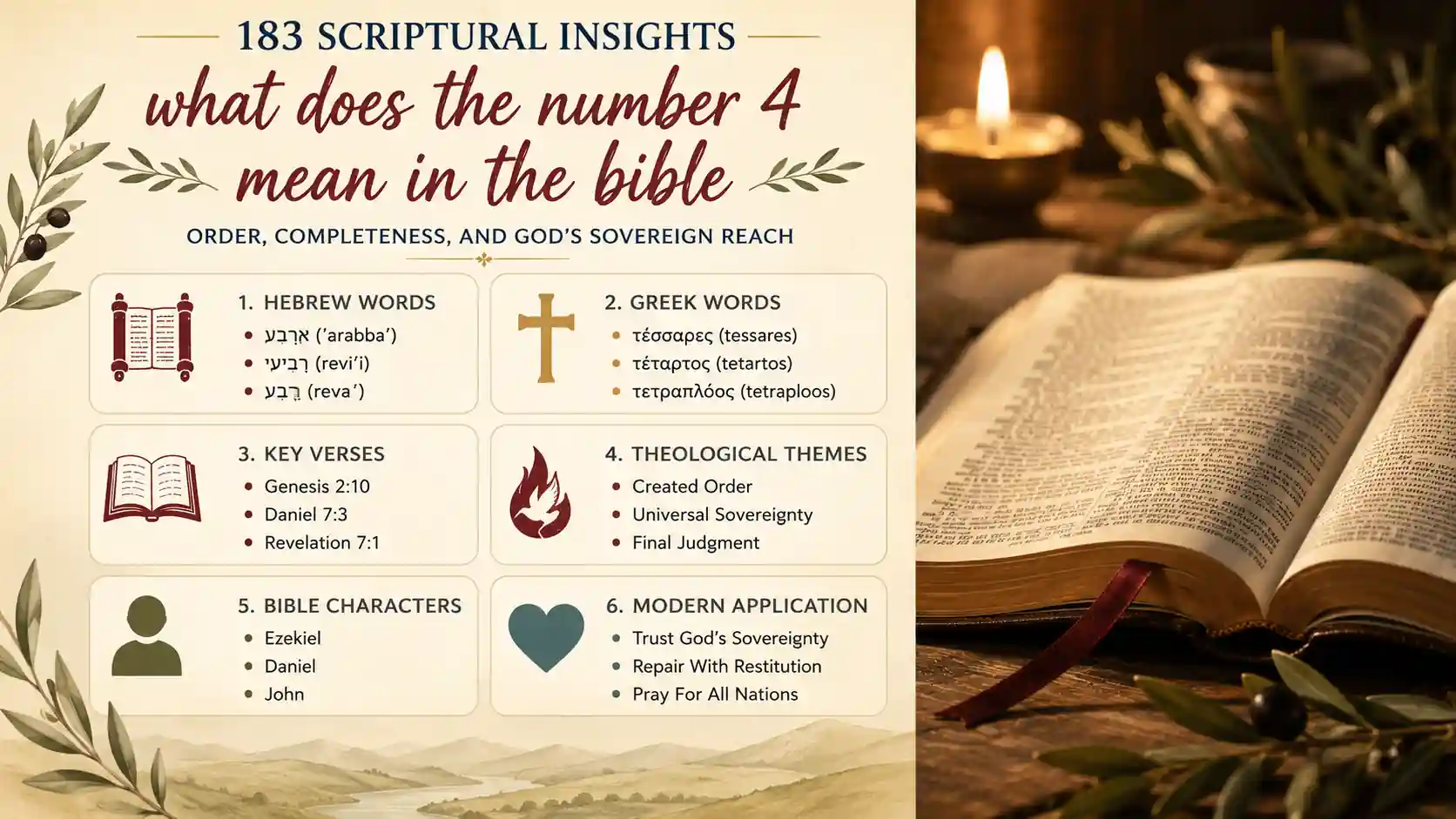
What does the number 4 mean in the Bible? Scripture often uses four in settings involving creation, earthly extent, ordered completeness, divine government, and worldwide judgment. Yet the Bible never gives a universal formula declaring that four must carry the same symbolic meaning in every passage.
Your study should therefore begin with each verse in its literary and historical context. Four may simply report a quantity, but repeated patterns such as four winds, four corners, four kingdoms, and four living creatures frequently communicate breadth, order, or comprehensive reach within the created world.
Four in Key Scripture References
| Verse | Passage Snippet | Context |
|---|---|---|
| Genesis 2:10 | River divided into four | Eden’s waters reach surrounding lands |
| Genesis 15:16 | Fourth generation returns | God times Israel’s return to Canaan |
| Exodus 27:2 | Four horns on altar | Tabernacle altar has ordered symmetry |
| 2 Samuel 12:6 | Restore the lamb fourfold | David unknowingly judges his own sin |
| Ezekiel 1:5 | Four living creatures | God’s mobile throne appears in exile |
| Daniel 7:3 | Four great beasts | Kingdoms rise from the turbulent sea |
| Zechariah 6:1 | Four chariots emerge | Heavenly agents execute divine judgment |
| Revelation 7:1 | Four angels and winds | Judgment is restrained across the earth |
| Revelation 21:16 | City lies foursquare | New Jerusalem displays perfect proportion |
Four in Bible Translation Comparison
| Verse | KJV | NIV | ESV | NASB |
|---|---|---|---|---|
| Genesis 2:10 | four heads | four headwaters | four rivers | four rivers |
| Ezekiel 1:5 | four living creatures | four living creatures | four living creatures | four living beings |
| Daniel 3:25 | four men loose | four men walking | four men unbound | four men untied |
| Daniel 7:3 | four great beasts | four great beasts | four great beasts | four great beasts |
| Zechariah 6:1 | four chariots | four chariots | four chariots | four chariots |
| Matthew 24:31 | four winds | four winds | four winds | four winds |
| Revelation 4:6 | four beasts | four living creatures | four living creatures | four living creatures |
| Revelation 7:1 | four corners | four corners | four corners | four corners |
| Revelation 21:16 | lieth foursquare | laid out like a square | lies foursquare | laid out as a square |
Four and the People and Characters Associated with It
| Person | Role | Connection |
|---|---|---|
| Moses | Covenant mediator | Records Eden’s rivers and tabernacle measurements |
| David | King of Israel | Orders fourfold repayment in Nathan’s parable |
| Nathan | Prophet | Uses a stolen lamb to expose David |
| Ezekiel | Exilic prophet | Sees four creatures, wheels, and directions |
| Nebuchadnezzar | Babylonian king | Sees four men inside the furnace |
| Daniel | Prophet and statesman | Receives visions of four world kingdoms |
| Zechariah | Postexilic prophet | Sees four horns, craftsmen, and chariots |
| Jesus | Messiah and teacher | Sends angels to gather from four winds |
| John | Apostle and seer | Describes four creatures and earth’s corners |
| Zacchaeus | Repentant tax collector | Promises fourfold restitution for fraud |
Four in Original Hebrew and Greek Words
| Original Word | Transliteration | Strong’s # | Literal Meaning |
|---|---|---|---|
| אַרְבַּע | ʾarbaʿ | H702 | four |
| אַרְבַּע | ʾarbaʿ | H703 | four in biblical Aramaic |
| אַרְבַּעְתַּיִם | ʾarbaʿtayim | H706 | fourfold |
| רְבִיעִי | reviʿi | H7243 | fourth |
| רֶבַע | revaʿ | H7253 | quarter or fourth part |
| τέσσαρες | tessares | G5064 | four |
| τεταρταῖος | tetartaios | G5066 | on the fourth day |
| τέταρτος | tetartos | G5067 | fourth |
| τετρακισχίλιοι | tetrakischilioi | G5070 | four thousand |
| τετραπλόος | tetraploos | G5073 | fourfold |
Four and Related Biblical Concepts
| Concept | Connection | Supporting Verse |
|---|---|---|
| Creation | Luminaries appointed on the fourth day | Genesis 1:14–19 |
| Eden | One river becomes four branches | Genesis 2:10–14 |
| Earthly extent | Four corners represent the whole land | Isaiah 11:12 |
| Winds | Four directions express comprehensive reach | Jeremiah 49:36 |
| Kingdoms | Four beasts represent successive empires | Daniel 7:3–17 |
| Divine throne | Four creatures attend God’s glory | Ezekiel 1:5–28 |
| Judgment | Four chariots patrol under divine authority | Zechariah 6:1–8 |
| Restitution | Fourfold payment repairs serious loss | Exodus 22:1 |
| Gospel mission | Elect gathered from the four winds | Matthew 24:31 |
| New creation | Holy city is perfectly foursquare | Revelation 21:16 |
Four in Historical and Cultural Context
| Aspect | Detail | Biblical Source |
|---|---|---|
| Ancient geography | Four winds indicated every direction | Daniel 8:8 |
| Hebrew numerals | אַרְבַּע changes form by grammatical gender | Genesis 2:10 |
| Aramaic usage | Daniel uses an Aramaic form for four | Daniel 3:25 |
| Altar construction | Four horns stood at four corners | Exodus 27:2 |
| Military guarding | Four squads guarded Peter in shifts | Acts 12:4 |
| Legal restitution | Sheep theft could require fourfold payment | Exodus 22:1 |
| Prophetic imagery | Beasts portrayed imperial powers | Daniel 7:17 |
| Exilic setting | Ezekiel’s vision assured displaced Judah | Ezekiel 1:1–3 |
| Apocalyptic language | Cosmic directions showed worldwide scope | Revelation 7:1 |
| City planning | Foursquare design signaled balance and security | Revelation 21:16 |
Four and Its Theological Themes
| Theme | Explanation | Scripture |
|---|---|---|
| Created order | God structures the world purposefully | Genesis 1:14–19 |
| Universal sovereignty | Every direction remains under God’s rule | Zechariah 6:5 |
| Divine presence | God’s throne reaches His exiled people | Ezekiel 1:26–28 |
| Human empire | Earthly kingdoms rise and fall | Daniel 7:17 |
| Final judgment | God restrains and releases cosmic forces | Revelation 7:1–3 |
| Preservation | A fourth figure appears in Babylon’s fire | Daniel 3:25 |
| Justice | Repentance produces measurable restitution | Luke 19:8 |
| Worldwide gathering | Christ gathers His people from everywhere | Mark 13:27 |
| Perfect holiness | New Jerusalem possesses ordered proportions | Revelation 21:16 |
| Christ’s supremacy | The Son of Man receives lasting dominion | Daniel 7:13–14 |
Four in Modern Application for Believers
| Area | Practice | Scripture |
|---|---|---|
| Bible study | Interpret numbers within their passage | Nehemiah 8:8 |
| Worship | Honor God as Lord of all creation | Revelation 4:11 |
| Trust | Remember that no place lies beyond God | Psalm 139:7–10 |
| Repentance | Repair damage where restitution is possible | Luke 19:8 |
| Mission | Pray for believers among all peoples | Matthew 24:31 |
| Politics | Refuse to treat empires as eternal | Daniel 7:14 |
| Suffering | Seek God’s presence within the furnace | Daniel 3:25 |
| Stewardship | Value order without worshiping patterns | 1 Corinthians 14:40 |
| Hope | Await the perfectly ordered holy city | Revelation 21:16 |
| Discernment | Reject superstitious number predictions | Deuteronomy 18:10–12 |
What Does the Number 4 Mean in the Bible Across Creation and Prophecy?
Four most consistently appears in relation to the breadth and order of the created realm. The fourth day brings the sun, moon, and stars into their appointed functions. Eden’s river separates into four branches, while prophetic texts speak of four winds or four corners to describe the full extent of the earth.
This does not mean every occurrence secretly symbolizes “creation.” Acts 21:9 simply reports that Philip had four prophetic daughters. Sound interpretation distinguishes ordinary counting from symbolic imagery instead of forcing every reference into a predetermined numerical code.
אַרְבַּע And τέσσαρες within the Language of Scripture
The ordinary Hebrew term אַרְבַּע, ʾarbaʿ, and the Greek τέσσαρες, tessares, mean “four.” Their primary function is numerical. Related words can describe the fourth item, a quarter, four thousand, or repayment at four times the original value.
The vocabulary itself does not contain a hidden mystical definition. Symbolic significance arises from the inspired author’s use of the number within a particular vision, law, narrative, or architectural description. Your interpretation must follow the text rather than later systems of numerology.
Four Kingdoms and the Sovereignty of the Son of Man
Daniel 7 presents four beasts rising from the sea, followed by the heavenly court and the arrival of one like a Son of Man. The four creatures represent kings or kingdoms, showing that violent imperial power is temporary, accountable, and subordinate to God’s judgment.
The main message is not an invitation to calculate modern political events from the number four. Daniel directs your hope toward God’s everlasting kingdom. The beasts lose their dominion, but the Son of Man receives authority that will not pass away.
Four Living Creatures from Ezekiel to Revelation
Ezekiel’s four living creatures accompany a vision of God’s throne during Judah’s exile. Each creature has four faces and four wings, and the wheels move in every direction. The imagery announces that the Lord is not confined to Jerusalem. His glorious rule reaches Babylon and every part of creation.
Revelation 4 also places four living creatures around the throne. Their ceaseless worship centers attention on God’s holiness, creative authority, and eternal life. The number contributes to the scene’s ordered fullness, but God Himself, not the number, is the object of worship.
Frequently Asked Questions About the Number Four
Does אַרְבַּע, ʾarbaʿ, always symbolize the created world?
No. It normally means four, and symbolism must be established from the passage’s context.
Why does Daniel 3:25 describe a fourth person in the furnace?
Nebuchadnezzar sees an unexpected heavenly figure with the three Hebrews, emphasizing divine presence and deliverance.
Do the four corners of Revelation 7:1 teach that the earth is physically square?
No. “Four corners” is directional imagery describing the earth in its comprehensive extent.
Are Ezekiel’s four living creatures the same beings seen in Revelation 4?
The visions share major features, though each writer presents them within a distinct prophetic setting and purpose.
Does τέσσαρες, tessares, give believers a code for predicting events?
No. Scripture calls you to faithful interpretation, not superstition, divination, or date setting.