
What does covet mean in the Bible? To covet is to set your heart on something that belongs to another person, allowing desire to become possessive, discontented, or greedy. Scripture does not condemn every desire. It condemns desire that rejects God’s boundaries, resents your neighbor’s good, or treats another person’s life as something you deserve to possess.
The biblical vocabulary includes longing, craving, dishonest gain, greed, and love of money. From the tenth commandment to Jesus’ warning about possessions, coveting is exposed as a heart-level sin that can produce theft, adultery, exploitation, and idolatry.
Key Covet Scripture References
| Verse | Passage Snippet | Context |
|---|---|---|
| Exodus 20:17 | “You shall not covet” | The tenth commandment forbids desiring a neighbor’s household. |
| Deuteronomy 5:21 | “Neither shall you desire” | Moses repeats the command and includes the neighbor’s field. |
| Joshua 7:21 | “I coveted them and took them” | Achan’s desire leads to theft and covenant judgment. |
| Micah 2:2 | “They covet fields” | Powerful people seize homes and inherited land. |
| Luke 12:15 | “Beware of covetousness” | Jesus warns that life is not measured by possessions. |
| Romans 7:7 | “You shall not covet” | Paul explains how the law exposes inward sin. |
| Colossians 3:5 | “Covetousness, which is idolatry” | Greed gives created things the devotion owed to God. |
| Hebrews 13:5 | “Without covetousness” | Contentment rests on God’s faithful presence. |
These passages show that coveting is more than admiration. It is an inward reaching for what God has assigned to someone else, often accompanied by a willingness to ignore justice, love, or covenant limits.
Covet Bible Translation Comparison
| Verse | KJV | NIV | ESV | NASB |
|---|---|---|---|---|
| Exodus 20:17 | “Thou shalt not covet” | “You shall not covet” | “You shall not covet” | “You shall not covet” |
| Deuteronomy 5:21 | “Neither shalt thou desire” | “You shall not set your desire” | “You shall not desire” | “You shall not desire” |
| Joshua 7:21 | “I coveted them” | “I coveted them” | “I coveted them” | “I coveted them” |
| Micah 2:2 | “They covet fields” | “They covet fields” | “They covet fields” | “They covet fields” |
| Luke 12:15 | “Beware of covetousness” | “Be on your guard against greed” | “Guard against all covetousness” | “Be on your guard against greed” |
| Romans 7:7 | “Thou shalt not covet” | “You shall not covet” | “You shall not covet” | “You shall not covet” |
| Colossians 3:5 | “Covetousness, which is idolatry” | “Greed, which is idolatry” | “Covetousness, which is idolatry” | “Greed, which amounts to idolatry” |
| Hebrews 13:5 | “Without covetousness” | “Free from the love of money” | “Free from love of money” | “Free from the love of money” |
The translations differ mainly in how they express the underlying sin. “Covetousness” preserves traditional theological language, while “greed” and “love of money” clarify particular forms of grasping desire. No single English term captures every shade of the Hebrew and Greek vocabulary.
People and Characters Associated with Covet
| Person | Role | Connection |
|---|---|---|
| Eve | First woman | She saw the forbidden fruit as desirable and took it. |
| Achan | Israelite soldier | He coveted devoted treasure and hid it. |
| David | King of Israel | He desired Bathsheba, another man’s wife. |
| Ahab | King of Israel | He became resentful over Naboth’s vineyard. |
| Jezebel | Queen of Israel | She arranged Naboth’s death to obtain his land. |
| Gehazi | Elisha’s servant | He pursued gifts his master had refused. |
| Judas Iscariot | Disciple and betrayer | His love of money accompanied theft and betrayal. |
| Rich fool | Character in Jesus’ parable | He hoarded abundance without being rich toward God. |
Achan gives one of Scripture’s clearest descriptions of coveting’s progression. He saw valuable objects, coveted them, took them, and concealed them. What began in the eye and heart became an act that harmed the whole covenant community.
Ahab’s conduct follows a similar pattern. His fixation on Naboth’s vineyard produced resentment, manipulation, false accusation, and murder. Coveting often promises private satisfaction while creating public suffering.
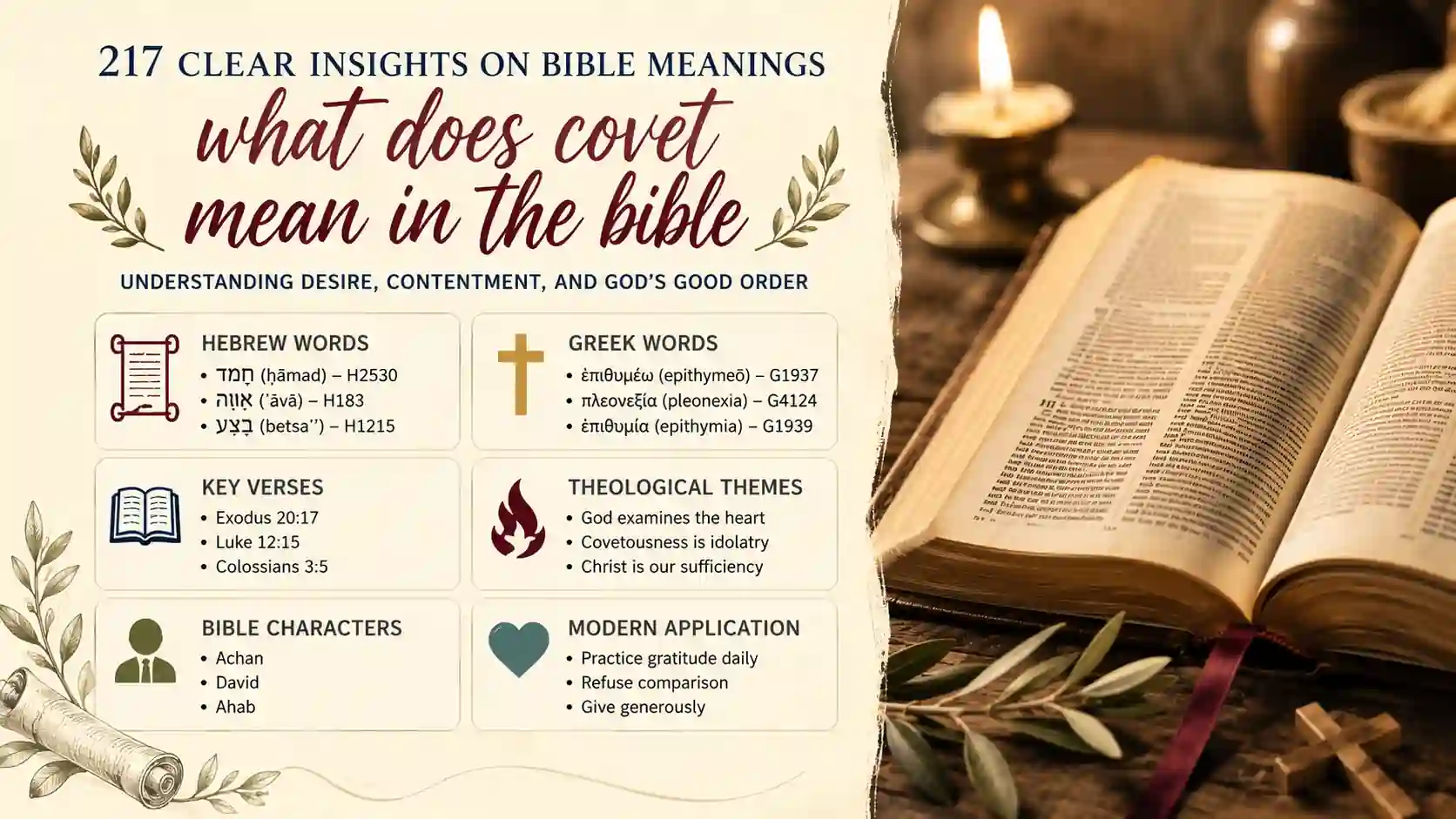
Original Hebrew and Greek Words for Covet
| Original Word | Transliteration | Strong’s # | Literal Meaning |
|---|---|---|---|
| חָמַד | ḥāmad | H2530 | To desire, delight in, or covet |
| אָוָה | ʾāvâ | H183 | To long for, crave, or wish |
| בֶּצַע | betsaʿ | H1215 | Gain, profit, often dishonest gain |
| תַּאֲוָה | taʾavâ | H8378 | Desire, craving, appetite |
| ἐπιθυμέω | epithymeō | G1937 | To desire strongly or set the heart upon |
| ἐπιθυμία | epithymia | G1939 | Desire, craving, or lust |
| πλεονεξία | pleonexia | G4124 | Greedy desire to have more |
| ἀφιλάργυρος | aphilargyros | G866 | Free from the love of money |
The primary verb in Exodus 20:17 is חָמַד, ḥāmad, Strong’s H2530. It can describe delight or desire without automatically indicating sin, so context determines its moral character. In the tenth commandment, the desired objects belong to your neighbor, making the longing forbidden and possessive.
Deuteronomy 5:21 also uses אָוָה, ʾāvâ, Strong’s H183, for setting one’s desire on a neighbor’s property. In the New Testament, ἐπιθυμέω, epithymeō, Strong’s G1937, can describe either proper longing or sinful craving. πλεονεξία, pleonexia, Strong’s G4124, emphasizes grasping for more.
Related Biblical Concepts of Covet
| Concept | Connection | Supporting Verse |
|---|---|---|
| Discontentment | Coveting rejects the portion God has provided. | Hebrews 13:5 |
| Idolatry | Desired possessions can become rival gods. | Colossians 3:5 |
| Envy | You resent the good another person possesses. | Proverbs 14:30 |
| Theft | Coveting may move from desire to taking. | Joshua 7:21 |
| Adultery | Forbidden desire may target another person’s spouse. | Matthew 5:28 |
| Dishonest gain | Greed seeks profit without justice. | Exodus 18:21 |
| Oppression | Powerful people seize homes, fields, or wages. | Micah 2:2 |
| Contentment | Trust in God weakens possessive craving. | Philippians 4:11 |
Coveting is related to envy, but the two are not identical. Envy grieves over another person’s advantage. Coveting reaches toward that advantage and says, “It should be mine.” The sins frequently work together, especially when comparison produces resentment.
Coveting also relates to idolatry because it assigns saving power to created things. Money, property, romance, influence, or status begins to promise the security, identity, and joy that should be sought in God.
Historical and Cultural Context of Covet
| Aspect | Detail | Biblical Source |
|---|---|---|
| Sinai covenant | The command was given to Israel after deliverance from Egypt. | Exodus 19 to 20 |
| Household economy | A house included family, workers, animals, and goods. | Exodus 20:17 |
| Agricultural land | Fields supported livelihood and family continuity. | Deuteronomy 5:21 |
| Tribal inheritance | Land was connected to covenant inheritance. | Leviticus 25:23 |
| Boundary markers | Moving boundaries could steal ancestral property. | Deuteronomy 19:14 |
| Debt vulnerability | The poor could lose land through exploitation. | Nehemiah 5:1–5 |
| Royal power | Kings could abuse authority to seize property. | 1 Kings 21 |
| Roman wealth | Jesus taught amid visible inequality and taxation. | Luke 12:13–21 |
In ancient Israel, coveting a field was not merely wishing for a prettier piece of land. Family land represented food, work, stability, identity, and inherited participation in the covenant community. Seizing it could endanger generations.
The tenth commandment therefore protected both the neighbor’s possessions and the social bonds surrounding them. By addressing desire before action, the law confronted the hidden source of many visible injustices.
Theological Themes of Covet
| Theme | Explanation | Scripture |
|---|---|---|
| God examines the heart | Divine law reaches motives as well as actions. | Romans 7:7 |
| Neighbor-love | Love refuses to grasp what belongs to another. | Romans 13:9–10 |
| Divine ownership | All possessions ultimately belong to God. | Psalm 24:1 |
| Human stewardship | You manage gifts rather than possess them absolutely. | 1 Chronicles 29:14 |
| Idolatrous desire | Greed directs worship toward created things. | Colossians 3:5 |
| Christ’s sufficiency | True life is not found in material abundance. | Luke 12:15 |
| Grace and renewal | The Spirit reshapes disordered desires. | Galatians 5:16 |
| Eternal treasure | Believers seek riches that endure before God. | Matthew 6:19–21 |
The position of the command within the Decalogue is significant. Earlier commands prohibit murder, adultery, theft, and false testimony. The final command reaches behind those acts to the inward desire that may produce them.
Paul recognized this searching power in Romans 7:7. A person may appear outwardly respectable while remaining inwardly consumed by comparison and craving. The command against coveting removes the illusion that righteousness is merely external.
Modern Application of Covet for Believers
| Area | Practice | Scripture |
|---|---|---|
| Money | Build spending habits around stewardship rather than status. | Matthew 6:24 |
| Possessions | Thank God for what you already have. | 1 Thessalonians 5:18 |
| Social media | Refuse comparison that breeds resentment. | Galatians 6:4 |
| Career | Pursue faithful work without craving another person’s position. | Colossians 3:23 |
| Relationships | Honor marriages and personal boundaries. | Hebrews 13:4 |
| Giving | Practice generosity as resistance to greed. | 2 Corinthians 9:7 |
| Prayer | Confess possessive desires honestly before God. | Psalm 139:23–24 |
| Contentment | Rest in God’s presence and provision. | Hebrews 13:5 |
What Does Covet Mean in the Bible’S Tenth Commandment?
In Exodus 20:17, coveting means nurturing a possessive desire for your neighbor’s household, spouse, workers, animals, or goods. The repeated phrase “your neighbor’s” shows that the issue is not ordinary appreciation but a longing that refuses to respect what God has entrusted to someone else.
The command protects the neighbor before any property is taken. It teaches you to confront sin at its inward beginning, where imagination, comparison, and dissatisfaction can grow into schemes and actions.
חָמַד ḤāMad and the Difference Between Desire and Sin
The Hebrew verb חָמַד, ḥāmad, can refer to something desirable or delightful. Genesis 2:9 uses related language for trees that were pleasant to sight. Desire itself is part of human nature and can be directed toward wisdom, righteousness, fellowship, and God’s presence.
Desire becomes coveting when it opposes God’s will or seeks what is forbidden. The object, motive, intensity, and intended action all matter. You may admire your neighbor’s home without resenting its owner or imagining that it should be yours.
πλεονεξία Pleonexia and the Idolatry of More
The Greek noun πλεονεξία, pleonexia, describes greed or the determination to possess more. Jesus warns against every form of it in Luke 12:15 because abundance cannot give life. The rich fool had full barns but was unprepared to meet God.
Paul calls covetousness idolatry in Colossians 3:5 because greed makes acquisition an object of trust and devotion. The cure is not merely owning fewer things. Your heart must learn that Christ, not accumulation, is the source of security and fullness.
From Sinai to the New Covenant Heart
The command against coveting reveals the unity of biblical ethics. At Sinai, God forbade Israel from grasping after a neighbor’s goods. Jesus later taught that evil desires arise from within, and Paul showed that love fulfills the law by refusing harm to one’s neighbor.
Under the new covenant, obedience is not reduced to avoiding visible theft. The Holy Spirit forms contentment, generosity, gratitude, and sincere love within you. These virtues do more than restrain coveting. They replace it with joy in God’s gifts to others.
Frequently Asked Questions About Covet
Does חָמַד, ḥāmad, always mean sinful coveting?
No. The word can mean desire or delight, and its moral meaning depends on the object and context.
Why does Deuteronomy 5:21 use both “covet” and “desire”?
The verse uses related Hebrew verbs to emphasize forbidden longing for both a neighbor’s wife and property.
Why do some translations say “greed” instead of “covetousness” in Luke 12:15?
They are translating πλεονεξία, pleonexia, a word emphasizing acquisitive desire for more.
How can covetousness be idolatry in Colossians 3:5?
It treats possessions, status, or pleasure as sources of life and security that belong only to God.
Is wanting a better job, home, or income automatically coveting?
No. The desire becomes sinful when it is ruled by envy, discontentment, injustice, or obsession with what belongs to another.