
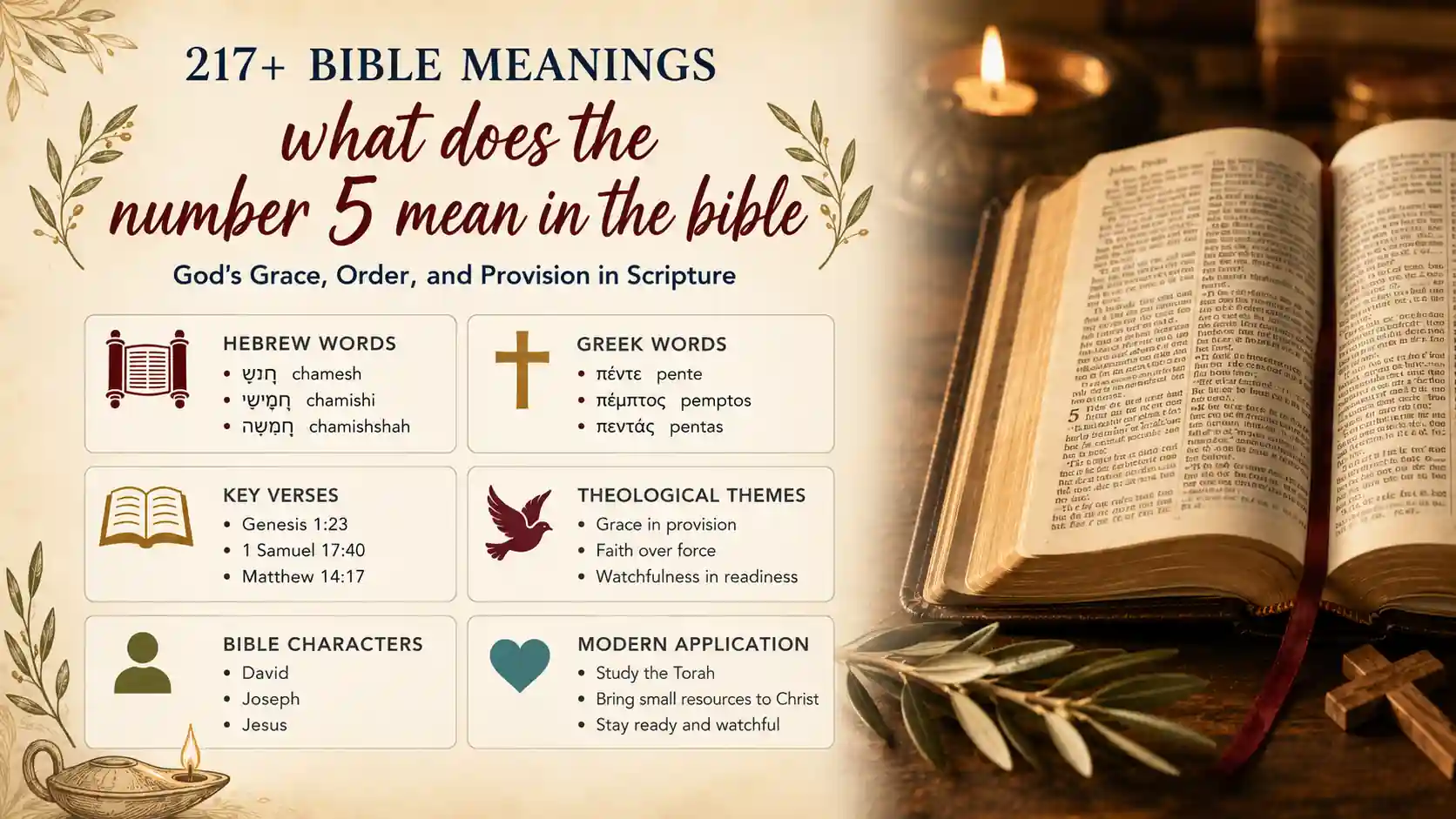
When you ask, “what does the number 5 mean in the Bible,” your study should begin with Scripture before symbolism. The Bible uses five as an ordinary number, yet it often appears where God provides ordered responsibility, measured mercy, covenant instruction, and human limitation met by divine sufficiency.
Five should not be treated like a secret code. It is better read as a repeated biblical pattern. From the Torah to the Gospels, five can point your attention to God’s gracious provision, holy order, and the call to faithful stewardship.
Number 5 Key Scripture References
| Verse | Passage Snippet | Context |
|---|---|---|
| Genesis 1:23 | fifth day | Sea creatures and birds created |
| Exodus 13:18 | by fives | Israel leaves Egypt in ranks |
| Exodus 26:3 | five curtains | Tabernacle fabric joined |
| Leviticus 26:8 | five chase a hundred | Covenant victory promised |
| 1 Samuel 17:40 | five smooth stones | David faces Goliath |
| 2 Kings 7:13 | five horses | Samaria scouts famine relief |
| Matthew 14:17 | five loaves | Jesus feeds five thousand |
| John 5:2 | five porches | Bethesda healing setting |
Number 5 Bible Translation Comparison
| Verse | KJV | NIV | ESV | NASB |
|---|---|---|---|---|
| Gen. 1:23 | fifth day | fifth day | fifth day | fifth day |
| Ex. 13:18 | harnessed | armed for battle | equipped for battle | in martial array |
| Ex. 26:3 | five curtains | five curtains | five curtains | five curtains |
| Lev. 26:8 | five of you | five of you | five of you | five of you |
| 1 Sam. 17:40 | five smooth stones | five smooth stones | five smooth stones | five smooth stones |
| Matt. 14:17 | five loaves | five loaves | five loaves | five loaves |
| Matt. 25:2 | five were wise | five were foolish | five were foolish | five were foolish |
| John 4:18 | five husbands | five husbands | five husbands | five husbands |
Number 5 People & Characters Associated
| Person | Role | Connection |
|---|---|---|
| Moses | Prophet and mediator | Five books linked to Torah |
| David | Shepherd and king | Chose five smooth stones |
| Goliath | Philistine giant | Faced David’s five stones |
| Joseph | Egypt’s administrator | Gave Benjamin five portions |
| Benjamin | Jacob’s youngest son | Received fivefold favor |
| Samaritan woman | Witness in Samaria | Had five husbands |
| Jesus | Messiah and teacher | Multiplied five loaves |
| Philip | Disciple | Present before feeding miracle |
Number 5 Original Hebrew & Greek Words
| Original Word | Transliteration | Strong’s # | Literal Meaning |
|---|---|---|---|
| חָמֵשׁ | chamesh | H2568 | five |
| חֲמִשָּׁה | chamishshah | H2568 | five |
| חֲמִישִׁי | chamishi | H2549 | fifth |
| חֹמֶשׁ | chomesh | H2567 | fifth part |
| חָמֻשִׁים | chamushim | H2571 | armed, by fives |
| פֶּנְטָטֶוּχος | Pentateuchos | later Greek term | five-scroll book |
| πέντε | pente | G4002 | five |
| πέμπτος | pemptos | G3991 | fifth |
Number 5 Related Biblical Concepts
| Concept | Connection | Supporting Verse |
|---|---|---|
| Torah | Five books of Moses | Deuteronomy 31:24 |
| Creation order | Fifth day teems with life | Genesis 1:20-23 |
| Covenant obedience | Five chase a hundred | Leviticus 26:8 |
| Worship structure | Five curtains joined | Exodus 26:3 |
| Provision | Five loaves multiplied | Matthew 14:17-21 |
| Readiness | Five wise virgins | Matthew 25:1-13 |
| Human inability | Only five loaves | John 6:9 |
| Restoration | Fivefold repayment | Exodus 22:1 |
Number 5 Historical & Cultural Context
| Aspect | Detail | Biblical Source |
|---|---|---|
| Ancient counting | Five fingers aid counting | Implied bodily measure |
| Torah scrolls | Fivefold Mosaic instruction | Genesis to Deuteronomy |
| Tabernacle craft | Five panels grouped | Exodus 26 |
| Covenant warfare | Small faithful group prevails | Leviticus 26:8 |
| Legal restitution | Ox repaid fivefold | Exodus 22:1 |
| Royal favor | Five garments to Benjamin | Genesis 45:22 |
| Pool setting | Five covered colonnades | John 5:2 |
| Wedding customs | Ten virgins divided five and five | Matthew 25 |
Number 5 Theological Themes
| Theme | Explanation | Scripture |
|---|---|---|
| Grace in provision | Little becomes enough in Christ | Matthew 14:17-21 |
| Covenant instruction | God forms His people by Torah | Deuteronomy 6:1-9 |
| Ordered worship | Holy space built by pattern | Exodus 26:3 |
| Faith over force | David trusts the Lord | 1 Samuel 17:40-47 |
| Watchfulness | Five wise are prepared | Matthew 25:2-10 |
| Human lack | Five loaves cannot feed crowds alone | John 6:9 |
| Restoration | Wrongdoing requires costly repayment | Exodus 22:1 |
| Divine victory | Five overcome a hundred | Leviticus 26:8 |
Number 5 Modern Application for Believers
| Area | Practice | Scripture |
|---|---|---|
| Bible reading | Study the Torah carefully | Deuteronomy 31:24 |
| Prayer | Bring small resources to Christ | John 6:9 |
| Stewardship | Use entrusted talents faithfully | Matthew 25:15 |
| Courage | Face giants with trust | 1 Samuel 17:45 |
| Repentance | Make restitution where needed | Exodus 22:1 |
| Worship | Honor God’s ordered holiness | Exodus 26:30 |
| Readiness | Keep watch for the Bridegroom | Matthew 25:13 |
| Compassion | Notice the weak at Bethesda | John 5:6 |
חָמֵשׁ Chamesh and the Ordinary Beauty of Five
The Hebrew word חָמֵשׁ, chamesh, is first of all a normal counting word. Scripture does not ask you to treat every five as a hidden prophecy. The number can count loaves, stones, curtains, men, animals, husbands, years, and groups.
Yet ordinary numbers become theologically rich when they stand inside God’s story. Five often appears where human limits are exposed. A boy has only five loaves, David has only five stones, and Israel’s five faithful warriors can chase a hundred only because covenant blessing rests on them.
What Does the Number 5 Mean in the Bible Through Torah and Covenant
The strongest biblical association with five is the Torah, the five books traditionally connected with Moses. Genesis, Exodus, Leviticus, Numbers, and Deuteronomy give Israel its creation memory, redemption story, priestly order, wilderness testing, and covenant instruction.
This does not mean the Bible says, “five means Torah” in a formula. It means that one of the Bible’s most important fivefold realities is the written foundation of covenant life. When you see five in Scripture, it is wise to ask whether the passage is emphasizing instruction, order, responsibility, or God’s gracious formation of His people.
Five Loaves, Five Thousand, and Grace Made Visible in Christ
In Matthew 14 and John 6, five loaves show the smallness of human resources before the hunger of the multitude. The disciples can count the lack, but Christ can bless, break, distribute, and leave abundance behind.
Here the number five serves the Gospel story beautifully. It does not work like magic. It works like testimony. What is insufficient in human hands becomes more than enough in the hands of the Son of God, who feeds His people like the Lord feeding Israel in the wilderness.
Five Smooth Stones and Faithful Readiness Before the Battle
David’s five smooth stones in 1 Samuel 17 are often over-symbolized. The text emphasizes David’s faith in the living God, not a secret meaning in the stones. He takes ordinary shepherd tools and moves toward Goliath with covenant confidence.
Still, the number matters because it belongs to the scene of readiness. David is not careless. He selects, prepares, and trusts. For your study, five here can remind you that faith is not passivity. Faith gathers what is available and relies on the Lord for the victory.
Five Wise Virgins and the Call to Watchful Discipleship
In Matthew 25, Jesus speaks of ten virgins, five wise and five foolish. The division creates a moral contrast. The wise are prepared for the bridegroom’s arrival, while the foolish presume they can borrow readiness at the last moment.
The Greek πέντε, pente, simply means five, but the parable uses the number to sharpen accountability. Not everyone who waits outwardly is inwardly prepared. The number five here presses you toward watchfulness, perseverance, and personal faithfulness before Christ.
Questions Bible Students Ask About Number 5
Does חָמֵשׁ, chamesh, always symbolize grace?
No. חָמֵשׁ means five, and grace may be a theme in some passages, but context must govern interpretation.
Why does Exodus 13:18 translate חָמֻשִׁים, chamushim, differently?
Because the word can suggest Israel went out arranged, armed, or in ranks, so translations choose the sense that best fits the exodus march.
Is πέντε, pente, in the feeding of the five thousand mainly symbolic?
It counts the loaves, but the miracle uses that small number to display Christ’s abundant provision.
Do David’s five smooth stones prove that five means victory?
No. The passage teaches the Lord’s victory through faith, with five stones showing David’s prepared obedience.
How should believers apply the number 5 without becoming superstitious?
Read each passage in context, honor the plain meaning, and let repeated patterns point you toward God’s provision, order, and faithfulness.