
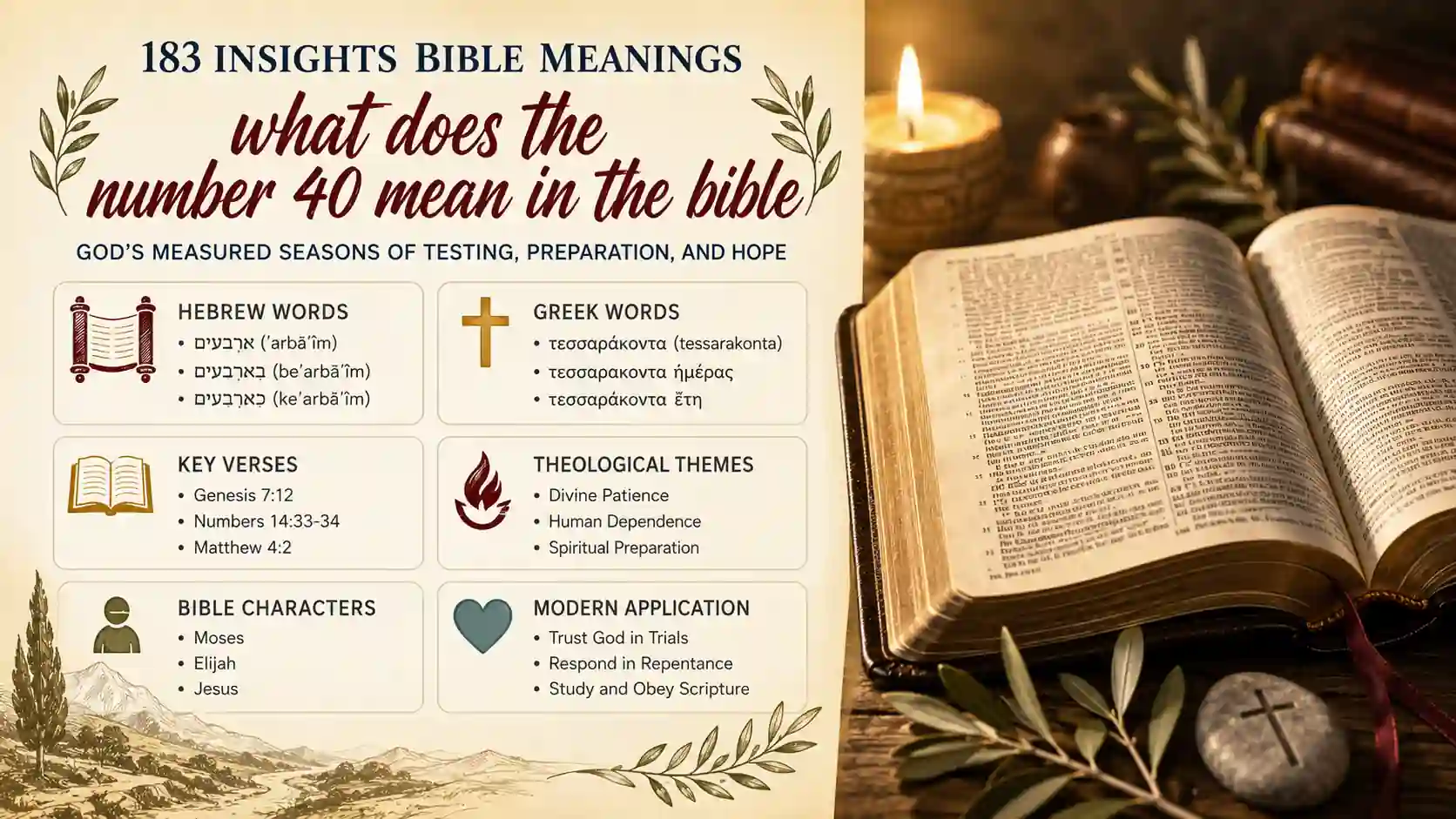
What does the number 40 mean in the Bible? Scripture repeatedly uses forty during periods of testing, judgment, preparation, transition, and divinely directed transformation. The number appears in accounts involving the flood, Israel’s wilderness journey, Moses, Elijah, Jonah, Jesus, and the early church.
Yet the Bible never gives forty one fixed symbolic definition. Your study should begin with each passage’s historical and literary context. Taken together, these texts reveal a recurring pattern. God uses measured seasons of difficulty or waiting to expose hearts, accomplish judgment, prepare servants, and lead His people into a new stage of His purpose.
Number 40 Key Scripture References
| Verse | Passage Snippet | Context |
|---|---|---|
| Genesis 7:12 | Rain fell forty days and nights | The flood brought judgment upon a violent world |
| Exodus 24:18 | Moses remained forty days | Moses received covenant instruction on Sinai |
| Numbers 14:33-34 | Forty years in the wilderness | Israel’s unbelief delayed entry into Canaan |
| Deuteronomy 8:2 | The Lord led you forty years | Wilderness testing revealed Israel’s heart |
| 1 Samuel 17:16 | Goliath challenged Israel forty days | Israel faced sustained fear before David’s victory |
| 1 Kings 19:8 | Elijah traveled forty days | God sustained the exhausted prophet to Horeb |
| Jonah 3:4 | Nineveh had forty days | A warning period opened the way for repentance |
| Matthew 4:2 | Jesus fasted forty days | Christ resisted temptation in the wilderness |
| Acts 1:3 | Jesus appeared for forty days | The risen Christ prepared His apostles for mission |
Number 40 Bible Translation Comparison
| Verse | KJV | NIV | ESV | NASB |
|---|---|---|---|---|
| Genesis 7:12 | forty days and forty nights | forty days and forty nights | forty days and forty nights | forty days and forty nights |
| Exodus 24:18 | forty days and forty nights | forty days and forty nights | forty days and forty nights | forty days and forty nights |
| Numbers 14:34 | even forty years | forty years | forty years | forty years |
| Deuteronomy 8:2 | these forty years | these forty years | these forty years | these forty years |
| 1 Samuel 17:16 | forty days | forty days | forty days | forty days |
| Jonah 3:4 | Yet forty days | Forty more days | Yet forty days | Forty more days |
| Matthew 4:2 | forty days and forty nights | forty days and forty nights | forty days and forty nights | forty days and forty nights |
| Acts 1:3 | forty days | forty days | forty days | forty days |
Number 40 People and Characters Associated
| Person | Role | Connection |
|---|---|---|
| Noah | Flood survivor | Waited through forty days of rainfall |
| Moses | Covenant mediator | Spent forty days with God on Sinai twice |
| Israel | Covenant nation | Wandered forty years after refusing Canaan |
| Joshua | Israelite leader | Spied Canaan for forty days before the wilderness judgment |
| Goliath | Philistine champion | Defied Israel morning and evening for forty days |
| David | Future king | Ended the crisis that had continued forty days |
| Elijah | Prophet | Journeyed forty days to Horeb in God’s strength |
| Jonah | Prophet to Nineveh | Announced judgment after forty days |
| Jesus | Messiah and Son of God | Fasted forty days and appeared forty days after resurrection |
| Apostles | Witnesses of Christ | Received instruction during forty post-resurrection days |
Number 40 Original Hebrew and Greek Words
| Original Word | Transliteration | Strong’s # | Literal Meaning |
|---|---|---|---|
| אַרְבָּעִים | ʾarbāʿîm | H705 | forty |
| וְאַרְבָּעִים | weʾarbāʿîm | H705 | and forty |
| בְּאַרְבָּעִים | beʾarbāʿîm | H705 | in forty |
| כְּאַרְבָּעִים | keʾarbāʿîm | H705 | about forty |
| לְאַרְבָּעִים | leʾarbāʿîm | H705 | for forty |
| τεσσαράκοντα | tessarakonta | G5062 | forty |
| τεσσαρακονταετής | tessarakontaetēs | G5063 | forty years old |
| τεσσαράκοντα ἡμέρας | tessarakonta hēmeras | G5062 | forty days |
| τεσσαράκοντα ἔτη | tessarakonta etē | G5062 | forty years |
Number 40 Related Biblical Concepts
| Concept | Connection | Supporting Verse |
|---|---|---|
| Testing | Forty can mark a season that reveals faith and obedience | Deuteronomy 8:2 |
| Judgment | The flood’s forty days brought divine judgment | Genesis 7:12 |
| Repentance | Nineveh received forty days to turn from evil | Jonah 3:4-10 |
| Preparation | Moses received instruction before leading Israel onward | Exodus 24:18 |
| Dependence | Jesus fasted and relied upon the Father’s word | Matthew 4:1-4 |
| Transition | Forty years separated slavery from settlement in Canaan | Joshua 5:6 |
| Perseverance | Elijah continued through weakness by God’s provision | 1 Kings 19:7-8 |
| Revelation | God disclosed covenant truth to Moses on Sinai | Exodus 34:28 |
| Witness | Jesus taught the apostles before His ascension | Acts 1:3 |
Number 40 Historical and Cultural Context
| Aspect | Detail | Biblical Source |
|---|---|---|
| Ancient counting | Forty could describe an exact, substantial period | Exodus 24:18 |
| Flood chronology | Forty days identifies the main period of rainfall | Genesis 7:12 |
| Spy mission | Twelve men examined Canaan for forty days | Numbers 13:25 |
| Judicial limits | Israelite law limited corporal punishment to forty blows | Deuteronomy 25:3 |
| Wilderness generation | A generation experienced forty years outside Canaan | Numbers 14:29-34 |
| Military intimidation | Goliath’s challenge continued for forty days | 1 Samuel 17:16 |
| Prophetic warning | Nineveh received time to respond before destruction | Jonah 3:4 |
| Jewish fasting | Extended fasting expressed dependence and consecration | Exodus 34:28 |
| Resurrection witness | Forty days strengthened apostolic testimony | Acts 1:3 |
Number 40 Theological Themes
| Theme | Explanation | Scripture |
|---|---|---|
| Divine patience | God sometimes gives time before executing judgment | Jonah 3:4-10 |
| Holy judgment | Persistent rebellion eventually receives a measured sentence | Numbers 14:34 |
| Covenant formation | Moses’ forty days centered upon God’s covenant word | Exodus 24:18 |
| Human dependence | Wilderness seasons expose the need for God’s provision | Deuteronomy 8:3 |
| Faithful obedience | Jesus succeeded where Israel had repeatedly failed | Matthew 4:1-11 |
| Spiritual preparation | God prepares servants before public responsibility | Exodus 34:28-32 |
| Redemptive transition | Forty often stands between an old condition and a new calling | Acts 1:3-8 |
| Mercy through warning | Announced judgment can summon genuine repentance | Jonah 3:5-10 |
| Sustaining grace | God strengthens weary servants for the road ahead | 1 Kings 19:5-8 |
Number 40 Modern Application for Believers
| Area | Practice | Scripture |
|---|---|---|
| Trials | Ask what God may be revealing in your heart | Deuteronomy 8:2 |
| Waiting | Remain faithful when change does not come quickly | Numbers 14:33 |
| Repentance | Respond promptly when Scripture exposes sin | Jonah 3:5 |
| Prayer | Set aside focused time to seek God humbly | Exodus 34:28 |
| Temptation | Answer deception with rightly understood Scripture | Matthew 4:4 |
| Leadership | Receive God’s instruction before acting publicly | Exodus 24:12 |
| Weariness | Accept rest, nourishment, and renewed direction | 1 Kings 19:5-8 |
| Courage | Refuse to let prolonged fear define your obedience | 1 Samuel 17:32 |
| Witness | Learn Christ’s teaching and share it faithfully | Acts 1:3-8 |
What Does the Number 40 Mean in the Bible’S Narrative Pattern?
The number forty often marks a complete, divinely measured season in which God deals seriously with individuals or communities. Rain falls for forty days, spies examine Canaan for forty days, Israel wanders for forty years, and Nineveh receives forty days to repent.
These examples do not make forty a secret code for every hardship. They show that biblical authors repeatedly connect the number with meaningful periods whose boundaries remain under God’s authority. A season may feel prolonged to you, but Scripture presents God as neither absent nor careless during it.
אַרְבָּעִים And the Wilderness Testing of Israel
The Hebrew word אַרְבָּעִים, ʾarbāʿîm, appears prominently in Israel’s wilderness history. Deuteronomy 8 explains the theological purpose of those forty years. God humbled Israel, tested the nation, provided manna, and taught that human life depends upon every word proceeding from Him.
The forty years were both punishment and instruction. Israel suffered the consequences of unbelief, yet God continued to guide, feed, preserve, and discipline His covenant people. Your own trials should not be equated directly with Israel’s judgment, but their history warns you against unbelief and teaches dependence.
τεσσαράκοντα And Jesus’ Forty Days in the Wilderness
The Greek word τεσσαράκοντα, tessarakonta, identifies the forty days of Jesus’ wilderness fast. His experience recalls Israel’s forty years, but the contrast is decisive. Where Israel complained and disobeyed, Jesus trusted the Father and answered the tempter from Deuteronomy.
Christ’s victory reveals more than a method for resisting temptation. He stands as the faithful Son who fulfills the obedience Israel failed to offer. When you face temptation, your hope rests first in His righteousness, then in the Spirit-enabled obedience that flows from union with Him.
Forty Days from Resurrection to Apostolic Mission
Acts 1 records that the risen Jesus appeared to His disciples during forty days and spoke about the kingdom of God. This period was not a trial like the flood or wilderness wandering. It was a season of confirmation, instruction, and preparation before the ascension and Pentecost.
The apostles needed certainty about the resurrection and clarity concerning their mission. Jesus gave both before commanding them to wait for the Holy Spirit. The pattern reminds you that Christian service should arise from confidence in the risen Lord, careful attention to His teaching, and dependence upon divine power.
Questions Bible Students Ask About the Number 40
Does אַרְבָּעִים always symbolize testing in the Old Testament?
No. It can mark testing, judgment, preparation, travel, leadership, or simply an exact period, depending on the passage.
Why do the KJV and ESV say “yet forty days” while the NIV and NASB say “forty more days” in Jonah 3:4?
Both renderings communicate that Nineveh faced destruction after a remaining period of forty days.
Did Jesus fast forty days mainly to copy Moses and Elijah?
His fast recalls both figures, but Matthew especially presents Jesus as the faithful Son succeeding where Israel failed.
Were Israel’s forty wilderness years only a punishment?
They were judicial punishment for unbelief, but they also became years of discipline, provision, revelation, and covenant instruction.
Should believers create forty-day practices because forty appears repeatedly in Scripture?
A forty-day practice may be useful, but Scripture neither guarantees special power in the number nor commands Christians to treat it as a spiritual formula.