
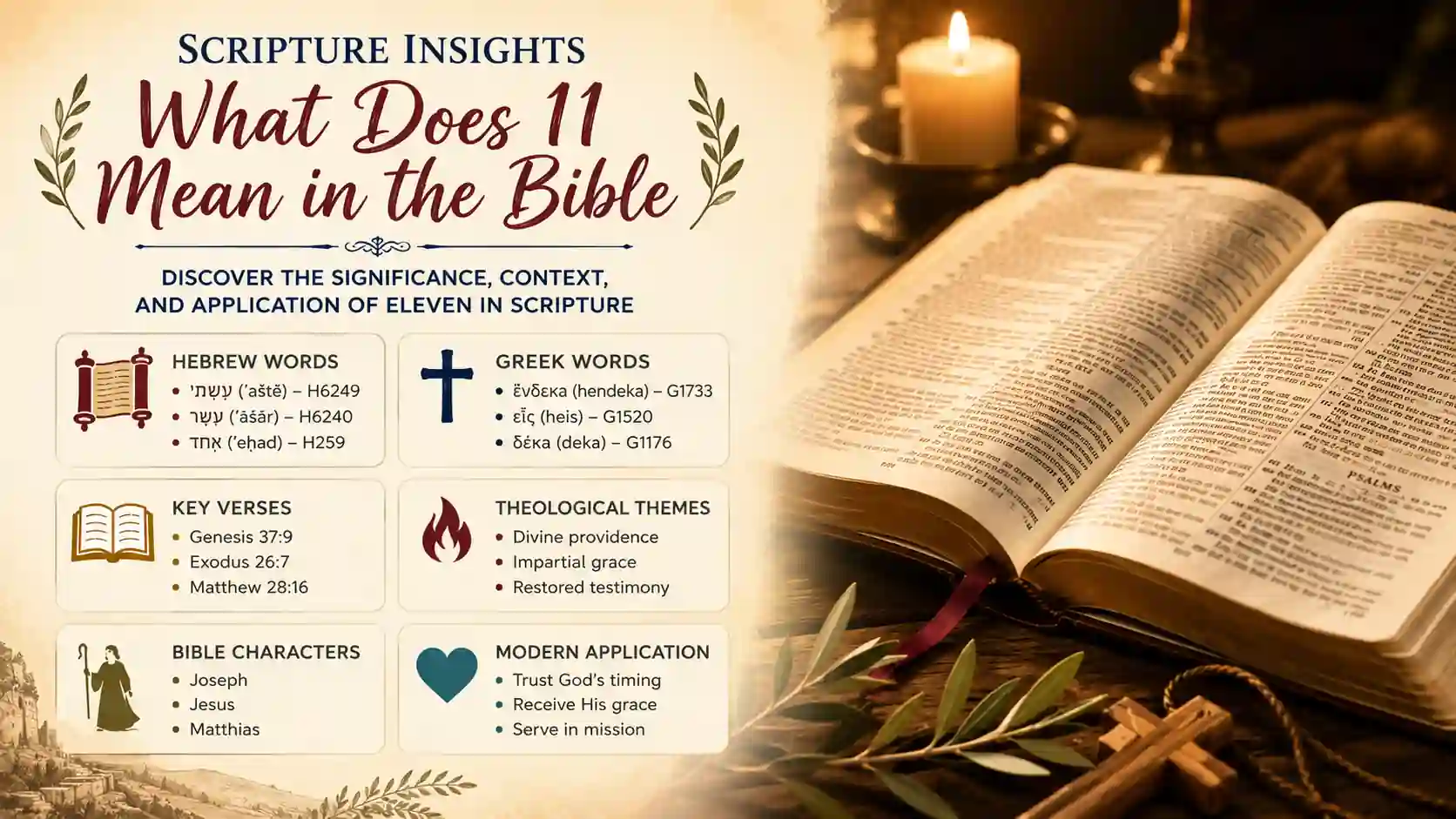
What does 11 mean in the Bible? Scripture uses eleven as an ordinary number in historical records, worship instructions, royal chronologies, prophetic dates, and narratives about Jesus’ disciples. It does not explicitly define eleven as a universal symbol with one hidden spiritual meaning.
Some passages connect eleven with incompleteness, transition, judgment, or restoration, but those ideas arise from each passage’s context. As you study, let the inspired text guide your interpretation rather than allowing modern numerology to control it.
Eleven Key Scripture References
| Verse | Passage Snippet | Context |
|---|---|---|
| Genesis 32:22 | Jacob took his eleven sons | Benjamin had been born, but Dinah was counted separately |
| Genesis 37:9 | Eleven stars bowed down | Joseph dreamed of his brothers honoring him |
| Exodus 26:7 | Make eleven goat-hair curtains | Outer covering of the tabernacle |
| Numbers 29:20 | Offer eleven bulls | Third day of the Feast of Booths |
| Deuteronomy 1:2 | An eleven-day journey | Distance from Horeb to Kadesh-barnea |
| 2 Kings 23:36 | Jehoiakim reigned eleven years | Judah declined under a rebellious king |
| Matthew 20:6 | About the eleventh hour | Late workers entered the vineyard |
| Matthew 28:16 | The eleven disciples went | The risen Christ commissioned his followers |
| Acts 1:26 | Numbered with the eleven | Matthias replaced Judas among the apostles |
These references show that eleven appears in several literary settings. Its significance comes from what God is doing in each passage, not from a fixed numerical code imposed on every occurrence.
Eleven Bible Translation Comparison
| Verse | KJV | NIV | ESV | NASB |
|---|---|---|---|---|
| Genesis 32:22 | His eleven sons | His eleven sons | His eleven children | His eleven children |
| Genesis 37:9 | Eleven stars | Eleven stars | Eleven stars | Eleven stars |
| Exodus 26:7 | Eleven curtains | Eleven altogether | Eleven curtains | Eleven curtains in all |
| Deuteronomy 1:2 | Eleven days’ journey | Takes eleven days | Eleven days’ journey | Eleven days’ journey |
| 2 Kings 23:36 | Reigned eleven years | Reigned eleven years | Reigned eleven years | Reigned eleven years |
| Matthew 20:6 | Eleventh hour | About five afternoon | Eleventh hour | About the eleventh hour |
| Matthew 28:16 | Eleven disciples went away | Eleven disciples went | Eleven disciples went | Eleven disciples proceeded |
| Acts 1:26 | Numbered with eleven | Added to eleven | Numbered with eleven | Added to eleven apostles |
Matthew 20:6 displays the clearest translation difference. The KJV, ESV, and NASB retain the ancient Jewish expression “eleventh hour,” while the NIV communicates its approximate modern equivalent, around five in the afternoon. Matthew 28:16 consistently identifies the post-resurrection group as eleven disciples.
Eleven People and Characters Associated
| Person | Role | Connection |
|---|---|---|
| Jacob | Patriarch | Crossed the Jabbok with eleven sons |
| Joseph | Son of Jacob | Saw eleven stars bow in his dream |
| Benjamin | Youngest brother | Completed Jacob’s group of twelve sons |
| Moses | Covenant mediator | Gave instructions for eleven curtains |
| Jehoiakim | King of Judah | Reigned eleven years in Jerusalem |
| Zedekiah | Final Davidic king | Reigned eleven years before Jerusalem fell |
| Jesus | Messiah and teacher | Spoke of laborers hired at the eleventh hour |
| Judas Iscariot | Betraying apostle | His departure left the apostolic group at eleven |
| Matthias | Apostolic witness | Chosen to join the remaining eleven |
These people reveal the varied settings in which eleven occurs. Joseph’s eleven stars concern family destiny, Jehoiakim and Zedekiah belong to Judah’s collapse, and the eleven disciples stand between Judas’s betrayal and the restoration of the Twelve.
Eleven Original Hebrew and Greek Words
| Original Word | Transliteration | Strong’s # | Literal Meaning |
|---|---|---|---|
| עַשְׁתֵּי | ʿaštê | H6249 | Eleven or eleventh |
| עֶשֶׂר | ʿeśer | H6240 | Ten |
| אֶחָד | ʾeḥad | H259 | One |
| עָשָׂר | ʿāśār | H6240 | Ten in compound numbers |
| עַשְׁתֵּי עָשָׂר | ʿaštê ʿāśār | H6249 and H6240 | Eleven |
| ἕνδεκα | hendeka | G1733 | One and ten |
| εἷς | heis | G1520 | One |
| δέκα | deka | G1176 | Ten |
| ἑνδέκατος | hendekatos | G1734 | Eleventh |
The Hebrew expression עַשְׁתֵּי עָשָׂר, ʿaštê ʿāśār, combines the special compound form for eleven with the word for ten. Strong’s H6249 identifies עַשְׁתֵּי, ʿaštê, as a term used for “eleven” or “eleventh” in combination with H6240.
The Greek ἕνδεκα, hendeka, is built from words associated with “one” and “ten,” giving the straightforward sense “one and ten.” Strong’s G1733 occurs six times in the KJV New Testament and carries no inherent moral or mystical definition.
Eleven Related Biblical Concepts
| Concept | Connection | Supporting Verse |
|---|---|---|
| Family promise | Eleven brothers bow in Joseph’s dream | Genesis 37:9 |
| Pilgrimage | Eleven days separate Horeb and Kadesh | Deuteronomy 1:2 |
| Tabernacle worship | Eleven curtains cover the sacred tent | Exodus 26:7 |
| Festival sacrifice | Eleven bulls offered on the third day | Numbers 29:20 |
| Royal accountability | Two kings reigned eleven years | 2 Kings 23:36 |
| Approaching judgment | Zedekiah’s reign ended in conquest | 2 Kings 24:18 |
| Generous grace | Late laborers receive the owner’s gift | Matthew 20:6 |
| Apostolic loss | Judas’s absence leaves eleven disciples | Matthew 28:16 |
| Restored witness | Matthias joins the remaining eleven | Acts 1:26 |
The Bible sometimes places eleven near moments of tension or transition. Yet it also appears in worship regulations and geographic measurements, where no negative symbolism is suggested. This variety warns you against treating every mention as a coded prophecy.
Eleven Historical and Cultural Context
| Aspect | Detail | Biblical Source |
|---|---|---|
| Ancient counting | Compound forms expressed one plus ten | Genesis 37:9 |
| Family structure | Sons represented household and tribal identity | Genesis 35:22-26 |
| Tabernacle design | Goat hair formed a protective outer tent | Exodus 26:7-13 |
| Wilderness travel | Journey lengths were measured by travel days | Deuteronomy 1:2 |
| Festival worship | Sacrifices decreased daily during Booths | Numbers 29:12-34 |
| Regnal dating | Kings were recorded by years of rule | 2 Kings 23:36 |
| Jewish daylight | The eleventh hour was near day’s end | Matthew 20:6 |
| Apostolic identity | Twelve reflected Israel’s twelve tribes | Matthew 19:28 |
| Witness selection | Apostles testified to the resurrection | Acts 1:21-26 |
The eleventh hour in Jesus’ vineyard parable was not eleven o’clock at night. Jewish daylight was commonly reckoned from sunrise, so the eleventh hour pointed to approximately five in the afternoon, shortly before work ended.
The eleven tabernacle curtains also served a practical architectural purpose. Five were joined as one set and six as another, with the extra portion folded at the front and additional material extending over the rear and sides.
Eleven Theological Themes
| Theme | Explanation | Scripture |
|---|---|---|
| Divine providence | God advances his purposes through human events | Genesis 37:5-11 |
| Covenant fulfillment | Joseph’s dream anticipates family preservation | Genesis 45:5-8 |
| Holy order | Tabernacle details reflect obedient worship | Exodus 26:7 |
| Human delay | Israel lingered despite a short journey | Deuteronomy 1:2-6 |
| Accountable kingship | Long reigns do not guarantee faithfulness | 2 Kings 23:36-37 |
| Impartial grace | God gives according to his generosity | Matthew 20:1-16 |
| Human failure | Judas’s betrayal wounds the apostolic circle | Matthew 27:3-5 |
| Resurrection mission | Christ entrusts his mission to imperfect disciples | Matthew 28:16-20 |
| Restored testimony | The apostolic body is prepared for witness | Acts 1:15-26 |
A responsible theology of eleven must preserve this range. Eleven can stand beside failure in one narrative and beside obedient worship in another. The number itself does not create the theology. The surrounding words, events, and covenant setting do.
Eleven Modern Applications for Believers
| Area | Practice | Scripture |
|---|---|---|
| Bible interpretation | Read numbers within their context | Nehemiah 8:8 |
| Spiritual discernment | Test claims about hidden meanings | 1 Thessalonians 5:21 |
| Waiting | Trust God when fulfillment seems delayed | Genesis 37:9 |
| Worship | Honor God through careful obedience | Exodus 26:7 |
| Stewardship | Receive God’s generosity without envy | Matthew 20:15 |
| Repentance | Do not waste seasons of opportunity | Deuteronomy 1:6 |
| Leadership | Remember that authority brings accountability | 2 Kings 23:36-37 |
| Failure | Return to Christ after disappointment | John 21:15-19 |
| Mission | Serve despite weakness and imperfection | Matthew 28:16-20 |
Your application should grow from the passage rather than from speculation. When you encounter eleven, ask who is present, what event is unfolding, and how the passage contributes to the biblical author’s message.
What Does 11 Mean in the Bible as a Whole?
The Bible never states that eleven always means disorder, rebellion, judgment, or incompleteness. Those interpretations are sometimes proposed because eleven follows ten, which may represent completeness in certain contexts, or because it falls short of twelve, a number often connected with Israel’s tribes and Jesus’ apostles.
That reasoning may offer a limited literary observation, but it cannot function as an interpretive rule. Exodus 26:7 uses eleven in the carefully ordered design of the tabernacle, while Numbers 29:20 uses it in commanded worship. Neither text presents eleven as evil or chaotic.
The Eleven Disciples Between Betrayal and Commission
The eleven disciples provide the most theologically significant New Testament use. Judas had betrayed Jesus and left the group, so “the eleven” honestly records loss. Nevertheless, the risen Lord met these imperfect men in Galilee and gave them the Great Commission.
Their reduced number did not prevent Christ from exercising all authority or promising his abiding presence. The passage emphasizes Jesus’ faithfulness more than apostolic completeness. Your hope rests in the risen King, who works through servants still recovering from grief, fear, doubt, and failure.
Ἕνδεκα And the Grace of the Eleventh Hour
In Matthew 20, the landowner hires laborers throughout the day, including at the eleventh hour. The phrase identifies a late time, not a mystical season. The parable confronts resentment when the owner generously pays the late workers the same daily wage.
Jesus is not teaching that effort, faithfulness, or obedience are meaningless. He exposes the pride that treats God’s kindness as a debt. As you study the eleventh hour, you are invited to rejoice when grace reaches someone later than you expected.
עַשְׁתֵּי עָשָׂר In Israel’S Worship and History
The Hebrew expression עַשְׁתֵּי עָשָׂר, ʿaštê ʿāśār, appears in passages about curtains, offerings, journeys, kings, and prophetic dates. This breadth shows that Hebrew writers could use eleven as a normal cardinal or ordinal number without implying a secret meaning.
Deuteronomy 1:2 is especially sobering because an eleven-day distance introduces a review of Israel’s long wilderness experience. The contrast highlights unbelief and delayed obedience, but the warning comes from Israel’s history, not from an evil quality hidden within eleven.
Questions About Eleven in Scripture
Does עַשְׁתֵּי, ʿaštê, mean disorder in Hebrew?
No. Strong’s H6249 means “eleven” or “eleventh” and does not lexically mean disorder.
Why does Matthew call Jesus’ followers “the eleven disciples”?
Judas Iscariot was no longer among them, so the phrase accurately describes the remaining apostolic group before Matthias was chosen.
Does the eleventh hour in Matthew 20 predict an end-times date?
No. It describes workers hired near the end of an ordinary workday within Jesus’ parable of divine generosity.
Why were there eleven goat-hair curtains in Exodus 26?
They formed the tabernacle’s outer tent, with the additional curtain providing the overlap required by God’s design.
Should you use eleven as a personal sign from God?
You should seek guidance through Scripture, prayer, wisdom, and providence rather than assigning automatic messages to repeated numbers.