
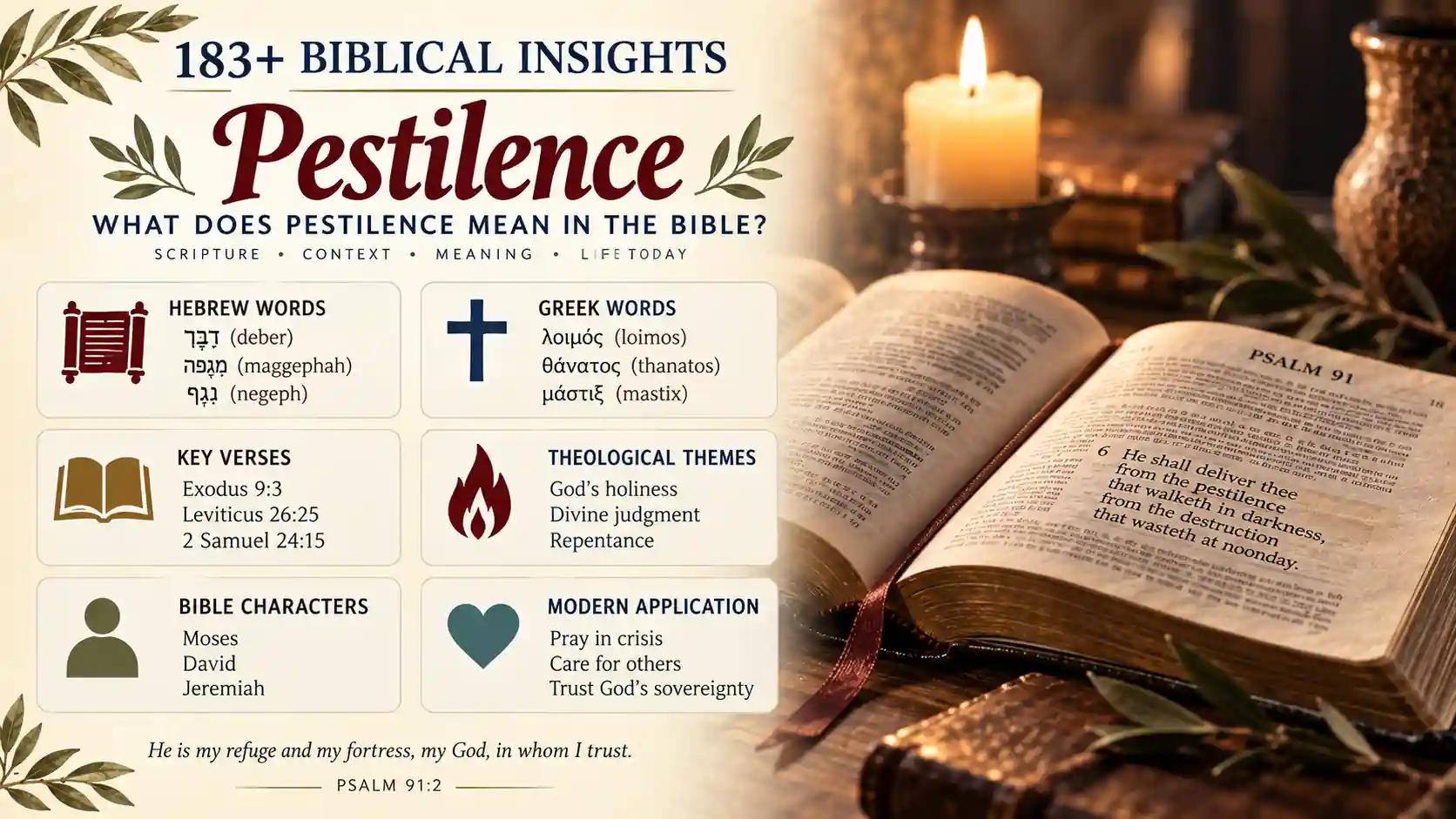
What does pestilence mean in the Bible? Scripture usually uses the word for a devastating outbreak of disease or plague that brings widespread suffering and death. In the Old Testament, the principal Hebrew term is דֶּבֶר (deber), while the New Testament uses λοιμός (loimos). Both words carry greater weight than the ordinary idea of sickness.
In your study, pestilence appears within covenant warnings, divine judgments, national crises, prophetic preaching, and promises of God’s protection and restoration. Reading these passages in context helps you see both God’s holiness and his mercy.
Pestilence Key Scripture References
| Verse | Passage Snippet | Context |
|---|---|---|
| Exodus 5:3 | “pestilence or with the sword” | Moses warns Pharaoh of judgment |
| Exodus 9:3 | “a very grievous murrain” | Livestock plague in Egypt |
| Leviticus 26:25 | “send the pestilence among you” | Covenant disobedience warning |
| Numbers 14:12 | “smite them with the pestilence” | Israel rebels after the spies |
| Deuteronomy 28:21 | “pestilence cleave unto thee” | Covenant curses for rebellion |
| 2 Samuel 24:15 | “pestilence upon Israel” | Judgment after David’s census |
| Psalm 91:6 | “pestilence that walketh in darkness” | Confidence in God’s protection |
| Jeremiah 14:12 | “sword and famine and pestilence” | Judgment on persistent rebellion |
| Ezekiel 5:12 | “pestilence… shall consume thee” | Judgment against Jerusalem |
| Habakkuk 3:5 | “Before him went the pestilence” | Poetic vision of divine power |
Pestilence Bible Translation Comparison
| Verse | KJV | NIV | ESV | NASB |
|---|---|---|---|---|
| Exodus 9:3 | murrain | terrible plague | severe plague | very severe pestilence |
| Leviticus 26:25 | pestilence | plague | pestilence | pestilence |
| Numbers 14:12 | pestilence | plague | pestilence | pestilence |
| Deuteronomy 28:21 | pestilence | plague | pestilence | plague |
| 2 Samuel 24:15 | pestilence | plague | pestilence | pestilence |
| Psalm 91:6 | pestilence | pestilence | pestilence | pestilence |
| Jeremiah 14:12 | pestilence | plague | pestilence | pestilence |
| Ezekiel 5:12 | pestilence | plague | pestilence | plague |
| Luke 21:11 | pestilences | pestilences | pestilences | plagues |
| Acts 24:5 | pestilent fellow | troublemaker | plague | real pest |
Pestilence People and Characters Associated
| Person | Role | Connection |
|---|---|---|
| Moses | Covenant mediator | Warned of plague in Egypt |
| Pharaoh | Egyptian king | Resisted God before the plagues |
| Aaron | High priest | Stood between living and dead |
| David | King of Israel | Census followed by pestilence |
| Gad | Prophet | Presented David’s judgment choices |
| Solomon | King and temple builder | Prayed concerning national pestilence |
| Jeremiah | Prophet | Repeatedly warned of pestilence |
| Ezekiel | Exilic prophet | Named pestilence among judgments |
| Habakkuk | Prophet | Portrayed pestilence before God |
| Jesus | Messiah and teacher | Foretold pestilences before the end |
Pestilence Original Hebrew and Greek Words
| Original Word | Transliteration | Strong’s # | Literal Meaning |
|---|---|---|---|
| דֶּבֶר | deber | H1698 | pestilence, plague |
| מַגֵּפָה | maggephah | H4046 | plague, stroke |
| נֶגֶף | negeph | H5063 | blow, plague |
| מַכָּה | makkah | H4347 | blow, wound, plague |
| קֶטֶב | qeteb | H6986 | destruction, deadly plague |
| שַׁחֶפֶת | shachepheth | H7829 | wasting disease |
| λοιμός | loimos | G3061 | pestilence, plague |
| θάνατος | thanatos | G2288 | death |
| μάστιξ | mastix | G3148 | scourge, affliction |
| πληγή | plēgē | G4127 | blow, wound, plague |
Pestilence Related Biblical Concepts
| Concept | Connection | Supporting Verse |
|---|---|---|
| Covenant curse | Pestilence follows rebellion | Leviticus 26:25 |
| Divine judgment | God judges persistent sin | Numbers 14:12 |
| Famine | Often paired with pestilence | Jeremiah 14:12 |
| Sword | Part of a judgment triad | Jeremiah 24:10 |
| Prayer | God’s people seek mercy | 2 Chronicles 20:9 |
| Repentance | Humbling accompanies restoration | 2 Chronicles 7:13-14 |
| Refuge | God protects according to his will | Psalm 91:3-6 |
| Intercession | Atonement checks a plague | Numbers 16:46-48 |
| Sovereignty | Calamity remains under God’s rule | 2 Samuel 24:15 |
| Restoration | Judgment is not Scripture’s final word | Jeremiah 33:6 |
Pestilence Historical and Cultural Context
| Aspect | Detail | Biblical Source |
|---|---|---|
| Ancient disease | Epidemics could devastate communities | Psalm 91:6 |
| Livestock disease | Plague could strike animals | Exodus 9:3 |
| Warfare | Siege encouraged famine and disease | Jeremiah 21:7 |
| Covenant treaty | Disease appears among curse sanctions | Deuteronomy 28:21 |
| Census crisis | David’s census preceded national plague | 2 Samuel 24:15 |
| Temple prayer | Pestilence prompted communal prayer | 1 Kings 8:37-39 |
| Siege of Jerusalem | Disease accompanied military disaster | Ezekiel 5:12 |
| Prophetic warning | Prophets treated plague morally and covenantally | Jeremiah 28:8 |
| Agrarian society | Epidemics threatened food and survival | Amos 4:9-10 |
| Roman era | Jesus listed pestilences among upheavals | Luke 21:11 |
Pestilence Theological Themes
| Theme | Explanation | Scripture |
|---|---|---|
| God’s holiness | Sin is treated seriously | Leviticus 26:25 |
| God’s sovereignty | Pestilence is never beyond his authority | 2 Samuel 24:15 |
| Human rebellion | Judgment may expose covenant unfaithfulness | Deuteronomy 28:21 |
| Mercy | God may restrain deserved judgment | 2 Samuel 24:16 |
| Intercession | Faithful prayer matters in crisis | Numbers 16:48 |
| Repentance | Calamity can summon people to return | Amos 4:10-11 |
| Refuge | Believers may trust God amid danger | Psalm 91:2-6 |
| Justice | Prophetic judgment is morally purposeful | Jeremiah 14:12 |
| Providence | History remains under God’s government | Habakkuk 3:5 |
| Hope | God promises healing and restoration | Jeremiah 33:6 |
Pestilence Modern Application for Believers
| Area | Practice | Scripture |
|---|---|---|
| Fear | Seek refuge in God | Psalm 91:2 |
| Prayer | Bring communal suffering before God | 2 Chronicles 20:9 |
| Repentance | Examine your heart humbly | Amos 4:10-11 |
| Compassion | Care for sufferers | Matthew 25:36 |
| Wisdom | Avoid careless presumption | Matthew 4:7 |
| Intercession | Pray for communities in crisis | Numbers 16:47-48 |
| Worship | Remember God’s sovereignty | Habakkuk 3:17-19 |
| Humility | Avoid simplistic judgments about sufferers | Luke 13:1-5 |
| Hope | Trust God’s ultimate restoration | Revelation 21:4 |
| Endurance | Remain faithful through upheaval | Luke 21:19 |
דֶּבֶר Deber and the Old Testament Meaning of Pestilence
The central Hebrew word behind “pestilence” is דֶּבֶר (deber), Strong’s H1698. It refers to a destructive plague or epidemic and appears repeatedly in the Torah, historical books, Psalms, and prophets. In Exodus 9:3 it describes a plague affecting livestock, showing that its biblical range is broader than one particular human disease.
Frequently, deber occurs alongside famine and sword. Jeremiah especially uses this pattern when describing the covenant consequences facing Judah. The expression therefore does not merely identify a medical condition. Within those passages, pestilence belongs to the theological language of judgment, national catastrophe, and covenant accountability.
What Does Pestilence Mean in the Bible within the Covenant?
Leviticus 26 and Deuteronomy 28 provide essential background. Israel had entered a covenant relationship with the Lord, and that covenant included blessings for faithfulness and consequences for persistent rebellion. Pestilence appears among those consequences in Leviticus 26:25 and Deuteronomy 28:21.
This setting prevents you from treating every biblical reference to disease as an isolated natural event. Yet it also prevents the opposite error of assuming that every modern outbreak must be a specific divine judgment. Scripture explicitly identifies certain ancient pestilences as judgments, but you need biblical revelation before assigning that explanation to a particular contemporary event.
David’s Census and the Mercy within Pestilence
One of Scripture’s most sobering pestilence narratives appears in 2 Samuel 24 and 1 Chronicles 21. After David’s sinful census, the prophet Gad places three judgments before him. David chooses to fall into the Lord’s hands, and a devastating pestilence comes upon Israel.
Yet the account is not simply about punishment. In 2 Samuel 24:16, the Lord commands the destroying angel to stop. David confesses his sin, builds an altar, and offers sacrifice. The narrative joins justice with mercy and eventually connects the site with the future temple location according to 1 Chronicles 21 and 22.
λοιμός Loimos, Jesus, and Pestilences in the New Testament
The principal New Testament term is λοιμός (loimos), Strong’s G3061, meaning “pestilence” or “plague.” Jesus uses its plural form in Luke 21:11 while describing earthquakes, famines, pestilences, terrifying events, and signs associated with the tumult preceding the consummation.
Jesus does not tell his disciples to construct a prophetic timetable whenever disease appears. Luke 21 places pestilence among a broad collection of upheavals while emphasizing endurance, testimony, vigilance, and faithfulness. Your response to such texts should therefore be sober trust rather than sensational speculation.
The same Greek noun appears figuratively in Acts 24:5. Tertullus calls Paul a λοιμός, effectively describing him as a “pest” or public menace. That usage shows how a word for destructive plague could become a vivid metaphor for a person regarded as socially troublesome.
Questions About Pestilence in the Bible
Is דֶּבֶר (deber) simply another Hebrew word for ordinary sickness?
No. Deber normally describes pestilence or destructive plague rather than routine individual illness.
Why does the KJV say “murrain” in Exodus 9:3 instead of “pestilence”?
“Murrain” is an older English term for infectious disease among livestock, fitting the animal plague described in that verse.
Does Psalm 91:6 promise that believers can never die from pestilence?
Psalm 91 calls you to confidence in God’s sovereign protection, but Scripture does not present faithful believers as universally exempt from suffering or death.
Does λοιμός (loimos) in Luke 21:11 mean every pandemic proves the end is immediately at hand?
No. Jesus includes pestilences among wider upheavals while directing his disciples toward endurance, witness, and watchfulness rather than date-setting.
Why are sword, famine, and pestilence so often mentioned together by Jeremiah?
They form a recurring prophetic picture of covenant judgment, especially during warfare and Jerusalem’s approaching destruction.