
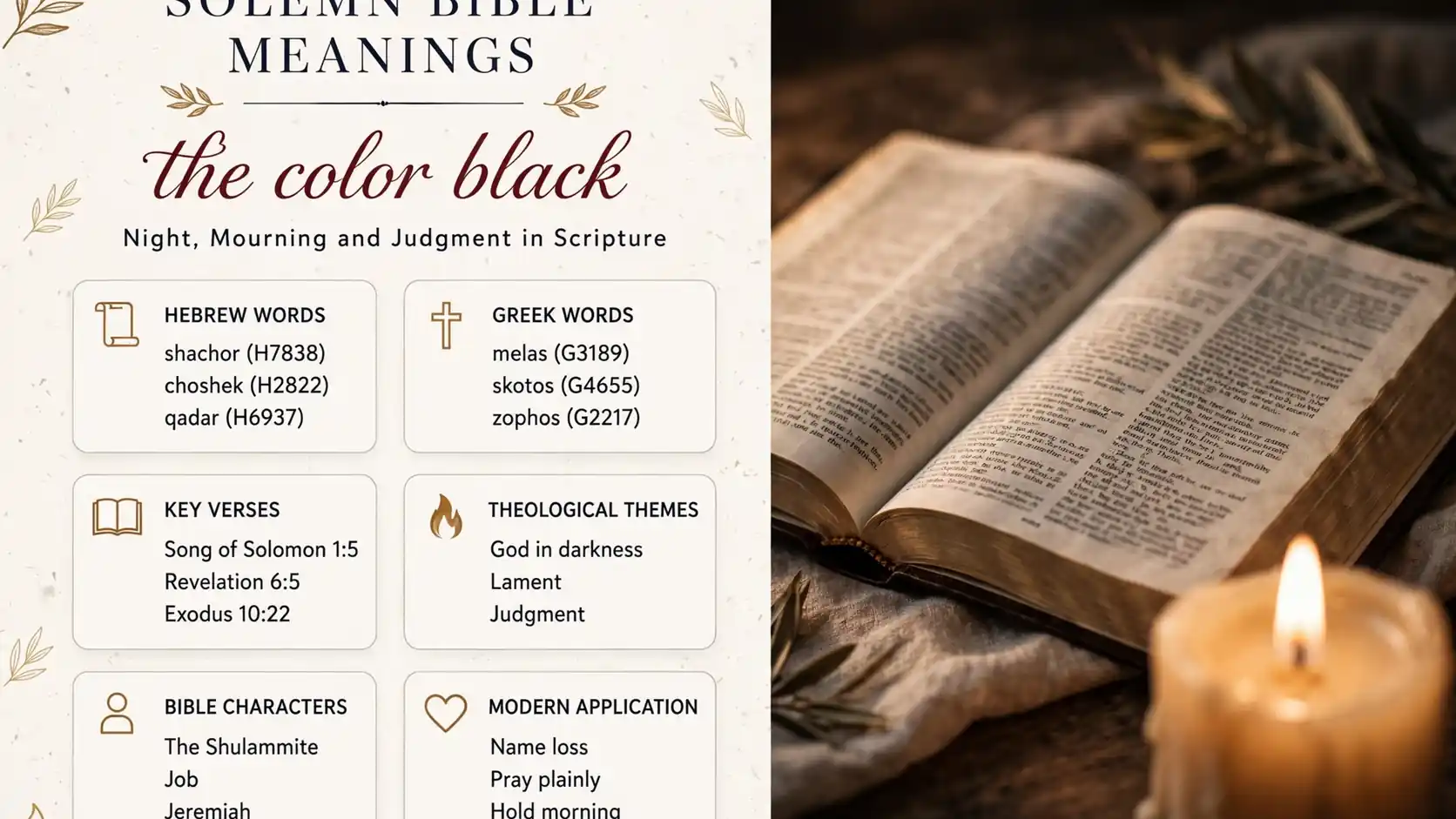
When you ask what does the color black mean in the bible, you are asking about a color that Scripture uses in more than one way. It can picture night, mourning, famine, judgment, and a beauty darkened by the sun. It is not one flat symbol, and each passage must be read in its own setting.
You will meet black in songs of love, in laments over ruined cities, and in visions of horses and darkened skies. The pages below gather the verses, the Hebrew and Greek words, the people, and the themes so you can tell mourning from judgment and night from famine.
Color Black in Key Scripture References
| Verse | Passage Snippet | Context |
|---|---|---|
| Song of Solomon 1:5 | I am black but comely | A woman speaks of sun darkened skin |
| Song of Solomon 5:11 | His locks are black as a raven | Praise for a beloved man |
| Lamentations 4:8 | Their visage is blacker than a coal | Jerusalem after siege and hunger |
| Jeremiah 8:21 | I am black | A prophet mourns a wounded people |
| Job 30:30 | My skin is black upon me | Job describes pain and fever |
| Revelation 6:5 | A black horse | A rider carries scales for grain |
| Revelation 6:12 | The sun became black as sackcloth | A vision of cosmic shaking |
| Zechariah 6:2 | Black horses | Chariots sent across the earth |
| Leviticus 13:37 | Black hair in the spot | A sign of a healing skin mark |
| Exodus 10:22 | Thick darkness in Egypt | Darkness fell for three days |
Color Black in Bible Translation Comparison
| Verse | KJV | NIV | ESV | NASB |
|---|---|---|---|---|
| Song of Solomon 1:5 | I am black | I am dark | I am very dark | I am black |
| Song of Solomon 5:11 | Black as a raven | Black as a raven | Black as a raven | Black as a raven |
| Lamentations 4:8 | Blacker than a coal | Blacker than soot | Blacker than soot | Blacker than soot |
| Jeremiah 8:21 | I am black | I mourn | I mourn | I mourn |
| Job 30:30 | My skin is black | My skin grows black | My skin turns black | My skin turns black |
| Revelation 6:5 | A black horse | A black horse | A black horse | A black horse |
| Revelation 6:12 | Black as sackcloth | Black like sackcloth | Black as sackcloth | Black like sackcloth |
| Zechariah 6:2 | Black horses | Black horses | Black horses | Black horses |
| Leviticus 13:37 | Black hair | Black hair | Black hair | Black hair |
| Exodus 10:22 | Darkness over Egypt | Darkness covered Egypt | Darkness over Egypt | Darkness over Egypt |
Color Black in People and Characters Associated
| Person | Role | Connection |
|---|---|---|
| The Shulammite | Beloved in the Song | She calls herself black from the sun |
| Job | Suffering servant | His skin darkens in affliction |
| Jeremiah | Prophet of lament | He mourns in blackened grief |
| John | Seer of Revelation | He sees a black horse and a black sun |
| Zechariah | Postexilic prophet | He sees black horses in vision |
| Moses | Leader of Israel | He announces darkness over Egypt |
| Pharaoh | King of Egypt | His land lies under thick darkness |
| David | King and psalmist | He walks through dark valleys |
| Solomon | King and poet | His song praises raven black hair |
| Jerusalem | Covenant city | Her princes grow black in famine |
Color Black in Original Hebrew and Greek Words
| Original Word | Transliteration | Strong’s # | Literal Meaning |
|---|---|---|---|
| שָׁחֹר | shachor | H7838 | Black in color |
| חֹשֶׁךְ | choshek | H2822 | Darkness or obscurity |
| קָדַר | qadar | H6937 | To be dark or mourn |
| אֲפֵלָה | aphelah | H653 | Gloom or deep darkness |
| עָפָר | aphar | H6083 | Dust or dry earth |
| לַיִל | layil | H3915 | Night or nighttime |
| μέλας | melas | G3189 | Black in color |
| σκότος | skotos | G4655 | Darkness or gloom |
| ζόφος | zophos | G2217 | Murky darkness |
| σκοτία | skotia | G4653 | Darkness or dimness |
Color Black in Related Biblical Concepts
| Concept | Connection | Supporting Verse |
|---|---|---|
| Night | Black marks the end of light | Genesis 1:5 |
| Mourning | Dark dress and grief go together | Jeremiah 8:21 |
| Famine | A black horse brings scarce grain | Revelation 6:5 |
| Judgment | Dark skies warn of reckoning | Revelation 6:12 |
| Sin and guilt | Darkness pictures hidden wrong | John 3:19 |
| Death and grave | Darkness recalls the shadowed pit | Job 10:21 |
| Beauty | Black hair signals youthful strength | Song of Solomon 5:11 |
| Humility | Sun darkened skin signals labor | Song of Solomon 1:6 |
| Mystery | Thick darkness hides divine presence | Exodus 20:21 |
| Hope after night | Morning follows the darkest hour | Psalm 30:5 |
Color Black in Historical and Cultural Context
| Aspect | Detail | Biblical Source |
|---|---|---|
| Sun and labor | Field workers darkened in the sun | Song of Solomon 1:6 |
| Sackcloth | Rough dark cloth marked grief | Revelation 6:12 |
| Siege famine | Hunger changed faces and skin | Lamentations 4:8 |
| Egyptian plague | Darkness stopped daily work | Exodus 10:22 |
| Horse colors | Colors carried meaning in visions | Zechariah 6:2 |
| Raven hair | Dark hair marked youth and vigor | Song of Solomon 5:11 |
| Skin disease | Hair color helped a priest judge | Leviticus 13:37 |
| Night travel | Darkness brought danger and fear | Genesis 15:12 |
| Temple veil | Darkness fell at a sacred hour | Matthew 27:45 |
| Ancient dyes | Dark tones came from nature | Song of Solomon 1:5 |
Color Black in Theological Themes
| Theme | Explanation | Scripture |
|---|---|---|
| God in darkness | God works beyond human sight | Exodus 20:21 |
| Lament | Grief darkens speech and sight | Lamentations 4:8 |
| Judgment | Black skies picture divine reckoning | Revelation 6:12 |
| Scarcity | A black horse warns of hunger | Revelation 6:5 |
| Human frailty | Bodies darken under suffering | Job 30:30 |
| Created beauty | Dark features can praise God | Song of Solomon 1:5 |
| Light and dark | Darkness defines the gift of light | Genesis 1:4 |
| Repentance | Mourning opens the way to return | Jeremiah 8:21 |
| Mystery | Faith trusts what it cannot see | Job 10:21 |
| Restoration | Morning follows night in grace | Psalm 30:5 |
Color Black in Modern Application for Believers
| Area | Practice | Scripture |
|---|---|---|
| Grief | Name loss without hiding sorrow | Jeremiah 8:21 |
| Reading visions | Read symbols in their own context | Revelation 6:5 |
| Beauty | Honor varied skin and hair | Song of Solomon 1:5 |
| Suffering | Pray plainly in dark seasons | Job 30:30 |
| Justice | Notice hunger behind stark images | Revelation 6:6 |
| Worship | Trust God in unseen darkness | Exodus 20:21 |
| Repentance | Let mourning lead to change | Lamentations 4:8 |
| Hope | Hold morning after night | Psalm 30:5 |
| Study | Check Hebrew before a quick claim | Song of Solomon 1:5 |
| Community | Sit with mourners in silence | Job 2:13 |
Shachor and the Color Black in Love and Labor
The Hebrew word shachor points first to color, not to character. In the Song, a woman who worked in vineyards says the sun has darkened her skin, and she still calls herself lovely. Her blackness tells a story of labor in the fields, not a story of shame. That plain reading guards you against turning every dark image into a moral label.
The same root also helps you hear praise in the Song. Raven black hair becomes a picture of vigor and youth, and the poet uses it with delight. When you keep labor, beauty, and color together, you avoid forcing a single meaning onto a word that Scripture uses with warmth in one place and sorrow in another.
Choshek and What Does the Color Black Mean in the Bible at Night and in Judgment
The Hebrew word choshek names darkness itself, and it runs from creation to plague to prophecy. At creation, darkness stood before light, and God set a boundary between them. In Egypt, thick darkness stopped work for three days, and no one rose from a place of fear. Those scenes show darkness as absence, danger, and divine action.
In prophecy, a sun turned black as sackcloth warns that human power will shake. That image is not a weather report, and it is not a code for one modern event alone. It belongs to a long biblical pattern where dark skies mark the day when God judges pride, and it calls readers to humility rather than to fearful guessing.
The Black Horse and the Color Black in Famine and Mourning
The black horse in Revelation carries a pair of scales, and the voice that follows it prices wheat and barley in a time of want. The color here does not praise the rider, and it does not describe a person. It marks scarcity, and the scales make the point concrete for ordinary households. A careful reader will ask what hunger meant for the first hearers before asking what it means for a later age.
Mourning gives black a second, quieter use in the prophets. Jeremiah speaks as one blackened by grief for a wounded people, and Lamentations pictures faces darkened by siege and hunger. In those passages, black belongs to the body of a sufferer, not to an abstract evil. That human use keeps the symbol close to real pain, and it invites compassion instead of cold speculation.
Frequently Asked Questions About the Color Black in the Bible
Does shachor always mean something bad in the Bible?
No, shachor names the color black, and the Song uses it for beauty and for sun darkened skin from labor.
Why do some translations say dark where others say black in Song of Solomon 1:5?
Translators weigh Hebrew shachor against English tone, and dark can soften a color word that black states plainly.
What does the black horse in Revelation 6:5 mean?
The black horse with scales pictures grain scarcity and famine prices, not a single modern nation or person.
Is the darkness in Exodus 10:22 the same as choshek in Genesis 1:2?
Both use darkness language, yet Egypt faces a plague darkness while Genesis pictures darkness before ordered light.
How should I apply the color black in my own study without misreading it?
Read each passage in its own setting, check the Hebrew or Greek word, and let mourning, famine, night, and beauty stay distinct.