
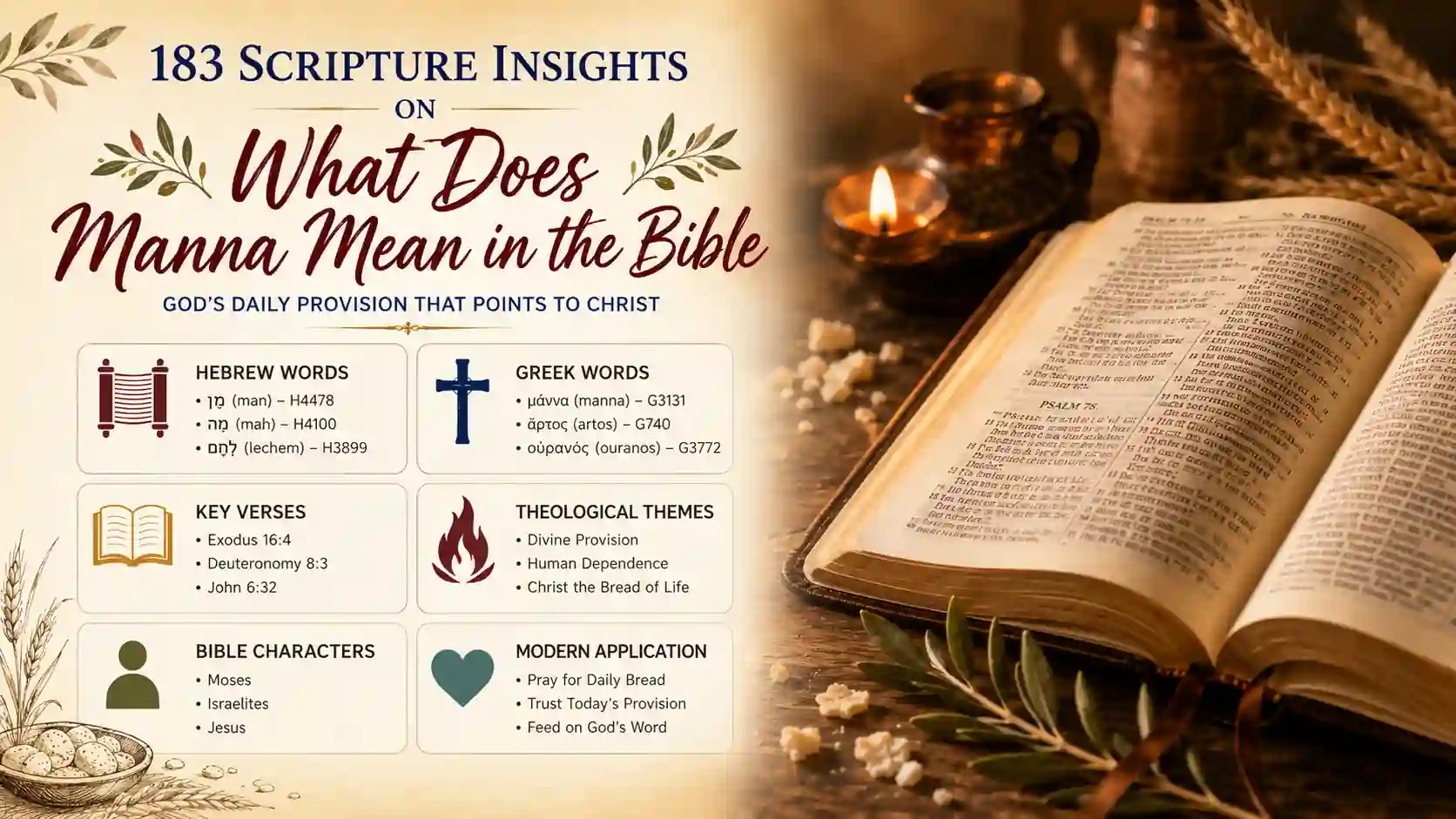
What does manna mean in the Bible? Manna is the mysterious food God provided for Israel after the exodus from Egypt. Its name is connected with the Israelites’ surprised question, “What is it?” Yet manna means far more than wilderness nourishment. It reveals God as Provider, Teacher, Covenant Lord, and Savior.
As you follow manna from Exodus through Revelation, you discover a unified biblical theme. God gives daily bread, tests trusting obedience, teaches dependence on his Word, and ultimately points you to Jesus Christ, the true bread from heaven.
Key Manna Scripture References
| Verse | Passage Snippet | Context |
|---|---|---|
| Exodus 16:4 | “Bread from heaven” | God promises daily provision |
| Exodus 16:15 | “What is it?” | Israel first sees manna |
| Exodus 16:18 | “No lack” | Each household receives enough |
| Exodus 16:31 | “Like coriander seed” | Manna’s appearance and taste |
| Exodus 16:33 | “Keep an omer” | A memorial is preserved |
| Exodus 16:35 | “Forty years” | Provision continues in the wilderness |
| Numbers 11:7 | “Appearance of bdellium” | Manna’s appearance is described |
| Deuteronomy 8:3 | “Not by bread alone” | Manna teaches dependence on God |
| John 6:32 | “True bread from heaven” | Jesus corrects the crowd |
| Revelation 2:17 | “Hidden manna” | Christ promises eternal reward |
Manna Bible Translation Comparison
| Verse | KJV | NIV | ESV | NASB |
|---|---|---|---|---|
| Exodus 16:4 | “bread from heaven” | “bread from heaven” | “bread from heaven” | “bread from heaven” |
| Exodus 16:15 | “It is manna” | “What is it?” | “What is it?” | “What is it?” |
| Exodus 16:18 | “had no lack” | “did not have too little” | “had no lack” | “had no lack” |
| Exodus 16:31 | “wafers made with honey” | “wafers made with honey” | “wafers made with honey” | “wafers with honey” |
| Exodus 16:35 | “forty years” | “forty years” | “forty years” | “forty years” |
| Numbers 11:8 | “fresh oil” | “olive oil” | “cakes baked with oil” | “cakes baked with oil” |
| Deuteronomy 8:3 | “every word” | “every word” | “every word” | “everything” |
| John 6:31 | “bread from heaven” | “bread from heaven” | “bread from heaven” | “bread out of heaven” |
| Hebrews 9:4 | “golden pot” | “gold jar” | “golden urn” | “golden jar” |
| Revelation 2:17 | “hidden manna” | “hidden manna” | “hidden manna” | “hidden manna” |
People and Characters Associated with Manna
| Person | Role | Connection |
|---|---|---|
| The Lord | Covenant Provider | Sends manna from heaven |
| Moses | Israel’s mediator | Announces and explains God’s gift |
| Aaron | Israel’s priest | Preserves manna before the testimony |
| Israelites | Covenant community | Gather, eat, test, and sometimes misuse it |
| Joshua | Moses’ successor | Leads Israel when manna ceases |
| Asaph | Psalm writer | Calls manna heavenly grain |
| Nehemiah | Postexilic governor | Recalls God’s wilderness faithfulness |
| Jesus | Bread of Life | Fulfills what manna anticipated |
| Capernaum crowd | Jesus’ hearers | Requests another bread sign |
| John | Revelation’s seer | Records Christ’s promise of hidden manna |
Original Hebrew and Greek Words for Manna
| Original Word | Transliteration | Strong’s # | Literal Meaning |
|---|---|---|---|
| מָן | man | H4478 | Manna |
| מַה | mah | H4100 | What |
| הוּא | hu | H1931 | It, he |
| לֶחֶם | lechem | H3899 | Bread, food |
| שָׁמַיִם | shamayim | H8064 | Heavens, sky |
| עֹמֶר | omer | H6016 | Dry measure |
| שַׁבָּת | shabbat | H7676 | Sabbath, rest |
| מָטָר | matar | H4305 | To rain down |
| μάννα | manna | G3131 | Manna |
| ἄρτος | artos | G740 | Bread, loaf |
The Hebrew noun מָן, man, is Strong’s H4478. It is traditionally associated with מַה, mah, meaning “what,” because the Israelites asked מָן הוּא, man hu, when they encountered the unfamiliar substance. The Greek μάννα, manna, is Strong’s G3131 and carries the Hebrew term into the New Testament.
Biblical Concepts Related to Manna
| Concept | Connection | Supporting Verse |
|---|---|---|
| Divine provision | God feeds a helpless people | Exodus 16:4 |
| Daily dependence | Manna is gathered each morning | Exodus 16:21 |
| Obedience | Israel must follow gathering instructions | Exodus 16:16 |
| Contentment | Each person receives enough | Exodus 16:18 |
| Sabbath rest | A double portion precedes Sabbath | Exodus 16:22 |
| Covenant testing | God tests whether Israel will obey | Exodus 16:4 |
| God’s Word | Life depends on God’s command | Deuteronomy 8:3 |
| Remembrance | An omer is preserved | Exodus 16:32 |
| Spiritual nourishment | Christ gives eternal life | John 6:35 |
| Final fellowship | Hidden manna is promised | Revelation 2:17 |
Historical and Cultural Context of Manna
| Aspect | Detail | Biblical Source |
|---|---|---|
| Setting | Wilderness of Sin | Exodus 16:1 |
| Time | Second month after Egypt | Exodus 16:1 |
| Crisis | The community lacks food | Exodus 16:3 |
| Appearance | Fine flakes like frost | Exodus 16:14 |
| Color | White like coriander seed | Exodus 16:31 |
| Taste | Like honey wafers | Exodus 16:31 |
| Preparation | Ground, crushed, boiled, or baked | Numbers 11:8 |
| Measurement | One omer per person | Exodus 16:16 |
| Schedule | Gathered for six mornings | Exodus 16:26 |
| Conclusion | Ceases after entering Canaan | Joshua 5:12 |
Theological Themes Revealed Through Manna
| Theme | Explanation | Scripture |
|---|---|---|
| Grace | God feeds people who complain | Exodus 16:2–4 |
| Providence | God supplies what Israel cannot produce | Exodus 16:12 |
| Sovereignty | Heaven and earth obey God | Psalm 78:23–24 |
| Human dependence | Life rests on God’s command | Deuteronomy 8:3 |
| Trust | Israel receives bread one day at a time | Exodus 16:19 |
| Holiness | God’s instructions govern ordinary meals | Exodus 16:28 |
| Remembrance | Future generations must see the manna | Exodus 16:32 |
| Christology | Manna anticipates the Bread of Life | John 6:32–35 |
| Communion | Christ gives himself for the world | John 6:51 |
| Perseverance | Hidden manna awaits the conqueror | Revelation 2:17 |
Modern Applications from Manna
| Area | Practice | Scripture |
|---|---|---|
| Prayer | Ask God for daily bread | Matthew 6:11 |
| Anxiety | Trust today’s provision | Exodus 16:4 |
| Work | Gather faithfully while opportunity remains | Exodus 16:21 |
| Contentment | Receive enough without hoarding | Exodus 16:18 |
| Rest | Honor God’s pattern of work and rest | Exodus 16:23 |
| Scripture | Feed daily on God’s Word | Deuteronomy 8:3 |
| Gratitude | Remember past provision | Exodus 16:32 |
| Generosity | Share so others do not lack | 2 Corinthians 8:15 |
| Worship | Seek the Giver above the gift | John 6:26–27 |
| Faith in Christ | Receive the Bread of Life | John 6:35 |
מָן In Exodus and the Question “What Is It?”
When the morning dew disappeared, Israel saw a fine, flake-like substance covering the wilderness. The people asked one another, מָן הוּא, man hu. Exodus explains that they did not know what it was. Moses answered by directing their attention away from the substance itself and toward its divine source. It was the bread the Lord had given them to eat.
This origin explains the traditional association between manna and the question “What is it?” The name preserves Israel’s wonder. Manna was unfamiliar, unearned, and impossible for the people to manufacture. Every morning confronted them with the reality that their survival depended upon a gift they could neither predict nor control.
What Does Manna Mean in the Bible for Israel’S Covenant Life?
Manna was provision, but it was also a covenant test. God commanded each household to gather an omer per person. They were not to keep ordinary portions overnight. Those who hoarded discovered worms and a foul smell, showing that fear-driven accumulation could not secure tomorrow better than obedience to God.
The Sabbath instructions revealed another dimension. On the sixth day, Israel gathered twice as much, and the stored food did not spoil. God was teaching the nation that rest was possible because his care did not cease when their labor ceased. The manna trained former slaves to live by trust rather than relentless production.
Deuteronomy 8 and the Lesson Beyond Physical Bread
Moses later explained why God permitted Israel to hunger before feeding them with manna. The experience humbled them and taught them that human beings do not live by bread alone. Physical food sustains the body, but food itself exists and nourishes only under the command and faithfulness of God.
This does not make material needs unspiritual. God took Israel’s hunger seriously and gave actual food. Yet he refused to let the gift become detached from the Giver. In your study, manna teaches you to receive daily necessities gratefully while recognizing that your deepest security rests in God’s spoken promise.
Jesus Christ as the True Bread from Heaven
In John 6, the crowd appealed to the manna account after Jesus fed the five thousand. Jesus corrected their understanding. Moses was not the ultimate giver, and wilderness manna was not the final bread. The Father gives the true bread from heaven, the one who comes down and gives life to the world.
Jesus then declared, “I am the bread of life.” Israel ate manna and eventually died, but those who receive Christ by faith possess eternal life. Manna therefore functions as a God-given pattern that reaches fulfillment in Jesus. The wilderness bread sustained mortal life temporarily, while Christ gives resurrection life permanently.
Manna also appears in Hebrews 9 as part of Israel’s sanctuary memory and in Revelation 2 as “hidden manna.” The final image suggests that Christ will sustain and welcome those who remain faithful. The Bible’s manna theme begins with hungry travelers and ends with victorious believers receiving what only their Lord can give.
Frequently Asked Questions About Manna
Does מָן, man, literally mean “What is it?”
The noun means manna, though its biblical name is traditionally connected with Israel’s question מָן הוּא, man hu, in Exodus 16:15.
Was manna a naturally occurring desert substance?
Proposed natural parallels exist, but the biblical account emphasizes its miraculous timing, quantity, Sabbath pattern, forty-year duration, and divine source.
Why does Exodus 16:15 differ between “What is it?” and “It is manna”?
The Hebrew phrase can sound like the later name, but the verse’s explanation shows that the people were asking about an unknown substance.
Why did manna spoil on ordinary days but not before the Sabbath?
The difference demonstrated that Israel’s security depended on God’s command rather than the food’s ordinary properties.
What does the “hidden manna” in Revelation 2:17 represent?
It portrays Christ’s secret, enduring provision and the fellowship promised to believers who overcome through faithful allegiance.