
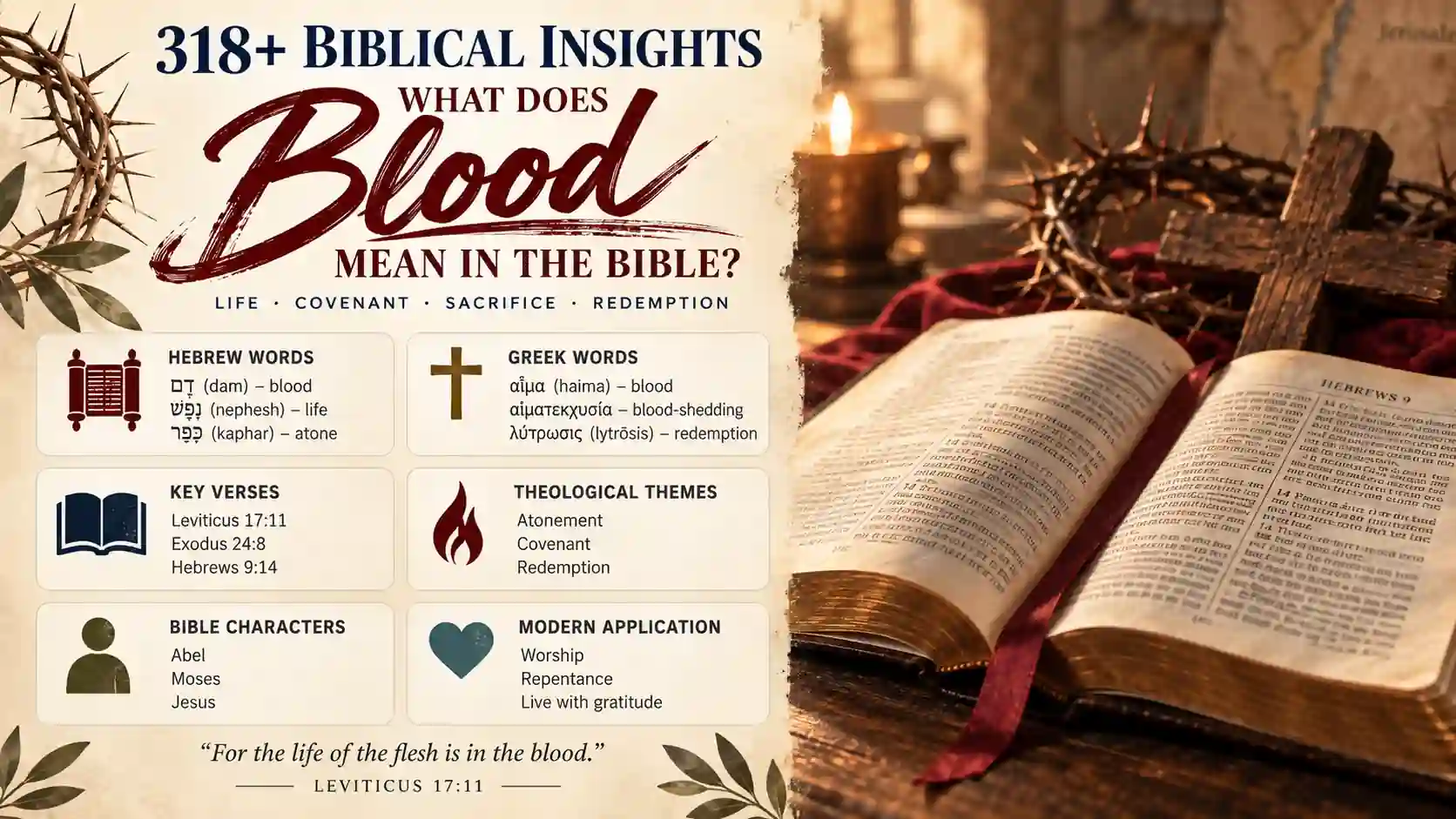
What does blood mean in the bible? Scripture uses blood as far more than a physical substance. Blood represents life, the seriousness of death, accountability for violence, covenant commitment, purification, sacrifice, atonement, and ultimately the saving death of Jesus Christ. From Abel’s blood crying from the ground to the blood of the Lamb in Revelation, the theme runs through the biblical story.
As you trace these passages, you discover a consistent foundation. Life belongs to God. Sin brings death, reconciliation is costly, and Christ’s self-offering brings the sacrificial imagery of Scripture to its decisive fulfillment.
Key Blood Scripture References
| Verse | Passage Snippet | Context |
|---|---|---|
| Genesis 4:10 | Abel’s blood cries from the ground | Innocent blood demands divine justice |
| Genesis 9:4 | Life must not be eaten with blood | God teaches Noah the sanctity of life |
| Exodus 12:13 | Blood will be a sign | Passover blood marks Israelite houses |
| Exodus 24:8 | Blood of the covenant | Moses confirms God’s covenant with Israel |
| Leviticus 17:11 | Life of the flesh is in the blood | God assigns sacrificial blood an atoning function |
| Isaiah 53:12 | He poured out his life unto death | The Servant willingly suffers for others |
| Matthew 26:28 | My blood of the covenant | Jesus interprets His death covenantally |
| Hebrews 9:14 | Blood of Christ cleanses the conscience | Christ’s sacrifice surpasses ritual purification |
| 1 Peter 1:19 | Precious blood of Christ | Redemption rests on Christ’s spotless sacrifice |
| Revelation 12:11 | Blood of the Lamb | Christ’s victory grounds the saints’ perseverance |
Leviticus explicitly connects דָּם, dam, with נֶפֶשׁ, nephesh, life, while Exodus uses blood in Passover protection and covenant inauguration.
Blood Bible Translation Comparison
| Verse | KJV | NIV | ESV | NASB |
|---|---|---|---|---|
| Genesis 4:10 | “brother’s blood” | “brother’s blood” | “brother’s blood” | “brother’s blood” |
| Exodus 12:13 | “blood shall be” | “blood will be” | “blood shall be” | “blood shall be” |
| Exodus 24:8 | “blood of the covenant” | “blood of the covenant” | “blood of the covenant” | “blood of the covenant” |
| Leviticus 17:11 | “life of the flesh” | “life of a creature” | “life of the flesh” | “life of the flesh” |
| Matthew 26:28 | “my blood” | “my blood” | “my blood” | “My blood” |
| Romans 3:25 | “faith in his blood” | “shedding of his blood” | “by his blood” | “in His blood” |
| Hebrews 9:22 | “shedding of blood” | “shedding of blood” | “shedding of blood” | “shedding of blood” |
| 1 Peter 1:19 | “precious blood” | “precious blood” | “precious blood” | “precious blood” |
The differences are usually matters of translation emphasis rather than radically different theology. Romans 3:25 is especially worth comparing because English versions arrange the relationship among Christ’s blood, sacrifice, and faith differently.
People and Characters Associated with Blood
| Person | Role | Connection |
|---|---|---|
| Abel | Righteous son of Adam | His murdered blood cries for justice |
| Cain | Abel’s murderer | Becomes accountable for innocent blood |
| Noah | Covenant patriarch | Receives prohibition against consuming lifeblood |
| Moses | Covenant mediator | Applies sacrificial blood in Exodus 24 |
| Aaron | High priest | Ministers sacrificial blood before God |
| Passover households | Israelites in Egypt | Place lamb’s blood on their doorframes |
| David | Israelite king | Speaks repeatedly of bloodguilt and deliverance |
| Jesus | Messiah and Son | Identifies His death as covenant blood |
| Peter | Apostle | Calls Christ’s blood precious and spotless |
| John | Apostle and seer | Portrays victory through the Lamb’s blood |
These people demonstrate that biblical blood imagery cannot be reduced to one idea. Depending on the passage, blood may signify murder, life, ritual sacrifice, covenant ratification, deliverance, or Christ’s redemptive death.
Original Hebrew and Greek Blood Words
| Original Word | Transliteration | Strong’s # | Literal Meaning |
|---|---|---|---|
| דָּם | dam | H1818 | blood, bloodshed |
| נֶפֶשׁ | nephesh | H5315 | life, living being, person |
| כָּפַר | kaphar | H3722 | atone, make reconciliation |
| שָׁפַךְ | shaphak | H8210 | pour out, shed |
| αἷμα | haima | G129 | blood |
| αἱματεκχυσία | haimatekchysia | G130 | shedding of blood |
| καθαρισμός | katharismos | G2512 | cleansing, purification |
| λύτρωσις | lytrōsis | G3085 | redemption, release by ransom |
The primary Hebrew noun is דָּם, dam, Strong’s H1818, used for human or animal blood and also for bloodshed. The standard New Testament noun is αἷμα, haima, G129. Hebrews 9:22 contains the rarer αἱματεκχυσία, haimatekchysia, G130, meaning blood-shedding.
Leviticus 17:11 also connects blood with נֶפֶשׁ, nephesh, H5315, while כָּפַר, kaphar, H3722, supplies important Old Testament vocabulary for making atonement. Hebrews develops the themes of purification and redemption with words such as καθαρισμός and λύτρωσις.
Related Biblical Blood Concepts
| Concept | Connection | Supporting Verse |
|---|---|---|
| Life | Blood is closely identified with creaturely life | Leviticus 17:11 |
| Bloodguilt | Unlawful killing creates accountability | Genesis 4:10 |
| Passover | Blood marks households for deliverance | Exodus 12:13 |
| Covenant | Blood solemnizes covenant relationship | Exodus 24:8 |
| Atonement | Sacrificial blood functions on the altar | Leviticus 17:11 |
| Purification | Blood appears in cleansing rites | Leviticus 16:19 |
| Forgiveness | Hebrews links forgiveness with sacrifice | Hebrews 9:22 |
| Redemption | Christ obtains eternal redemption | Hebrews 9:12 |
| Reconciliation | Christ’s death makes peace possible | Colossians 1:20 |
| Victory | The Lamb’s blood grounds final triumph | Revelation 12:11 |
Blood therefore functions within several overlapping biblical categories. You should allow each passage to determine which emphasis is present rather than assuming every reference to blood means exactly the same thing.
Historical and Cultural Context of Blood
| Aspect | Detail | Biblical Source |
|---|---|---|
| Ancient sacrifice | Blood was handled at the altar | Leviticus 1:5 |
| Blood prohibition | Israelites were forbidden to consume it | Leviticus 17:10 |
| Life principle | Blood was associated with the creature’s life | Leviticus 17:11 |
| Hunting practice | Blood was poured out and covered | Leviticus 17:13 |
| Passover rite | Lamb’s blood marked doors in Egypt | Exodus 12:7 |
| Sinai covenant | Moses applied covenant blood | Exodus 24:6-8 |
| Day of Atonement | High priest brought blood into the sanctuary | Leviticus 16:14-15 |
| Bloodguilt | Murder polluted both offender and land | Numbers 35:33 |
| Temple worship | Animal blood accompanied sacrifices | 2 Chronicles 29:22 |
| First-century Judaism | Hebrews assumes knowledge of sanctuary worship | Hebrews 9:6-7 |
Israel’s sacrificial practices belonged to a world in which slaughter, altar worship, priesthood, purity, and sacred space were concrete realities. Leviticus insists that blood is not ordinary food because the creature’s life is associated with it and God has assigned sacrificial blood a specific altar function.
Hebrews draws on this ritual world while arguing that Christ’s self-offering accomplishes what repeated animal sacrifices could not finally accomplish. Its description of covenant blood consciously recalls the Sinai ceremony of Exodus 24.
Theological Themes of Blood
| Theme | Explanation | Scripture |
|---|---|---|
| Sanctity of life | Life ultimately belongs to God | Genesis 9:4-6 |
| Divine justice | Innocent blood calls for judgment | Genesis 4:10 |
| Substitution | Sacrificial life is presented at the altar | Leviticus 17:11 |
| Atonement | God provides blood for altar reconciliation | Leviticus 17:11 |
| Deliverance | Passover blood accompanies rescue from judgment | Exodus 12:13 |
| Covenant | Blood confirms solemn covenant relationship | Exodus 24:8 |
| Redemption | Christ secures eternal redemption | Hebrews 9:12 |
| Cleansing | Christ’s blood cleanses the conscience | Hebrews 9:14 |
| Forgiveness | Sacrifice addresses the guilt of sin | Hebrews 9:22 |
| New covenant | Jesus gives His blood covenant significance | Matthew 26:28 |
One of the most important distinctions in your study is between blood shed criminally and blood offered sacrificially. Abel’s blood represents innocent life violently taken. Sacrificial blood in Leviticus belongs to worship instituted by God. Christ’s blood refers to His voluntarily given life and sacrificial death.
That distinction keeps biblical blood theology from becoming mechanical. Scripture’s emphasis is not that a physical substance possesses magical power. The significance of blood arises from life given, death incurred, God’s covenant purposes, and, in the New Testament, the identity and self-offering of Jesus.
Modern Application of Blood for Believers
| Area | Practice | Scripture |
|---|---|---|
| Worship | Remember Christ’s costly self-giving | 1 Corinthians 11:25 |
| Assurance | Trust Christ’s sufficient cleansing | 1 John 1:7 |
| Repentance | Treat sin as serious before God | Hebrews 9:22 |
| Gratitude | Value the price of redemption | 1 Peter 1:18-19 |
| Communion | Remember the new covenant reverently | Luke 22:20 |
| Conscience | Bring guilt to Christ rather than hiding it | Hebrews 9:14 |
| Justice | Respect innocent human life | Genesis 9:6 |
| Holiness | Live as one redeemed at great cost | 1 Peter 1:15-19 |
| Fellowship | Walk in light with other believers | 1 John 1:7 |
| Perseverance | Stand faithfully through Christ’s victory | Revelation 12:11 |
For you as a believer, the doctrine of Christ’s blood should lead neither to superstition nor to detached theological vocabulary. It calls you to remember that redemption came through the real death and self-offering of Jesus.
It also shapes your treatment of human life. Scripture’s language about innocent blood, bloodguilt, sacrifice, and redemption repeatedly reminds you that life is sacred because it belongs to God.
דָּם Dam and the Biblical Connection Between Blood and Life
The Hebrew דָּם, dam, does not automatically mean “atonement” whenever it occurs. In Genesis 4 it is Abel’s murdered blood. In Genesis 9 it appears within God’s commands concerning life and killing. In Leviticus it becomes central to sacrificial worship. The context determines the theological significance.
Leviticus 17:11 gives the controlling explanation for Israel’s sacrificial use of blood. The נֶפֶשׁ, nephesh, of the flesh is associated with the blood, and God says He has given the blood upon the altar for atonement. Blood matters because life matters, and life belongs to God.
What Does Blood Mean in the Bible from Passover to Sinai?
At Passover, blood belongs to a story of judgment and deliverance. The Israelites place the lamb’s blood on their houses as the divinely appointed sign in Exodus 12. The event becomes foundational to Israel’s memory of redemption from slavery.
At Sinai, the imagery develops further. Moses takes sacrificial blood and declares, “the blood of the covenant” in Exodus 24:8. Blood now appears within a solemn covenant ceremony linking God and the people under the covenant’s obligations. Jesus later deliberately echoes covenant language at the Last Supper.
αἷμα Haima and the Blood of Christ in Hebrews
The Greek word αἷμα, haima, appears throughout the New Testament for literal blood, bloodshed, and especially in passages interpreting Jesus’ death. Hebrews places Christ’s blood in deliberate comparison with the blood associated with Israel’s sanctuary sacrifices.
Hebrews 9:14 says Christ offered Himself to God and that His blood cleanses the conscience. The argument reaches beyond ceremonial purification toward inward access to God. Hebrews 9:12 describes Christ as obtaining eternal λύτρωσις, lytrōsis, redemption, through His decisive priestly work.
From Abel’s Blood to the Blood of the Lamb
Genesis begins the Bible’s bloodshed theme with Abel. His blood “cries” from the ground, portraying innocent death as something God sees and judges. Hebrews 12:24 later contrasts Abel’s blood with Jesus’ sprinkled blood, saying Christ’s blood speaks a better word.
Revelation completes the biblical trajectory with the Lamb. Those who belong to God conquer “by the blood of the Lamb” in Revelation 12:11. Blood imagery that once testified to murder and guilt now also points to Christ’s sacrificial victory and the redemption of His people.
Frequently Asked Questions About Blood in the Bible
Does the Hebrew word דָּם, dam, always mean atonement?
No. Dam means blood and can refer to physical blood, murder, bloodguilt, sacrifice, or covenant blood depending on its context.
What does Leviticus 17:11 mean when it says the life, נֶפֶשׁ nephesh, is in the blood?
It connects blood with creaturely life and explains why Israel could neither consume blood casually nor treat sacrificial blood as ordinary.
Does Hebrews 9:22 teach that absolutely every Old Testament forgiveness required blood?
Hebrews says “nearly everything” is purified with blood and places its statement about blood-shedding within an argument about covenant sacrifice and Christ’s superior offering.
Why does Jesus call the cup His “blood of the covenant” in Matthew 26:28?
His words intentionally frame His approaching death through covenant and sacrificial imagery, especially the covenant blood language of Exodus 24.
What is the difference between αἷμα haima and αἱματεκχυσία haimatekchysia?
Haima, G129, is the ordinary Greek noun for blood, while haimatekchysia, G130, specifically means blood-shedding and occurs in Hebrews 9:22.