
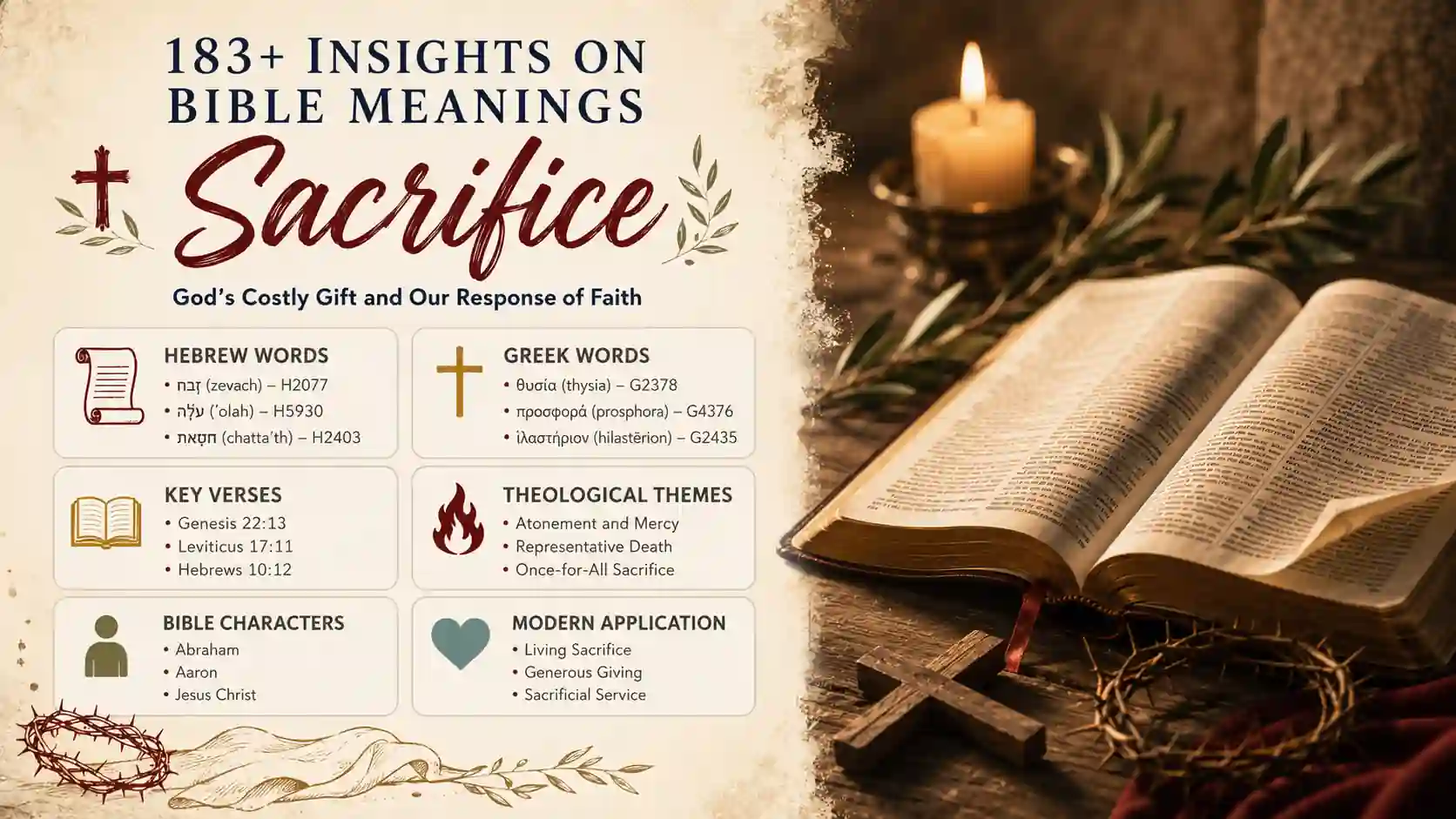
What does sacrifice mean in the Bible? At its heart, sacrifice is the costly offering of something valuable to God as an act of worship, thanksgiving, fellowship, repentance, or atonement. Scripture presents sacrifice through altars, animals, grain, incense, praise, obedience, generosity, and surrendered lives.
The biblical story moves from the offerings of Genesis to Israel’s sanctuary and finally to Jesus Christ, whose once-for-all sacrifice fulfills the earlier system. As you study this theme, you see that God desires more than ritual. He seeks faith, holiness, mercy, gratitude, and wholehearted devotion.
Key Sacrifice Scripture References
| Verse | Passage Snippet | Context |
|---|---|---|
| Genesis 4:4 | Abel brought the firstborn | Worship before the law |
| Genesis 22:13 | Abraham offered the ram | Substitute for Isaac |
| Exodus 12:27 | The Lord’s Passover sacrifice | Deliverance from Egypt |
| Leviticus 1:3 | A burnt offering without defect | Voluntary dedication |
| Leviticus 17:11 | Blood makes atonement | Life given for life |
| Psalm 51:17 | A broken and contrite heart | Repentance beyond ritual |
| Isaiah 53:10 | His life an offering for guilt | Suffering servant |
| Mark 10:45 | His life as a ransom | Christ’s saving mission |
| Romans 12:1 | Present your bodies | Living sacrifice |
| Hebrews 10:12 | One sacrifice for sins | Christ’s completed work |
Bible Translation Comparison for Sacrifice
| Verse | KJV | NIV | ESV | NASB |
|---|---|---|---|---|
| Genesis 22:8 | provide himself a lamb | provide the lamb | provide for himself the lamb | provide for Himself the lamb |
| Exodus 12:27 | sacrifice of the Lord’s passover | Passover sacrifice | sacrifice of the Lord’s Passover | Passover sacrifice |
| Leviticus 17:11 | atonement for the soul | atonement for one’s life | atonement by the life | atonement for your lives |
| Psalm 40:6 | sacrifice and offering | sacrifice and offering | sacrifice and offering | sacrifice and meal offering |
| Psalm 51:17 | broken spirit | broken spirit | broken spirit | broken spirit |
| Isaiah 53:10 | offering for sin | offering for sin | guilt offering | guilt offering |
| Romans 12:1 | living sacrifice | living sacrifice | living sacrifice | living and holy sacrifice |
| Ephesians 5:2 | sacrifice to God | sacrifice to God | sacrifice to God | sacrifice to God |
| Hebrews 10:12 | one sacrifice for sins | one sacrifice for sins | single sacrifice for sins | one sacrifice for sins |
| Hebrews 13:15 | sacrifice of praise | sacrifice of praise | sacrifice of praise | sacrifice of praise |
People and Characters Associated with Sacrifice
| Person | Role | Connection |
|---|---|---|
| Abel | Faithful worshiper | Offered the flock’s firstborn |
| Noah | Covenant patriarch | Built an altar after the flood |
| Abraham | Father of faith | Prepared to offer Isaac |
| Isaac | Promised son | Carried wood to Moriah |
| Moses | Covenant mediator | Received sacrificial laws |
| Aaron | High priest | Presented offerings for Israel |
| David | King and psalmist | Valued contrition above ritual |
| Elijah | Prophet | Offered sacrifice on Carmel |
| John the Baptist | Forerunner | Called Jesus God’s Lamb |
| Jesus Christ | Son and High Priest | Offered himself for sinners |
Original Hebrew and Greek Words for Sacrifice
| Original Word | Transliteration | Strong’s # | Literal Meaning |
|---|---|---|---|
| זֶבַח | zevach | H2077 | Sacrifice or slaughtered offering |
| מִנְחָה | minchah | H4503 | Gift or grain offering |
| עֹלָה | ʿolah | H5930 | That which ascends |
| קָרְבָּן | qorban | H7133 | Something brought near |
| חַטָּאת | chattaʾth | H2403 | Sin or sin offering |
| אָשָׁם | ʾasham | H817 | Guilt or guilt offering |
| תּוֹדָה | todah | H8426 | Thanksgiving or praise |
| θυσία | thysia | G2378 | Sacrifice or offering |
| προσφορά | prosphora | G4376 | Offering presented |
| ἱλαστήριον | hilastērion | G2435 | Atoning place or mercy seat |
Related Biblical Concepts of Sacrifice
| Concept | Connection | Supporting Verse |
|---|---|---|
| Atonement | Sin is covered or cleansed | Leviticus 17:11 |
| Substitution | One life stands for another | Genesis 22:13 |
| Covenant | Sacrifice confirms relationship | Exodus 24:5-8 |
| Passover | Blood marks God’s rescued people | Exodus 12:13 |
| Consecration | The worshiper belongs to God | Leviticus 1:9 |
| Forgiveness | Guilt is answered through offering | Leviticus 4:31 |
| Thanksgiving | Gratitude becomes worship | Leviticus 7:12 |
| Fellowship | A shared meal celebrates peace | Leviticus 7:15 |
| Ransom | Christ gives his life for many | Mark 10:45 |
| Obedience | Faithfulness outweighs empty ritual | 1 Samuel 15:22 |
Historical and Cultural Context of Sacrifice
| Aspect | Detail | Biblical Source |
|---|---|---|
| Altars | Places of approach and worship | Genesis 8:20 |
| Tabernacle | Central sanctuary in the wilderness | Exodus 40:29 |
| Temple | Permanent center of national worship | 1 Kings 8:62-64 |
| Priests | Mediated sacrificial ceremonies | Leviticus 1:5 |
| Unblemished animals | Represented fitting gifts to God | Leviticus 22:21 |
| Laying on hands | Identified worshiper with offering | Leviticus 1:4 |
| Blood application | Signified life and cleansing | Leviticus 4:6-7 |
| Burning | Sent the offering upward to God | Leviticus 1:9 |
| Sacred meals | Expressed fellowship and gratitude | Deuteronomy 12:7 |
| Day of Atonement | Annual cleansing of sanctuary and people | Leviticus 16:29-34 |
Theological Themes of Sacrifice
| Theme | Explanation | Scripture |
|---|---|---|
| God’s holiness | Sin cannot be treated casually | Leviticus 19:2 |
| Human guilt | Sacrifice exposes sin’s seriousness | Leviticus 5:5-6 |
| Divine mercy | God provides a way of approach | Leviticus 16:30 |
| Costly worship | True offering involves real value | 2 Samuel 24:24 |
| Representative death | Another dies in the sinner’s place | Isaiah 53:5 |
| Covenant blood | Relationship is established through blood | Exodus 24:8 |
| Messianic fulfillment | Earlier sacrifices anticipate Christ | Hebrews 10:1 |
| Once-for-all atonement | Christ’s offering is unrepeatable | Hebrews 10:10 |
| Resurrection victory | The sacrificed Christ now lives | Revelation 1:18 |
| Renewed obedience | Grace produces surrendered lives | Romans 12:1-2 |
Modern Application of Sacrifice for Believers
| Area | Practice | Scripture |
|---|---|---|
| Personal devotion | Offer your whole life to God | Romans 12:1 |
| Worship | Praise God through Christ | Hebrews 13:15 |
| Generosity | Share resources with others | Hebrews 13:16 |
| Service | Spend yourself for God’s people | Philippians 2:17 |
| Marriage | Love with Christlike self-giving | Ephesians 5:25 |
| Discipleship | Take up your cross daily | Luke 9:23 |
| Mission | Accept hardship for the gospel | 2 Timothy 2:3 |
| Repentance | Bring a humble, contrite heart | Psalm 51:17 |
| Mercy | Place compassion above performance | Matthew 9:13 |
| Stewardship | Give God your first and best | Proverbs 3:9 |
זֶבַח Zevach and the Costly Approach to God
The Hebrew noun זֶבַח, zevach, usually describes an animal sacrifice that has been slaughtered and presented to God. Its use reminds you that biblical sacrifice was not a vague feeling of devotion. It involved a visible, costly gift offered according to God’s revealed instructions.
Yet the physical cost never made the act spiritually effective by itself. Cain and Abel both brought offerings, but God regarded Abel and his offering with favor because it was presented in faith. Hebrews 11:4 interprets Abel’s sacrifice as evidence of trusting worship, not merely correct religious technique.
The sacrificial system therefore joined outward action with inward allegiance. A worshiper approached the holy God with reverence, acknowledging dependence, guilt, gratitude, or renewed fellowship. When the heart resisted God, even technically correct sacrifices became offensive, as Isaiah 1:11-17 forcefully declares.
What Does Sacrifice Mean in the Bible’S Covenant Story?
Sacrifice appears throughout the Bible’s covenant history. After the flood, Noah offered burnt offerings, and God reaffirmed his commitment to creation. At Sinai, Moses sprinkled sacrificial blood and announced the “blood of the covenant,” confirming Israel’s pledged relationship with the Lord.
Passover added the theme of deliverance. The lamb’s blood did not function as a magical substance. It marked households that trusted God’s promise and obeyed his command. Israel’s firstborn lived because a substitute died, and the rescued nation was then called to belong wholly to God.
The Day of Atonement developed the theme of cleansing. Leviticus 16 describes sacrifices offered for the priesthood, the people, and the sanctuary. Sin polluted both human life and sacred space, so atonement addressed guilt, impurity, and broken fellowship with the covenant God.
θυσία Thysia and the Once-For-All Offering of Christ
The Greek word θυσία, thysia, carries the ordinary sense of a sacrifice or sacrificial offering. New Testament writers use it both for Israel’s offerings and for the death of Jesus. Ephesians 5:2 says Christ gave himself as an offering and sacrifice to God.
Jesus fulfills the sacrificial patterns without simply repeating them. He is identified with the Passover lamb, the sin offering, the covenant sacrifice, and the suffering servant. His death is voluntary, representative, obedient, and sufficient. He is also the High Priest who presents the offering.
Hebrews emphasizes that Christ did not need to offer himself repeatedly. Animal sacrifices reminded worshipers of sin and provided covenantal cleansing, but they could not bring final perfection. Jesus offered one sacrifice for sins and sat down, signaling that his atoning work was complete.
Living Sacrifice After the Temple Offerings
Because Christ’s sacrifice is complete, Christians do not present animals to obtain forgiveness. You approach God through Jesus, whose blood grants confident access to the divine presence. Christian sacrifice is therefore a response to redemption, never an attempt to purchase it.
Romans 12:1 calls you to present your body as a “living sacrifice.” The language includes your ordinary physical life, decisions, relationships, work, possessions, and habits. Instead of dying upon an altar, you live in continual dedication to the One who showed you mercy.
Hebrews 13 names praise, generosity, and practical sharing as sacrifices pleasing to God. Philippians describes financial support and ministry service with similar imagery. These offerings do not compete with Christ’s work. They rise from it as grateful worship shaped by love.
Questions About Biblical Sacrifice
How are זֶבַח zevach and עֹלָה ʿolah different?
A zevach is broadly a slaughtered sacrifice, while an ʿolah is wholly burned so that it symbolically ascends to God.
Why does Psalm 51:17 call a broken spirit God’s sacrifice?
David teaches that repentance and humility are essential, since outward offerings without a surrendered heart cannot please God.
Does Isaiah 53:10 call the servant a sin offering or a guilt offering?
The Hebrew word אָשָׁם, ʾasham, specifically means a guilt offering, though some translations use the broader phrase “offering for sin.”
Why could animal sacrifices not permanently remove sin according to Hebrews?
They served God’s covenant purposes and anticipated Christ, but only the incarnate Son’s obedient self-offering provides final and complete atonement.
What does it mean for you to become a living sacrifice?
It means responding to God’s mercy by dedicating your embodied, everyday life to obedient, holy, and loving service.