
What does Sabbath mean in the Bible? At its heart, Sabbath means ceasing from ordinary labor so that time may be received as holy before God. Scripture presents it as a pattern rooted in creation, a command within Israel’s covenant, a sign of sanctification, and a gift intended for human well-being.
As you follow the Sabbath theme through Scripture, you encounter more than a weekly rule. You see God’s completed work, Israel’s deliverance, Jesus’ merciful authority, and the promised rest that remains for God’s people.
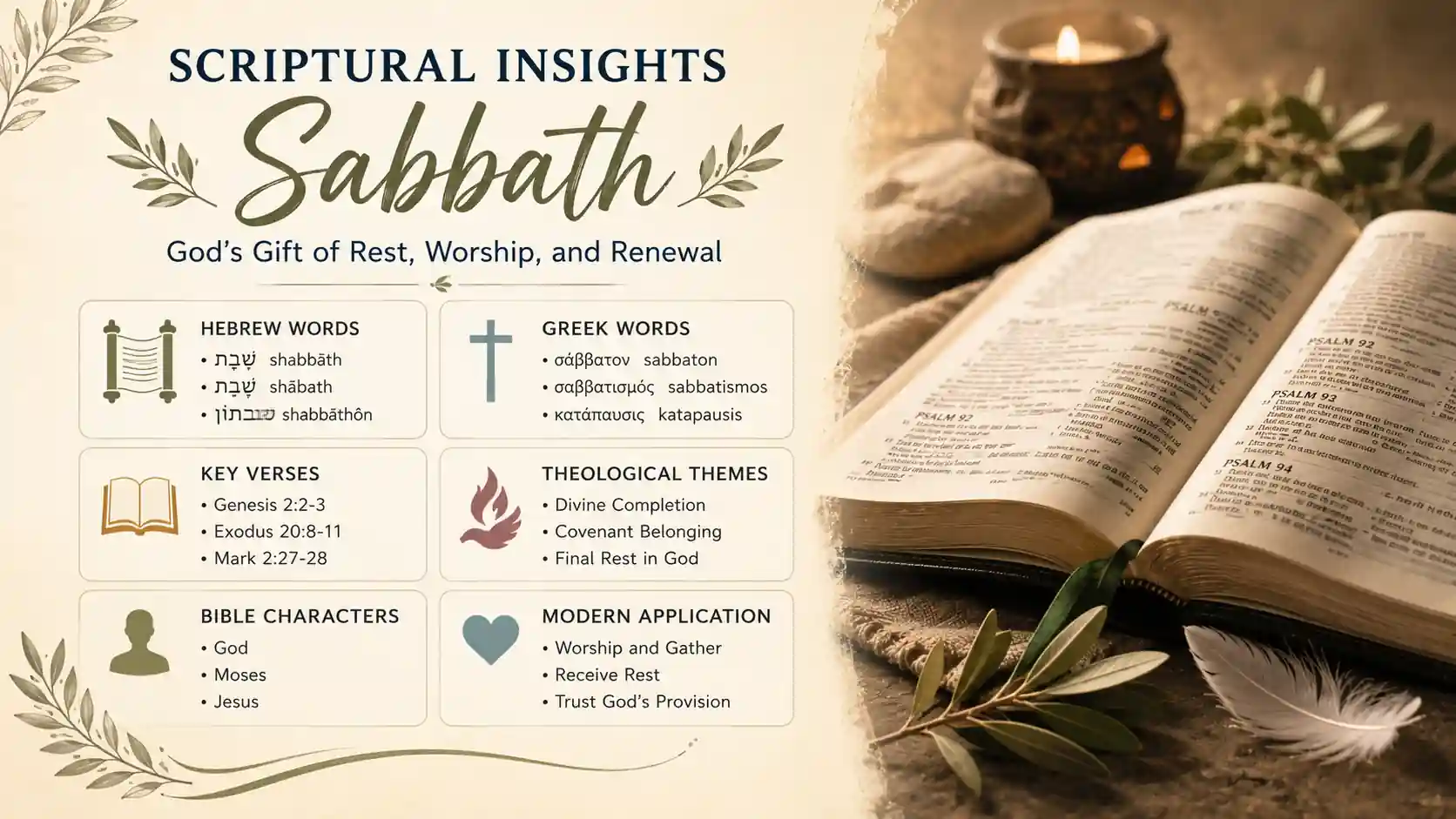
Sabbath Key Scripture References
| Verse | Passage Snippet | Context |
|---|---|---|
| Genesis 2:2-3 | God rested on the seventh day | Creation pattern |
| Exodus 16:23-30 | A holy Sabbath to the Lord | Manna in wilderness |
| Exodus 20:8-11 | Remember the Sabbath day | Fourth commandment |
| Exodus 31:13 | A sign between God and Israel | Covenant identity |
| Deuteronomy 5:12-15 | Observe the Sabbath day | Freedom from slavery |
| Isaiah 58:13-14 | Call the Sabbath a delight | Faithful worship |
| Mark 2:27-28 | Sabbath was made for man | Jesus corrects misuse |
| Luke 4:16 | Jesus entered the synagogue | Regular Jewish practice |
| Colossians 2:16-17 | Sabbath days are a shadow | Fulfillment in Christ |
| Hebrews 4:9-11 | A Sabbath rest remains | Final rest with God |
Sabbath Bible Translation Comparison
| Verse | KJV | NIV | ESV | NASB |
|---|---|---|---|---|
| Genesis 2:2 | He rested | He rested | He rested | He rested |
| Exodus 20:8 | Remember the sabbath day | Remember the Sabbath day | Remember the Sabbath day | Remember the Sabbath day |
| Exodus 31:15 | Sabbath of rest | Day of sabbath rest | Sabbath of solemn rest | Sabbath of complete rest |
| Deuteronomy 5:12 | Keep the sabbath day | Observe the Sabbath day | Observe the Sabbath day | Keep the Sabbath day |
| Isaiah 58:13 | Call the sabbath a delight | Call the Sabbath a delight | Call the Sabbath a delight | Call the Sabbath a delight |
| Mark 2:27 | Made for man | Made for man | Made for man | Made for man |
| Matthew 12:8 | Lord even of the sabbath day | Lord of the Sabbath | Lord of the Sabbath | Lord of the Sabbath |
| Colossians 2:16 | Sabbath days | Sabbath day | Sabbath | Sabbath day |
| Hebrews 4:9 | Rest to the people of God | Sabbath-rest | Sabbath rest | Sabbath rest |
| Acts 17:2 | Three sabbath days | Three Sabbath days | Three Sabbath days | Three Sabbaths |
Sabbath People and Characters Associated
| Person | Role | Connection |
|---|---|---|
| God | Creator and covenant Lord | Rested after creation |
| Adam and Eve | First humans | Lived within creation’s seventh-day pattern |
| Moses | Lawgiver and mediator | Delivered Sabbath commands |
| Aaron | Israel’s high priest | Served within Sabbath worship |
| Israelites | Covenant nation | Commanded to cease from labor |
| Nehemiah | Governor and reformer | Opposed Sabbath commerce |
| Isaiah | Prophet | Called Sabbath a delight |
| Jeremiah | Prophet | Warned Jerusalem about Sabbath violation |
| Jesus | Messiah and Lord | Healed and taught on Sabbath |
| Paul | Apostle to the Gentiles | Reasoned in synagogues on Sabbath |
Sabbath Original Hebrew and Greek Words
| Original Word | Transliteration | Strong’s # | Literal Meaning |
|---|---|---|---|
| שַׁבָּת | shabbāth | H7676 | Sabbath, intermission |
| שָׁבַת | shābath | H7673 | Cease, desist, rest |
| שַׁבָּתוֹן | shabbāthôn | H7677 | Solemn or complete rest |
| נוּחַ | nûach | H5117 | Settle down, rest |
| מְנוּחָה | menûchāh | H4496 | Resting place, repose |
| שֶׁבַע | shebaʿ | H7651 | Seven |
| σάββατον | sabbaton | G4521 | Sabbath, seventh day, week |
| σαββατισμός | sabbatismos | G4520 | Sabbath observance or rest |
| κατάπαυσις | katapausis | G2663 | Rest, place of rest |
| καταπαύω | katapauō | G2664 | Cause to rest, cease |
Sabbath Related Biblical Concepts
| Concept | Connection | Supporting Verse |
|---|---|---|
| Creation | God ceased after completing creation | Genesis 2:2-3 |
| Holiness | God set the seventh day apart | Exodus 20:8 |
| Covenant | Sabbath marked Israel as God’s people | Exodus 31:16 |
| Redemption | Rest recalled deliverance from Egypt | Deuteronomy 5:15 |
| Provision | God supplied enough manna beforehand | Exodus 16:29 |
| Worship | Sacred assemblies occurred on Sabbath | Leviticus 23:3 |
| Mercy | Human need outweighed legalistic burdens | Matthew 12:7-12 |
| Justice | Servants and foreigners also rested | Deuteronomy 5:14 |
| Faith | Rest required trust in God’s provision | Exodus 16:29-30 |
| Fulfillment | Sabbath shadows point toward Christ | Colossians 2:16-17 |
Sabbath Historical and Cultural Context
| Aspect | Detail | Biblical Source |
|---|---|---|
| Seventh day | Sabbath followed six working days | Exodus 20:9-10 |
| Evening boundary | Sacred rest ran from evening to evening | Leviticus 23:32 |
| Manna preparation | Food was gathered beforehand | Exodus 16:22-23 |
| Household inclusion | Children and servants received rest | Exodus 20:10 |
| Animal rest | Working animals were not excluded | Deuteronomy 5:14 |
| Holy assembly | Israel gathered for sacred worship | Leviticus 23:3 |
| Temple offerings | Special sacrifices marked the day | Numbers 28:9-10 |
| Commercial restrictions | Buying and selling were restrained | Nehemiah 13:15-22 |
| Synagogue reading | Scripture was read publicly | Acts 13:14-15 |
| First-century disputes | Traditions defined permitted work | Mark 2:23-28 |
Sabbath Theological Themes
| Theme | Explanation | Scripture |
|---|---|---|
| Divine completion | God’s rest declares creation complete | Genesis 2:2 |
| Sacred time | God claims time as holy | Genesis 2:3 |
| Human limitation | People are not made for endless labor | Exodus 20:9-10 |
| Trusting provision | Rest confesses dependence upon God | Exodus 16:29 |
| Covenant belonging | Sabbath identified sanctified Israel | Exodus 31:13 |
| Liberating grace | Rest remembers freedom from bondage | Deuteronomy 5:15 |
| Compassionate obedience | Sabbath serves life and mercy | Mark 3:4 |
| Messianic authority | Jesus is Lord of the Sabbath | Matthew 12:8 |
| Spiritual fulfillment | Christ is the substance behind shadows | Colossians 2:17 |
| Final hope | God’s people await complete rest | Hebrews 4:9 |
Sabbath Modern Application for Believers
| Area | Practice | Scripture |
|---|---|---|
| Worship | Reserve regular time to honor God | Isaiah 58:13-14 |
| Rest | Receive bodily limits without shame | Mark 2:27 |
| Work | Labor faithfully without making work an idol | Exodus 20:9 |
| Family | Create rhythms of shared rest | Exodus 20:10 |
| Mercy | Use sacred time to serve human need | Matthew 12:12 |
| Trust | Stop striving and depend on God | Psalm 127:2 |
| Community | Gather for teaching and fellowship | Acts 13:44 |
| Justice | Extend rest to workers and dependents | Deuteronomy 5:14 |
| Reflection | Remember creation and redemption | Deuteronomy 5:15 |
| Hope | Look toward God’s everlasting rest | Hebrews 4:9-11 |
What Does Sabbath Mean in the Bible Through שָׁבַת?
The Hebrew verb שָׁבַת, shābath, primarily means to cease, stop, or desist. Genesis 2 does not picture God resting because creation exhausted Him. God ceased because His work was complete, ordered, and good. Sabbath therefore begins with completion rather than fatigue.
This meaning corrects the idea that Sabbath is merely inactivity. Biblical rest is a purposeful cessation that acknowledges God’s sufficiency. When you stop ordinary work, you confess that the world continues under His care and that your worth does not depend upon uninterrupted productivity.
שַׁבָּת As Creation Gift and Mosaic Covenant Sign
Genesis establishes the seventh-day pattern before Israel receives the law at Sinai. God blesses and sanctifies the seventh day, giving the Sabbath theme a creation-wide foundation. Exodus 20 later commands Israel to remember that pattern because the Creator completed His work in six days.
Yet the Mosaic Sabbath also had a distinct covenant function. Exodus 31 calls it a sign between God and Israel, while Deuteronomy connects it with liberation from Egypt. Israel’s weekly rest declared both that the Lord created them and that He had freed them from relentless servitude.
Jesus the Lord of the Sabbath and the Priority of Mercy
Jesus did not treat the Sabbath as meaningless. He worshiped in the synagogue, taught from Scripture, and performed acts of healing on that day. His controversies arose because certain interpretations had turned a gracious command into a burden that could obstruct compassion.
When Jesus said the Sabbath was made for humanity, He restored its proper direction. The day was God’s gift for worship, restoration, mercy, and life. By calling Himself Lord of the Sabbath, Jesus claimed authority to reveal its true purpose and to expose traditions that contradicted God’s compassionate character.
From σάββατον to the σαββατισμός of Hebrews 4
The New Testament usually uses σάββατον, sabbaton, for the weekly Sabbath. Hebrews 4:9 uses the rarer σαββατισμός, sabbatismos, declaring that a Sabbath rest remains for God’s people. The passage links God’s creation rest, Israel’s entrance into Canaan, and the believer’s promised inheritance.
Hebrews does not reduce this rest to a free day or a private feeling. God’s people enter rest by faith, cease from self-reliant works, persevere in obedience, and await complete fellowship with Him. Weekly rest may witness to that hope, but the ultimate reality is participation in God’s finished work through Christ.
Questions Bible Students Ask About the Sabbath
Does שַׁבָּת, shabbāth, literally mean Saturday?
It means Sabbath or cessation, while its biblical weekly observance falls on the seventh day.
Why does Exodus 20 connect Sabbath with creation while Deuteronomy 5 connects it with Egypt?
The two passages present complementary foundations, honoring God as Creator and remembering Him as Redeemer.
What is the difference between שַׁבָּת, shabbāth, and שַׁבָּתוֹן, shabbāthôn?
Shabbāth names the Sabbath, while shabbāthôn emphasizes solemn, complete, or special rest.
Did Jesus break the Sabbath when He healed people?
No, He challenged restrictive traditions and taught that doing good and showing mercy are lawful on the Sabbath.
Does σαββατισμός in Hebrews 4:9 command Christians to observe a particular day?
The verse directly announces a remaining Sabbath rest, with its fullest meaning centered on faithful entrance into God’s promised rest.