
What does anointed mean in the Bible? At its simplest, anointing means applying oil to a person or object. Yet Scripture gives the act a deeper significance. Anointing publicly marked someone or something as chosen, consecrated, and set apart for God’s purpose.
As you follow this theme through Scripture, you will see priests, kings, prophets, sacred objects, ordinary believers, and Jesus himself described in anointing language. The outward use of oil often represented God’s appointment, while the greater reality was his presence, authority, and Spirit-given power.
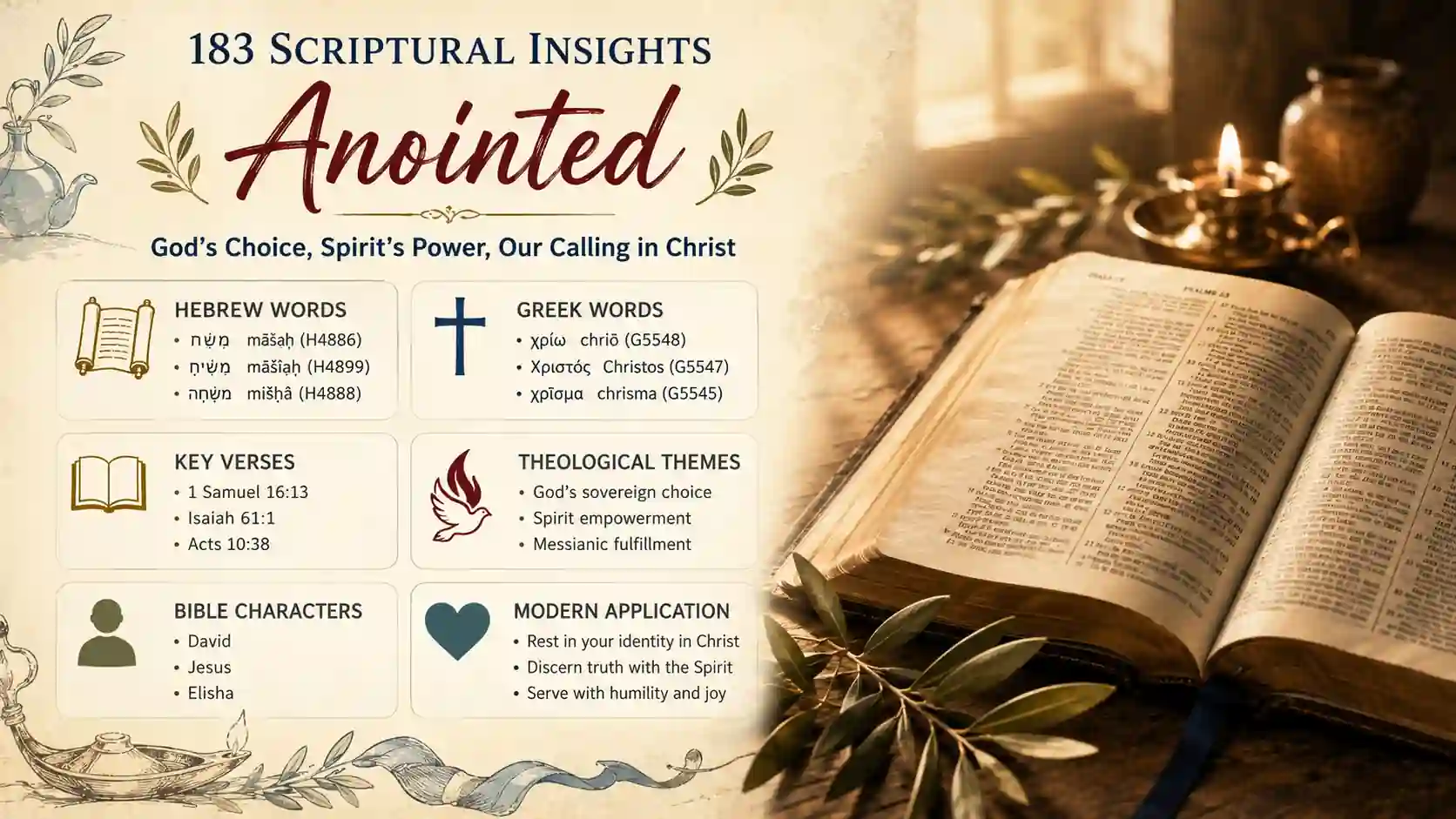
Anointed Key Scripture References
| Verse | Passage Snippet | Context |
|---|---|---|
| Exodus 28:41 | “Anoint them” | Aaron’s sons consecrated as priests |
| Exodus 30:30 | “Anoint Aaron and his sons” | Priests set apart for sacred service |
| 1 Samuel 10:1 | “The LORD has anointed you” | Saul appointed ruler over Israel |
| 1 Samuel 16:13 | “Samuel took the horn of oil” | David anointed as Israel’s future king |
| Psalm 2:2 | “Against his Anointed” | Nations oppose the Lord’s chosen king |
| Isaiah 61:1 | “The LORD has anointed me” | Spirit-empowered proclamation of good news |
| Luke 4:18 | “He has anointed me” | Jesus applies Isaiah’s prophecy to himself |
| Acts 10:38 | “Anointed Jesus…with the Holy Spirit” | Peter summarizes Christ’s ministry |
| 2 Corinthians 1:21 | “Anointed us is God” | Believers established in Christ |
| 1 John 2:20 | “An anointing from the Holy One” | Christians equipped to recognize truth |
Anointed Bible Translation Comparison
| Verse | KJV | NIV | ESV | NASB |
|---|---|---|---|---|
| 1 Samuel 16:13 | “anointed him” | “anointed him” | “anointed him” | “anointed him” |
| Psalm 2:2 | “his anointed” | “his anointed” | “his Anointed” | “His Anointed” |
| Psalm 45:7 | “anointed thee” | “anointed you” | “anointed you” | “anointed You” |
| Isaiah 45:1 | “his anointed, to Cyrus” | “his anointed, to Cyrus” | “his anointed, to Cyrus” | “His anointed, to Cyrus” |
| Isaiah 61:1 | “anointed me” | “anointed me” | “anointed me” | “anointed me” |
| Luke 4:18 | “anointed me” | “anointed me” | “anointed me” | “anointed me” |
| Acts 4:27 | “holy child Jesus” | “holy servant Jesus” | “holy servant Jesus” | “holy servant Jesus” |
| Acts 10:38 | “anointed Jesus” | “anointed Jesus” | “anointed Jesus” | “anointed Jesus” |
| 2 Corinthians 1:21 | “hath anointed us” | “anointed us” | “has anointed us” | “anointed us” |
| 1 John 2:20 | “an unction” | “an anointing” | “anointed” | “an anointing” |
Anointed People and Characters Associated
| Person | Role | Connection |
|---|---|---|
| Aaron | High priest | Anointed and consecrated for priestly ministry |
| Aaron’s sons | Priests | Set apart to serve at the sanctuary |
| Saul | First king of Israel | Anointed by Samuel at God’s command |
| David | Covenant king | Anointed before the Spirit came upon him |
| Solomon | King and temple builder | Anointed publicly at Gihon |
| Elisha | Prophet | Appointed to succeed Elijah |
| Cyrus | Persian ruler | Called God’s anointed instrument |
| Jesus | Messiah and Son of God | Anointed with the Holy Spirit and power |
| The apostles | Gospel witnesses | Prayed concerning God’s anointed servant |
| Believers | Members of Christ | Anointed by God and taught by the Holy One |
Anointed Original Hebrew and Greek Words
| Original Word | Transliteration | Strong’s # | Literal Meaning |
|---|---|---|---|
| מָשַׁח | māšaḥ | H4886 | To smear or anoint |
| מָשִׁיחַ | māšîaḥ | H4899 | Anointed one |
| מִשְׁחָה | mišḥâ | H4888 | Anointing or consecrated portion |
| שֶׁמֶן | šemen | H8081 | Oil, especially olive oil |
| סוּךְ | sûḵ | H5480 | To rub or pour on |
| χρίω | chriō | G5548 | To anoint or consecrate |
| Χριστός | Christos | G5547 | Anointed One, Christ |
| χρῖσμα | chrisma | G5545 | Anointing or spiritual endowment |
| ἀλείφω | aleiphō | G218 | To apply or rub with oil |
| μύρον | myron | G3464 | Fragrant ointment or perfume |
Anointed Related Biblical Concepts
| Concept | Connection | Supporting Verse |
|---|---|---|
| Consecration | Anointing separates someone for God | Exodus 30:30 |
| Divine appointment | God chooses the person before the ceremony | 1 Samuel 10:1 |
| Holy Spirit | The Spirit supplies power for the calling | 1 Samuel 16:13 |
| Priesthood | Priests were anointed for sanctuary service | Leviticus 8:12 |
| Kingship | Israel’s kings ruled as God’s appointed servants | 1 Samuel 16:12 |
| Prophetic mission | God empowers proclamation and witness | Isaiah 61:1 |
| Messiah | The promised ruler is God’s Anointed One | Psalm 2:2 |
| Healing | Oil sometimes accompanies prayer for the sick | James 5:14 |
| Hospitality | Oil refreshed and honored a guest | Luke 7:46 |
| Truth | The believer’s anointing guards apostolic teaching | 1 John 2:27 |
Anointed Historical and Cultural Context
| Aspect | Detail | Biblical Source |
|---|---|---|
| Olive oil | Commonly used for food, light, medicine, and ritual | Deuteronomy 8:8 |
| Pouring on the head | Publicly marked appointment to office | 1 Samuel 10:1 |
| Horn of oil | Samuel carried oil when anointing David | 1 Samuel 16:13 |
| Sacred formula | Tabernacle oil followed a commanded recipe | Exodus 30:22-25 |
| Restricted use | Holy oil was not for ordinary personal use | Exodus 30:31-33 |
| Priestly succession | Anointing identified the succeeding high priest | Leviticus 6:22 |
| Royal legitimacy | Anointing signaled recognized kingship | 1 Kings 1:39 |
| Guest hospitality | Hosts could anoint a visitor’s head | Psalm 23:5 |
| Burial preparation | Fragrant ointments honored the dead | Mark 16:1 |
| Medical care | Oil soothed and treated wounds | Luke 10:34 |
Anointed Theological Themes
| Theme | Explanation | Scripture |
|---|---|---|
| God’s sovereign choice | True appointment begins with God’s will | 1 Samuel 16:1 |
| Holiness | The anointed person is set apart for God | Exodus 40:13 |
| Service | Anointing commissions rather than glorifies self | Leviticus 8:30 |
| Spirit empowerment | God equips those he appoints | Isaiah 61:1 |
| Covenant kingship | David’s line anticipates the eternal King | 2 Samuel 7:16 |
| Messianic fulfillment | Jesus fulfills Israel’s anointed offices | Luke 4:21 |
| Suffering Messiah | God’s Anointed One is opposed and rejected | Acts 4:27 |
| Resurrection authority | The crucified Jesus is declared Lord and Christ | Acts 2:36 |
| Union with Christ | Believers belong to the Anointed One | 2 Corinthians 1:21 |
| Discernment | The Spirit confirms the truth about Christ | 1 John 2:20 |
Anointed Modern Application for Believers
| Area | Practice | Scripture |
|---|---|---|
| Identity | Rest in belonging to Christ, not spiritual status | 2 Corinthians 1:21 |
| Service | Use your gifts for God’s glory and others’ good | 1 Peter 4:10 |
| Discernment | Test teaching by the apostolic gospel | 1 John 2:24 |
| Humility | Treat calling as stewardship, not superiority | Romans 12:3 |
| Prayer | Ask elders to pray faithfully for the sick | James 5:14 |
| Worship | Honor Jesus as God’s promised Messiah | John 1:41 |
| Courage | Depend on the Spirit when bearing witness | Acts 1:8 |
| Obedience | Follow God’s Word rather than personal impressions | 2 Timothy 3:16 |
| Community | Recognize that all believers share one Spirit | 1 Corinthians 12:13 |
| Hope | Await the complete reign of the Anointed King | Revelation 11:15 |
מָשַׁח And the Old Testament Act of Setting Apart
The main Hebrew verb is מָשַׁח, māšaḥ, which means to smear, spread, or anoint. In ceremonial settings, oil was poured or applied to indicate that a person or object had been removed from common use and dedicated to God. The oil did not create holiness by its own power. God’s command and purpose gave the ceremony its meaning.
Aaron, his sons, the tabernacle, the altar, and sacred utensils were anointed. These passages show that biblical anointing was not merely a description of emotional intensity or unusual ability. It concerned consecration. Something anointed was claimed for holy service and therefore had to be treated according to God’s instructions.
מָשִׁיחַ And Israel’S Priests, Kings, and Unexpected Servants
The noun מָשִׁיחַ, māšîaḥ, means “anointed one.” English receives the word “Messiah” through this Hebrew term. In the Old Testament, however, māšîaḥ does not refer exclusively to the final Messiah. It can describe an anointed priest, an Israelite king, or another ruler appointed for God’s purpose.
David repeatedly called Saul “the LORD’s anointed,” even while Saul acted unjustly. David was not approving Saul’s sin. He was refusing to seize the throne through personal vengeance. Isaiah 45:1 even calls Cyrus, a Persian king, God’s anointed because God appointed him to release exiles and advance his redemptive plan.
What Does Anointed Mean in the Bible When Applied to Jesus?
The Greek title Χριστός, Christos, means “Anointed One” and corresponds to the Hebrew māšîaḥ. “Jesus Christ” therefore means more than a personal name followed by a surname. It confesses that Jesus is the promised Messiah, the King chosen by God to accomplish salvation and reign over his people.
Jesus read Isaiah 61 in the synagogue and declared that the Scripture had been fulfilled in their hearing. His anointing was not presented as a private feeling or merely a ceremony with oil. The Father anointed him with the Holy Spirit and power to preach, heal, liberate, suffer, die, rise, and establish God’s kingdom.
χρῖσμα And the Believer’S Life in the Anointed One
First John uses the noun χρῖσμα, chrisma, meaning “anointing.” John tells Christians that they have an anointing from the Holy One and that this anointing teaches them. The term occurs three times in 1 John 2:20 and 2:27.
John is not promising that every private interpretation is correct or that believers no longer need teachers. He is assuring the church that the Holy Spirit enables God’s people to recognize and remain in the apostolic truth about Jesus. Your anointing is not grounds for self-promotion. It is God’s gracious provision for faithful life in Christ.
Questions Bible Students Ask About Anointed
Does מָשִׁיחַ, māšîaḥ, always refer to Jesus?
No. It can describe priests, Israelite kings, Cyrus, and ultimately the promised Messiah fulfilled in Jesus.
Why does Isaiah 45:1 call the pagan king Cyrus “anointed”?
God appointed Cyrus as an instrument to defeat nations, release exiles, and serve God’s covenant purposes.
Is χρίω, chriō, the same as ordinary anointing with perfume?
Not exactly. χρίω often emphasizes sacred appointment, while ἀλείφω commonly describes applying oil for care, hospitality, burial, or healing.
Does 1 John 2:27 mean Christians do not need Bible teachers?
No. It means the Spirit protects believers from antichrist deception by grounding them in the truth they received about Jesus.
Should believers call themselves “the Lord’s anointed”?
Believers are anointed in Christ, but Scripture gives no support for using the title to avoid correction, claim superiority, or demand unquestioning loyalty.