
What does satiated mean in the Bible? The word describes being filled until a genuine need or desire has been satisfied. Scripture applies this idea to physical hunger, material abundance, spiritual longing, covenant blessing, and even sinful excess.
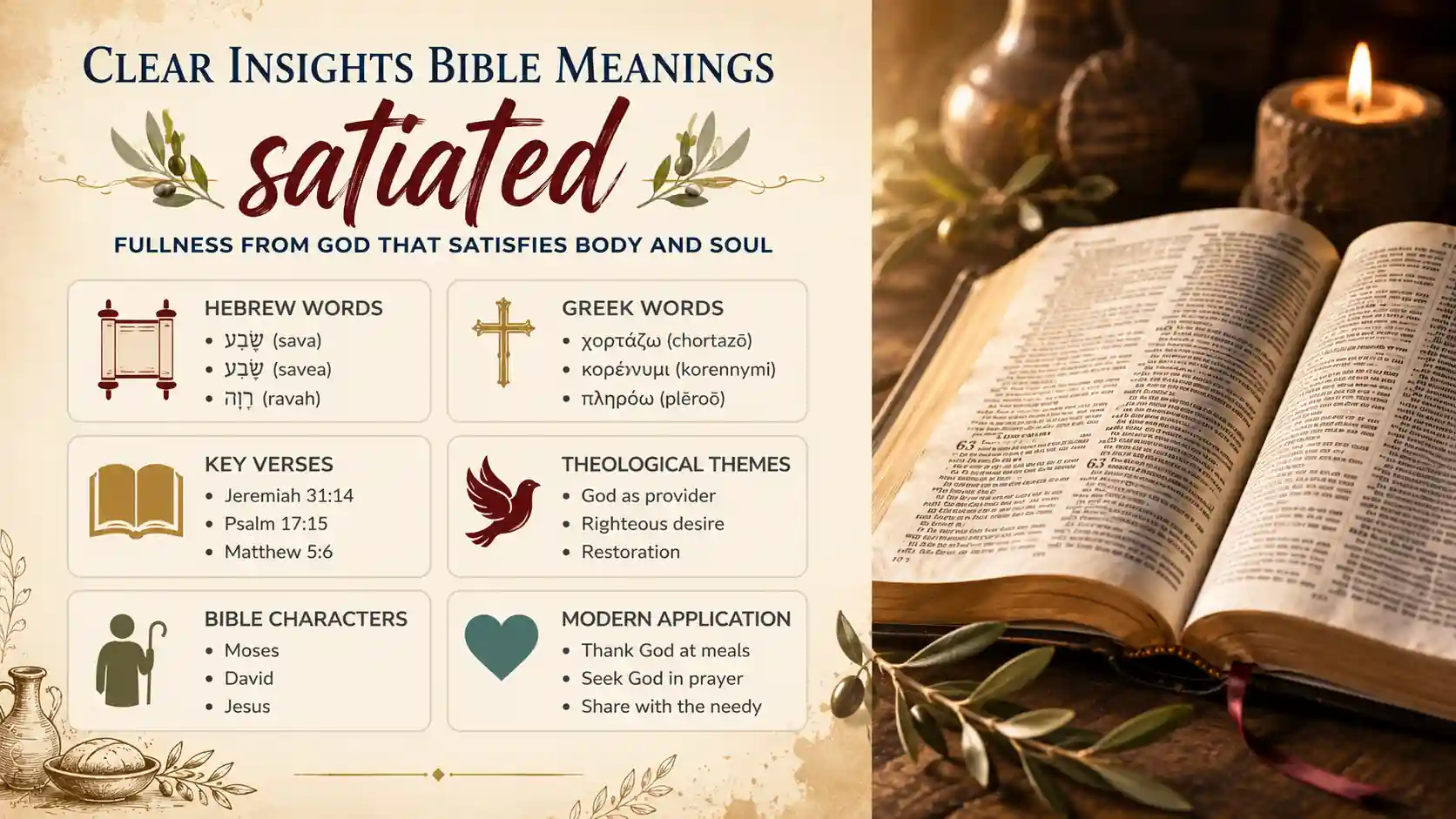
In your study, you will find that biblical satiation is deeper than temporary comfort. The Hebrew root שָׂבַע, sava, and the Greek verb χορτάζω, chortazō, often picture God filling hungry people with food, goodness, righteousness, or the joy of his presence.
Satiated Key Scripture References
| Verse | Passage Snippet | Context |
|---|---|---|
| Jeremiah 31:14 | Priests satiated with abundance | Israel’s promised restoration |
| Deuteronomy 8:10 | Eat, become full, bless God | Covenant life in Canaan |
| Psalm 17:15 | Satisfied by God’s likeness | David seeks God’s presence |
| Psalm 22:26 | The afflicted eat and are satisfied | Worship after deliverance |
| Psalm 63:5 | Soul satisfied with rich food | David worships in wilderness |
| Psalm 104:13 | Earth satisfied by God’s works | Hymn to the Creator |
| Psalm 107:9 | God satisfies the longing soul | Thanksgiving for redemption |
| Isaiah 55:2 | Delight in rich spiritual food | Invitation to covenant grace |
| Matthew 5:6 | Hunger for righteousness satisfied | Jesus’ kingdom blessing |
| Matthew 14:20 | Everyone ate and was satisfied | Feeding of the five thousand |
Satiated Bible Translation Comparison
| Verse | KJV | NIV | ESV | NASB |
|---|---|---|---|---|
| Jeremiah 31:14 | Satiate with fatness | Satisfy with abundance | Feast with abundance | Refresh with abundance |
| Deuteronomy 8:10 | Eaten and art full | Eaten and are satisfied | Eat and be full | Eaten and are satisfied |
| Psalm 17:15 | Satisfied with thy likeness | Satisfied seeing your likeness | Satisfied with your likeness | Satisfied with your likeness |
| Psalm 22:26 | Eat and be satisfied | Eat and be satisfied | Eat and be satisfied | Eat and be satisfied |
| Psalm 63:5 | Satisfied as with marrow | Satisfied with richest foods | Satisfied with fat food | Satisfied with marrow |
| Psalm 104:13 | Earth is satisfied | Earth is satisfied | Earth is satisfied | Earth is satisfied |
| Psalm 107:9 | Satisfieth the longing soul | Satisfies the thirsty | Satisfies the longing soul | Satisfied the thirsty soul |
| Matthew 5:6 | They shall be filled | They will be filled | They shall be satisfied | They shall be satisfied |
| Matthew 14:20 | Were filled | Were satisfied | Were satisfied | Were satisfied |
| Philippians 4:12 | To be full | Being well fed | Abundance and need | Being filled |
These comparisons show that “satiated,” “satisfied,” “filled,” and “full” often represent the same underlying biblical idea. Jeremiah 31:14 is especially important because the KJV uses “satiate,” while several modern translations choose “satisfy,” “feast,” or “refresh.”
Satiated People and Characters Associated
| Person | Role | Connection |
|---|---|---|
| Moses | Covenant mediator | Warned Israel after becoming full |
| David | Psalmist and king | Sought satisfaction in God |
| Jeremiah | Prophet of restoration | Promised satiated priests |
| Isaiah | Prophet of consolation | Invited the thirsty to feast |
| Ruth | Faithful Moabite | Ate until satisfied at harvest |
| Boaz | Bethlehem landowner | Provided abundant food |
| Elijah | Prophet | Fed by God during famine |
| Israel | Covenant people | Received manna and promised land |
| Jesus | Messiah and teacher | Satisfied hungry crowds |
| Paul | Apostle | Learned fullness and hunger |
Satiated Original Hebrew and Greek Words
| Original Word | Transliteration | Strong’s # | Literal Meaning |
|---|---|---|---|
| שָׂבַע | sava | H7646 | To be filled or satisfied |
| שָׂבֵעַ | savea | H7649 | Sated, full, satisfied |
| שֹׂבַע | sova | H7648 | Fullness or abundance |
| רָוָה | ravah | H7301 | To drink fully, saturate |
| דָּשֵׁן | dashen | H1878 | To make rich or fat |
| מָלֵא | male | H4390 | To fill or become full |
| χορτάζω | chortazō | G5526 | To feed until satisfied |
| ἐμπίπλημι | empimplēmi | G1705 | To fill completely |
| κορέννυμι | korennymi | G2880 | To sate or eat enough |
| πληρόω | plēroō | G4137 | To fill or bring to fullness |
The primary Old Testament root is שָׂבַע, sava, Strong’s H7646. It expresses being filled to satisfaction, whether literally with food or figuratively with goodness, years, honor, trouble, or God’s presence. The related adjective שָׂבֵעַ, savea, H7649, describes someone who is sated or full.
The principal New Testament term is χορτάζω, chortazō, Strong’s G5526. It originally carried the image of feeding or grazing until full, then developed the broader sense of satisfying human hunger or desire. κορέννυμι, korennymi, G2880, has the stronger sense of being sated or having eaten enough.
Satiated Related Biblical Concepts
| Concept | Connection | Supporting Verse |
|---|---|---|
| Divine provision | God supplies genuine need | Psalm 107:9 |
| Covenant blessing | Obedient Israel eats fully | Deuteronomy 11:15 |
| Thanksgiving | Fullness should produce praise | Deuteronomy 8:10 |
| Spiritual hunger | God satisfies seekers | Matthew 5:6 |
| God’s presence | Communion surpasses possessions | Psalm 17:15 |
| Contentment | Fullness does not control faith | Philippians 4:12 |
| Compassion | Hungry crowds receive food | Matthew 15:32 |
| Restoration | Exiles receive divine goodness | Jeremiah 31:14 |
| Warning against pride | Fullness can cause forgetfulness | Deuteronomy 8:11 |
| Final redemption | Hunger ultimately disappears | Revelation 7:16 |
Satiated Historical and Cultural Context
| Aspect | Detail | Biblical Source |
|---|---|---|
| Ancient agriculture | Rain determined food security | Deuteronomy 11:14 |
| Covenant meals | Eating expressed fellowship | Exodus 24:11 |
| Harvest gleaning | Poor people gathered leftovers | Leviticus 19:9 |
| Priestly portions | Priests received sacrificial food | Leviticus 7:31 |
| Wilderness scarcity | Israel depended on manna | Exodus 16:12 |
| Promised land | Fullness came from fertile land | Deuteronomy 8:7 |
| Hospitality | Hosts provided abundant meals | Genesis 18:6 |
| Royal banquets | Plenty displayed wealth and honor | 1 Kings 4:22 |
| Famine | Hunger signaled severe judgment | 2 Kings 6:25 |
| Messianic meals | Abundance pictured salvation | Isaiah 25:6 |
Satiated Theological Themes
| Theme | Explanation | Scripture |
|---|---|---|
| God as provider | Every good provision comes from him | Psalm 145:16 |
| Grace | God fills those who cannot repay | Isaiah 55:1 |
| Dependence | Human life requires divine care | Deuteronomy 8:3 |
| Gratitude | Satisfaction should lead to blessing God | Deuteronomy 8:10 |
| Righteous desire | Holy hunger receives God’s promise | Matthew 5:6 |
| Judgment | Self-indulgence can precede loss | Luke 6:25 |
| Contentment | Christ sustains abundance and need | Philippians 4:12 |
| Restoration | God reverses sorrow and deprivation | Jeremiah 31:13 |
| Communion | God himself is the soul’s portion | Psalm 63:5 |
| Consummation | Redeemed people hunger no more | Revelation 7:16 |
Satiated Modern Application for Believers
| Area | Practice | Scripture |
|---|---|---|
| Meals | Thank God before and after eating | Deuteronomy 8:10 |
| Finances | Receive abundance without pride | Deuteronomy 8:14 |
| Prayer | Bring spiritual hunger to God | Psalm 107:9 |
| Worship | Seek satisfaction in God’s presence | Psalm 63:5 |
| Generosity | Share food with hungry people | Isaiah 58:10 |
| Contentment | Trust Christ in plenty or need | Philippians 4:12 |
| Discipleship | Cultivate hunger for righteousness | Matthew 5:6 |
| Stewardship | Avoid wasteful excess | John 6:12 |
| Hospitality | Welcome others with generosity | Romans 12:13 |
| Hope | Await complete satisfaction in Christ | Revelation 7:16 |
What Does Satiated Mean in the Bible’S Hebrew Covenant Setting?
In the Old Testament, satiation frequently belongs to covenant language. God promised Israel rain, crops, livestock, bread, and security so the people could “eat and be satisfied.” Fullness was not presented as an achievement of human independence. It was evidence of the Lord’s faithful provision.
Yet the same covenant texts contain a warning. Once Israel became full, the people might forget the God who rescued them from Egypt and sustained them in the wilderness. Your study should therefore distinguish grateful satisfaction from complacent self-sufficiency. Biblical fullness is safe only when it produces remembrance, obedience, and praise.
Jeremiah 31 places satiation within the hope of restoration after judgment. The Lord promises that mourning will become joy, the weary will be refreshed, priests will receive abundance, and the people will be satisfied with his goodness. This is not merely increased food production. It is the renewal of covenant fellowship.
That promise appears near Jeremiah’s announcement of the new covenant in Jeremiah 31:31–34. The chapter connects restored land, renewed worship, forgiven sin, and transformed hearts. Satiation therefore becomes a picture of salvation in which God supplies what exile, idolatry, and human effort could never provide.
שָׂבַע Sava and the Difference Between Fullness and Faithfulness
The Hebrew root שָׂבַע, sava, can describe ordinary fullness after eating. Ruth 2:14 says that Ruth ate, was satisfied, and had some food left over. The detail demonstrates Boaz’s generosity and God’s quiet provision for a vulnerable widow through covenant faithfulness.
The root can also describe deeper satisfaction. David declares in Psalm 17:15 that he will be satisfied when he beholds God’s likeness. His contrast is striking. Others may be full of earthly treasure, but David’s ultimate portion is the face and presence of God.
Scripture also uses the language negatively. A person can become full of violence, contempt, trouble, or self-indulgence. Satiation itself is therefore not automatically holy. Its moral quality depends on what fills you and whether that fullness draws your heart toward God or away from him.
This tension helps you read Proverbs, the Prophets, and the covenant warnings carefully. God condemns neither food nor abundance. He condemns pride, injustice, forgetfulness, and appetite without restraint. True satiation receives creation gratefully while refusing to make created gifts into gods.
χορτάζω Chortazō and Jesus’ Promise to Satisfy the Hungry
In the Gospels, χορτάζω, chortazō, joins physical provision with kingdom revelation. When Jesus feeds the five thousand and the four thousand, the crowds do not receive symbolic crumbs. They eat until satisfied, and food remains. His compassion addresses real bodily hunger.
These miracles recall God’s wilderness provision and reveal Jesus as the messianic shepherd who feeds his people. They also anticipate the abundance of God’s kingdom. The leftovers do not encourage waste. They testify that Christ’s ability to provide exceeds the crowd’s need.
In Matthew 5:6, Jesus applies the same word family to those who hunger and thirst for righteousness. Such people recognize that they cannot manufacture the righteousness God requires. They long for God’s justice, personal holiness, restored relationships, and the final setting right of creation.
Jesus promises that they will be satisfied. This fulfillment begins as God forgives, transforms, and sustains his people, but it also points forward. Present disciples still grieve sin and injustice. Complete satiation awaits the kingdom’s fullness, when God’s will is done without resistance and his redeemed people hunger no more.
Satiation as Gratitude, Contentment, and Hope
For your daily life, biblical satiation begins with gratitude. Deuteronomy 8:10 commands God’s people to bless him after eating and becoming full. Satisfaction should awaken worship because the meal, the land, the strength to work, and the community around the table are gifts.
This practice also guards your heart against entitlement. Rather than measuring God’s goodness only by comfort, you learn with Paul to live through both abundance and need. Christian contentment is not permanent ease. It is confidence that Christ remains sufficient in changing circumstances.
Biblical satisfaction should also produce generosity. God’s provision was never meant to terminate in the person who received it. Israel left gleanings for the poor, Jesus fed hungry crowds, and Isaiah connected care for the afflicted with spiritual renewal.
Finally, the Bible directs your deepest appetite toward God. Food satisfies the body temporarily, but the soul’s enduring rest is found in communion with its Creator. Every faithful experience of provision becomes a signpost toward the day when Christ’s people will dwell fully in his presence.
Frequently Asked Questions About Satiated in the Bible
Does שָׂבַע, sava, always describe something positive?
No. It can describe grateful fullness, but also excess, weariness, pride, or being filled with suffering.
Why does the KJV say “satiate with fatness” in Jeremiah 31:14?
“Fatness” represents rich abundance, especially the choice portions associated with flourishing worship and priestly provision.
Why do some translations say “filled” while others say “satisfied” in Matthew 5:6?
Both render χορτάζω, chortazō, which means being fed or filled until one’s hunger is genuinely satisfied.
Is Psalm 17:15 about satisfaction in this life or after death?
The verse can express David’s present hope in God’s presence while also reaching toward final communion with God.
How can you pursue biblical satiation without becoming spiritually complacent?
Receive God’s gifts gratefully, practice generosity, remember the giver, and keep your deepest hunger fixed on his righteousness.