
What does a burning tree mean in the Bible? Scripture does not assign one universal meaning to every burning plant. The image changes with its setting. A bush burning without being consumed reveals God’s holy presence and His call of Moses. Forests consumed by flame often portray judgment, while surviving growth can suggest preservation and renewed hope.
Your study should therefore begin with the passage itself. Ask who causes the fire, whether the tree is consumed, who witnesses it, and what God says. Those details distinguish revelation from judgment, purification, warfare, and prophetic warning.
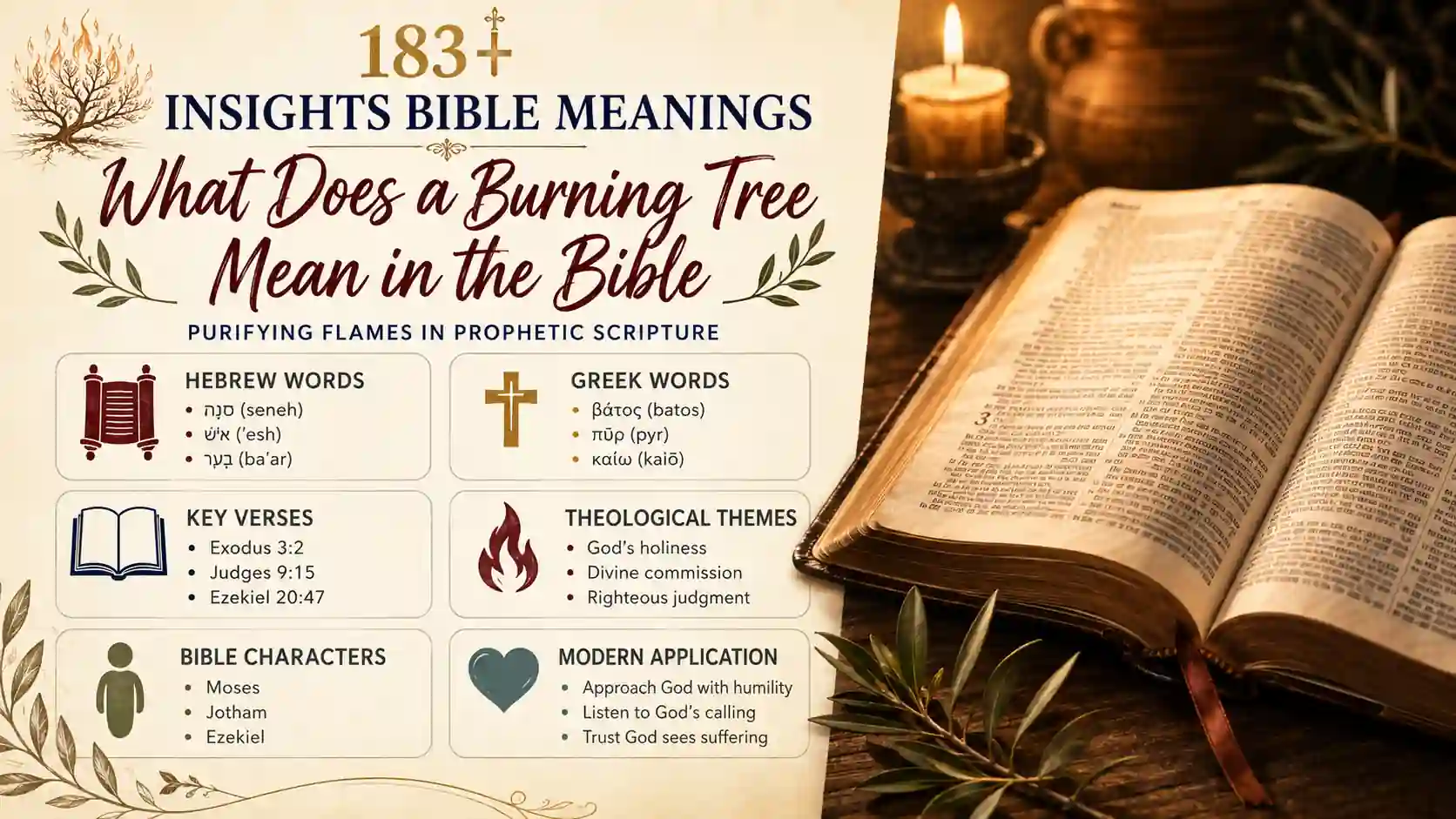
Burning Tree Key Scripture References
| Verse | Passage Snippet | Context |
|---|---|---|
| Exodus 3:2 | Bush burned but was not consumed | God appears to Moses at Horeb |
| Exodus 3:3 | Moses turns aside to investigate | The sign attracts the future deliverer |
| Exodus 3:4 | God calls from within the bush | Moses receives a personal summons |
| Deuteronomy 33:16 | Favor of the One in the bush | Moses recalls God’s covenant presence |
| Judges 9:15 | Fire comes from the bramble | Jotham warns against corrupt kingship |
| Ezekiel 20:47 | Fire consumes every green tree | Judgment is announced against the south |
| Zechariah 11:1–2 | Cedars and oaks fall before fire | Proud leaders and powers are humbled |
| Revelation 8:7 | A third of the trees are burned | Trumpet judgment strikes the earth |
Burning Tree Bible Translation Comparison
| Verse | KJV | NIV | ESV | NASB |
|---|---|---|---|---|
| Exodus 3:2 | Bush burned, not consumed | Bush did not burn up | Bush was not consumed | Bush was not consumed |
| Exodus 3:3 | Great sight | Strange sight | Great sight | Marvelous sight |
| Exodus 3:4 | God called from the bush | God called from the bush | God called from the bush | God called from the bush |
| Deuteronomy 33:16 | Good will of him in the bush | Favor of him in the bush | Favor of him who dwells in the bush | Favor of him who dwelt in the bush |
| Judges 9:15 | Fire come out of the bramble | Fire come out of the thornbush | Fire come out of the bramble | Fire come out of the bramble |
| Ezekiel 20:47 | Devour every green tree | Devour every green tree | Devour every green tree | Consume every green tree |
| Zechariah 11:1 | Fire may devour thy cedars | Fire may devour your cedars | Fire may devour your cedars | Fire may feed on your cedars |
| Revelation 8:7 | Third part of trees burnt up | Third of trees burned up | Third of trees burned up | Third of trees burned up |
Burning Tree People and Characters Associated
| Person | Role | Connection |
|---|---|---|
| Moses | Shepherd and deliverer | Sees the unconsumed burning bush |
| Angel of the LORD | Divine messenger | Appears in the flame at Horeb |
| The LORD | Covenant God | Speaks from the bush and commissions Moses |
| Abraham | Patriarch | God identifies Himself as Abraham’s God |
| Isaac | Covenant heir | Named in God’s self-revelation |
| Jacob | Father of Israel | Named as part of the covenant line |
| Jotham | Son of Gideon | Uses bramble fire in his royal fable |
| Abimelech | Violent king | Represented by the destructive bramble |
| Ezekiel | Exilic prophet | Announces fire against the southern forest |
| John | Apostolic seer | Witnesses trees burned in trumpet judgment |
Burning Tree Original Hebrew and Greek Words
| Original Word | Transliteration | Strong’s # | Literal Meaning |
|---|---|---|---|
| סְנֶה | seneh | H5572 | Thornbush or bramble |
| אֵשׁ | ʾesh | H784 | Fire |
| בָּעַר | baʿar | H1197 | To burn or consume |
| לַבָּה | labbah | H3827 | Flame |
| עֵץ | ʿets | H6086 | Tree or wood |
| יַעַר | yaʿar | H3293 | Forest or woodland |
| βάτος | batos | G942 | Thornbush or bramble |
| πῦρ | pyr | G4442 | Fire |
| καίω | kaiō | G2545 | To burn or kindle |
| δένδρον | dendron | G1186 | Tree |
Burning Tree Related Biblical Concepts
| Concept | Connection | Supporting Verse |
|---|---|---|
| Divine presence | God manifests Himself in fire | Exodus 3:2–6 |
| Holiness | Moses must remove his sandals | Exodus 3:5 |
| Revelation | God makes His identity known | Exodus 3:6 |
| Calling | Moses is sent to confront Pharaoh | Exodus 3:10 |
| Covenant faithfulness | God remembers the patriarchal promises | Exodus 3:15–17 |
| Preservation | The bush burns without destruction | Exodus 3:2 |
| Judgment | Fire consumes rebellious vegetation | Ezekiel 20:47 |
| False leadership | Bramble fire pictures ruinous kingship | Judges 9:15 |
| Human pride | Majestic trees are brought low | Zechariah 11:2 |
| Cosmic warning | Burned trees accompany trumpet judgment | Revelation 8:7 |
Burning Tree Historical and Cultural Context
| Aspect | Detail | Biblical Source |
|---|---|---|
| Location | Moses encounters God near Horeb | Exodus 3:1 |
| Occupation | Moses is tending Jethro’s flock | Exodus 3:1 |
| Environment | Thorny shrubs fit a wilderness setting | Exodus 3:2 |
| Fire imagery | Fire often signals divine activity | Exodus 13:21 |
| Holy ground | God’s presence sanctifies ordinary soil | Exodus 3:5 |
| Bare feet | Removing sandals expresses reverence | Exodus 3:5 |
| Israel’s condition | Hebrews suffer under Egyptian oppression | Exodus 3:7–9 |
| Royal fables | Trees can represent rulers and peoples | Judges 9:8–15 |
| Forest warfare | Fire could devastate land and resources | 2 Samuel 18:8 |
| Apocalyptic imagery | Earthly disasters communicate divine judgment | Revelation 8:7 |
Burning Tree Theological Themes
| Theme | Explanation | Scripture |
|---|---|---|
| God’s holiness | His presence demands reverence | Exodus 3:5 |
| God’s self-revelation | He speaks and identifies Himself | Exodus 3:6 |
| Covenant continuity | He is the God of Abraham, Isaac, and Jacob | Exodus 3:6 |
| Compassion | He sees and hears His people’s suffering | Exodus 3:7 |
| Divine commission | Revelation leads to obedient service | Exodus 3:10 |
| Sustaining grace | God’s fire does not destroy the chosen sign | Exodus 3:2 |
| Righteous judgment | Rebellion can bring consuming fire | Ezekiel 20:47 |
| Sovereignty over rulers | Proud trees and leaders can fall | Zechariah 11:1–2 |
| Resurrection hope | Jesus cites the bush account against the Sadducees | Mark 12:26–27 |
| Final accountability | Creation itself is touched by judgment | Revelation 8:7 |
Burning Tree Modern Application for Believers
| Area | Practice | Scripture |
|---|---|---|
| Worship | Approach God with humility | Exodus 3:5 |
| Calling | Listen when God redirects your path | Exodus 3:4 |
| Service | Accept that God sends ordinary people | Exodus 3:10 |
| Suffering | Trust that God sees oppression | Exodus 3:7 |
| Identity | Ground faith in God’s revealed character | Exodus 3:14 |
| Perseverance | Seek grace that sustains under pressure | Exodus 3:2 |
| Leadership | Reject power that harms those it governs | Judges 9:15 |
| Repentance | Take prophetic warnings seriously | Ezekiel 20:47 |
| Creation care | Receive environmental judgment as morally serious | Revelation 8:7 |
| Scripture study | Interpret symbols through their context | Luke 20:37–38 |
סְנֶה And the Bush That Fire Could Not Consume
The famous object in Exodus 3 is not technically called a tree. The Hebrew noun סְנֶה, seneh, Strong’s H5572, means a thornbush or bramble. It appears mainly in the burning-bush account and again in Moses’ blessing, where he remembers “the One who dwelt in the bush.” The limited use of the word ties it closely to this decisive revelation.
The wonder is not simply that vegetation catches fire in a dry region. Moses sees that the bush remains intact. The Hebrew verb בָּעַר, baʿar, describes burning, while the text stresses that the bush is not consumed. The sign directs Moses away from natural explanations and toward the God who speaks from within the flame.
What Does a Burning Tree Mean in the Bible at Horeb?
At Horeb, fire signifies holy presence rather than destruction. God tells Moses not to approach casually and commands him to remove his sandals because the ground has become holy. The soil is not inherently sacred. It is sacred because the Holy One has chosen to reveal Himself there.
The event also introduces God’s saving mission. He has seen Israel’s affliction, heard the people’s cry, and come to deliver them. The burning bush therefore joins transcendence with compassion. The God whose holiness causes Moses to hide his face is also the God who attends to the suffering of enslaved people.
From Jotham’S Bramble to Ezekiel’S Burning Forest
Not every burning plant represents gracious revelation. In Judges 9, Jotham tells a fable in which the trees seek a king. The unproductive bramble accepts authority and threatens to send out fire. The image exposes Abimelech’s violent rule. Leadership separated from righteousness becomes dangerous to everyone beneath it.
Ezekiel’s burning forest carries a similar severity. Green and dry trees are consumed together as the prophet announces judgment. In such passages, trees may symbolize inhabitants, rulers, strength, or an entire land. The fire warns that entrenched rebellion eventually meets God’s righteous opposition.
βάτος, Resurrection, and the New Testament Reading
The Septuagint and New Testament use βάτος, batos, Strong’s G942, for the bush. Jesus refers to “the passage about the bush” when answering the Sadducees, who denied resurrection. He focuses not on the flame but on God’s declaration that He is the God of Abraham, Isaac, and Jacob.
Jesus reasons that God is not the God of the dead but of the living. The bush narrative therefore becomes more than Moses’ call story. It bears witness to the continuing covenant relationship between God and His people. The One who preserves the bush also remains faithful to those who belong to Him beyond physical death.
Burning Tree Questions Bible Students Ask
Does every burning tree in Scripture symbolize God’s presence?
No. Context determines whether fire communicates presence, judgment, warfare, warning, or another theme.
Why is סְנֶה, seneh, translated as both “bush” and “bramble”?
The rare Hebrew noun refers to a thorny shrub, so English translations choose terms that express the same general plant type.
Was the burning bush meant to symbolize Israel suffering in Egypt?
The text does not explicitly make that identification, though many readers see a fitting picture of affliction without annihilation.
Why does Jesus connect βάτος, batos, with resurrection?
He uses God’s words at the bush to show that the patriarchs remain alive to the covenant-keeping God.
What should you do when you encounter burning-tree imagery in your study?
Examine the speaker, setting, result of the fire, and surrounding message before assigning symbolic meaning.