
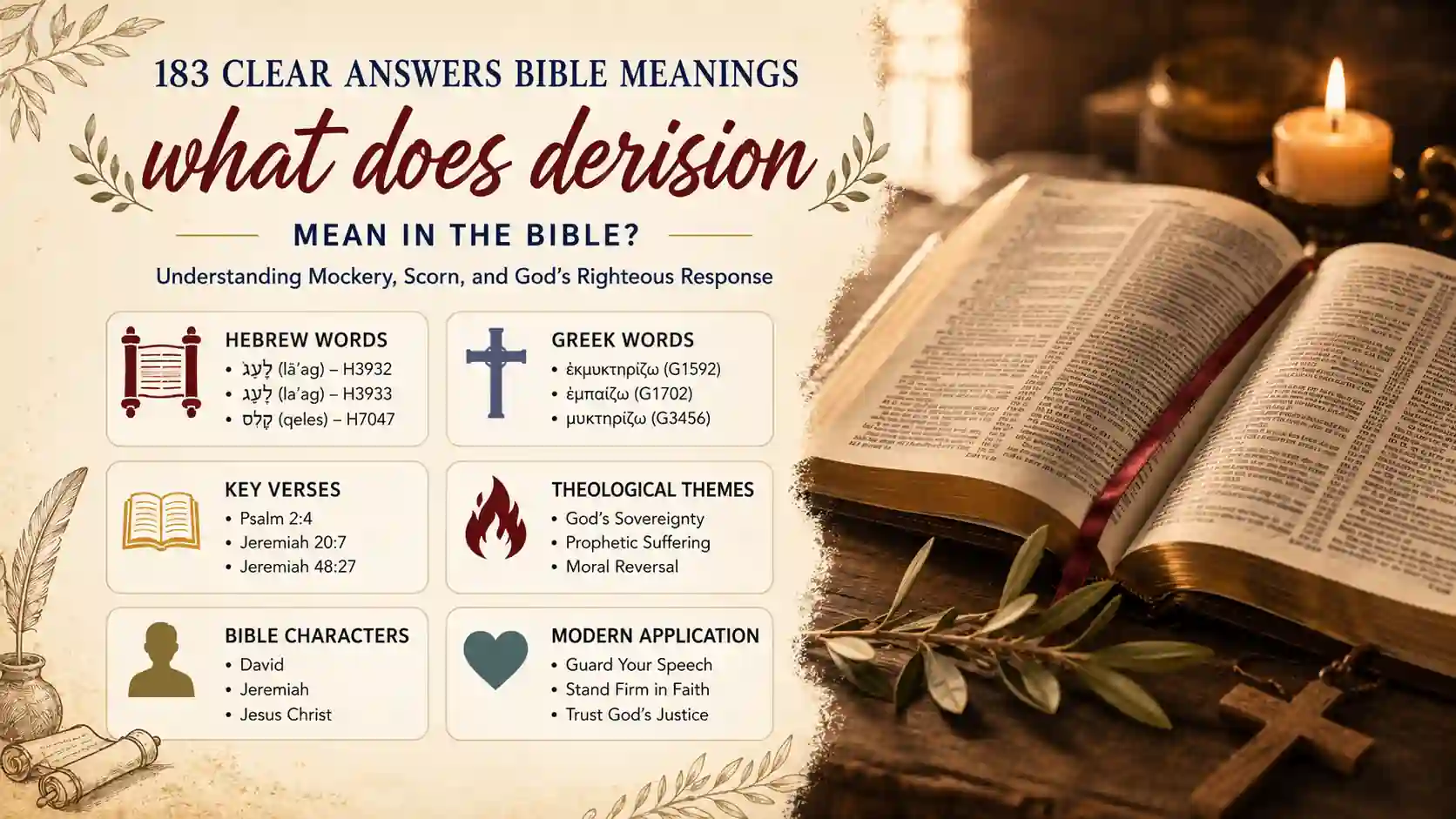
What does derision mean in the Bible? Derision is scorn expressed through ridicule, mocking speech, contemptuous laughter, insulting gestures, or public humiliation. Scripture presents it as more serious than playful teasing because it attacks a person’s dignity, rejects God’s truth, or treats divine authority as powerless.
Yet the Bible also speaks of God holding rebels in derision. In that setting, derision reveals the absurdity and certain defeat of human pride before the sovereign Lord. Your study must therefore distinguish sinful human mockery from God’s righteous judgment.
Key Derision Scripture References
| Verse | Passage Snippet | Context |
|---|---|---|
| Psalm 2:4 | “The Lord shall have them in derision” | God answers rebellious kings |
| Psalm 44:13 | “A scorn and a derision” | Israel laments national shame |
| Psalm 59:8 | “Have all the heathen in derision” | David trusts God against enemies |
| Psalm 119:51 | “The proud have had me greatly in derision” | The psalmist remains faithful |
| Psalm 123:4 | “The scorning of those that are at ease” | Worshipers plead for mercy |
| Jeremiah 20:7 | “I am in derision daily” | Jeremiah suffers for preaching |
| Jeremiah 48:26 | “He also shall be in derision” | Moab is judged for pride |
| Jeremiah 48:27 | “Was not Israel a derision unto thee?” | Moab mocked God’s people |
| Jeremiah 48:39 | “Moab be a derision” | The mocker becomes mocked |
| Lamentations 3:14 | “A derision to all my people” | The sufferer endures ridicule |
Derision in Major Bible Translations
| Verse | KJV | NIV | ESV | NASB |
|---|---|---|---|---|
| Psalm 2:4 | Have them in derision | Scoffs at them | Holds them in derision | Scoffs at them |
| Psalm 44:13 | Scorn and derision | Scorn and derision | Scorn and derision | Scoffing and derision |
| Psalm 59:8 | Have all the heathen in derision | Scoff at all those nations | Hold all nations in derision | Scoff at all the nations |
| Psalm 119:51 | Had me greatly in derision | Mock me unmercifully | Utterly deride me | Utterly deride me |
| Jeremiah 20:7 | I am in derision daily | I am ridiculed all day long | Become a laughingstock all day | Become a laughingstock all day |
| Jeremiah 48:26 | He also shall be in derision | She will become an object of ridicule | He too shall be held in derision | He also will become a laughingstock |
| Jeremiah 48:27 | Was not Israel a derision | Was not Israel the object of your ridicule | Was not Israel a derision to you | Was not Israel a laughingstock to you |
| Jeremiah 48:39 | Moab be a derision | Moab has become an object of ridicule | Moab has become a derision | Moab will become a laughingstock |
People and Characters Associated with Derision
| Person | Role | Connection |
|---|---|---|
| David | King and psalmist | Mocked by enemies yet trusted God |
| Jeremiah | Prophet of Judah | Ridiculed for proclaiming judgment |
| Job | Righteous sufferer | Became an object of mockery |
| The psalmist | Faithful worshiper | Derided for obeying God’s law |
| Israel | Covenant nation | Mocked after military defeat |
| Moab | Proud neighboring nation | Ridiculed Israel and faced judgment |
| Sennacherib | Assyrian king | Mocked the living God |
| Hezekiah | King of Judah | Sought God under Assyrian taunts |
| Jesus Christ | Suffering Messiah | Mocked by rulers, soldiers, and crowds |
| Paul | Apostle to the Gentiles | Warned that God cannot be mocked |
Original Hebrew and Greek Words for Derision
| Original Word | Transliteration | Strong’s # | Literal Meaning |
|---|---|---|---|
| לָעַג | lāʿag | H3932 | To mock or deride |
| לַעַג | laʿag | H3933 | Mocking or derision |
| קֶלֶס | qeles | H7047 | A laughingstock |
| שְׂחוֹק | seḥoq | H7814 | Laughter or ridicule |
| לוּץ | lûṣ | H3887 | To scoff or scorn |
| צָחַק | ṣāḥaq | H6711 | To laugh or mock |
| ἐκμυκτηρίζω | ekmyktērizō | G1592 | To sneer contemptuously |
| ἐμπαίζω | empaizō | G1702 | To mock or ridicule |
| μυκτηρίζω | myktērizō | G3456 | To turn up the nose |
Biblical Concepts Related to Derision
| Concept | Connection | Supporting Verse |
|---|---|---|
| Mockery | Derision expressed through ridicule | Jeremiah 20:7 |
| Scorn | Contempt for a person or truth | Psalm 123:4 |
| Reproach | Public shame placed upon someone | Psalm 44:13 |
| Pride | Inner source of contemptuous speech | Jeremiah 48:29 |
| Blasphemy | Mockery directed against God | Isaiah 37:23 |
| Persecution | Ridicule used against the faithful | Psalm 119:51 |
| Divine judgment | God reverses the mocker’s position | Jeremiah 48:39 |
| Sovereignty | Human rebellion cannot threaten God | Psalm 2:4 |
| Vindication | God defends His mocked servants | Psalm 59:8 |
| Perseverance | Faithfulness despite ridicule | Psalm 119:51 |
Historical and Cultural Context of Derision
| Aspect | Detail | Biblical Source |
|---|---|---|
| Public honor | Reputation shaped community standing | Psalm 44:13 |
| City gates | Public disputes and ridicule occurred there | Job 30:1, 9 |
| Taunting songs | Enemies turned suffering into entertainment | Lamentations 3:14 |
| Head shaking | Gesture of contempt and rejection | Psalm 22:7 |
| Clapping hands | Could celebrate another’s downfall | Job 27:23 |
| Hissing | Signaled horror, contempt, or disgrace | Jeremiah 19:8 |
| Military taunts | Armies mocked enemies before battle | 2 Kings 18:28 |
| Prophetic rejection | Messengers often became laughingstocks | Jeremiah 20:7 |
| Covenant shame | Defeat exposed Israel to foreign mockery | Psalm 44:13 |
| Royal propaganda | Kings used insults to weaken resistance | Isaiah 36:4 |
Theological Themes within Biblical Derision
| Theme | Explanation | Scripture |
|---|---|---|
| God’s sovereignty | Rebellion appears foolish before His throne | Psalm 2:4 |
| Human dignity | Cruel mockery contradicts neighbor love | Proverbs 17:5 |
| Covenant discipline | Israel’s shame could follow disobedience | Deuteronomy 28:37 |
| Prophetic suffering | Truthful messengers may face ridicule | Jeremiah 20:7 |
| Messianic suffering | Jesus endured contempt without retaliation | Luke 23:35 |
| Moral reversal | Those who mock may become objects of scorn | Jeremiah 48:27, 39 |
| Divine justice | God holds contempt for Him accountable | Isaiah 37:23 |
| Faithful endurance | Ridicule need not turn you from Scripture | Psalm 119:51 |
| Grace for the humble | God opposes scoffers and favors humility | Proverbs 3:34 |
| Final accountability | God cannot be treated with contempt safely | Galatians 6:7 |
Modern Application of Derision for Believers
| Area | Practice | Scripture |
|---|---|---|
| Speech | Refuse humiliating jokes and insults | Ephesians 4:29 |
| Social media | Do not join contemptuous crowds | Exodus 23:2 |
| Persecution | Remain obedient when faith is mocked | Psalm 119:51 |
| Conflict | Answer gently rather than retaliating | Proverbs 15:1 |
| Leadership | Never use ridicule to control others | Mark 10:42–43 |
| Worship | Treat God’s name and Word reverently | Galatians 6:7 |
| Compassion | Defend people made into laughingstocks | Proverbs 31:8 |
| Self-examination | Repent of pride behind sarcastic contempt | Proverbs 3:34 |
| Prayer | Bring humiliation honestly before God | Psalm 123:3–4 |
| Hope | Trust God to judge and vindicate rightly | 1 Peter 2:23 |
What Does Derision Mean in the Bible Through לָעַג LāʿAg?
The Hebrew verb לָעַג, lāʿag, describes mocking, deriding, or treating someone with scorn. It may involve laughter, insulting words, imitation, or speech intended to reduce another person to an object of contempt.
The related noun לַעַג, laʿag, names the mockery itself or the condition of becoming a laughingstock. Job, the psalmists, Jeremiah, Israel, and Moab all appear within this painful vocabulary of humiliation.
In Psalm 119:51, arrogant people greatly deride the faithful worshiper, yet he refuses to abandon God’s law. Derision therefore becomes a test of allegiance, exposing whether you value human approval more than obedience to Scripture.
Jeremiah’s experience is equally personal. Because his warnings of judgment sounded unbelievable to his hearers, his ministry made him a daily laughingstock, but the ridicule did not make his message false.
Divine Derision in Psalm 2 and Psalm 59
Psalm 2 portrays the nations and their rulers conspiring against the Lord and His anointed king. God’s laughter is not nervous amusement or petty cruelty, but the settled response of the sovereign King to a rebellion that cannot possibly overthrow Him.
The statement that God holds them in derision means their proud alliance is futile. His enthronement is secure, His decree concerning His Son stands firm, and no earthly ruler can cancel His purpose.
Psalm 59 uses similar language while David is surrounded by violent enemies. Their mouths sound threatening, yet God laughs because He sees their limits, their motives, and the judgment they cannot escape.
You should not use these passages to justify personal cruelty. Divine derision belongs to the holy Judge whose knowledge is perfect, while human beings are repeatedly commanded to reject pride, vengeance, and malicious contempt.
Moab’S Derision and the Prophetic Reversal
Jeremiah 48 gives one of Scripture’s clearest studies of derision as moral reversal. Moab had treated Israel as though God’s covenant people were common thieves, speaking of them with contempt and delighting in their humiliation.
Moab’s mockery arose from arrogance against the Lord. The prophecy therefore announces that Moab itself will become a derision, a shattered nation whose disgrace causes surrounding peoples to recoil.
This reversal does not teach that every suffering person has mocked others. It teaches that nations and individuals who build their security on pride cannot treat God, His truth, or His people with contempt indefinitely.
The prophets often connect derision with ruined cities, broken military confidence, hissing, head shaking, and public lamentation. These images show how quickly celebrated power can become a warning to others when God judges arrogance.
Christ’S Mocking and the Redemption of Shame
The New Testament presents Jesus as the righteous sufferer who enters fully into human derision. Religious leaders sneered at Him, soldiers dressed Him as a parody king, and spectators challenged Him to save Himself while He hung on the cross.
The Greek verbs ἐκμυκτηρίζω, ekmyktērizō, and ἐμπαίζω, empaizō, describe contemptuous sneering and calculated ridicule. Christ was mocked precisely because His enemies rejected His identity, kingship, saving mission, and trust in the Father.
Jesus did not answer derision with sinful derision. He entrusted Himself to the One who judges justly, prayed for His persecutors, and completed the work of redemption while shame was being publicly heaped upon Him.
When you are mocked for faithful discipleship, Christ’s suffering keeps you from despair and revenge. You follow a Savior who understands humiliation, defeated its power through the cross, and promises final honor to those who remain faithful.
Frequently Asked Questions About Derision in Scripture
Does לָעַג lāʿag always refer to harmless joking?
No, it normally communicates hostile mockery, scorn, or contempt rather than affectionate humor.
Why does Psalm 2:4 say that God holds the nations in derision?
The verse reveals the futility of rebellion against God’s sovereign rule, not uncontrolled or malicious laughter.
Why do some translations say “derision” while others say “scoffs” or “laughingstock”?
Each rendering expresses a different aspect of the underlying words, including mocking action, contemptuous speech, and public disgrace.
How should you respond when people treat your faith with derision?
Remain faithful to Scripture, answer with gentleness, pray honestly, and entrust final judgment to God.
Can Galatians 6:7 mean that human beings are able to injure God through μυκτηρίζω myktērizō?
No, it warns that treating God with contempt cannot deceive, diminish, or escape the judgment of the sovereign Lord.