
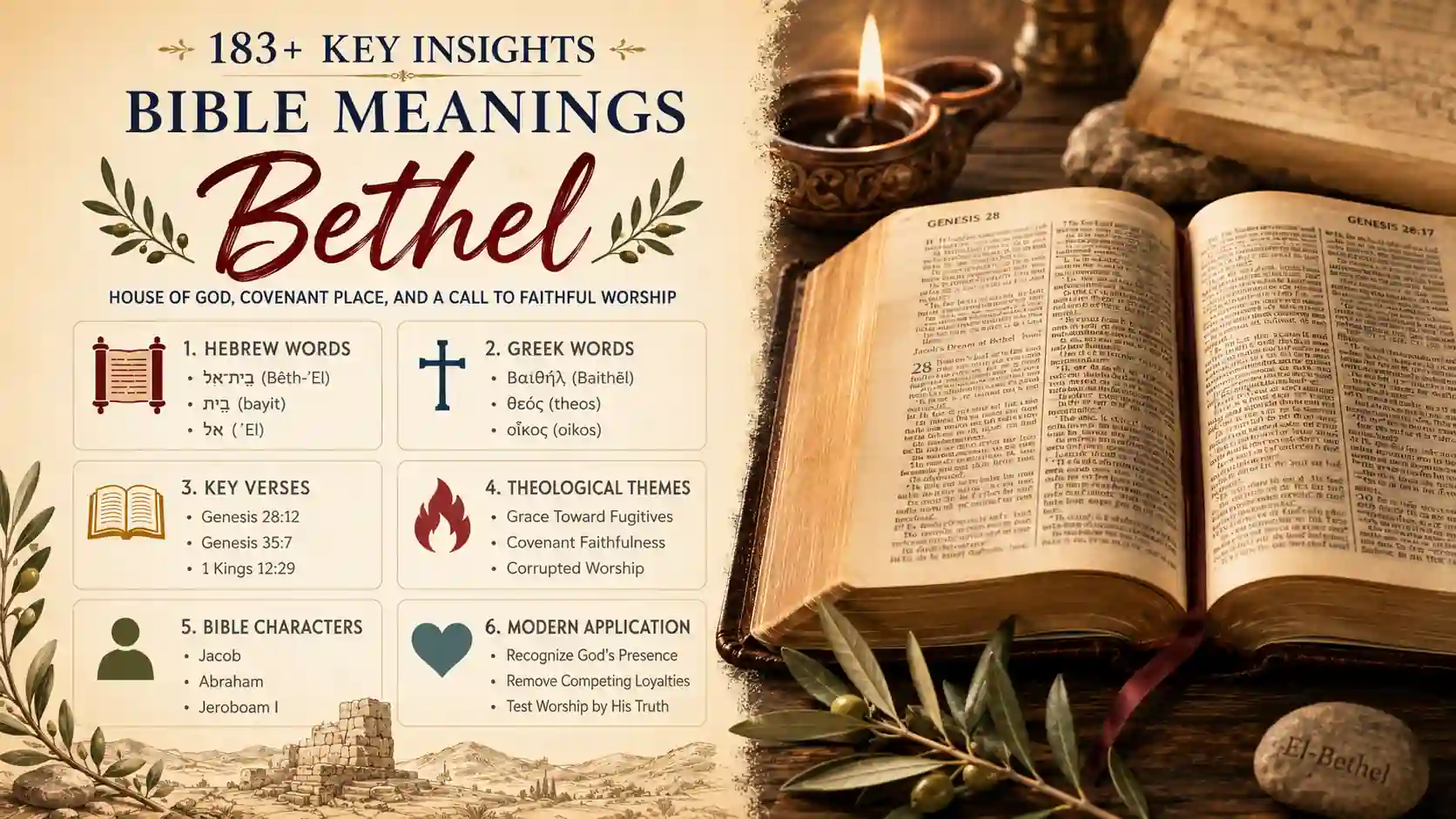
What does Bethel mean in the Bible? The name means “house of God,” but Scripture gives it a richer story than a simple definition. Bethel was a geographical location, a place of divine revelation, a center of worship, and eventually a warning against religious corruption.
As you trace Bethel from Abraham and Jacob through Israel’s judges, kings, and prophets, you see how a place associated with God’s presence could become polluted by idolatry. Its history invites you to treasure genuine communion with God rather than trusting sacred memories, locations, or ceremonies.
Bethel Key Scripture References
| Verse | Passage Snippet | Context |
|---|---|---|
| Genesis 12:8 | Abram camps east of Bethel | Abram builds an altar and calls on the Lord |
| Genesis 13:3-4 | Abram returns toward Bethel | He revisits the altar after leaving Egypt |
| Genesis 28:12 | Jacob sees heaven opened | Angels ascend and descend in his dream |
| Genesis 28:17 | “House of God” | Jacob responds with reverent fear |
| Genesis 28:19 | Luz is named Bethel | Jacob gives the place its covenant name |
| Genesis 31:13 | “God of Bethel” | God recalls Jacob’s pillar and vow |
| Genesis 35:7 | Jacob builds an altar | He names the site El-Bethel |
| 1 Kings 12:29 | A golden calf stands there | Jeroboam establishes rival worship |
| Amos 5:5 | “Do not seek Bethel” | God rejects Israel’s corrupted sanctuary |
| Hosea 10:15 | Judgment comes upon Bethel | Idolatrous religion cannot protect Israel |
Bethel Bible Translation Comparison
| Verse | KJV | NIV | ESV | NASB |
|---|---|---|---|---|
| Genesis 28:12 | ladder | stairway | ladder | ladder |
| Genesis 28:13 | Lord stood above it | Lord stood above it | Lord stood above it | Lord stood above it |
| Genesis 28:17 | dreadful | awesome | awesome | awesome |
| Genesis 28:17 | house of God | house of God | house of God | house of God |
| Genesis 28:19 | called the name | called that place | called the name | named that place |
| Genesis 31:13 | God of Bethel | God of Bethel | God of Bethel | God of Bethel |
| Genesis 35:7 | El-beth-el | El Bethel | El-bethel | El-bethel |
| Hosea 4:15 | Beth-aven | Beth Aven | Beth-aven | Beth-aven |
| Amos 4:4 | transgress | sin | transgress | rebel |
| Amos 5:5 | come not | do not go | do not enter | do not enter |
Bethel People and Characters Associated
| Person | Role | Connection |
|---|---|---|
| Abraham | Patriarch | Builds an altar near Bethel |
| Lot | Abraham’s nephew | Travels through the Bethel region |
| Jacob | Patriarch | Dreams, vows, worships, and returns there |
| Rachel | Jacob’s wife | Travels with Jacob toward Bethel |
| Deborah | Rebekah’s nurse | Buried below Bethel |
| Samuel | Prophet and judge | Visits Bethel on his judicial circuit |
| Jeroboam I | Northern king | Places a golden calf at Bethel |
| Unnamed man of God | Judahite prophet | Condemns Jeroboam’s altar |
| Amos | Prophet | Announces judgment against Bethel |
| Hosea | Prophet | Exposes Bethel as a center of wickedness |
Bethel Original Hebrew and Greek Words
| Original Word | Transliteration | Strong’s # | Literal Meaning |
|---|---|---|---|
| בֵּית־אֵל | Bêth-ʾĒl | H1008 | House of God |
| בַּיִת | bayit | H1004 | House, household |
| אֵל | ʾEl | H410 | God, Mighty One |
| לוּז | Luz | H3870 | Luz, Bethel’s former name |
| אֵל בֵּית־אֵל | ʾEl Bêth-ʾĒl | H416 | God of the house of God |
| בֵּית אָוֶן | Bêth ʾĀwen | H1007 | House of wickedness |
| אָוֶן | ʾāwen | H205 | Trouble, evil, idolatry |
| מַצֵּבָה | matstsebah | H4676 | Pillar, standing stone |
| מִזְבֵּחַ | mizbeach | H4196 | Altar, place of sacrifice |
| Βαιθήλ | Baithēl | No separate Greek Strong’s # | Greek form of Bethel |
The Hebrew place-name בֵּית־אֵל combines בַּיִת, “house,” with אֵל, “God.” The Septuagint commonly represents the name as Βαιθήλ, a transliteration rather than a translated Greek expression. Strong’s Greek Concordance does not assign it an independent New Testament entry.
Bethel Related Biblical Concepts
| Concept | Connection | Supporting Verse |
|---|---|---|
| Divine presence | Jacob realizes God is near | Genesis 28:16 |
| Covenant promise | God repeats Abrahamic promises | Genesis 28:13-15 |
| Revelation | Jacob receives a dream from God | Genesis 28:12 |
| Worship | Altars are built near and at Bethel | Genesis 12:8 |
| Consecration | Jacob pours oil on the pillar | Genesis 28:18 |
| Vows | Jacob pledges loyalty and giving | Genesis 28:20-22 |
| Repentance | Jacob removes foreign gods | Genesis 35:2-4 |
| Remembrance | God recalls Jacob’s earlier encounter | Genesis 31:13 |
| Idolatry | Jeroboam installs a golden calf | 1 Kings 12:28-29 |
| Judgment | Prophets condemn false worship | Amos 3:14 |
Bethel Historical and Cultural Context
| Aspect | Detail | Biblical Source |
|---|---|---|
| Earlier name | The city was formerly called Luz | Genesis 28:19 |
| Location | Near the Benjamin-Ephraim border | Joshua 16:1-2 |
| Elevation | Travelers commonly “went up” to Bethel | Genesis 35:1 |
| Patriarchal era | Abraham worshiped nearby | Genesis 12:8 |
| Jacob’s pillar | A stone marked divine encounter | Genesis 28:18 |
| Conquest period | Joseph’s tribes captured the city | Judges 1:22-25 |
| Judicial center | Samuel included it in his circuit | 1 Samuel 7:16 |
| Northern sanctuary | Jeroboam created royal worship there | 1 Kings 12:32-33 |
| Prophetic center | A company of prophets lived there | 2 Kings 2:3 |
| Assyrian period | Bethel’s priesthood taught new settlers | 2 Kings 17:27-28 |
Bethel Theological Themes
| Theme | Explanation | Scripture |
|---|---|---|
| Grace toward fugitives | God meets Jacob while he is fleeing | Genesis 28:10-15 |
| God’s initiative | Revelation begins with God, not Jacob | Genesis 28:12-13 |
| Covenant faithfulness | God promises land, offspring, and presence | Genesis 28:13-15 |
| Holy fear | Jacob responds with awe | Genesis 28:16-17 |
| Presence beyond buildings | God was present before Jacob recognized Him | Genesis 28:16 |
| Renewal | Jacob returns after years of wandering | Genesis 35:1 |
| Household cleansing | Idols are buried before worship | Genesis 35:2-4 |
| Corrupted worship | Bethel becomes a rival sanctuary | 1 Kings 12:26-33 |
| Empty religion | Sacred activity cannot replace obedience | Amos 5:4-6 |
| Righteous judgment | God holds polluted worship accountable | Amos 3:14 |
Bethel Modern Application for Believers
| Area | Practice | Scripture |
|---|---|---|
| Awareness | Recognize God’s presence with reverence | Genesis 28:16 |
| Scripture | Receive God’s promises by faith | Genesis 28:13-15 |
| Worship | Respond to grace with devotion | Genesis 28:18 |
| Commitment | Keep vows made before God | Ecclesiastes 5:4 |
| Repentance | Remove competing loyalties | Genesis 35:2 |
| Family leadership | Call your household toward holiness | Genesis 35:2-3 |
| Remembrance | Recall times of God’s faithfulness | Genesis 31:13 |
| Discernment | Test worship by God’s revealed truth | Amos 5:21-24 |
| Humility | Do not trust religious reputation | Amos 4:4 |
| Perseverance | Return to faithful obedience after failure | Genesis 35:1 |
What Does Bethel Mean in the Bible’S Patriarchal Story?
Bethel literally means “house of God,” yet the earliest biblical references emphasize encounter rather than architecture. Abraham pitched his tent near Bethel and built an altar, but no temple or permanent sanctuary is described. The site first appears as a place where a pilgrim calls upon the Lord.
Jacob later arrived there as a frightened fugitive. He had no congregation, priesthood, or sanctuary around him. God graciously revealed Himself through a dream and renewed the covenant promises given to Abraham and Isaac, showing that divine grace preceded Jacob’s worship and commitment.
בֵּית־אֵל And Jacob’S Covenant Encounter
In Genesis 28, Jacob sees a structure joining earth and heaven, with God’s angels ascending and descending. The vision assures him that heaven is not closed and that the covenant God remains active. God promises land, descendants, worldwide blessing, protection, and eventual return.
Jacob names the location Bethel because he recognizes it as “the house of God” and “the gate of heaven.” His stone pillar does not imprison God within one location. It marks a revelation that transformed an ordinary resting place into a remembered site of worship, awe, and promise.
From El-Bethel to the Golden Calf
When Jacob returns in Genesis 35, God commands him to go to Bethel and build an altar. Jacob first instructs his household to discard foreign gods, purify themselves, and change their garments. Renewal at Bethel requires more than revisiting an emotional memory. It calls for repentance and reordered allegiance.
Jacob names the altar אֵל בֵּית־אֵל, El-Bethel, “God of Bethel” or “God of the house of God.” The wording directs attention away from the sacred location and toward the God who revealed Himself there. Bethel mattered because of God, not because the soil possessed independent holiness.
How Bethel Became Beth-Aven in the Prophets
After Israel’s kingdom divided, Jeroboam I established a golden calf at Bethel. His political goal was to keep northern Israelites from worshiping in Jerusalem. He created an alternative priesthood, altar, festival, and sacrificial system, blending the language of Israel’s faith with practices God had not commanded.
Hosea therefore calls the region בֵּית אָוֶן, Beth-Aven, “house of wickedness” or “house of iniquity,” a cutting wordplay on Bethel. Amos likewise warns Israel not to seek Bethel. A place named “house of God” had become a center of rebellion because its worship separated religious enthusiasm from covenant obedience.
Questions Bible Students Ask About Bethel
Does Bethel always mean a physical house or temple?
No. The name means “house of God,” but it usually identifies a town and sacred location rather than a particular building.
Why did Jacob rename Luz as בֵּית־אֵל, Bêth-ʾĒl?
He named it Bethel because God revealed Himself there and Jacob recognized the place as associated with God’s presence.
Is Βαιθήλ, Baithēl, a separate Greek word with its own Strong’s number?
No. It is the Septuagint’s Greek transliteration of the Hebrew place-name and has no separate New Testament Strong’s entry.
Why did Hosea call Bethel בֵּית אָוֶן, Beth-Aven?
Hosea used the name “house of wickedness” to expose how the famous sanctuary had been corrupted by idolatrous worship.
What should Bethel teach you about sacred places?
A place can remind you of God’s faithfulness, but no location, tradition, or past experience can substitute for present obedience to Him.