
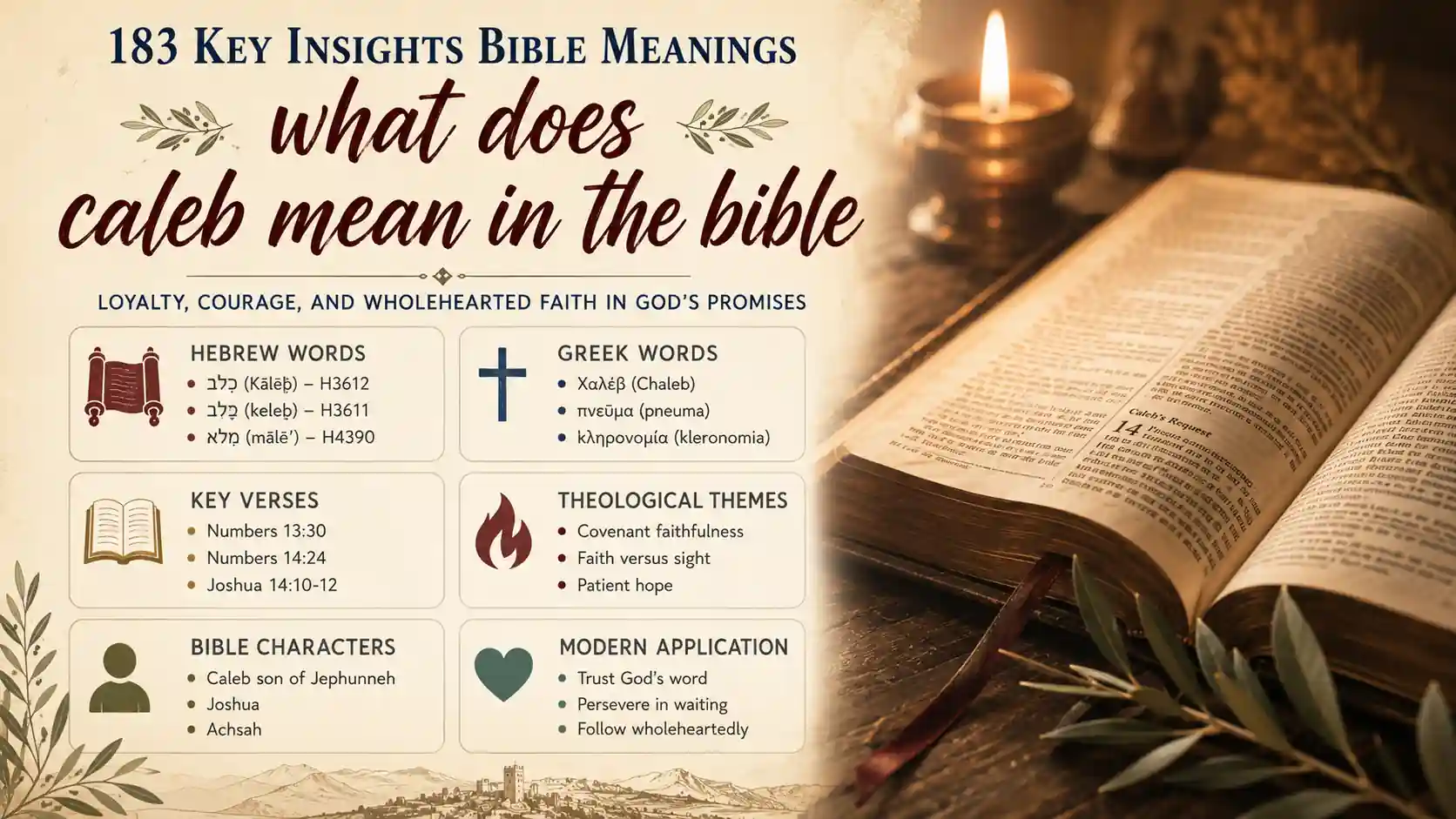
What does Caleb mean in the Bible? The Hebrew name כָּלֵב, commonly transliterated Kālēḇ or Kaleb, is traditionally connected with the Hebrew noun for “dog.” In the ancient world, that association could suggest tenacity, courage, loyalty, or determined service rather than merely functioning as an insult.
Caleb’s biblical significance, however, rests less on the possible etymology of his name and more on his character. Scripture remembers him as the servant who trusted God, resisted fearful unbelief, waited patiently for his inheritance, and followed the Lord wholeheartedly.
Caleb Key Scripture References
| Verse | Passage Snippet | Context |
|---|---|---|
| Numbers 13:6 | “Caleb the son of Jephunneh” | Judah selects Caleb to inspect Canaan. |
| Numbers 13:30 | “Let us go up at once” | Caleb quiets the fearful assembly. |
| Numbers 14:6-9 | “The LORD is with us” | Joshua and Caleb oppose Israel’s rebellion. |
| Numbers 14:24 | “Another spirit” | God commends Caleb’s wholehearted obedience. |
| Numbers 26:65 | “Caleb son of Jephunneh” | Only Joshua and Caleb survive that generation. |
| Numbers 32:12 | “Wholly followed the LORD” | Their faith contrasts with Israel’s unbelief. |
| Deuteronomy 1:36 | “To him will I give” | Moses recalls Caleb’s promised inheritance. |
| Joshua 14:10-12 | “Give me this mountain” | Caleb claims Hebron at eighty-five. |
| Joshua 14:13-14 | “Joshua blessed him” | Hebron becomes Caleb’s inheritance. |
| Joshua 15:13-17 | “Caleb drove out” | Caleb defeats Anakite inhabitants. |
Caleb Bible Translation Comparison
| Verse | KJV | NIV | ESV | NASB |
|---|---|---|---|---|
| Numbers 13:30 | “Let us go up” | “We should go up” | “Let us go up” | “Go up immediately” |
| Numbers 14:24 | “Another spirit” | “A different spirit” | “A different spirit” | “A different spirit” |
| Numbers 14:24 | “Followed me fully” | “Follows me wholeheartedly” | “Followed me fully” | “Followed Me fully” |
| Numbers 32:12 | “Wholly followed” | “Followed wholeheartedly” | “Wholly followed” | “Followed fully” |
| Deuteronomy 1:36 | “Hath wholly followed” | “Followed wholeheartedly” | “Wholly followed” | “Followed fully” |
| Joshua 14:8 | “Wholly followed” | “Followed wholeheartedly” | “Wholly followed” | “Followed fully” |
| Joshua 14:12 | “Give me this mountain” | “Give me this hill country” | “Give me this hill country” | “Give me this hill country” |
| Joshua 14:14 | “Wholly followed” | “Followed wholeheartedly” | “Wholly followed” | “Followed fully” |
The translation differences are small but meaningful. “Mountain” in the KJV and “hill country” in many modern versions represent the same elevated region around Hebron. Likewise, “wholly followed,” “followed fully,” and “followed wholeheartedly” express Caleb’s complete allegiance to God.
Caleb People and Characters Associated
| Person | Role | Connection |
|---|---|---|
| Jephunneh | Caleb’s father | Caleb is repeatedly identified as his son. |
| Moses | Covenant leader | Sends Caleb to explore Canaan. |
| Joshua | Fellow faithful spy | Stands with Caleb against the ten spies. |
| Anak | Anakite ancestor | His descendants occupy Caleb’s inheritance. |
| Sheshai | Anakite leader | Driven from Hebron by Caleb. |
| Ahiman | Anakite leader | Defeated during Caleb’s conquest. |
| Talmai | Anakite leader | Expelled from the Hebron region. |
| Othniel | Warrior and judge | Captures Debir and marries Achsah. |
| Achsah | Caleb’s daughter | Receives land and springs from her father. |
| Kenaz | Clan ancestor | Caleb is associated with the Kenizzites. |
Caleb’s relationships place him within Israel’s wilderness and conquest generations. Joshua shares his faith, Moses announces God’s promise, and Caleb’s family continues the work of establishing Judah in the land.
Caleb Original Hebrew and Greek Words
| Original Word | Transliteration | Strong’s # | Literal Meaning |
|---|---|---|---|
| כָּלֵב | Kālēḇ | H3612 | Caleb, traditionally “dog” |
| כֶּלֶב | keleḇ | H3611 | Dog |
| כָּלִבִּי | Kālippî | H3614 | Calebite |
| קְנִזִּי | Qənizzî | H7074 | Kenizzite |
| מָלֵא | mālēʾ | H4390 | Fill, fulfill fully |
| אַחֵר | ʾaḥēr | H312 | Another, different |
| רוּחַ | rûaḥ | H7307 | Spirit, breath, disposition |
| יָרַשׁ | yāraš | H3423 | Possess, inherit, dispossess |
| חֶבְרוֹן | Ḥeḇrôn | H2275 | Hebron, association |
| Χαλέβ | Chaleb | No NT Strong’s # | Greek form of Caleb |
The proper name כָּלֵב is listed as H3612 and is usually linked with כֶּלֶב, H3611, meaning “dog.” Lexicons differ about how confidently that relationship should define the personal name, so claims that Caleb literally means “wholehearted” should be qualified. “Wholehearted” describes Caleb’s conduct, but it is not the direct lexical meaning of his name.
The Septuagint represents his name as Χαλέβ, Chaleb. Because Caleb does not appear as a named person in the Greek New Testament, his Greek form has no standard New Testament Strong’s number. It is a transliteration of the Hebrew name rather than a translated Greek word.
Caleb Related Biblical Concepts
| Concept | Connection | Supporting Verse |
|---|---|---|
| Faith | Caleb trusts God’s promise over visible danger. | Numbers 13:30 |
| Courage | He recommends entering fortified Canaan. | Numbers 14:9 |
| Wholeheartedness | His allegiance is undivided. | Numbers 14:24 |
| Perseverance | He waits forty-five years for Hebron. | Joshua 14:10 |
| Inheritance | God grants the land Caleb explored. | Deuteronomy 1:36 |
| Minority faithfulness | He resists the majority report. | Numbers 14:6-9 |
| Spiritual endurance | His confidence remains strong in old age. | Joshua 14:11 |
| God’s presence | Victory depends on the Lord being with him. | Joshua 14:12 |
| Obedient warfare | Caleb drives out Canaanite strongholds. | Joshua 15:14 |
| Generational influence | His faith shapes Achsah and Othniel. | Joshua 15:16-19 |
Caleb demonstrates that biblical faith is not wishful thinking. He sees the same fortified cities and formidable inhabitants as the other spies, yet interprets them in light of God’s covenant promise.
Caleb Historical and Cultural Context
| Aspect | Detail | Biblical Source |
|---|---|---|
| Exodus generation | Caleb leaves Egypt with Israel. | Numbers 14:22-24 |
| Tribal identity | He represents the tribe of Judah. | Numbers 13:6 |
| Clan background | He is called a Kenizzite. | Joshua 14:6 |
| Spy mission | Twelve leaders survey Canaan. | Numbers 13:1-20 |
| Kadesh-barnea | Israel decides whether to enter the land. | Numbers 13:26 |
| Anakim | Large warriors inhabit the hill country. | Numbers 13:28, 33 |
| Wilderness judgment | Unbelieving adults die outside Canaan. | Numbers 14:26-35 |
| Land allotment | Tribal territories are assigned under Joshua. | Joshua 14:1-5 |
| Hebron | Ancient hill-country city awarded to Caleb. | Joshua 14:13 |
| Levitical use | Hebron later serves priests and refugees. | Joshua 21:11-13 |
Caleb is both a representative of Judah and “the Kenizzite.” Some scholars understand this description as evidence that his family had non-Israelite ancestry but became incorporated into Judah. Scripture does not explain the process, so your study should avoid going beyond the text.
The Anakim were associated with unusual size and military intimidation. Their presence explains why Hebron appeared threatening, but the narrative emphasizes that no human strength could cancel the Lord’s promise.
Caleb Theological Themes
| Theme | Explanation | Scripture |
|---|---|---|
| Covenant faithfulness | God keeps the inheritance promised to Caleb. | Joshua 14:9-13 |
| Faith versus sight | Caleb judges circumstances through God’s word. | Numbers 13:30 |
| Unbelief and judgment | Israel’s refusal produces wilderness death. | Numbers 14:20-35 |
| Divine approval | God calls Caleb “my servant.” | Numbers 14:24 |
| Another spirit | Caleb displays a different disposition. | Numbers 14:24 |
| Wholehearted obedience | His loyalty continues across decades. | Joshua 14:14 |
| Patient hope | Promise may involve prolonged waiting. | Joshua 14:10 |
| Grace and responsibility | God promises victory, yet Caleb must fight. | Joshua 14:12 |
| Rest after conflict | Caleb’s account leads toward settled inheritance. | Joshua 14:15 |
| Faithful legacy | Courage bears fruit in the next generation. | Joshua 15:16-19 |
Caleb’s story joins divine sovereignty and human obedience without treating them as rivals. God promises the land, preserves Caleb, and grants victory. Caleb must still speak, wait, advance, and drive out the occupants.
His faithfulness does not earn God’s covenant grace. Rather, his obedience reveals that he truly trusts the God who has graciously spoken. His works are the active expression of confidence in God’s character.
Caleb Modern Application for Believers
| Area | Practice | Scripture |
|---|---|---|
| Decision-making | Let God’s word outweigh fearful opinion. | Numbers 13:30 |
| Peer pressure | Remain faithful when the majority resists truth. | Numbers 14:10 |
| Speech | Encourage obedience rather than spreading panic. | Numbers 14:7-9 |
| Waiting | Hold promises patiently through long delays. | Joshua 14:10 |
| Aging | Continue serving with courage and purpose. | Joshua 14:11 |
| Ambition | Seek assignments that display reliance on God. | Joshua 14:12 |
| Prayer | Depend humbly on the Lord’s presence. | Joshua 14:12 |
| Family | Cultivate courageous faith in your household. | Joshua 15:16-19 |
| Endurance | Follow God through every season. | Joshua 14:14 |
| Hope | Remember that God does not forget his word. | Deuteronomy 1:36 |
You should not apply “give me this mountain” as a guarantee that every personal ambition will succeed. Caleb’s request rests on a specific promise God had already made through Moses.
A sound application begins with Scripture, not desire. Caleb encourages you to obey what God has revealed, trust his presence, and remain steadfast when fulfillment seems delayed.
What Does Caleb Mean in the Bible Beyond Its Etymology?
The likely lexical connection between כָּלֵב and “dog” can sound surprising to modern readers. Yet ancient names do not always carry the emotional associations that their English equivalents possess. Dogs could represent persistence, vigilance, or loyalty, although Scripture can also use the animal negatively.
The Bible never builds its interpretation of Caleb around a definition of his name. Instead, it repeatedly explains who he is through a verbal description. Caleb “wholly followed” the Lord. His spiritual identity comes from sustained covenant loyalty, not from a creative rearrangement of Hebrew letters.
כָּלֵב And the Language of Wholehearted Allegiance
The popular claim that Caleb means “wholehearted” probably arises from his character and from recurring statements about his obedience. Numbers 14:24 says he possessed “another spirit” and followed God fully. Joshua 14 repeats that testimony several times.
The Hebrew construction involves the verb מָלֵא, mālēʾ, which commonly means “to fill” or “to be full.” In this context it conveys fully carrying through one’s allegiance. Caleb did not follow God without weakness or sin, but he followed without joining Israel’s decisive rebellion.
Caleb at Kadesh-Barnea and the Crisis of Unbelief
Kadesh-barnea becomes a turning point because Israel stands near the promised land but refuses to enter. Ten spies interpret Canaan’s defenses as proof that obedience is impossible. Caleb interprets the same evidence under the authority of God’s promise.
This contrast teaches you that unbelief may present itself as sensible caution. Caleb is not ignorant of military danger. He knows the land contains fortified cities and Anakim, but he also knows Israel’s ultimate question is whether the Lord delights in them and remains with them.
Hebron, Inheritance, and Forty-Five Years of Faith
Caleb is forty when Moses sends him from Kadesh-barnea, and eighty-five when he asks Joshua for Hebron. His long wait includes wilderness wandering, national transition, warfare, and the deaths of nearly an entire generation.
When the inheritance finally comes, Caleb does not request an easy retirement. He asks for the difficult territory associated with the Anakim. His confidence is humble rather than presumptuous because he says, “It may be that the LORD will be with me.” His courage rests on divine presence, not personal strength.
Questions About Caleb’S Name and Story
Does the Hebrew name כָּלֵב actually mean “wholehearted”?
Not directly. H3612 is traditionally associated with כֶּלֶב, “dog,” while wholeheartedness describes Caleb’s faithful conduct.
Why is Caleb called both a Judahite and a Kenizzite?
He represents Judah, while “Kenizzite” probably identifies his family or clan background, though Scripture does not explain the relationship fully.
What does “another spirit” mean in Numbers 14:24?
It describes Caleb’s different disposition of faith, courage, and obedience in contrast with the unbelieving generation.
Why do some translations say “mountain” and others say “hill country” in Joshua 14:12?
The Hebrew refers to the elevated region around Hebron, so both expressions describe the same requested territory.
How can you follow the Lord wholeheartedly like Caleb?
Trust God’s revealed word, resist fear-driven unbelief, obey patiently, and depend on his presence through every season.