
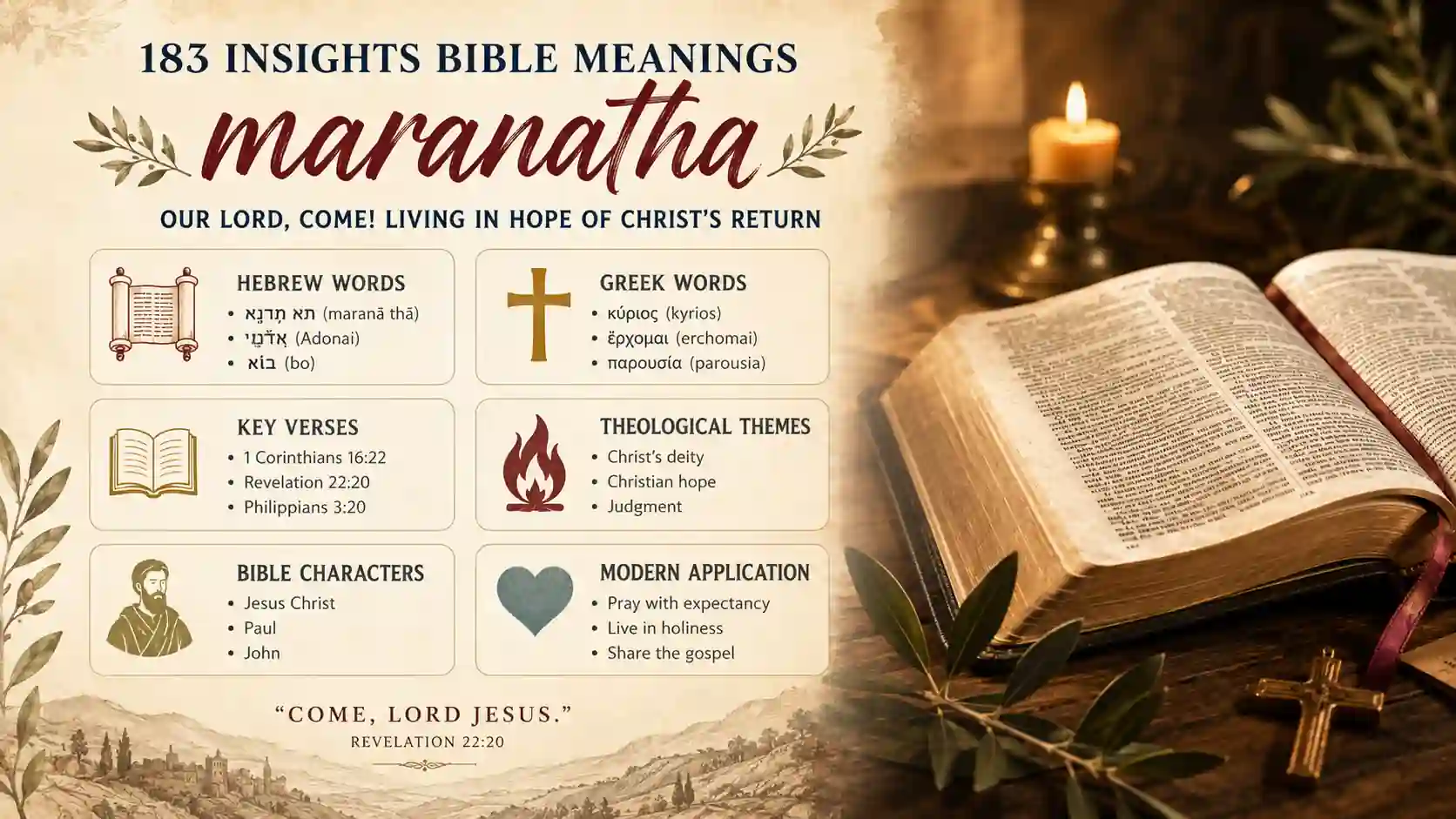
What does maranatha mean in the Bible? This ancient expression is an Aramaic confession and prayer preserved in Greek letters in 1 Corinthians 16:22. It most naturally means “Our Lord, come!” though its form can also be understood as “Our Lord has come.”
For the earliest Christians, Maranatha joined faith in Jesus’ identity with hope for his return. As you study the word, you encounter judgment, grace, worship, perseverance, and the church’s longing to see Christ complete his redemptive work.
Maranatha Key Scripture References
| Verse | Passage Snippet | Context |
|---|---|---|
| 1 Corinthians 16:22 | “Maranatha” | Paul closes with warning and hope |
| 1 Corinthians 16:23 | “Grace of our Lord Jesus” | Grace follows the solemn warning |
| Revelation 22:20 | “Come, Lord Jesus” | Final New Testament prayer |
| John 14:3 | “I will come again” | Jesus promises to receive his disciples |
| Acts 1:11 | “Will come in the same way” | Angels announce Christ’s return |
| Philippians 3:20 | “We await a Savior” | Believers expect Jesus from heaven |
| 1 Thessalonians 4:16 | “The Lord himself will descend” | Paul comforts grieving Christians |
| Titus 2:13 | “Waiting for our blessed hope” | Christ’s appearing shapes godly living |
| James 5:8 | “The coming of the Lord” | Suffering believers are told to endure |
| 2 Peter 3:12 | “Waiting for and hastening” | Holy conduct accompanies expectation |
Maranatha Bible Translation Comparison
| Verse | KJV | NIV | ESV | NASB |
|---|---|---|---|---|
| 1 Corinthians 16:22 | “Anathema Maranatha” | “Come, Lord!” | “Our Lord, come!” | “Maranatha” |
| Revelation 22:20 | “Come, Lord Jesus” | “Come, Lord Jesus” | “Come, Lord Jesus” | “Come, Lord Jesus” |
| John 14:3 | “I will come again” | “I will come back” | “I will come again” | “I am coming again” |
| Acts 1:11 | “Shall so come” | “Will come back” | “Will come” | “Will come” |
| Philippians 3:20 | “We look for the Saviour” | “We eagerly await a Savior” | “We await a Savior” | “We eagerly wait for a Savior” |
| 1 Thessalonians 4:16 | “The Lord himself shall descend” | “The Lord himself will come down” | “The Lord himself will descend” | “The Lord Himself will descend” |
| Titus 2:13 | “Looking for that blessed hope” | “We wait for the blessed hope” | “Waiting for our blessed hope” | “Looking for the blessed hope” |
| James 5:8 | “Coming of the Lord draweth nigh” | “Lord’s coming is near” | “Coming of the Lord is at hand” | “Coming of the Lord is near” |
Maranatha People and Characters Associated
| Person | Role | Connection |
|---|---|---|
| Jesus Christ | Lord and returning King | The one addressed in Maranatha |
| Paul | Apostle to the Gentiles | Preserves the expression in Corinthians |
| Corinthian believers | Original recipients | Called to love and await Christ |
| John | Apostle and seer | Prays “Come, Lord Jesus” |
| The Twelve | Witnesses of Jesus | Heard his promise to return |
| Angels at the ascension | Heavenly messengers | Announced Jesus would come again |
| Thessalonian believers | Persecuted church | Comforted by Christ’s future descent |
| James’s readers | Suffering Christians | Urged to wait patiently |
| Peter’s readers | Expectant believers | Called to holiness before the day |
| Early worshipers | Aramaic and Greek Christians | Used Maranatha as communal prayer |
Maranatha Original Hebrew, Aramaic, and Greek Words
| Original Word | Transliteration | Strong’s # | Literal Meaning |
|---|---|---|---|
| מָרַנָא תָא | maranā thā | G3134 | Our Lord, come |
| Μαράνα θά | Marana tha | G3134 | Aramaic prayer in Greek letters |
| κύριος | kyrios | G2962 | Lord, master |
| ἔρχομαι | erchomai | G2064 | Come, arrive |
| παρουσία | parousia | G3952 | Presence, arrival, coming |
| ἀνάθεμα | anathema | G331 | Accursed, devoted to judgment |
| φιλέω | phileō | G5368 | Love, cherish, hold dear |
| אֲדֹנָי | Adonai | H136 | Lord, sovereign master |
| בּוֹא | bo | H935 | Come, enter, arrive |
| מָר | mar | No separate biblical Strong’s entry | Aramaic lord or master |
Maranatha Related Biblical Concepts
| Concept | Connection | Supporting Verse |
|---|---|---|
| Second coming | Maranatha asks Jesus to return | Revelation 22:20 |
| Lordship of Christ | Jesus is addressed as “our Lord” | Romans 10:9 |
| Christian hope | Believers await their Savior | Philippians 3:20 |
| Final judgment | Christ’s coming exposes unbelief | 1 Corinthians 16:22 |
| Resurrection | The dead in Christ will rise | 1 Thessalonians 4:16 |
| Watchfulness | Disciples must remain ready | Matthew 24:42 |
| Perseverance | Hope strengthens suffering saints | James 5:7-8 |
| Holiness | Expectation affects conduct | 2 Peter 3:11-12 |
| Kingdom fulfillment | Christ completes his reign | 1 Corinthians 15:24-25 |
| Grace | The returning Lord sustains his people | 1 Corinthians 16:23 |
Maranatha Historical and Cultural Context
| Aspect | Detail | Biblical Source |
|---|---|---|
| Language | Aramaic words appear in a Greek letter | 1 Corinthians 16:22 |
| Roman Corinth | Diverse commercial city with many religions | Acts 18:1-17 |
| Church divisions | Believers were divided around leaders | 1 Corinthians 1:10-13 |
| Moral disorder | Paul confronted serious misconduct | 1 Corinthians 5:1-5 |
| Worship disputes | Gatherings showed inequality and confusion | 1 Corinthians 11:17-22 |
| Resurrection debate | Some denied future resurrection | 1 Corinthians 15:12 |
| Apostolic letter closing | Paul personally authenticated the letter | 1 Corinthians 16:21 |
| Early confession | Aramaic wording may reflect Palestinian worship | 1 Corinthians 16:22 |
| Eucharistic use | Early Christians repeated it in worship | Didache 10.6 |
| Persecution setting | Christ’s return gave courage under pressure | 1 Thessalonians 1:10 |
Maranatha Theological Themes
| Theme | Explanation | Scripture |
|---|---|---|
| Christ’s deity | Jesus receives prayer as the sovereign Lord | 1 Corinthians 16:22 |
| Already and not yet | Christ has come and will come again | Hebrews 9:28 |
| Judgment | His return confronts rejection and evil | 2 Thessalonians 1:7-9 |
| Salvation | The returning Lord gathers his people | Matthew 24:31 |
| Resurrection | Christ raises believers at his coming | 1 Corinthians 15:22-23 |
| Hope | Future glory steadies present faith | Titus 2:13 |
| Love for Christ | True expectation includes personal devotion | 1 Corinthians 16:22 |
| Grace | Warning is followed by Christ’s grace | 1 Corinthians 16:23 |
| Mission | The gospel goes forth before the end | Matthew 24:14 |
| New creation | Jesus’ return leads to restored creation | Revelation 21:1-5 |
Maranatha Modern Application for Believers
| Area | Practice | Scripture |
|---|---|---|
| Prayer | Ask Christ to complete his kingdom | Revelation 22:20 |
| Worship | Confess Jesus as your Lord | Philippians 2:11 |
| Suffering | Wait with patient courage | James 5:7-8 |
| Holiness | Live ready for Christ’s appearing | 1 John 3:2-3 |
| Evangelism | Share the gospel while time remains | 2 Corinthians 5:20 |
| Grief | Comfort others with resurrection hope | 1 Thessalonians 4:18 |
| Decision-making | Choose what honors the returning King | 2 Corinthians 5:9-10 |
| Community | Encourage believers toward faithfulness | Hebrews 10:24-25 |
| Stewardship | Serve faithfully until the Master returns | Luke 12:42-43 |
| Endurance | Hold firmly to your confession | Revelation 3:11 |
What Does Maranatha Mean in the Bible and in Paul’S Warning?
The New Testament records Maranatha only once, at the end of 1 Corinthians. Paul writes, “If anyone has no love for the Lord, let him be accursed. Our Lord, come!” The Greek text preserves the Aramaic sounds as Μαράνα θά, Marana tha, rather than replacing them with a normal Greek sentence.
This placement makes the expression both a prayer and a solemn declaration. Paul is not casually adding a religious slogan. He has spent the letter correcting pride, immorality, idolatry, loveless worship, misuse of spiritual gifts, and denial of resurrection. Maranatha announces that every issue must finally be viewed before the returning Lord.
מָרַנָא תָא And the Aramaic Voice of the Earliest Church
The expression is usually divided as מָרַנָא תָא, maranā thā, meaning “Our Lord, come!” The first part combines the Aramaic word for “Lord” with a first-person plural ending, producing “our Lord.” The second part functions as an appeal for the Lord to come.
A different division can yield the sense “Our Lord has come.” This reading expresses the truth of the incarnation, while the command “Our Lord, come!” fits Paul’s context and closely parallels Revelation 22:20. Many interpreters therefore understand Maranatha primarily as an urgent prayer for Christ’s return without denying that Christian hope rests upon his first coming.
Why Paul Places Anathema Beside Maranatha
The word immediately before Maranatha is ἀνάθεμα, anathema, meaning something handed over to judgment. Paul’s statement is severe because love for the Lord is not a minor emotional preference. The letter presents allegiance to Jesus as the defining reality of Christian existence.
Yet the warning is followed by grace. Paul’s next words are, “The grace of the Lord Jesus be with you,” followed by an assurance of his own love. Judgment, grace, and love therefore stand together. The returning Christ judges persistent rejection, gives grace to his people, and teaches them to love one another while they wait.
Maranatha as the Church’S Prayer of Hope
Revelation ends with the Greek prayer ἔρχου, κύριε Ἰησοῦ, erchou, kyrie Iēsou, “Come, Lord Jesus.” This is the Greek equivalent of the forward-looking interpretation of Maranatha. Scripture closes not with speculation about dates but with a personal appeal to Jesus.
When you pray Maranatha, you are asking for more than an escape from hardship. You are asking Christ to defeat evil, raise the dead, judge with righteousness, gather his people, renew creation, and dwell with them forever. The prayer also examines your present life, since longing for his coming includes learning to love his appearing.
Questions About Maranatha
Is Maranatha a Hebrew, Aramaic, or Greek word?
It is an Aramaic expression preserved in the New Testament through the Greek spelling Μαράνα θά.
Does Maranatha mean “Our Lord has come” or “Our Lord, come”?
Both divisions are linguistically possible, but “Our Lord, come!” best matches 1 Corinthians 16:22 and Revelation 22:20.
Why does Paul connect ἀνάθεμα, anathema, with Maranatha?
He warns that the returning Lord will judge those whose rejection of Christ reveals an absence of love for him.
Can you use Maranatha as a personal prayer today?
Yes, you can pray it as a reverent request for Jesus to return and as a commitment to live faithfully until he does.
How should Maranatha affect your daily life?
It should deepen your love for Christ, strengthen endurance, encourage holiness, and keep your hope centered on his promised return.