
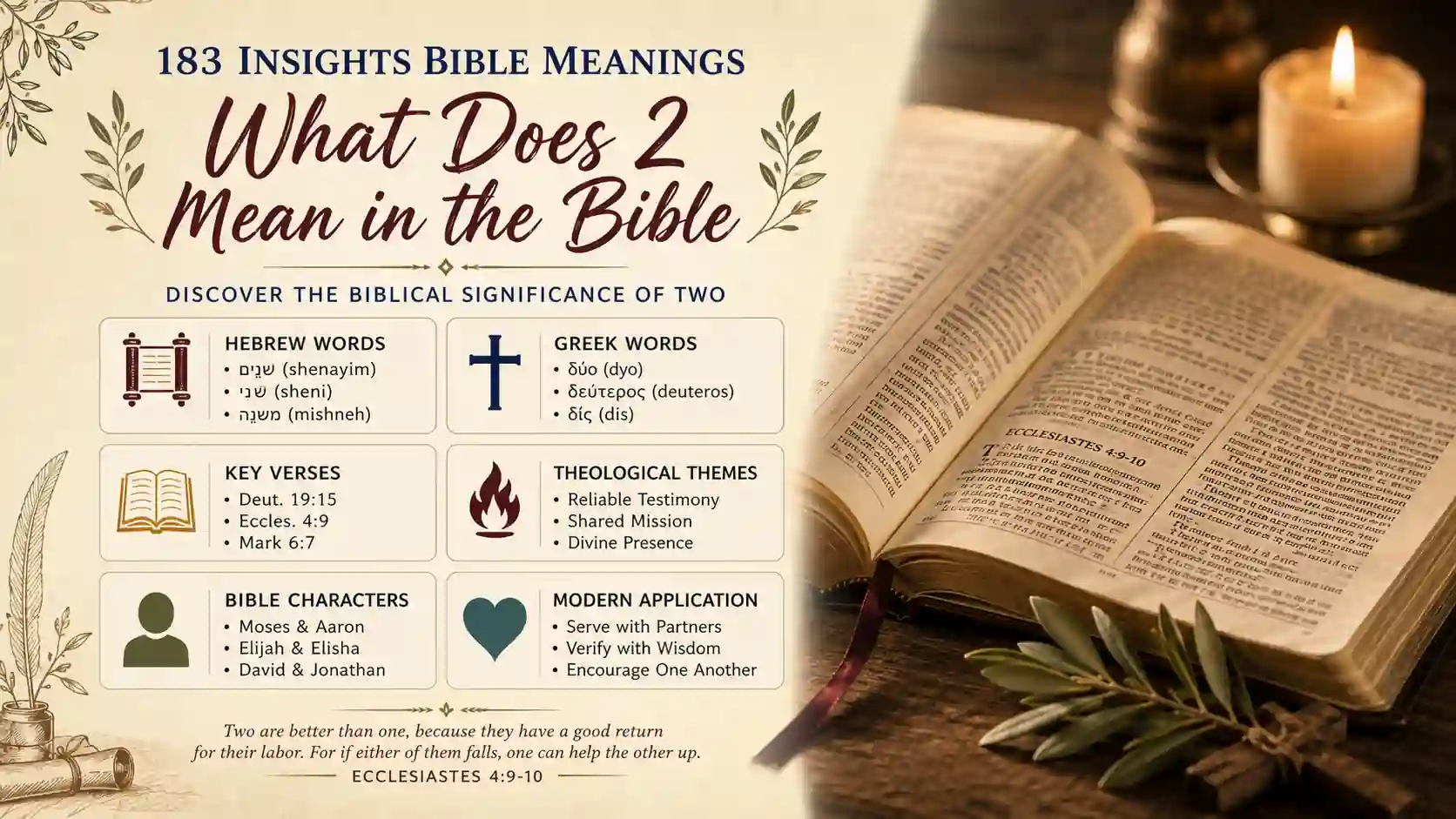
What does 2 mean in the Bible? Scripture does not assign the number two one fixed mystical definition. Instead, its meaning emerges from repeated biblical settings involving companionship, distinction, confirmation, covenant witness, and shared mission.
As you study these patterns, you will see two tablets, two witnesses, two disciples, two commandments, and two covenant representatives. Each passage must govern its own interpretation, yet together they reveal how God often uses pairs to establish truth, strengthen service, and display relationships within his redemptive work.
Key Scripture References About Two
| Verse | Passage Snippet | Context |
|---|---|---|
| Genesis 1:16 | Two great lights | Sun and moon govern distinct realms |
| Genesis 2:24 | The two become one flesh | Marriage joins man and woman |
| Genesis 6:19 | Two of every kind | Creatures enter Noah’s ark |
| Exodus 31:18 | Two tablets of testimony | God gives covenant commands |
| Deuteronomy 19:15 | Two or three witnesses | Testimony requires confirmation |
| Ecclesiastes 4:9 | Two are better than one | Companionship strengthens labor |
| Mark 6:7 | Sent them two by two | Jesus commissions shared ministry |
| Matthew 18:20 | Two or three gather | Christ is present with his people |
| Luke 10:1 | Sent them in pairs | Witnesses prepare towns for Jesus |
| Revelation 11:3 | My two witnesses | Prophetic testimony confronts rebellion |
Bible Translation Comparison for Two
| Verse | KJV | NIV | ESV | NASB |
|---|---|---|---|---|
| Genesis 1:16 | Two great lights | Two great lights | Two great lights | Two great lights |
| Genesis 2:24 | They shall be one flesh | They become one flesh | Become one flesh | Become one flesh |
| Exodus 31:18 | Two tables of testimony | Two tablets of covenant law | Two tablets of testimony | Two tablets of testimony |
| Deuteronomy 19:15 | Mouth of two witnesses | Testimony of two witnesses | Evidence of two witnesses | Evidence of two witnesses |
| Ecclesiastes 4:9 | Two are better than one | Two are better than one | Two are better than one | Two are better than one |
| Mark 6:7 | Two and two | Two by two | Two by two | Two by two |
| Matthew 18:20 | Two or three are gathered | Two or three gather | Two or three are gathered | Two or three have gathered |
| Luke 10:1 | Two and two | Two by two | Two by two | In pairs |
| John 8:17 | Testimony of two men | Testimony of two witnesses | Testimony of two people | Testimony of two people |
| Revelation 11:3 | My two witnesses | My two witnesses | My two witnesses | My two witnesses |
People and Characters Associated with Two
| Person | Role | Connection |
|---|---|---|
| Adam and Eve | First married couple | The two become one flesh |
| Cain and Abel | First brothers | Their lives display moral division |
| Moses and Aaron | Deliverer and spokesman | They confront Pharaoh together |
| Joshua and Caleb | Faithful spies | Two trust God’s promise |
| Elijah and Elisha | Prophet and successor | Ministry passes between generations |
| Naomi and Ruth | Covenant family companions | Loyalty carries them through loss |
| David and Jonathan | Covenant friends | Two lives joined by faithful love |
| Jesus and the Father | Divine witnesses | Their testimony is declared valid |
| Peter and John | Apostolic witnesses | They serve and testify together |
| Paul and Barnabas | Missionary partners | The church sends them together |
Original Hebrew and Greek Words for Two
| Original Word | Transliteration | Strong’s # | Literal Meaning |
|---|---|---|---|
| שְׁנַיִם | shenayim | H8147 | Two, a pair |
| שְׁתַּיִם | shetayim | H8147 | Two, feminine form |
| שֵׁנִי | sheni | H8145 | Second, another |
| מִשְׁנֶה | mishneh | H4932 | Double, second, copy |
| כִּפְלַיִם | kiplayim | H3718 | Double, twofold |
| δύο | dyo | G1417 | Two |
| δεύτερος | deuteros | G1208 | Second |
| δίς | dis | G1364 | Twice |
| δίδυμος | didymos | G1324 | Twin |
| ἀμφότεροι | amphoteroi | G297 | Both, both of two |
Related Biblical Concepts Connected with Two
| Concept | Connection | Supporting Verse |
|---|---|---|
| Marriage | Two persons form one covenant union | Genesis 2:24 |
| Witness | Two testimonies establish a matter | Deuteronomy 19:15 |
| Fellowship | A companion strengthens another | Ecclesiastes 4:9 |
| Mutual support | One raises the fallen partner | Ecclesiastes 4:10 |
| Shared mission | Disciples are sent in pairs | Mark 6:7 |
| Covenant testimony | Two tablets preserve God’s law | Exodus 31:18 |
| Great commandments | Love God and love your neighbor | Matthew 22:37-40 |
| Two ways | Life and death stand before Israel | Deuteronomy 30:19 |
| Two natures contrasted | Flesh opposes the Spirit | Galatians 5:17 |
| Confirmation | Multiple witnesses verify truth | 2 Corinthians 13:1 |
Historical and Cultural Context of Two
| Aspect | Detail | Biblical Source |
|---|---|---|
| Ancient courts | One accuser could not convict alone | Deuteronomy 19:15 |
| Covenant tablets | Stone tablets recorded divine commands | Exodus 31:18 |
| Marriage households | Union established a new family bond | Genesis 2:24 |
| Animal preservation | Creatures entered the ark in pairs | Genesis 7:9 |
| Travel safety | Companions offered help and protection | Ecclesiastes 4:10-12 |
| Rabbinic mission | Messengers could support their testimony | Luke 10:1 |
| Apostolic practice | Missionaries often served with partners | Acts 13:2 |
| Temple worship | Two cherubim overshadowed the ark | Exodus 25:18-20 |
| Agricultural labor | Shared work increased its reward | Ecclesiastes 4:9 |
| Prophetic symbolism | Paired witnesses gave public testimony | Revelation 11:3 |
Theological Themes Revealed Through Two
| Theme | Explanation | Scripture |
|---|---|---|
| Unity with distinction | Two remain persons yet form one union | Genesis 2:24 |
| Reliable testimony | Truth receives public confirmation | Deuteronomy 19:15 |
| Covenant revelation | God’s law governs his redeemed people | Exodus 31:18 |
| Shared vocation | God’s servants labor beside others | Mark 6:7 |
| Divine presence | Christ meets gathered believers | Matthew 18:20 |
| Mutual dependence | Human weakness invites companionship | Ecclesiastes 4:9-12 |
| Moral contrast | Scripture places two paths before humanity | Psalm 1:1-6 |
| Representative headship | Adam and Christ shape two humanities | Romans 5:12-19 |
| Reconciliation | Christ makes divided peoples one | Ephesians 2:14-16 |
| Prophetic accountability | God preserves testimony in hostile times | Revelation 11:3 |
Modern Application of Two for Believers
| Area | Practice | Scripture |
|---|---|---|
| Marriage | Build unity through covenant faithfulness | Genesis 2:24 |
| Friendship | Carry burdens and restore the fallen | Ecclesiastes 4:10 |
| Discernment | Verify serious claims carefully | Deuteronomy 19:15 |
| Ministry | Serve with accountable partners | Mark 6:7 |
| Prayer | Seek Christ together with other believers | Matthew 18:20 |
| Evangelism | Share and confirm the gospel faithfully | Luke 10:1 |
| Leadership | Develop trustworthy ministry teams | Acts 13:2 |
| Conflict | Bring appropriate witnesses when needed | Matthew 18:16 |
| Decision-making | Seek wise, godly counsel | Proverbs 15:22 |
| Discipleship | Encourage another believer consistently | Hebrews 10:24-25 |
שְׁנַיִם And the Biblical Pattern of Meaningful Pairs
The primary Hebrew cardinal number translated “two” is שְׁנַיִם, shenayim, Strong’s H8147. Its feminine form, שְׁתַּיִם, shetayim, belongs to the same entry and appears according to the grammatical gender of the noun being counted. Ordinarily, these forms simply identify a quantity, so you should not assume that every occurrence carries symbolic meaning.
Yet biblical authors sometimes place two persons or objects together to emphasize relationship. Adam and Eve become one flesh, two cherubim overshadow the ark, and two stone tablets bear covenant testimony. The significance comes from the inspired narrative and its context, not from an independent code attached to the number.
What Does 2 Mean in the Bible’S Laws of Witness?
Deuteronomy 19:15 declares that a matter must be established by two or three witnesses. This rule protected Israel’s courts from unsupported accusations and made public truth a communal responsibility. One person could report wrongdoing, but a judicial finding required corroborating testimony.
This legal pattern continues in the New Testament. Jesus applies it to church discipline in Matthew 18:16, Paul uses it in 2 Corinthians 13:1, and Jesus refers to the principle when discussing testimony in John 8:17-18. Two therefore often signifies adequate confirmation, although Scripture never teaches that two witnesses are automatically honest.
δύο, Shared Mission, and the Ministry of Jesus
The ordinary Greek word for two is δύο, dyo, Strong’s G1417. In Mark 6:7 and Luke 10:1, Jesus sends his messengers in pairs. Their partnership supplies companionship, accountability, practical assistance, and mutually reinforcing testimony as they announce the kingdom of God.
This pattern does not create an absolute rule that every Christian task requires exactly two workers. Paul sometimes traveled with teams of varying sizes, and believers occasionally served alone. Still, paired ministry reminds you that Christian service is normally communal rather than self-protective, isolated, or centered on personal recognition.
Two Adams, Two Paths, and One Saving Gospel
Biblical theology also uses paired contrasts. Psalm 1 presents the way of the righteous and the way of the wicked, while Deuteronomy 30 places life and death before Israel. These are not equal powers struggling for control, but morally distinct responses to the sovereign God.
Romans 5 presents an especially important pair, Adam and Christ. Through Adam came sin, condemnation, and death; through Jesus Christ come grace, righteousness, and life. Paul’s comparison does not reduce the gospel to number symbolism. It uses two representative heads to explain humanity’s ruin in Adam and the believer’s new standing in Christ.
Frequently Asked Questions About Two in the Bible
Does שְׁנַיִם, shenayim, always have a symbolic meaning?
No, it usually means the ordinary quantity two, and symbolism should be recognized only when the passage supports it.
Why did biblical law require two witnesses in Deuteronomy 19:15?
The requirement guarded against unsupported accusations and provided sufficient public confirmation for judicial action.
Why do some translations say “in pairs” instead of “two by two” in Luke 10:1?
Both render the same basic idea that Jesus organized his messengers into groups of two.
Does Matthew 18:20 mean Jesus is absent when one believer prays alone?
No, the verse assures gathered disciples of Christ’s authority and presence within its church-discipline context.
How can the biblical pattern of δύο, dyo, shape your ministry?
It can encourage you to seek partnership, accountability, mutual support, and credible testimony while serving Christ.