
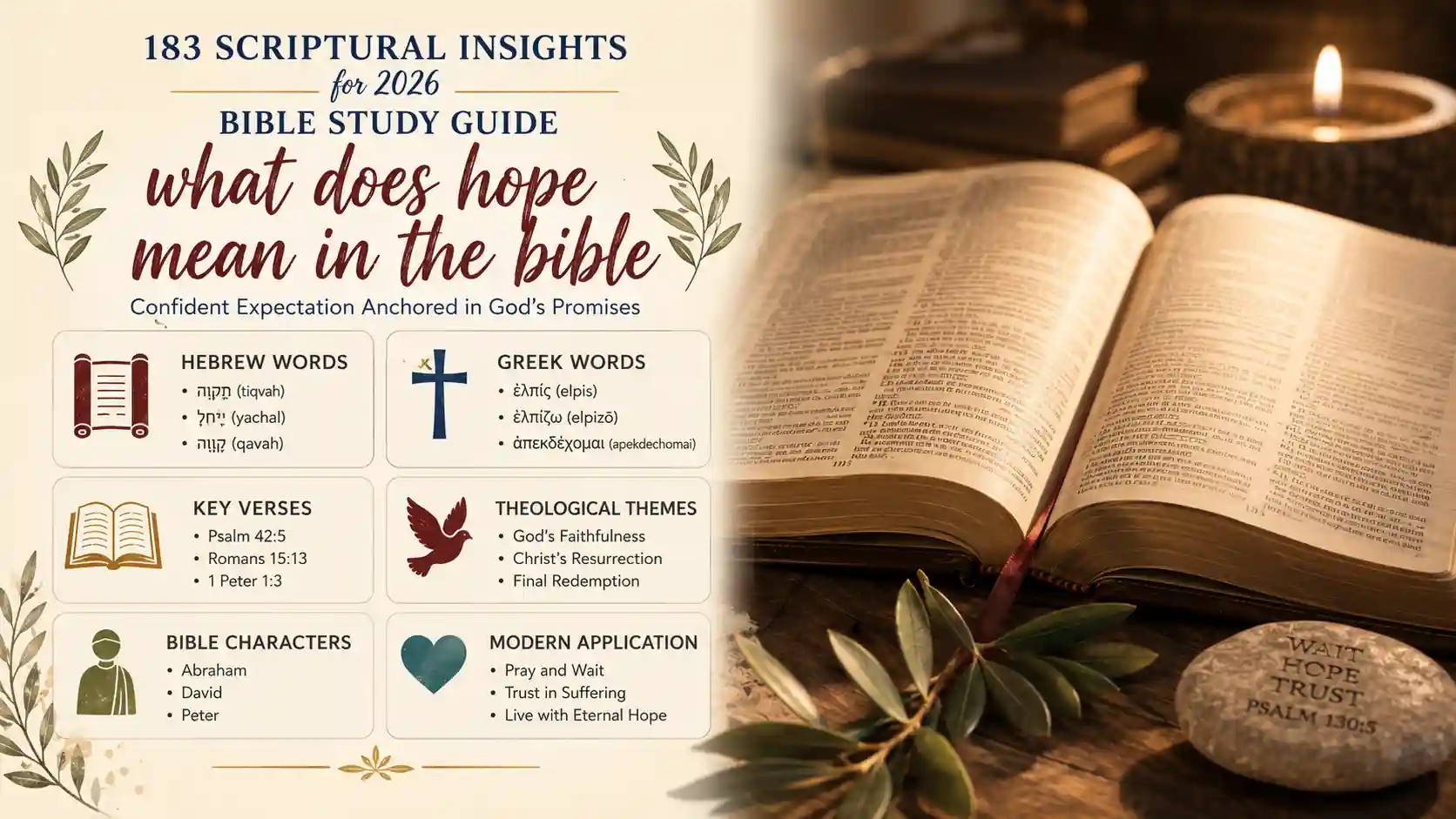
What does hope mean in the Bible? Biblical hope is not uncertain wishing or positive thinking. It is confident expectation grounded in the character, promises, and saving work of God. Scripture presents hope as patient waiting, courageous trust, and joyful anticipation of what God has pledged to accomplish.
In your study, you will see hope developing from Israel’s covenant confidence to the New Testament expectation of resurrection, Christ’s return, and eternal glory. Because God is faithful, biblical hope gives stability during suffering and strength for holy living.
Key Hope Scripture References
| Verse | Passage Snippet | Context |
|---|---|---|
| Psalm 42:5 | “Hope thou in God” | A discouraged worshiper addresses his troubled soul |
| Psalm 130:5 | “In his word do I hope” | Israel waits for divine mercy and redemption |
| Isaiah 40:31 | Those who hope in the Lord renew strength | Exiles are called to trust God’s unfailing power |
| Jeremiah 29:11 | “A future and a hope” | God promises restoration after Babylonian exile |
| Lamentations 3:21-24 | “Therefore I have hope” | God’s steadfast love sustains sufferers amid judgment |
| Romans 5:3-5 | Hope does not disappoint | Suffering produces endurance, character, and hope |
| Romans 15:13 | “The God of hope” | Paul prays for Spirit-produced joy and confidence |
| Hebrews 6:19 | Hope is an anchor for the soul | God’s oath and Christ’s priesthood secure believers |
| 1 Peter 1:3 | “A living hope” | Christ’s resurrection guarantees the believer’s inheritance |
Hope Bible Translation Comparison
| Verse | KJV | NIV | ESV | NASB |
|---|---|---|---|---|
| Psalm 42:5 | “hope thou in God” | “put your hope in God” | “hope in God” | “wait for God” |
| Psalm 130:5 | “in his word do I hope” | “in his word I put my hope” | “in his word I hope” | “I wait for His word” |
| Isaiah 40:31 | “wait upon the LORD” | “hope in the LORD” | “wait for the LORD” | “wait for the LORD” |
| Jeremiah 29:11 | “an expected end” | “a hope and a future” | “a future and a hope” | “a future and a hope” |
| Romans 5:5 | “hope maketh not ashamed” | “hope does not put us to shame” | “hope does not put us to shame” | “hope does not disappoint” |
| Romans 15:13 | “abound in hope” | “overflow with hope” | “abound in hope” | “abound in hope” |
| Hebrews 6:19 | “anchor of the soul” | “anchor for the soul” | “anchor of the soul” | “anchor of the soul” |
| 1 Peter 1:3 | “a lively hope” | “a living hope” | “a living hope” | “a living hope” |
The differences in Isaiah 40:31 and Psalm 42:5 show how Hebrew hope often includes waiting. The KJV’s “lively hope” in 1 Peter 1:3 uses “lively” in the older sense of living or life-giving, not merely cheerful. Romans 5:5 may be rendered “does not disappoint” or “does not put us to shame,” both expressing the certainty that God will vindicate those who trust him.
People and Characters Associated with Hope
| Person | Role | Connection |
|---|---|---|
| Abraham | Covenant patriarch | Hoped in God when natural circumstances offered no hope |
| Hannah | Praying mother | Entrusted her grief and future to the Lord |
| David | King and psalmist | Repeatedly called his soul to hope in God |
| Job | Righteous sufferer | Wrestled with hope amid loss, pain, and mortality |
| Jeremiah | Prophet of judgment | Found hope in God’s mercies during Jerusalem’s ruin |
| Simeon | Devout Israelite | Waited for the consolation of Israel |
| Paul | Apostle to the Gentiles | Proclaimed resurrection as Israel’s promised hope |
| Peter | Apostle and witness | Taught that Christ’s resurrection creates living hope |
| Jesus Christ | Messiah and High Priest | The ground, object, and fulfillment of Christian hope |
Original Hebrew and Greek Words for Hope
| Original Word | Transliteration | Strong’s # | Literal Meaning |
|---|---|---|---|
| תִּקְוָה | tiqvah | H8615 | Expectation, hope, cord |
| יָחַל | yachal | H3176 | Wait patiently, hope |
| קָוָה | qavah | H6960 | Wait, look eagerly, gather |
| בָּטַח | batach | H982 | Trust, feel secure |
| שֵׂבֶר | seber | H7664 | Hope, expectation |
| ἐλπίς | elpis | G1680 | Expectation, confidence |
| ἐλπίζω | elpizō | G1679 | Hope, expect, trust |
| ἀπεκδέχομαι | apekdechomai | G553 | Eagerly await |
| προσδέχομαι | prosdechomai | G4327 | Welcome, expect, wait for |
The noun תִּקְוָה, tiqvah, can refer literally to a cord or figuratively to expectation. Its imagery suggests something to which a person is attached. יָחַל, yachal, emphasizes patient waiting, while קָוָה, qavah, often describes expectant waiting for God’s action.
In the New Testament, ἐλπίς, elpis, normally expresses expectation or confidence, while ἐλπίζω, elpizō, describes the act of hoping or trusting. These words do not make hope self-generated. The confidence rests on its object, especially God, Christ, the resurrection, and the promised inheritance.
Related Biblical Hope Concepts
| Concept | Connection | Supporting Verse |
|---|---|---|
| Faith | Trusts God now while hope anticipates fulfillment | Hebrews 11:1 |
| Waiting | Hope remains attentive during apparent delay | Psalm 130:5 |
| Promise | God’s pledged word gives hope its certainty | Hebrews 6:13-18 |
| Covenant | Hope rests on God’s faithful commitments | Psalm 105:8 |
| Resurrection | Christ’s rising guarantees future life | 1 Peter 1:3 |
| Endurance | Hope strengthens believers under pressure | Romans 5:3-5 |
| Salvation | Believers await salvation’s final completion | Romans 8:23-25 |
| Holiness | Future hope motivates present purity | 1 John 3:3 |
| Glory | Hope anticipates sharing Christ’s glory | Colossians 1:27 |
Historical and Cultural Context of Hope
| Aspect | Detail | Biblical Source |
|---|---|---|
| Patriarchal promises | Abraham trusted promises of land, offspring, and blessing | Genesis 12:1-3 |
| Egyptian bondage | Israel waited for covenant deliverance | Exodus 2:23-25 |
| Davidic covenant | Israel expected an enduring royal heir | 2 Samuel 7:12-16 |
| Wisdom suffering | Job explored hope beyond visible circumstances | Job 13:15 |
| Babylonian exile | Prophets joined hope with restoration and repentance | Jeremiah 29:10-14 |
| Second Temple expectation | Faithful Israelites awaited messianic consolation | Luke 2:25-38 |
| Roman occupation | Many longed for Israel’s redemption | Luke 24:21 |
| Early Christian persecution | Resurrection hope strengthened suffering churches | 1 Peter 1:3-9 |
| Ancient anchoring | A ship’s anchor pictured stability and security | Hebrews 6:19 |
Jeremiah 29:11 was first spoken to Judean exiles living under Babylonian rule. Its promise did not guarantee immediate personal comfort. God announced that the exile would last seventy years, after which he would restore his covenant people. The verse therefore teaches durable, covenant-based hope during a long season of discipline.
Hebrews 6 uses temple imagery as well as nautical imagery. Hope is an anchor that enters “within the veil,” where Jesus has gone as the believer’s forerunner and High Priest. The Christian’s security is located not in changing earthly conditions but in God’s heavenly presence, where the risen Christ represents his people.
Theological Themes of Hope
| Theme | Explanation | Scripture |
|---|---|---|
| God’s faithfulness | Hope is certain because God cannot lie | Hebrews 6:18 |
| Christ’s resurrection | Jesus’ victory over death creates living hope | 1 Peter 1:3 |
| Union with Christ | Christ in believers is the hope of glory | Colossians 1:27 |
| The Holy Spirit | The Spirit causes hope to abound | Romans 15:13 |
| Final redemption | Believers await the redemption of the body | Romans 8:23 |
| Christ’s return | Hope looks toward Jesus’ appearing | Titus 2:13 |
| Eternal inheritance | God guards an imperishable inheritance | 1 Peter 1:4 |
| New creation | Hope anticipates righteousness in renewed creation | 2 Peter 3:13 |
| Perseverance | Hope enables steadfast obedience | 1 Thessalonians 1:3 |
Modern Hope Application for Believers
| Area | Practice | Scripture |
|---|---|---|
| Anxiety | Recall God’s character before imagining outcomes | Psalm 42:5 |
| Prayer | Wait honestly while trusting God’s word | Psalm 130:5 |
| Suffering | Let trials cultivate endurance rather than despair | Romans 5:3-5 |
| Grief | Mourn with resurrection hope | 1 Thessalonians 4:13-14 |
| Decision-making | Place confidence in God, not uncertain wealth | 1 Timothy 6:17 |
| Temptation | Let future glory encourage present purity | 1 John 3:3 |
| Witness | Explain the reason for your hope gently | 1 Peter 3:15 |
| Community | Encourage believers with Christ’s return | 1 Thessalonians 4:18 |
| Worship | Praise God for a secure inheritance | 1 Peter 1:3-4 |
Tiqvah and Yachal Show That Biblical Hope Waits
The Hebrew Scriptures portray hope as active dependence. When the psalmist says, “I wait for the LORD,” he uses language related to יָחַל, yachal. He is not doing nothing. He is praying, remembering, watching, and directing his confidence toward God’s word.
תִּקְוָה, tiqvah, adds the idea of expectation. In Joshua 2, the same word family describes Rahab’s scarlet cord. The lexical connection should not be turned into an elaborate allegory, yet it illustrates the word’s concrete range. Hope is like a line of expectation connecting the believer to a promised outcome.
Waiting is therefore not evidence that hope has failed. Scripture often places hope precisely in the interval between promise and fulfillment. Abraham waited for Isaac, Israel waited for deliverance, David waited for the throne, and the exiles waited for restoration.
Your hope matures when you refuse to replace God’s promise with your preferred timetable. Biblical waiting can include lament, questions, and tears. What distinguishes it from despair is its continued appeal to the Lord and its refusal to treat his silence as unfaithfulness.
What Does Hope Mean in the Bible’S Covenant Story?
In the Old Testament, hope grows from God’s covenant commitments. Abraham’s future depended on God’s promise rather than human fertility. Israel’s hope of restoration rested on the Lord’s covenant mercy, even after the nation experienced judgment for persistent rebellion.
The prophets expanded that expectation. They spoke of a righteous Davidic king, a renewed covenant, the gift of the Spirit, forgiveness, restored creation, and God’s presence among his people. Biblical hope became increasingly messianic without ceasing to be rooted in Israel’s Scriptures.
The New Testament announces that these promises reach their decisive fulfillment in Jesus Christ. His death deals with sin, his resurrection defeats death, and his exaltation confirms his royal and priestly authority. Christian hope is therefore centered on an accomplished event as well as a future promise.
You look backward to the empty tomb and forward to bodily resurrection, Christ’s appearing, final judgment, and renewed creation. The past act of God guarantees the future act of God. Hope lives between resurrection and return.
Elpis Becomes Living Hope Through Christ’S Resurrection
The Greek noun ἐλπίς, elpis, could describe expectation generally, whether good or bad. In apostolic teaching, however, its content is shaped by God’s saving action. Christian hope is not confidence that every earthly circumstance will improve. It is confidence that God will complete the redemption begun in Christ.
Peter calls it “living hope” because Jesus lives. This hope possesses vitality, endurance, and a guaranteed future. Its promised inheritance is imperishable, undefiled, and unfading, unlike wealth, health, political security, or social approval.
Paul likewise connects hope to resurrection. In Romans 8, creation groans, believers groan, and the Spirit helps them in weakness. Hope does not deny the groaning. It interprets suffering as labor pains within God’s movement toward liberation and glory.
This is why Christian hope can coexist with sorrow. You need not pretend that death is harmless or suffering is pleasant. You grieve truthfully, yet not as one who has no hope, because Jesus died and rose and will raise those who belong to him.
Hope as the Anchor within the Veil
Hebrews 6 presents one of Scripture’s richest pictures of hope. God confirmed his promise with an oath so that his people might receive strong encouragement. The anchor’s strength depends on the reliability of God, not the emotional steadiness of the person holding it.
This anchor enters behind the veil, a reference to God’s holy presence. Jesus has entered there as forerunner and eternal High Priest. The image shifts attention away from the storms surrounding you and toward the secure destination already reached by your representative.
Hope also produces moral seriousness. Titus calls Christ’s appearing the “blessed hope” while connecting it to self-controlled, upright, and godly living. First John teaches that everyone who possesses this hope purifies himself as Christ is pure.
You do not earn the promised future through obedience. Rather, the promised future reshapes your obedience. Because Christ will return, resurrection will occur, justice will prevail, and creation will be renewed, your present faithfulness has enduring meaning.
Questions About Biblical Hope
Does תִּקְוָה, tiqvah, always mean spiritual hope?
No. It can mean a literal cord or a general expectation, while its context determines whether it expresses hope in God.
Why does Isaiah 40:31 say “wait” in some translations and “hope” in others?
The Hebrew verb קָוָה, qavah, combines expectant waiting with confident reliance, so both renderings communicate part of its meaning.
How could Abraham hope “against hope” in Romans 4:18?
Natural circumstances offered no reasonable expectation, but Abraham trusted the promise and power of the God who gives life to the dead.
Is Hebrews 6:19 saying hope itself saves you?
No. Hope is secure because its object is God’s promise and because Jesus has entered God’s presence as the believer’s High Priest.
How can you practice biblical hope while grieving?
You may lament honestly while returning to God’s character, promises, Christ’s resurrection, and the certainty of future restoration.