
If you have ever wondered what does the mark of Cain mean in the Bible, you are asking about one of the oldest signs in Scripture. The story sits in Genesis 4, just after the first murder, and it surprises many readers because God does not only judge Cain. God also protects him.
That protection becomes the heart of the passage. The mark is not a curse added to punishment. It is a sign that limits revenge, guards a guilty life, and shows mercy inside judgment. You will see a God who confronts sin clearly and still refuses to hand Cain over to endless blood vengeance.
Mark of Cain Key Scripture References
| Verse | Passage Snippet | Context |
|---|---|---|
| Genesis 4:7 | Sin is crouching at the door | God warns Cain before murder and calls him to master sin |
| Genesis 4:8 | Cain rose up against Abel | Cain kills his brother in the field after rejected worship |
| Genesis 4:10 | Your brother blood cries out | God confronts Cain with Abel blood crying from the ground |
| Genesis 4:11 | Cursed from the ground | Cain loses fruitful farming after shedding blood |
| Genesis 4:13 | My punishment is greater than I can bear | Cain fears his sentence and names his dread of exile |
| Genesis 4:14 | Whoever finds me will kill me | Cain expects revenge from others who hear of murder |
| Genesis 4:15 | The Lord put a mark on Cain | God answers fear with a sign and a sevenfold warning |
| Genesis 4:16 | Cain went out from the Lord presence | Cain leaves for Nod and lives east of Eden |
Mark of Cain Bible Translation Comparison
| Verse | KJV | NIV | ESV | NASB |
|---|---|---|---|---|
| Genesis 4:7 | Sin lieth at the door | Sin crouching at your door | Sin crouching at the door | Sin crouching at the door |
| Genesis 4:10 | Brother blood crieth | Brother blood cries out | Brother blood is crying | Brother blood is crying |
| Genesis 4:11 | Cursed from the earth | Under a curse | Cursed from the ground | Cursed from the ground |
| Genesis 4:12 | Fugitive and vagabond | Restless wanderer | Fugitive and wanderer | Vagrant and wanderer |
| Genesis 4:13 | Greater than I can bear | More than I can bear | Greater than I can bear | Too great to bear |
| Genesis 4:14 | Shall slay me | Will kill me | Will kill me | Will kill me |
| Genesis 4:15 | Set a mark upon Cain | Put a mark on Cain | Put a mark on Cain | Appointed a sign for Cain |
| Genesis 4:16 | Went out from the Lord | Went out from the Lord | Went away from the Lord | Went out from the Lord |
Mark of Cain People and Characters Associated
| Person | Role | Connection |
|---|---|---|
| Cain | Firstborn son of Adam and Eve | He murders Abel and bears the protective mark |
| Abel | Younger brother and shepherd | His offering and murder set the story in motion |
| Adam | Father of Cain and Abel | His fall frames a world where sin spreads through families |
| Eve | Mother of Cain and Abel | She names Cain with hope before grief enters the family |
| The Lord | Judge and protector | God confronts Cain, sentences him, and limits vengeance |
| Lamech | Later descendant of Cain | He boasts of vengeance and twists the sevenfold warning |
| Enoch | Son of Cain | His name marks the city Cain builds in exile |
| Seth | Brother born after Abel | His birth gives the family a new line after loss |
Mark of Cain Original Hebrew and Greek Words
| Original Word | Transliteration | Strong’s # | Literal Meaning |
|---|---|---|---|
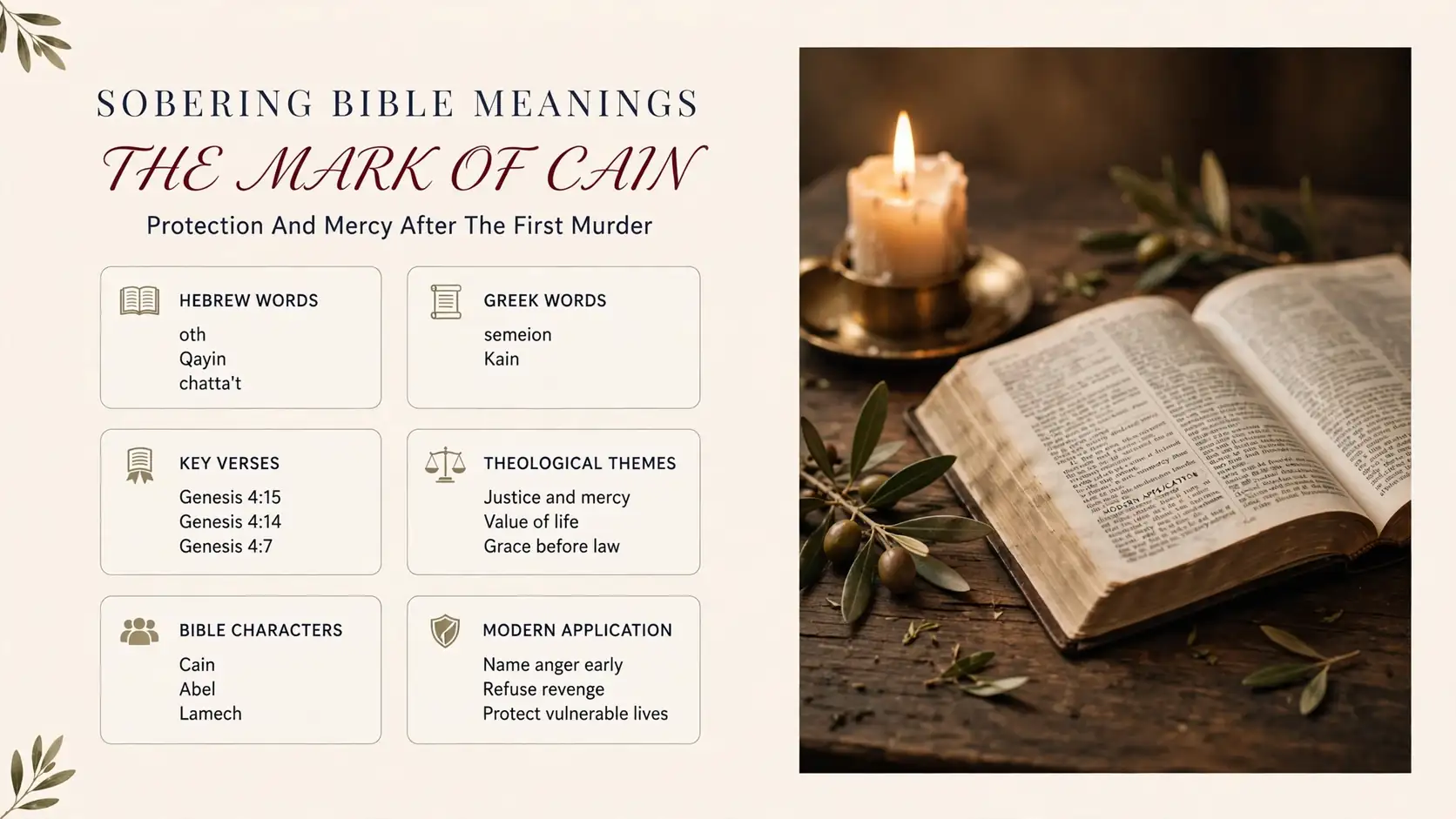
| אוֹת | oth | H226 | A sign, a mark, or a visible token |
| קַיִן | Qayin | H7014 | Cain, the name of the firstborn son |
| חַטָּאת | chatta’t | H2403 | Sin, or a sin offering in context |
| הָרַג | harag | H2026 | To kill, to slay, or to murder |
| נָקַם | naqam | H5358 | To avenge, to take vengeance, or to punish |
| שִׁבְעָתַיִם | shiv’atayim | H7659 | Sevenfold, seven times over in full measure |
| σημεῖον | semeion | G4592 | A sign, a token, or a distinguishing mark |
| Κάϊν | Kain | G2535 | Cain, as named in the Greek New Testament |
Mark of Cain Related Biblical Concepts
| Concept | Connection | Supporting Verse |
|---|---|---|
| Sin crouching | Sin is pictured as danger waiting to master Cain | Genesis 4:7 |
| Bloodguilt | Abel blood cries from the ground for justice | Genesis 4:10 |
| Sevenfold vengeance | God warns that killing Cain brings sevenfold punishment | Genesis 4:15 |
| Divine protection | The mark guards Cain from revenge by others | Genesis 4:15 |
| Exile | Cain leaves Eden and lives as a wanderer in Nod | Genesis 4:16 |
| Covenant sign | A visible sign carries a promise, like later signs | Genesis 9:13 |
| Brotherhood | The murder breaks the bond between brothers | Genesis 4:9 |
| Mercy in judgment | Judgment comes with a limit that preserves life | Genesis 4:15 |
Mark of Cain Historical and Cultural Context
| Aspect | Detail | Biblical Source |
|---|---|---|
| Blood vengeance | Ancient families often repaid murder with murder | Genesis 4:14 |
| Fugitive status | A killer without land or clan faced danger on the road | Genesis 4:12 |
| Farming and herding | Cain worked soil while Abel kept flocks | Genesis 4:2 |
| East of Eden | Nod lay east of Eden, away from the garden | Genesis 4:16 |
| City building | Cain built a city named for his son Enoch | Genesis 4:17 |
| Clan protection | A visible sign could warn strangers not to attack | Genesis 4:15 |
| Seven as fullness | Seven often signals completeness in Hebrew thought | Genesis 4:15 |
| Lamech boast | Later Cainite pride turned protection into a threat | Genesis 4:24 |
Mark of Cain Theological Themes
| Theme | Explanation | Scripture |
|---|---|---|
| Justice and mercy | God punishes murder yet sets a limit on revenge | Genesis 4:15 |
| Value of life | Abel blood matters to God even after death | Genesis 4:10 |
| Sin spreads | One act of envy grows into murder and exile | Genesis 4:8 |
| Grace before law | Mercy appears in Genesis long before Sinai | Genesis 4:15 |
| Human dignity | Even a murderer bears life that God protects | Genesis 4:15 |
| Judgment with purpose | Exile confronts Cain without ending his life | Genesis 4:12 |
| Warning against envy | Unchecked anger leads Cain from worship to violence | Genesis 4:5 |
| God seeks the guilty | God speaks to Cain before and after the murder | Genesis 4:9 |
Mark of Cain Modern Application for Believers
| Area | Practice | Scripture |
|---|---|---|
| Anger | Name anger early and seek counsel before it hardens | Genesis 4:7 |
| Envy | Confess envy in prayer instead of feeding comparison | Genesis 4:5 |
| Forgiveness | Refuse revenge and trust God with justice | Romans 12:19 |
| Protecting life | Defend vulnerable people from harm and retaliation | Genesis 4:15 |
| Honest confession | Tell God the truth about guilt without hiding | Psalm 32:5 |
| Restorative justice | Seek repair that limits harm and restores community | Micah 6:8 |
| Family conflict | Speak directly and early when tension grows at home | Genesis 4:9 |
| Community care | Watch over people who feel exiled or unsafe | Hebrews 13:3 |
The Hebrew Word Oth and What Does the Mark of Cain Mean in the Bible for Protection
The Hebrew word oth in Genesis 4:15 means a sign or a token, not a brand of shame. In other parts of Scripture, an oth can mark a promise, a warning, or a memory. The text never describes the shape, color, or place of the mark on Cain. It only tells you what the sign does, and it guards Cain from anyone who might kill him in revenge.
When you read the mark this way, mercy and judgment sit side by side. God does not excuse the murder, and Cain still loses his land, his home, and his nearness to Eden. Yet God also draws a line around vengeance and says that killing Cain will bring sevenfold punishment. The sign protects a guilty person, and that protection reveals a God who values life even when life has been taken.
Cain in the Primeval History of Genesis and the Covenant of Mercy
Genesis 1 to 11 tells the story of a good world bending under sin, and Cain stands near the start of that sad pattern. Adam and Eve leave Eden, their sons bring offerings, and envy turns into the first murder. The pattern grows through Lamech, who boasts about revenge, until the flood. Cain is not a side note, because his story shows how fast sin can move from a heart to a hand.
Mercy in this early story is not yet a written covenant with laws and sacrifices. It is a promise carried by a sign, much like the rainbow later given to Noah. God stays in conversation with Cain, names the sin, sets the consequence, and still limits what others may do to him. That early mercy points forward to a God who keeps seeking people after they have done terrible harm.
From Ancient Sign to Modern Grace in the Story of Cain
Readers sometimes turn the mark into a racial curse or a mark of doom, but Genesis gives no support for that reading. The text does not link the mark to skin, to a people group, or to later generations. It links the mark to one man, one crime, and one warning against revenge.
That careful reading also shapes how you treat people who have failed badly. You can name wrongdoing without calling for endless punishment, and you can protect life without pretending that harm did not happen. The mark invites you to practice a hard balance, truth about sin and mercy toward the sinner, in families, churches, and public life where revenge often feels easier than grace.
The Mark as Judgment and Mercy in Early Genesis Theology
Early Genesis theology often holds two truths in one hand, and Cain is a clear case. Judgment is real, because blood cries out and the ground bears witness against murder. Mercy is real too, because God speaks, limits vengeance, and lets Cain live, marry, and build. Neither truth cancels the other.
For your own study, let that tension guide how you read later signs in Scripture. Signs can warn, remember, protect, and promise, and they often appear right after failure. Cain reminds you that God confronts sin face to face, and still leaves a door open for life to continue under grace.
Frequently Asked Questions About the Mark of Cain
What does the Hebrew word oth tell us about what does the mark of Cain mean in the Bible?
Oth means a sign or token, so the mark functions as a visible warning and protection rather than a described physical brand.
Does Genesis 4:15 say what the mark looked like?
No, Genesis gives no shape, color, or location for the mark, so any detailed picture of it goes beyond the text.
Was the mark a punishment or a protection for Cain?
It was protection inside punishment, because Cain still faced exile while God warned others against killing him.
Why did God warn of sevenfold vengeance for killing Cain?
Sevenfold vengeance set a strong limit on blood revenge and showed that Cain’s life remained under God protection.
Does the mark of Cain apply to any race or people group today?
No, Genesis ties the mark to Cain alone and gives no basis for linking it to any race or later group.