
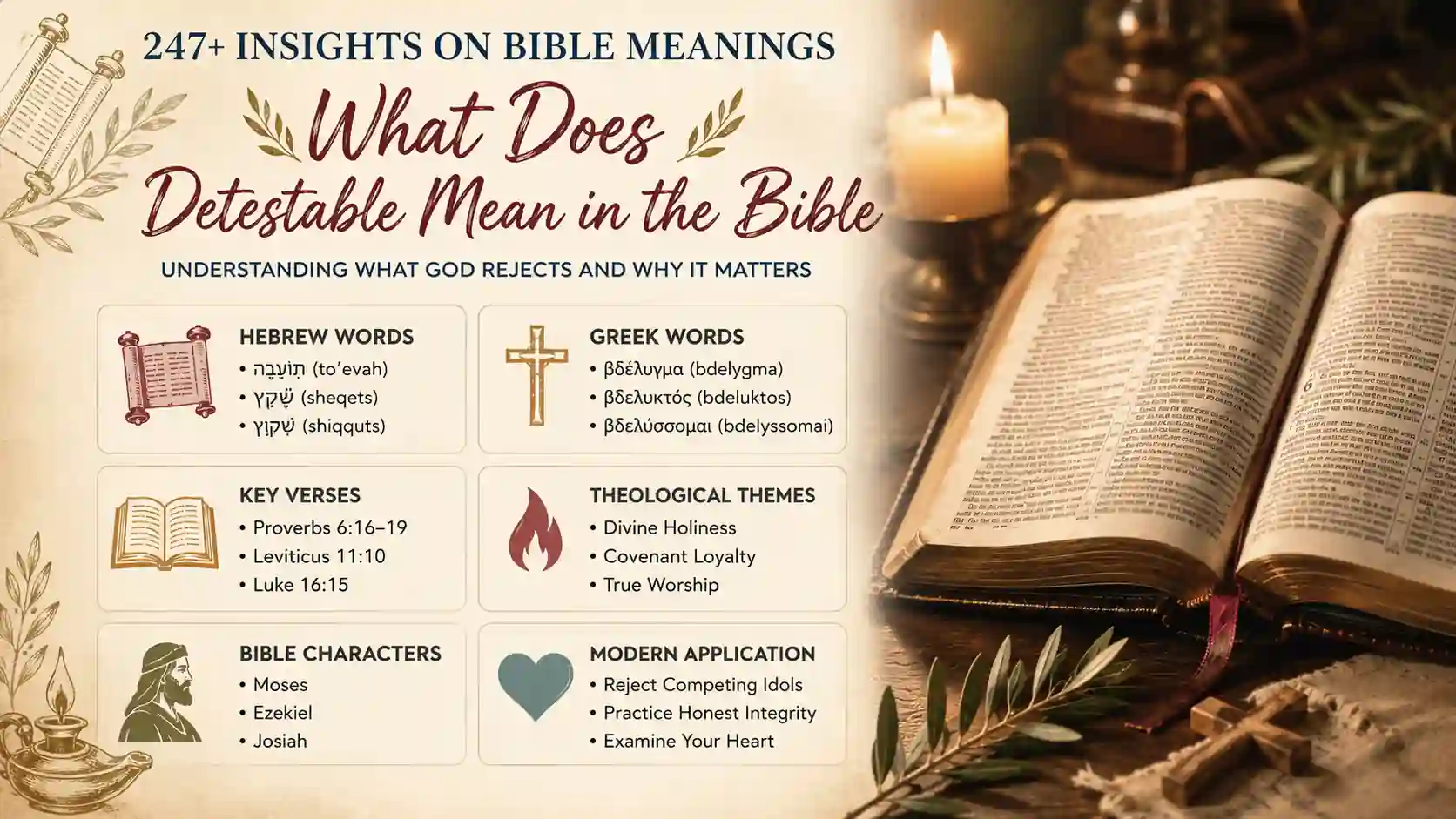
What does detestable mean in the Bible? The word describes something God regards as deeply offensive, loathsome, unclean, or incompatible with his holy character. Yet its precise meaning depends on the Hebrew or Greek term, the covenant setting, and the behavior or object being condemned.
In your study, you will find that “detestable” can describe idolatry, corrupt worship, prohibited foods, sexual immorality, dishonest commerce, violence, pride, and hypocritical religion. It is not merely an expression of personal dislike. It communicates God’s moral judgment or a boundary established for his covenant people.
Key Detestable Scripture References
| Verse | Passage Snippet | Context |
|---|---|---|
| Genesis 43:32 | Egyptians could not eat with Hebrews | Egyptian social and religious customs |
| Exodus 8:26 | Israel’s sacrifices were detestable to Egyptians | Moses rejects worshiping within Egypt |
| Leviticus 11:10 | Certain water creatures were detestable | Israel’s dietary holiness laws |
| Deuteronomy 7:25-26 | Do not bring a detestable thing home | Destruction of Canaanite idols |
| Proverbs 6:16-19 | Seven things the Lord detests | Pride, lies, violence, and discord |
| Proverbs 11:1 | Dishonest scales are detestable | Integrity in trade |
| Ezekiel 5:11 | The sanctuary was defiled | Idolatrous objects polluted the temple |
| Daniel 11:31 | The abomination that causes desolation | Pagan desecration of sacred space |
| Luke 16:15 | Humanly exalted things may be detestable | Jesus confronts religious self-justification |
| Titus 1:16 | Their works make them detestable | False teachers deny God by conduct |
Detestable Bible Translation Comparison
| Verse | KJV | NIV | ESV | NASB |
|---|---|---|---|---|
| Deuteronomy 7:26 | abomination | detestable thing | detestable thing | abomination |
| Proverbs 6:16 | an abomination | detestable | an abomination | abomination |
| Proverbs 11:1 | abomination | detests | abomination | abomination |
| Proverbs 16:5 | abomination | detests | abomination | abomination |
| Ezekiel 5:11 | detestable things | vile images | detestable things | detestable things |
| Ezekiel 11:18 | detestable things | vile images | detestable things | detestable things |
| Daniel 11:31 | abomination | abomination | abomination | abomination |
| Luke 16:15 | abomination | detestable | abomination | detestable |
| Titus 1:16 | abominable | detestable | detestable | detestable |
| Revelation 21:27 | defileth | impure | unclean | unclean |
People and Characters Associated with Detestable Things
| Person | Role | Connection |
|---|---|---|
| Moses | Covenant mediator | Warned Israel against idols and pagan practices |
| Aaron | Israel’s first high priest | Participated in making the golden calf |
| Solomon | King of Israel | Built shrines for foreign detestable gods |
| Jeroboam | Northern king | Established rival worship centers and idols |
| Ahab | King of Israel | Practiced idolatry under Jezebel’s influence |
| Jezebel | Phoenician queen | Promoted Baal worship in Israel |
| Manasseh | King of Judah | Placed idolatrous objects in the temple |
| Josiah | Reforming king | Removed detestable idols from Judah |
| Ezekiel | Exilic prophet | Exposed temple abominations and covenant rebellion |
| Titus | Pauline coworker | Confronted detestable conduct among false teachers |
Original Hebrew and Greek Words for Detestable
| Original Word | Transliteration | Strong’s # | Literal Meaning |
|---|---|---|---|
| תּוֹעֵבָה | toʿevah | H8441 | Abomination or abhorrent thing |
| תָּעַב | taʿav | H8581 | To abhor or regard as offensive |
| שֶׁקֶץ | sheqets | H8263 | Detestable or unclean thing |
| שָׁקַץ | shaqats | H8262 | To detest or make abominable |
| שִׁקּוּץ | shiqquts | H8251 | Detestable object, especially an idol |
| פִּגּוּל | piggul | H6292 | Foul or rejected sacrificial meat |
| גָּעַל | gaʿal | H1602 | To reject or loathe |
| βδέλυγμα | bdelygma | G946 | Abomination or loathsome thing |
| βδελυκτός | bdeluktos | G947 | Detestable or abominable |
| βδελύσσομαι | bdelyssomai | G948 | To be disgusted or abhor |
The most common Hebrew noun is תּוֹעֵבָה, toʿevah, Strong’s H8441. It occurs in contexts involving idolatry, sexual sin, dishonest trade, pride, violence, and other violations of God’s revealed order. שֶׁקֶץ, sheqets, often concerns ceremonial uncleanness, while שִׁקּוּץ, shiqquts, frequently identifies idols or idolatrous desecration.
Related Detestable Biblical Concepts
| Concept | Connection | Supporting Verse |
|---|---|---|
| Holiness | God separates his people from impurity | Leviticus 11:44-45 |
| Idolatry | False worship is spiritual betrayal | Deuteronomy 7:25 |
| Uncleanness | Some creatures marked covenant boundaries | Leviticus 11:10 |
| Pride | Self-exaltation opposes God | Proverbs 16:5 |
| Falsehood | Lying contradicts God’s truth | Proverbs 12:22 |
| Injustice | Dishonest trade exploits neighbors | Proverbs 11:1 |
| Violence | Shedding innocent blood is condemned | Proverbs 6:17 |
| Sexual immorality | Covenant-breaking practices defile | Leviticus 18:26 |
| Hypocrisy | Outward religion may conceal corruption | Luke 16:15 |
| Apostasy | Turning to idols abandons covenant loyalty | Ezekiel 14:6 |
Historical and Cultural Context of Detestable Language
| Aspect | Detail | Biblical Source |
|---|---|---|
| Egyptian customs | Shepherds and Hebrew meals caused offense | Genesis 43:32; 46:34 |
| Sacrificial conflict | Israelite sacrifices offended Egyptian religion | Exodus 8:26 |
| Dietary laws | Food distinctions marked Israel as holy | Leviticus 11 |
| Canaanite worship | Idols and rituals threatened covenant loyalty | Deuteronomy 7:25-26 |
| Child sacrifice | Molech worship violated life and covenant | Deuteronomy 12:31 |
| Temple purity | Idolatry polluted sacred space | Ezekiel 8 |
| Commercial markets | Standard weights protected the vulnerable | Deuteronomy 25:13-16 |
| Royal apostasy | Foreign shrines entered Israel through kings | 1 Kings 11:5-8 |
| Hellenistic oppression | Pagan worship desecrated the sanctuary | Daniel 11:31 |
| Cretan churches | False teachers contradicted their profession | Titus 1:10-16 |
Theological Themes within Detestable Passages
| Theme | Explanation | Scripture |
|---|---|---|
| Divine holiness | God rejects what contradicts his character | Leviticus 19:2 |
| Covenant loyalty | Israel must not imitate idolatrous nations | Deuteronomy 7:1-6 |
| True worship | Sacred devotion belongs to God alone | Exodus 20:3-6 |
| Moral integrity | God judges private motives and public actions | Proverbs 6:16-19 |
| Justice | Economic deception is a spiritual offense | Proverbs 20:10 |
| Temple sanctity | Idolatry profanes the place of worship | Ezekiel 5:11 |
| Heart evaluation | God sees beneath outward respectability | Luke 16:15 |
| Faith and works | Conduct reveals whether profession is genuine | Titus 1:16 |
| Repentance | God calls idolaters to turn and live | Ezekiel 14:6 |
| Final purity | Nothing unclean enters the holy city | Revelation 21:27 |
Modern Application of Detestable Passages for Believers
| Area | Practice | Scripture |
|---|---|---|
| Worship | Reject anything that competes with God | 1 John 5:21 |
| Speech | Refuse lying, slander, and false witness | Proverbs 12:22 |
| Business | Use honest prices, measures, and contracts | Proverbs 11:1 |
| Relationships | Avoid stirring unnecessary conflict | Proverbs 6:19 |
| Sexual conduct | Honor God with the body | 1 Corinthians 6:18-20 |
| Leadership | Match public profession with private conduct | Titus 1:16 |
| Humility | Resist pride and self-justification | Luke 16:15 |
| Discernment | Test teachings by Scripture and fruit | Matthew 7:15-20 |
| Repentance | Remove cherished idols from the heart | Ezekiel 14:6 |
| Mercy | Remember that cleansing comes through Christ | 1 Corinthians 6:11 |
What Does Detestable Mean in the Bible within the Covenant
When Scripture calls something detestable, it usually expresses more than emotional revulsion. It identifies an object, practice, attitude, or person’s conduct as contrary to God’s holiness, truth, justice, or covenant commands.
Context remains essential. Some detestable things, such as idolatry, murder, deceit, and pride, concern enduring moral evil. Other uses, especially those involving food, communicate ceremonial distinctions given specifically to Israel under the Mosaic covenant.
These categories sometimes overlap. Eating a prohibited creature concerned ritual uncleanness, but worshiping that creature as a deity involved idolatry. Your interpretation should therefore ask what is condemned, why it is condemned, and where the passage stands within the biblical covenants.
תּוֹעֵבָה ToʿEvah and the Moral Seriousness of Sin
The noun תּוֹעֵבָה, toʿevah, does not name only one kind of transgression. Proverbs applies it to arrogant hearts, lying lips, dishonest scales, acquitting the guilty, condemning the innocent, and prayers offered by those who reject God’s instruction.
This broad usage prevents you from reducing “detestable” to a narrow list of controversial sins. Scripture places private pride, commercial fraud, religious hypocrisy, violence, and false testimony under the searching judgment of the same holy God.
The word also appears frequently in warnings about idols. An idol is detestable because it gives created things the trust, love, fear, and worship due to the Creator. Israel could not bring such an object home without sharing in the rebellion it represented.
שֶׁקֶץ Sheqets and Israel’S Call to Distinctive Holiness
In Leviticus 11, שֶׁקֶץ, sheqets, describes creatures Israel was not permitted to eat. The word marks them as unacceptable for Israel’s diet under the covenant, not as morally guilty animals capable of rebellion.
These restrictions trained Israel to distinguish between clean and unclean, holy and common. Ordinary meals became reminders that the people belonged to the Lord and were called to live differently from the surrounding nations.
The New Testament changes the covenantal administration of food laws. Jesus taught that food entering the body does not create moral defilement, and Peter’s vision prepared him to receive Gentiles without treating them as ceremonially unclean. The holiness principle remains, while the food boundary no longer defines God’s multinational people.
βδελυκτός Bdeluktos and the Danger of Religious Hypocrisy
In Titus 1:16, Paul calls false teachers βδελυκτοί, bdeluktoi, the plural form of βδελυκτός, bdeluktos, Strong’s G947. They professed to know God, but their actions denied him. Their detestable condition was exposed through disobedience and their inability to produce genuinely good works.
Jesus makes a related point in Luke 16:15. The Pharisees justified themselves before people, but God knew their hearts. What society admired and exalted could be βδέλυγμα, bdelygma, an abomination before God.
These texts warn you against measuring holiness by reputation, ceremony, or theological vocabulary alone. Genuine faith bears fruit in obedience, humility, truthfulness, mercy, and love. Christ does not merely polish an outward image. He cleanses the conscience and forms a life that increasingly reflects his character.
Questions About What Detestable Means in Scripture
Does תּוֹעֵבָה, toʿevah, always refer to ceremonial uncleanness?
No. It can describe idolatry and ritual offenses, but it also describes pride, deceit, violence, sexual immorality, and dishonest commerce.
Why does the KJV often say “abomination” where the NIV says “detestable”?
Both words commonly translate the same Hebrew or Greek terms, but “detestable” often communicates the sense more naturally to modern readers.
Are the creatures called שֶׁקֶץ, sheqets, morally evil?
No. The word identifies them as ceremonially unacceptable food for Israel under the Mosaic covenant, not as morally responsible sinners.
What is the “detestable thing” or “abomination of desolation” in Daniel?
It describes an idolatrous profanation of the sanctuary and later becomes a pattern Jesus uses when warning of a future desecrating crisis.
How should Titus 1:16 shape your Christian life?
It should lead you to examine whether your conduct confirms your profession of knowing God rather than contradicting it.