
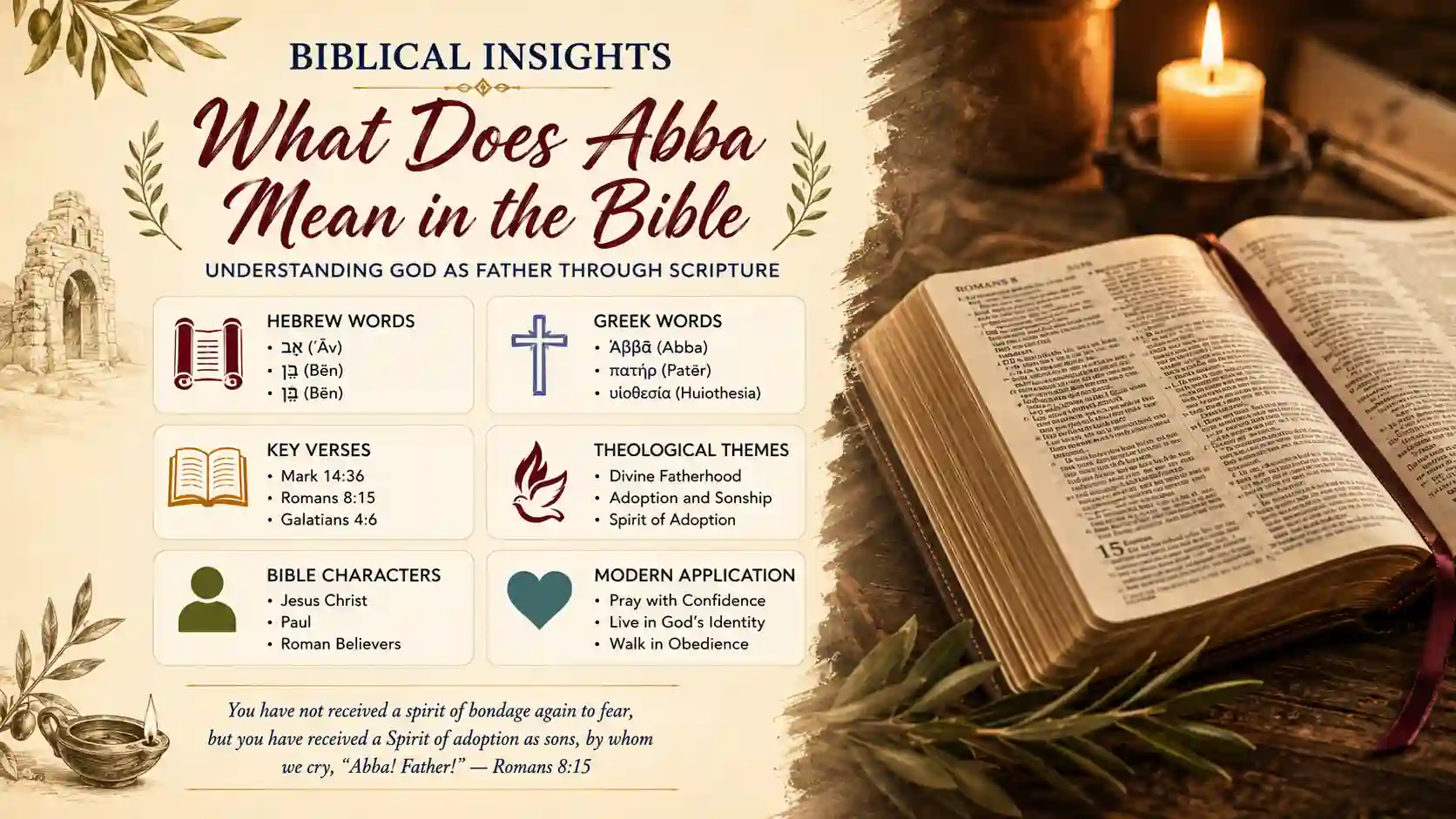
What does abba mean in the bible? Abba is an Aramaic family word meaning “father,” preserved in the Greek New Testament as Ἀββᾶ (Abba). Jesus used it while praying in Gethsemane, and Paul used it to describe the Spirit-given cry of those adopted into God’s family.
The word expresses genuine intimacy, but it never reduces God to a casual companion. When you call God “Abba, Father,” you approach him with the reverence owed to the sovereign Lord and the confidence granted to a beloved child.
Key Abba Scripture References
| Verse | Passage Snippet | Context |
|---|---|---|
| Mark 14:36 | “Abba, Father, all things are possible” | Jesus prays before his arrest |
| Romans 8:15 | “Abba, Father” | Adopted believers cry by the Spirit |
| Galatians 4:6 | “Abba, Father” | The Spirit speaks within God’s children |
| Matthew 26:39 | “My Father, if it be possible” | Matthew parallels Gethsemane’s prayer |
| Luke 22:42 | “Father, if thou be willing” | Luke records Jesus’ obedient surrender |
| Romans 8:16 | “We are the children of God” | The Spirit confirms believers’ identity |
| Galatians 4:7 | “No more a servant, but a son” | Sonship includes inheritance through God |
| John 20:17 | “My Father, and your Father” | The risen Christ identifies his disciples |
| Ephesians 1:5 | “Adoption of children by Jesus Christ” | Adoption rests on God’s gracious purpose |
Abba Bible Translation Comparison
| Verse | KJV | NIV | ESV | NASB |
|---|---|---|---|---|
| Mark 14:36 | “Abba, Father” | “Abba, Father” | “Abba, Father” | “Abba! Father!” |
| Romans 8:15 | “Abba, Father” | “Abba, Father” | “Abba! Father!” | “Abba! Father!” |
| Galatians 4:6 | “Abba, Father” | “Abba, Father” | “Abba! Father!” | “Abba! Father!” |
| Matthew 26:39 | “O my Father” | “My Father” | “My Father” | “My Father” |
| Luke 22:42 | “Father, if thou be willing” | “Father, if you are willing” | “Father, if you are willing” | “Father, if You are willing” |
| Romans 8:15 | “Spirit of adoption” | “Spirit you received brought about adoption” | “Spirit of adoption” | “spirit of adoption as sons” |
| Galatians 4:6 | “Spirit of his Son” | “Spirit of his Son” | “Spirit of his Son” | “Spirit of His Son” |
| Ephesians 1:5 | “adoption of children” | “adoption to sonship” | “adoption to himself as sons” | “adoption as sons and daughters” |
People and Characters Associated with Abba
| Person | Role | Connection |
|---|---|---|
| Jesus Christ | Eternal Son and Messiah | Prayed “Abba, Father” in Gethsemane |
| God the Father | Father of the Son and believers | Receives the cry “Abba, Father” |
| Paul | Apostle to the Gentiles | Explained Abba in Romans and Galatians |
| Mark | Gospel writer | Preserved Jesus’ Aramaic word in Greek |
| Roman believers | Adopted children of God | Cried “Abba” through the indwelling Spirit |
| Galatian believers | Heirs through Christ | Received the Spirit of God’s Son |
| Peter, James, and John | Gethsemane witnesses | Were near Jesus during his Abba prayer |
| Abraham | Covenant patriarch | Spiritual father of those who believe |
| The Holy Spirit | Spirit of adoption | Produces and confirms the Abba cry |
Original Hebrew, Aramaic, and Greek Words Behind Abba
| Original Word | Transliteration | Strong’s # | Literal Meaning |
|---|---|---|---|
| Ἀββᾶ | Abba | G5 | Father, an Aramaic address |
| πατήρ | patēr | G3962 | Father, parent, ancestor |
| אָב | ʾāv | H1 | Father, ancestor, household head |
| υἱοθεσία | huiothesia | G5206 | Adoption, placement as a son |
| υἱός | huios | G5207 | Son, descendant |
| τέκνον | teknon | G5043 | Child, offspring |
| πνεῦμα | pneuma | G4151 | Spirit, breath, wind |
| κράζω | krazō | G2896 | Cry aloud, call out |
| κληρονόμος | klēronomos | G2818 | Heir, one receiving an inheritance |
| בֵּן | bēn | H1121 | Son, child, descendant |
Related Biblical Concepts Connected with Abba
| Concept | Connection | Supporting Verse |
|---|---|---|
| Divine fatherhood | Abba addresses God as Father | Romans 8:15 |
| Adoption | God gives believers filial status | Ephesians 1:5 |
| Sonship | Believers belong to God’s household | Galatians 4:6–7 |
| The Holy Spirit | The Spirit produces the Abba cry | Galatians 4:6 |
| Prayer | Jesus addressed the Father in anguish | Mark 14:36 |
| Obedience | Intimacy accompanies submission | Mark 14:36 |
| Assurance | The Spirit confirms that you are God’s child | Romans 8:16 |
| Inheritance | Adopted children become heirs | Romans 8:17 |
| Union with Christ | Christ shares covenant blessings with believers | John 20:17 |
| Freedom from slavery | Sonship replaces fearful bondage | Romans 8:15 |
Historical and Cultural Context of Abba
| Aspect | Detail | Biblical Source |
|---|---|---|
| Language | Abba comes from Aramaic speech | Mark 14:36 |
| Greek preservation | New Testament writers transliterated Ἀββᾶ | Romans 8:15 |
| Added translation | πατήρ explains Abba as “Father” | Galatians 4:6 |
| Jewish prayer | God was known as Israel’s Father | Isaiah 63:16 |
| Household structure | Fathers represented authority and provision | Luke 11:11–13 |
| Roman adoption | Adoption established legal status and inheritance | Romans 8:15–17 |
| Gethsemane | Jesus prayed during intense sorrow | Mark 14:32–36 |
| Early churches | Jews and Gentiles shared one filial cry | Galatians 3:28–4:7 |
| Slavery imagery | Paul contrasts bondage with family membership | Galatians 4:1–7 |
| Inheritance customs | A recognized son received family privileges | Romans 8:17 |
Theological Themes Revealed Through Abba
| Theme | Explanation | Scripture |
|---|---|---|
| Trinity | Son, Father, and Spirit appear together | Galatians 4:6 |
| Christ’s sonship | Jesus uniquely addresses his Father | Mark 14:36 |
| Believers’ adoption | Grace brings sinners into God’s family | Romans 8:15 |
| Reverent intimacy | God is near without ceasing to be holy | Matthew 6:9 |
| Submissive prayer | Jesus joins trust with obedience | Mark 14:36 |
| Spiritual assurance | The Spirit bears witness with believers | Romans 8:16 |
| Redemption | Christ redeems those under the law | Galatians 4:4–5 |
| Freedom | God replaces servile fear with sonship | Romans 8:15 |
| Inheritance | God’s children are heirs with Christ | Romans 8:17 |
| Covenant family | Faith unites diverse believers in Christ | Galatians 3:26–29 |
Modern Application of Abba for Believers
| Area | Practice | Scripture |
|---|---|---|
| Prayer | Address God with trust and reverence | Matthew 6:9 |
| Anxiety | Bring painful requests to your Father | Mark 14:36 |
| Obedience | Submit your desires to God’s will | Luke 22:42 |
| Identity | Remember that you are God’s adopted child | Romans 8:15 |
| Assurance | Rest in the Spirit’s inward witness | Romans 8:16 |
| Fear | Reject the mindset of spiritual slavery | Romans 8:15 |
| Suffering | Remember that heirs suffer with Christ | Romans 8:17 |
| Community | Treat fellow believers as family | Galatians 3:26–28 |
| Gratitude | Thank God for redemption and adoption | Galatians 4:4–6 |
| Hope | Anticipate your promised inheritance | 1 Peter 1:3–4 |
Ἀββᾶ And the Meaning of “Abba, Father”
The Greek New Testament records Ἀββᾶ (Abba) three times, always followed by πατήρ (patēr), the ordinary Greek word for “father.” This pairing probably preserves the Aramaic expression while supplying its Greek meaning for readers who did not speak Aramaic.
Abba is sometimes described as meaning “Daddy,” but that explanation is too narrow. Children could use the word affectionately, yet older children and adults also used it respectfully, so “dear Father” or simply “Father” communicates its warmth and dignity more accurately.
What Does Abba Mean in the Bible at Gethsemane?
Mark 14:36 gives the only recorded occasion when Jesus personally says, “Abba, Father.” Facing betrayal, abandonment, suffering, and death, he brings his anguish openly before the Father while affirming that the Father possesses unlimited power.
Jesus’ intimacy does not lead to self-rule. His prayer moves from honest desire to willing obedience, teaching you that childlike trust includes both bold petition and surrender to God’s wiser purpose.
The Spirit of Adoption in Romans 8 and Galatians 4
Romans 8:15 contrasts “the spirit of bondage again to fear” with “the Spirit of adoption.” Through the Holy Spirit, you do not approach God as a terrified slave uncertain of acceptance, but as a child whom God has received and authorized to call him Father.
Galatians 4:4–7 grounds this privilege in Christ’s saving mission. God sent his Son to redeem those under the law, then sent “the Spirit of his Son” into believers’ hearts, making the Abba cry the fruit of redemption rather than a claim based on human worthiness.
Abba, Divine Fatherhood, and Reverent Confidence
Calling God Abba does not mean that every human being automatically enjoys the same covenant relationship with him. Paul connects this cry specifically with faith in Christ, redemption, adoption, and the indwelling Holy Spirit.
Yet the word offers profound assurance to everyone who belongs to Christ. Your Father knows your weakness, hears your prayers, disciplines you in love, supplies what is good, and promises an inheritance that you share with Christ.
Questions Bible Students Ask About Abba
Does Ἀββᾶ (Abba) literally mean “Daddy”?
Not exactly, since it expresses familial closeness but can also carry mature respect and should ordinarily be translated “Father.”
Why does the New Testament say both “Abba” and πατήρ (patēr)?
The writers preserve the Aramaic word associated with Jesus while giving its Greek equivalent for their readers.
Why does Jesus say “Abba, Father” only in Mark 14:36?
Mark preserves Jesus’ Aramaic address, while Matthew 26:39 and Luke 22:42 translate the prayer simply as “Father.”
Does Romans 8:15 teach that Christians should never experience fear?
It teaches that believers are no longer enslaved to condemning fear, although they may still face distress and learn to trust their Father.
How should “Abba, Father” shape your prayers?
You may speak honestly and confidently to God while submitting your desires to his holy and loving will.